Interviews are opportunities to demonstrate your expertise, and this guide is here to help you shine. Explore the essential Calibration of pressure, flow, temperature, and electrical instruments interview questions that employers frequently ask, paired with strategies for crafting responses that set you apart from the competition.
Questions Asked in Calibration of pressure, flow, temperature, and electrical instruments Interview
Q 1. Explain the concept of calibration traceability.
Calibration traceability is the ability to demonstrate the unbroken chain of comparisons that links a measurement result to a national or international standard. Think of it like a family tree for your measurements – each measurement is linked to the one before it, ultimately tracing back to a known, reliable source. This is crucial for ensuring the accuracy and reliability of your measurements and maintaining compliance with regulations.
For example, imagine calibrating a pressure gauge. You compare it to a secondary standard, which was itself calibrated against a primary standard at a national metrology institute (NMI) like NIST. The certificate from the NMI is the ‘root’ of your traceability. Every calibration step is documented, providing a clear and verifiable path back to the most accurate possible source.
Q 2. Describe the different types of calibration standards used.
Calibration standards are used to verify the accuracy of measuring instruments. They are categorized into primary, secondary, and working standards:
- Primary Standards: These are the most accurate standards, directly traceable to fundamental physical constants or national standards. They are usually found in national metrology institutes and rarely used for routine calibrations due to their cost and sensitivity.
- Secondary Standards: These are calibrated against primary standards and are used to calibrate other instruments or secondary standards. They offer a balance between accuracy and practicality.
- Working Standards: These are the most commonly used standards in daily calibration activities. They are frequently calibrated against secondary standards to ensure their accuracy.
Examples include calibrated weights for mass measurements, precision pressure gauges as secondary standards for pressure calibration, and resistance thermometers as working standards for temperature.
Q 3. What are the common methods for calibrating pressure instruments?
Common methods for calibrating pressure instruments involve comparing the instrument’s reading to a known pressure, typically using a deadweight tester or a calibrated pressure gauge.
- Deadweight Tester: This is a primary standard that uses calibrated weights to generate precise pressures. The weights are placed on a piston, creating a known force, which is then translated into pressure. The instrument under test is connected and its reading compared to the known pressure generated by the deadweight tester.
- Calibrated Pressure Gauge: A secondary or working standard pressure gauge with a known accuracy is used to calibrate other pressure instruments. The instrument under test and the calibrated gauge are simultaneously exposed to the same pressure source and their readings compared.
- Digital Pressure Calibrators: These sophisticated instruments combine a pressure source with a high-accuracy digital readout allowing for fast and efficient calibration of a wide range of pressure instruments.
The chosen method depends on the required accuracy, the type of pressure instrument, and available resources.
Q 4. How do you calibrate a flow meter using a primary standard?
Calibrating a flow meter using a primary standard typically involves a gravimetric or volumetric method. A primary standard is a device that directly measures the mass or volume of fluid passing through it in a specified period.
Gravimetric Method: The flow meter is connected in series with a weighing scale. A known volume of fluid is passed through the flow meter and simultaneously weighed. The flow rate is calculated by dividing the weight of the fluid by its density and time. The flow meter’s reading is then compared to this known flow rate.
Volumetric Method: This involves collecting a known volume of fluid over a precise time period in a calibrated tank or vessel. The flow rate is calculated, and the flow meter’s reading is compared. This is simpler for low flow rates.
For example, calibrating a water flow meter might involve using a precisely calibrated tank and timer to determine the volume of water passing through in a given time. Then, this volumetric standard is compared with the flow meter’s reading. Both methods ensure a direct comparison against a known, primary flow standard.
Q 5. Explain the principle of operation of a RTD temperature sensor.
An RTD (Resistance Temperature Detector) is a temperature sensor whose resistance changes predictably with temperature. It operates on the principle that the electrical resistance of a metal increases linearly with increasing temperature.
Commonly made of platinum, the RTD’s resistance is measured using a Wheatstone bridge circuit. The change in resistance, accurately correlated to temperature according to a known calibration curve, allows for precise temperature measurement. The higher the temperature, the higher the resistance. This linear relationship makes RTDs highly accurate and repeatable temperature sensors.
Q 6. How would you troubleshoot a temperature sensor reading inaccurately?
Troubleshooting an inaccurate temperature sensor reading involves a systematic approach:
- Check for Physical Damage: Inspect the sensor for any signs of physical damage (broken wires, cracked sensor housing).
- Verify Wiring and Connections: Ensure proper wiring and secure connections, looking for loose wires or corrosion.
- Check Calibration: Calibrate the sensor against a known accurate standard. If the calibration is off, the sensor may need replacement or repair.
- Check for Environmental Interference: Ensure the sensor isn’t affected by external factors like strong electromagnetic fields or excessive vibrations.
- Inspect Sensor Location: The sensor might not be placed properly for accurate reading – it might be shielded, exposed to direct heat, or obstructed.
- Consider Sensor Age and Operating Conditions: Older sensors degrade over time or may not perform as expected outside their specified operating conditions.
If the problem persists after checking all of these, the sensor likely needs replacing. Always record your troubleshooting steps and findings for future reference.
Q 7. What are the different types of electrical instrument calibrations?
Electrical instrument calibration covers a wide range of measurements:
- Voltage Calibration: Verifying the accuracy of voltage readings using calibrated voltage sources and precision voltmeters.
- Current Calibration: Checking the accuracy of current measurements using calibrated current sources and precision ammeters.
- Resistance Calibration: Measuring the accuracy of resistance readings using calibrated resistance standards and precision ohmmeters.
- Frequency Calibration: Calibrating frequency counters and signal generators using precision frequency standards.
- Power Calibration: Verifying power measurement accuracy using calibrated power meters and sources.
Calibration methods typically involve comparing the instrument’s reading against a known, accurate standard using appropriate test equipment and procedures. The specific techniques employed depend on the type of electrical instrument and the desired level of accuracy.
Q 8. How do you calibrate a multimeter?
Calibrating a multimeter involves comparing its readings to known, accurate standards. Think of it like checking a kitchen scale against a set of calibrated weights – you ensure your measuring tool is giving you reliable results. The process depends on the multimeter’s functions (voltage, current, resistance) and the required accuracy.
- Voltage Calibration: You’d use a precision voltage source, such as a calibrated power supply, to apply known voltages to the multimeter and record the deviations. For example, if the standard is 10.000V and the multimeter reads 9.995V, you’ve got a -0.005V error.
- Current Calibration: Requires precision current sources and high-precision shunt resistors to measure the current accurately. The multimeter’s reading is then compared against the calculated current value.
- Resistance Calibration: Precision resistors of known values (e.g., from a resistance decade box) are used. The multimeter measures the resistance, and the difference from the known value is the error.
Calibration is typically done using dedicated calibration software or by manually comparing readings and recording deviations. The multimeter might then require adjustment (if possible) to minimize errors, or correction factors are applied to future readings to compensate for systematic error.
Q 9. Explain the importance of calibration certificates.
Calibration certificates are crucial because they provide documented evidence that an instrument has been checked against traceable standards and meets specified accuracy requirements. Imagine a construction site – if the level used to ensure foundation integrity wasn’t calibrated and certified, you risk structural issues. Certificates serve several vital functions:
- Traceability: They link the instrument’s accuracy to national or international standards, ensuring global consistency.
- Legal Compliance: Many industries have regulations requiring calibrated equipment, with certificates serving as proof of compliance.
- Quality Assurance: Certificates demonstrate a commitment to accuracy and reliability, improving confidence in measurement results. In a pharmaceutical setting, for example, this is critical for manufacturing consistent dosages.
- Auditing: Calibration certificates are essential during audits, confirming adherence to quality management systems.
A certificate will typically state the instrument’s ID, calibration date, test methods used, results, uncertainties, and the expiry date, giving a complete picture of the instrument’s performance.
Q 10. What are the common sources of error in calibration?
Errors in calibration can stem from various sources, some instrument-specific and others due to the calibration process itself. These include:
- Instrument Drift: Over time, instruments can experience gradual changes in their performance.
- Environmental Factors: Temperature, humidity, and pressure variations can significantly affect readings, causing errors if not carefully controlled during calibration.
- Operator Error: Incorrect connections, improper handling, or misreading of values can introduce human error.
- Calibration Standard Errors: The reference standards themselves have uncertainties; therefore the accuracy of the calibration is limited by the accuracy of the standards.
- Resolution Limitations: The instrument’s display resolution may limit the precision of readings.
- Non-linearity: Some instruments may not respond linearly across their range, causing deviations from expected values.
Understanding these sources of error is crucial for identifying potential issues and improving calibration accuracy. A good calibration process anticipates and minimizes these sources through meticulous planning and execution.
Q 11. Describe the process of uncertainty analysis in calibration.
Uncertainty analysis in calibration quantifies the doubt associated with a measurement result. It involves determining all potential sources of error and combining them to calculate the overall uncertainty. This is crucial to provide a realistic assessment of the instrument’s accuracy.
The process generally follows the Guide to the Expression of Uncertainty in Measurement (GUM):
- Identify Sources of Uncertainty: List all possible contributors, including instrument resolution, calibration standard uncertainty, environmental effects, and operator error.
- Quantify Uncertainties: Assign a numerical value (standard deviation) to each source. This might involve using manufacturer specifications, previous calibration data, or statistical analysis.
- Combine Uncertainties: Combine the individual uncertainties using appropriate methods (e.g., root-sum-of-squares for independent uncertainties) to obtain the combined standard uncertainty.
- Expand Uncertainty: Multiply the combined standard uncertainty by a coverage factor (typically 2 for a 95% confidence level) to obtain the expanded uncertainty.
The expanded uncertainty is then reported alongside the calibration result, giving a complete picture of the measurement’s reliability. For example, a pressure measurement might be reported as 100.00 ± 0.25 kPa (k=2), indicating the true value likely lies within 99.75 to 100.25 kPa.
Q 12. How do you manage calibration data and records?
Effective calibration data and record management is essential for maintaining traceability and compliance. A robust system typically involves:
- Calibration Software: Specialized software manages calibration schedules, stores certificates, and tracks instrument performance over time. This is crucial for larger organizations.
- Database Systems: These databases can store all relevant data, providing quick access to instrument history.
- Physical Filing Systems: Paper copies of certificates should be kept in a secure, organized location as backups, especially for critical equipment.
- Unique Instrument Identification: Each instrument should have a unique identifier (e.g., serial number) to avoid confusion.
- Secure Storage: Data must be stored securely to prevent unauthorized access or loss.
Regular audits of the system help ensure data integrity and regulatory compliance. Properly maintained records are invaluable for demonstrating compliance during inspections and resolving discrepancies.
Q 13. What are the different calibration intervals for various instruments?
Calibration intervals vary widely based on several factors, including instrument type, criticality of application, usage frequency, and environmental conditions. There’s no one-size-fits-all answer. However, here are some general guidelines:
- High-Precision Instruments: Those used in critical applications (e.g., medical devices, aerospace) often require calibration more frequently, sometimes monthly or even weekly.
- General-Purpose Instruments: Instruments used in less critical applications might be calibrated annually or every six months.
- Flow Meters: The frequency may depend on factors such as the fluid being measured and the flow rate, potentially ranging from every three months to annually.
- Temperature Sensors: Similar to flow meters, frequency can vary based on application, typically from quarterly to annually.
- Pressure Gauges: Calibration frequency can be every six months to annually, depending on accuracy requirements.
Many companies establish their own calibration schedules based on risk assessments and best practices. The manufacturer’s recommendations are always a good starting point, but the actual interval should be determined by considering the instrument’s usage, stability, and the potential consequences of inaccurate measurements.
Q 14. Explain the difference between calibration and verification.
While both calibration and verification aim to ensure instrument accuracy, there’s a key distinction: calibration adjusts the instrument to meet standards, while verification simply confirms that it already meets them.
Calibration: Involves comparing the instrument’s readings against known standards, identifying deviations, and adjusting the instrument (if possible) to minimize those errors. It aims to bring the instrument’s readings as close as possible to the true values.
Verification: Involves comparing the instrument’s readings against known standards to check if it still meets pre-defined specifications. No adjustment is made during verification; it’s purely a confirmation check. If the instrument fails verification, it requires calibration.
Think of it this way: Calibration is like tuning a musical instrument to a perfect pitch, while verification is like checking if the instrument is already in tune. Verification might occur more frequently than calibration to ensure continued accuracy between calibrations.
Q 15. What safety precautions should be taken during calibration?
Safety is paramount during calibration. Before even touching an instrument, I always ensure I’ve reviewed the instrument’s safety data sheet (SDS) and understand any potential hazards. This includes identifying potential risks associated with the specific instrument, the calibration process, and the environment. For example, working with high-pressure systems requires extra caution, including using appropriate PPE like safety glasses and gloves, ensuring proper pressure relief valves are in place and functional, and conducting the work in a designated safe area.
Electrical calibrations necessitate working with low-voltage setups wherever possible, using insulated tools, and ensuring proper grounding to prevent electrical shocks. When dealing with high temperatures, I always use appropriate heat-resistant gloves and tools and ensure adequate ventilation to avoid heat exhaustion. I also have a clear understanding of emergency procedures and have a designated emergency response plan in place.
- Always use appropriate Personal Protective Equipment (PPE).
- Never work alone; have a colleague nearby.
- Thoroughly inspect the instrument and the calibration equipment before commencing.
- Follow all safety protocols and guidelines outlined in the relevant standards and documentation.
Career Expert Tips:
- Ace those interviews! Prepare effectively by reviewing the Top 50 Most Common Interview Questions on ResumeGemini.
- Navigate your job search with confidence! Explore a wide range of Career Tips on ResumeGemini. Learn about common challenges and recommendations to overcome them.
- Craft the perfect resume! Master the Art of Resume Writing with ResumeGemini’s guide. Showcase your unique qualifications and achievements effectively.
- Don’t miss out on holiday savings! Build your dream resume with ResumeGemini’s ATS optimized templates.
Q 16. How do you handle out-of-tolerance instruments during calibration?
Finding an instrument out-of-tolerance is a critical moment. My first step is to verify the results. I meticulously recheck the calibration procedure and all readings. This includes checking the calibration equipment itself for accuracy, and the environmental conditions for any influence. I also review the instrument’s history to check for any prior issues or trends. For example, repeated occurrences of the same deviation might suggest a systematic issue with the equipment. If errors persist, I investigate potential causes. This might involve analyzing the instrument for visible damage, checking for any loose connections or internal problems, or inspecting the instrument’s internal components if I have the requisite skills and authorization.
If a repair is needed, a formal documented process follows. The instrument is tagged ‘out-of-service’ and sent for repair or replacement. Calibration documentation is updated to reflect the out-of-tolerance status, the repair or replacement action taken, and the subsequent recalibration result. It’s vital to maintain a comprehensive record of all these steps for traceability.
Q 17. What is the significance of using appropriate calibration procedures?
Using the correct calibration procedures is crucial for ensuring accuracy, reliability, and compliance. Appropriate procedures guarantee that the calibration is performed to the required standards, leading to valid results. Using incorrect procedures can lead to incorrect measurements, potential safety hazards, and non-compliance with regulations such as ISO 9001 or industry-specific standards. This could have serious consequences, leading to inaccurate data interpretation, failed processes, product recalls, or even damage to equipment or injury to personnel.
For instance, calibrating a pressure gauge using an inappropriate reference standard or applying the wrong calibration method will result in unreliable readings. Sticking to documented procedures ensures that the same methods are consistently employed, improving repeatability and traceability of results. The procedures should outline the necessary equipment, environmental conditions, and steps to follow, ensuring a standardized approach for quality control.
Q 18. Describe your experience with different calibration software.
I have extensive experience with various calibration software packages, including Fluke Calibration software (e.g., MET/CAL), and several vendor-specific software solutions for different instrument types. My experience extends from basic data logging and analysis to more advanced features like automated testing sequences and generating custom reports. I’m proficient in using these software packages to manage calibration schedules, track instrument history, generate reports, and manage calibration certificates. My skills include configuring the software to match our specific requirements, performing data analysis and trend identification, and troubleshooting any software-related issues. For example, I have used MET/CAL to automate the calibration of a large number of temperature sensors, saving significant time and ensuring consistency in the calibration process.
I am adept at adapting to new software, and familiar with the data import and export functionalities to interface with our existing databases and reporting systems. This allows me to integrate the calibration data seamlessly into the broader quality management system.
Q 19. Explain your understanding of Good Calibration Practices (GCP).
Good Calibration Practices (GCP) encompass a comprehensive set of guidelines and procedures to ensure the accuracy and reliability of calibrations. It’s not just about the technical aspects; it also includes elements of documentation, traceability, personnel training, and quality management. Key elements of GCP include using traceable standards, adhering to established procedures, maintaining accurate records, and regularly reviewing and updating calibration processes. Following GCP significantly reduces uncertainty in measurement, improves data quality, and maintains compliance with regulations.
For instance, GCP mandates the use of calibrated reference standards whose own traceability can be verified back to national or international standards. Maintaining meticulous records—including the calibration equipment used, environmental factors, and the results—is crucial for demonstrating traceability and verifying the validity of calibration results. Regular audits ensure that the calibration system is functioning as intended and any deviations are promptly addressed.
Q 20. How do you ensure the accuracy and reliability of calibration results?
Ensuring accuracy and reliability involves a multi-faceted approach. Firstly, the calibration equipment must be meticulously maintained and calibrated regularly using traceable standards. Secondly, environmental conditions (temperature, humidity, etc.) must be controlled and monitored to minimize their impact on the calibration results. Thirdly, calibration procedures must be documented, validated, and consistently followed. And finally, competent personnel are essential. They must be trained in the relevant techniques, understand the instruments being calibrated, and interpret the results correctly. Regular internal audits and external proficiency testing help verify the accuracy of calibration results.
To illustrate, consider a temperature sensor calibration. We would use a calibrated temperature bath or reference thermometer traceable to national standards. Maintaining consistent temperatures throughout the calibration process is critical. Detailed records, including instrument identification, calibration date, and detailed readings, are crucial for traceability and future reference.
Q 21. What are the common causes of drift in instruments?
Instrument drift, the gradual change in an instrument’s reading over time, can stem from several causes. Environmental factors such as temperature fluctuations, humidity, and pressure can significantly impact various instruments. For example, a temperature sensor might drift due to thermal shock or prolonged exposure to extreme temperatures. Aging components within the instrument can degrade over time, affecting its accuracy. This includes changes in resistor values, capacitor leakage, or weakening of mechanical parts.
Mechanical wear and tear can also contribute to instrument drift, especially in instruments with moving parts. Additionally, contamination of sensors or internal components can affect their performance. Finally, power supply variations can also subtly affect certain instruments. Understanding these potential causes aids in developing preventive maintenance strategies and better handling of instrument drift.
Q 22. How do you perform a linearity check during calibration?
A linearity check verifies that an instrument’s output is proportional to its input across its entire measurement range. Imagine a perfectly linear scale – a 10kg weight shows 10kg, a 5kg weight shows 5kg, and so on. Linearity checks assess how closely your instrument matches this ideal.
We perform this check by applying a series of known inputs (calibration standards) across the instrument’s range. For each input, we record the instrument’s output. Then, we analyze the data using statistical methods, often calculating the maximum deviation from a fitted straight line (a best-fit line through the data points). This deviation is expressed as a percentage of the full-scale reading. A smaller deviation indicates better linearity. For instance, if the maximum deviation is less than 0.1% of full scale, the instrument exhibits excellent linearity.
Example: Calibrating a pressure transducer, we’d use a pressure calibrator to apply various known pressures (e.g., 0, 25%, 50%, 75%, and 100% of full scale). The transducer’s readings are compared to these known values, and a linearity analysis reveals any deviation from the ideal straight-line relationship. If deviations exceed specified tolerances, adjustments may be needed, or the instrument might require repair or replacement.
Q 23. Explain the concept of calibration drift and how to mitigate it.
Calibration drift refers to the gradual change in an instrument’s accuracy over time. Think of a clock that slowly gains or loses time – this is analogous to drift. It’s caused by various factors, including environmental conditions (temperature, humidity), aging components, or even the instrument’s usage itself.
Mitigating drift involves several strategies:
- Regular Calibration: Frequent calibration helps detect drift early and ensures the instrument remains within acceptable tolerances. The frequency depends on the instrument’s criticality and stability, but it can range from monthly to yearly.
- Environmental Control: Maintaining a stable operating environment helps minimize drift caused by temperature fluctuations or humidity changes. This might involve climate-controlled rooms or enclosures for sensitive instruments.
- Proper Handling and Storage: Careful handling prevents physical damage or shock that could lead to drift. Correct storage prevents exposure to extreme conditions.
- Preventive Maintenance: Regular maintenance includes cleaning, inspecting components, and replacing worn parts. This prevents degradation and extends the instrument’s lifespan.
- Using High-Quality Instruments: Choosing instruments known for their stability and low drift reduces the need for frequent calibration.
Example: A flow meter used in a critical process shows a gradual increase in its readings over several months. This suggests drift. By implementing regular calibration, we can detect and correct this issue before it leads to inaccurate measurements and potential safety hazards.
Q 24. Describe your experience with different types of calibration equipment.
My experience encompasses a wide array of calibration equipment, including:
- Pressure Calibrators: From manual deadweight testers providing highly accurate pressure references to automated calibrators capable of generating and measuring a range of pressures with high precision.
- Flow Calibrators: I’ve used various flow calibrators including those based on volumetric methods (e.g., bell provers) and those using differential pressure techniques. Experience also includes calibrating Coriolis and ultrasonic flow meters using specialized equipment.
- Temperature Calibrators: This includes dry-block calibrators, fluid baths, and resistance temperature detectors (RTDs) calibrated using traceable standards. I am proficient in calibrating thermocouples and thermistors.
- Multi-function Calibrators: These versatile instruments can calibrate pressure, temperature, and electrical signals (voltage, current, resistance) in a single unit, simplifying the calibration process and providing efficiency.
- Data Acquisition Systems: These are crucial for automated calibration, collecting and analyzing data from multiple sensors simultaneously. This increases efficiency and reduces human error.
I’m familiar with different manufacturers and models and understand their capabilities and limitations. Choosing the right equipment is crucial to ensure accurate and reliable calibration results.
Q 25. How do you determine the appropriate calibration method for a specific instrument?
Selecting the appropriate calibration method depends on several factors, including the instrument’s type, accuracy requirements, and available resources. It’s a decision based on a careful assessment of the situation.
Consider these factors:
- Instrument Type: A pressure gauge might require a comparison calibration against a known standard, while a complex process control system might need a more comprehensive functional test.
- Accuracy Requirements: High-accuracy applications demand more rigorous methods and traceability to national standards.
- Calibration Standards: The availability of suitable calibration standards (e.g., certified weights for pressure, standard thermometers for temperature) dictates the feasibility of different methods.
- Time and Resources: The complexity of the method and the time required should be balanced against the need for calibration.
Example: A simple thermometer might be calibrated using a comparison method against a certified thermometer, while a complex analytical instrument might require a multi-point calibration using multiple standards and specialized software for data analysis.
Q 26. What is your experience with different calibration techniques (e.g., comparison, substitution)?
I have extensive experience with various calibration techniques:
- Comparison Calibration: This method directly compares the instrument under test with a known standard. It’s straightforward and widely used for many instruments. For example, comparing a pressure gauge to a deadweight tester.
- Substitution Calibration: This involves substituting the instrument under test with a known standard to measure the same parameter. It’s effective in situations where direct comparison is difficult.
- Multi-point Calibration: This uses several known points across the instrument’s range for more comprehensive analysis of linearity and accuracy. It’s particularly suitable for non-linear instruments.
- In-situ Calibration: This is performed in the instrument’s actual operating environment, providing a more realistic assessment of its performance. However, it can be more challenging and time-consuming.
The choice of technique depends on factors described in the previous answer. Often, a combination of these methods provides the most comprehensive calibration.
Q 27. How do you handle discrepancies between calibration results and expected values?
Discrepancies between calibration results and expected values demand a systematic investigation. It’s not enough to simply adjust the instrument; we need to understand the *cause* of the discrepancy.
Here’s my approach:
- Verify the Calibration Standards: The first step is to ensure the calibration standards are accurate and traceable to national standards. An error in the standard directly impacts results.
- Review the Calibration Procedure: Check the calibration procedure for any errors or omissions. Did we follow all steps correctly?
- Analyze the Data: Examine the calibration data for any anomalies. Were there any unexpected fluctuations or readings outside the expected range?
- Investigate the Instrument: Inspect the instrument for any physical damage, signs of wear, or malfunctioning components. This might involve opening the instrument (if allowed) or checking for internal faults.
- Environmental Factors: Consider if environmental factors, such as temperature or humidity, could have influenced the results.
Once the cause is identified, appropriate corrective actions are taken. This could involve adjusting the instrument, repairing a faulty component, replacing the instrument, or revising the calibration procedure. Complete documentation of the investigation and corrective actions is crucial.
Q 28. Describe your experience with calibration of complex instrumentation systems.
Calibrating complex instrumentation systems requires a methodical and systematic approach. It goes beyond individual instrument calibration; it involves verifying the entire system’s performance and interaction between components.
My experience includes calibrating systems like:
- Process Control Systems: These often involve multiple sensors (pressure, temperature, flow, level), actuators, and control loops. Calibration requires careful coordination, testing individual components, and verifying the system’s overall performance.
- Analytical Instruments: Sophisticated analytical instruments demand specialized calibration procedures and software to ensure accuracy and compliance with regulatory requirements.
- Data Acquisition Systems: These systems need calibration checks of all data acquisition components to verify correct data collection and integrity.
For complex systems, a well-defined calibration plan is essential. It should outline the calibration procedures for each component, the required standards and equipment, the acceptance criteria, and the overall system verification tests. This process usually involves collaboration with engineers, technicians, and operators to ensure the system is functioning correctly after calibration.
Key Topics to Learn for Calibration of Pressure, Flow, Temperature, and Electrical Instruments Interview
- Pressure Calibration: Understanding different pressure units (PSI, bar, kPa), calibration methods (e.g., deadweight tester, electronic pressure calibrator), accuracy and uncertainty analysis, and troubleshooting common pressure instrument issues.
- Flow Calibration: Familiarize yourself with various flow measurement technologies (e.g., orifice plates, rotameters, ultrasonic flow meters), calibration techniques, and understanding the impact of fluid properties on flow measurement accuracy. Practice calculating flow rates and understanding flow calibration standards.
- Temperature Calibration: Learn about different temperature sensors (thermocouples, RTDs, thermistors), their characteristics, calibration methods (e.g., dry-block calibrators, temperature baths), and the significance of temperature measurement accuracy in various industrial processes. Understand concepts like thermal equilibrium and heat transfer.
- Electrical Instrument Calibration: Master calibration techniques for common electrical instruments like multimeters, oscilloscopes, and data acquisition systems. Understand concepts like accuracy, precision, linearity, and resolution. Be prepared to discuss calibration procedures and troubleshooting electrical instrument malfunctions.
- Calibration Standards and Traceability: Understand the importance of traceable calibration standards and their role in ensuring measurement accuracy and compliance with industry regulations. Familiarize yourself with relevant international standards (e.g., ISO 17025).
- Data Analysis and Reporting: Practice analyzing calibration data, identifying trends and anomalies, and creating clear and concise calibration reports. Understand the importance of proper documentation and record-keeping.
- Troubleshooting and Problem-Solving: Be prepared to discuss common calibration problems and your approach to troubleshooting and resolving them. This includes identifying the source of error and implementing corrective actions.
- Safety Procedures: Demonstrate knowledge of relevant safety procedures and precautions for handling calibration equipment and instruments.
Next Steps
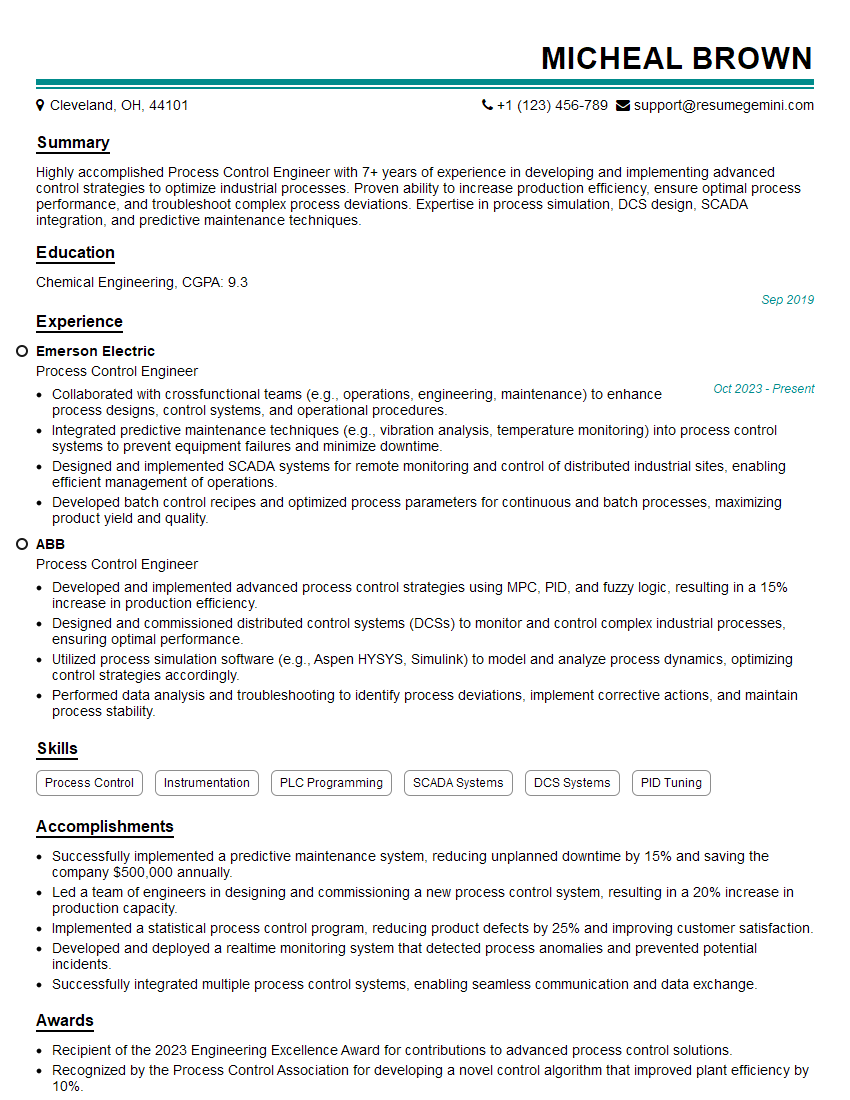
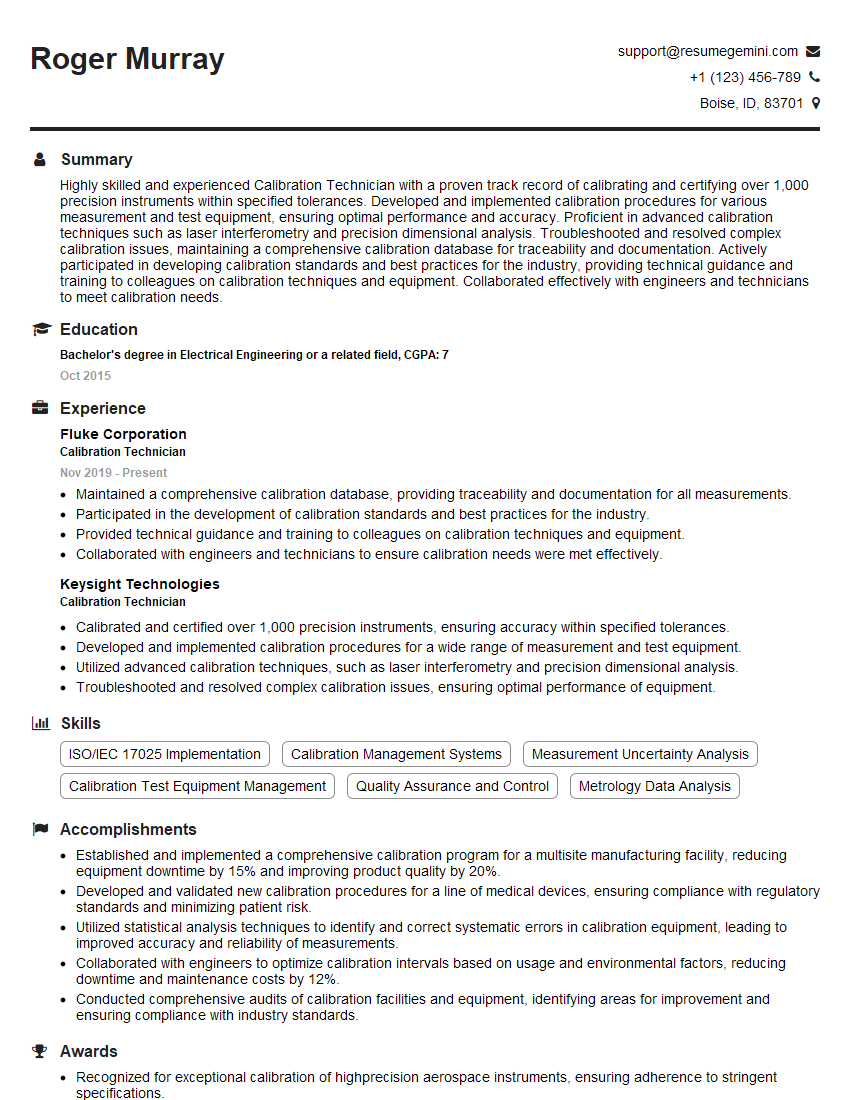
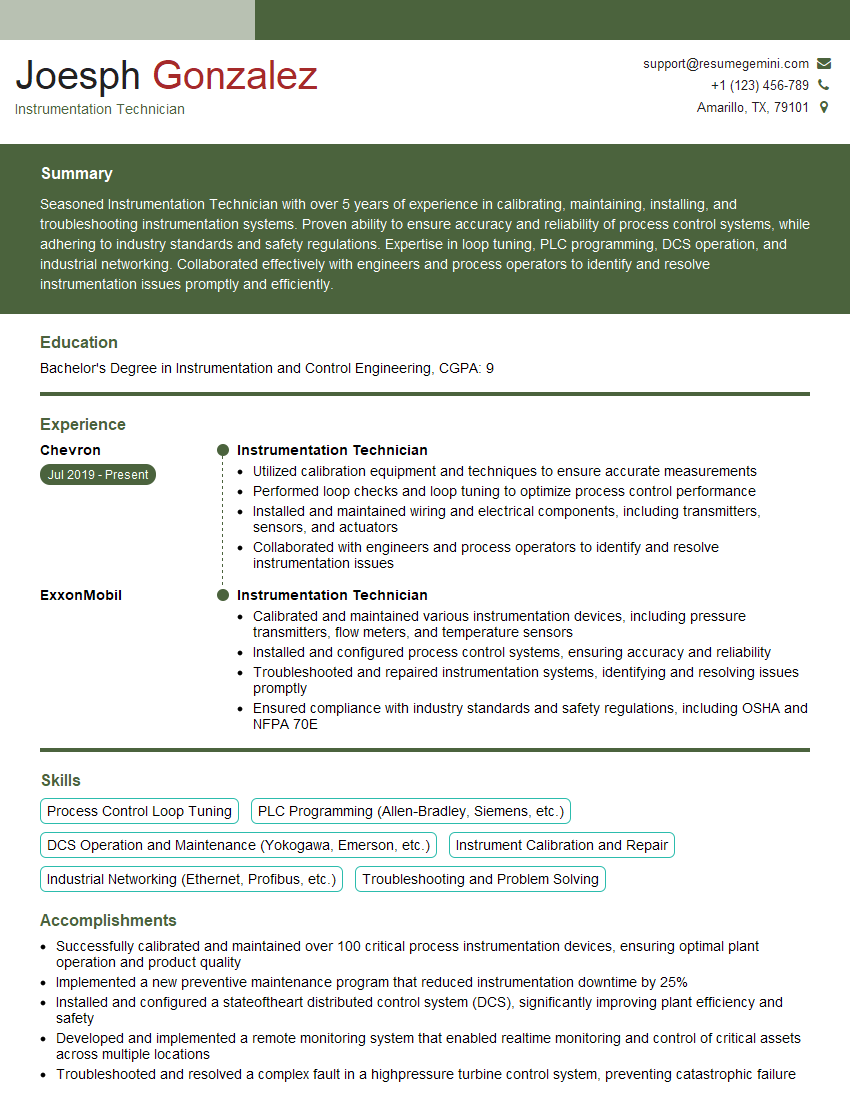
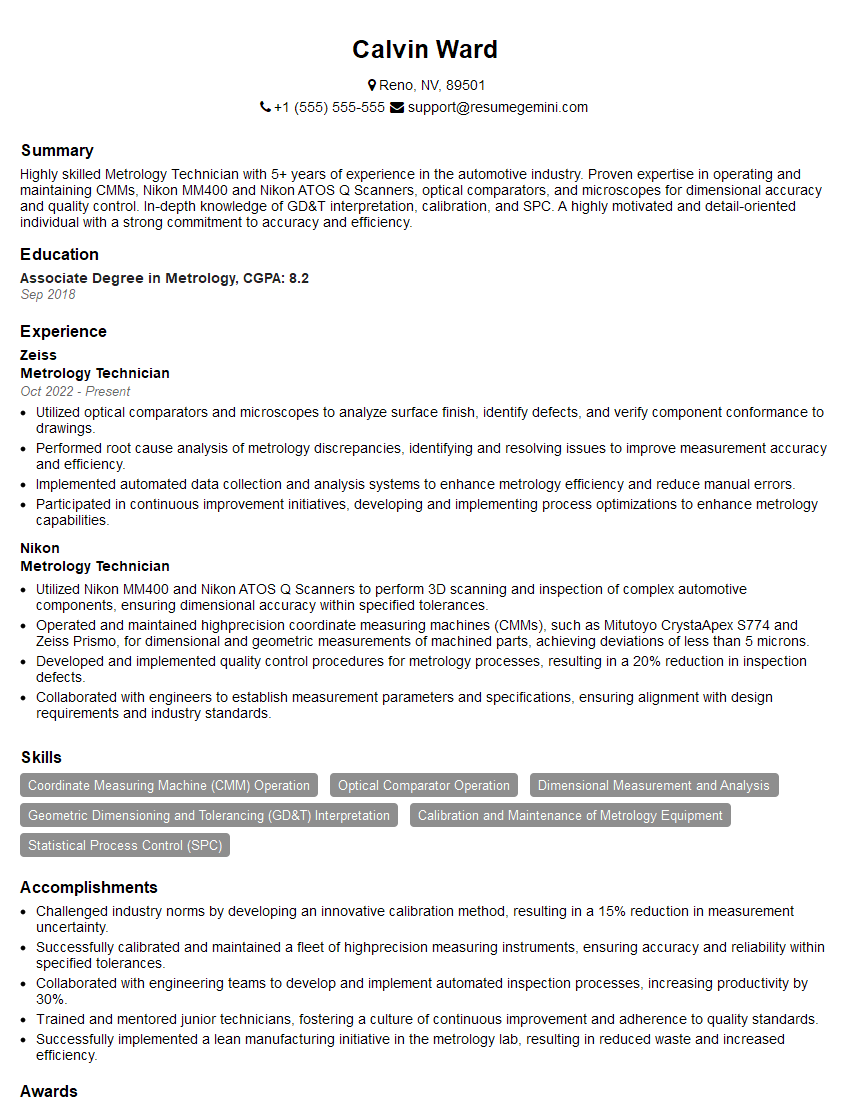
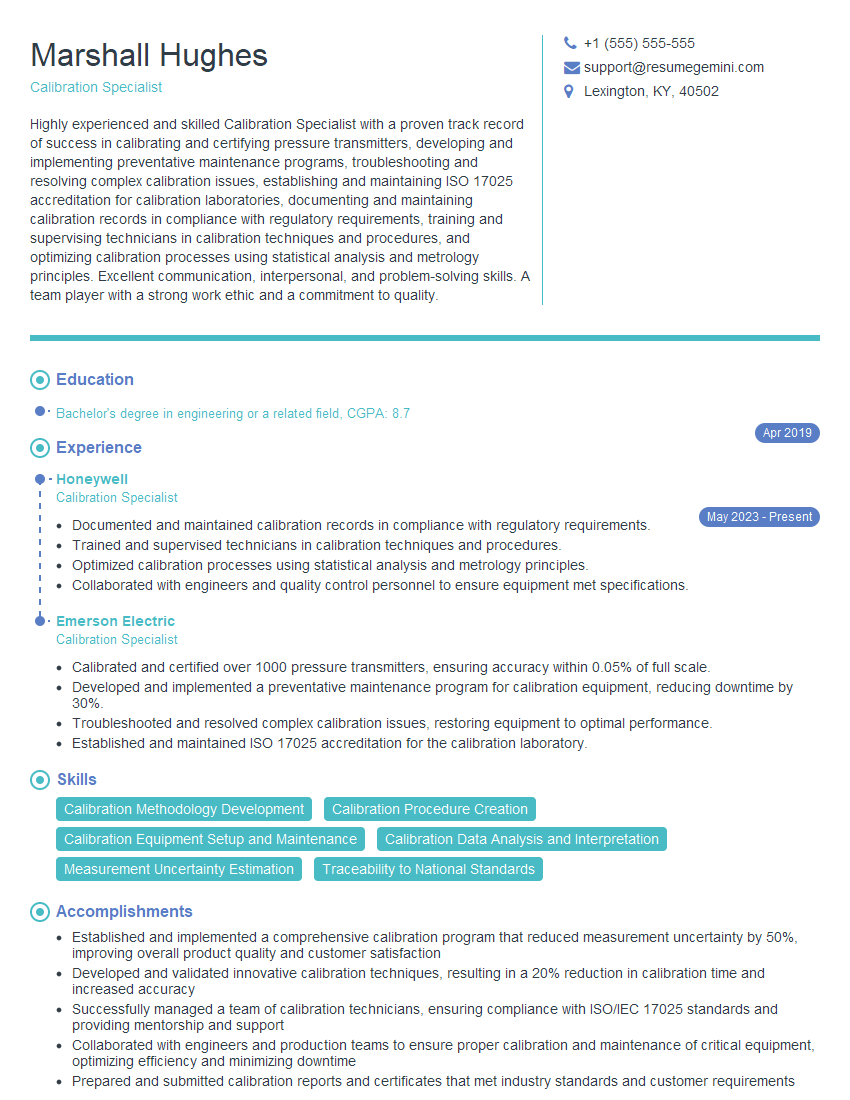
Mastering the calibration of pressure, flow, temperature, and electrical instruments is crucial for career advancement in many technical fields, opening doors to specialized roles and higher earning potential. A well-crafted resume is your key to unlocking these opportunities. An ATS-friendly resume, optimized for Applicant Tracking Systems, significantly increases your chances of getting noticed by recruiters. ResumeGemini is a trusted resource to help you build a professional and impactful resume that showcases your skills and experience effectively. Examples of resumes tailored to Calibration of pressure, flow, temperature, and electrical instruments are available to guide you through the process.
Explore more articles
Users Rating of Our Blogs
Share Your Experience
We value your feedback! Please rate our content and share your thoughts (optional).
What Readers Say About Our Blog
Amazing blog
hello,
Our consultant firm based in the USA and our client are interested in your products.
Could you provide your company brochure and respond from your official email id (if different from the current in use), so i can send you the client’s requirement.
Payment before production.
I await your answer.
Regards,
MrSmith
hello,
Our consultant firm based in the USA and our client are interested in your products.
Could you provide your company brochure and respond from your official email id (if different from the current in use), so i can send you the client’s requirement.
Payment before production.
I await your answer.
Regards,
MrSmith
These apartments are so amazing, posting them online would break the algorithm.
https://bit.ly/Lovely2BedsApartmentHudsonYards
Reach out at BENSON@LONDONFOSTER.COM and let’s get started!
Take a look at this stunning 2-bedroom apartment perfectly situated NYC’s coveted Hudson Yards!
https://bit.ly/Lovely2BedsApartmentHudsonYards
Live Rent Free!
https://bit.ly/LiveRentFREE
Interesting Article, I liked the depth of knowledge you’ve shared.
Helpful, thanks for sharing.
Hi, I represent a social media marketing agency and liked your blog
Hi, I represent an SEO company that specialises in getting you AI citations and higher rankings on Google. I’d like to offer you a 100% free SEO audit for your website. Would you be interested?