Unlock your full potential by mastering the most common Script Revising interview questions. This blog offers a deep dive into the critical topics, ensuring you’re not only prepared to answer but to excel. With these insights, you’ll approach your interview with clarity and confidence.
Questions Asked in Script Revising Interview
Q 1. Explain your process for revising a poorly paced script.
Revising a poorly paced script involves carefully analyzing the rhythm and flow of the narrative. It’s like conducting an orchestra – you need each section to contribute effectively and harmoniously, not rush or lag. My process begins with a scene-by-scene breakdown, identifying areas that feel rushed or stagnant. I then employ several techniques. For sluggish scenes, I look for opportunities to tighten dialogue, remove unnecessary exposition, or add a compelling subplot element to heighten tension or intrigue. Conversely, if a scene feels too fast, I may add descriptive passages, subtextual moments, or even a new scene to build suspense or give the audience time to process information. For instance, if a crucial plot reveal happens too abruptly, I might break it down into smaller, more impactful pieces, using foreshadowing and character reactions to build anticipation.
I often use a pacing chart – a simple spreadsheet where I note each scene and assign it a pacing value (e.g., fast, medium, slow). This visual representation helps me identify patterns and imbalances. Finally, I test the revised pacing by reading the script aloud or having a colleague read it, paying close attention to where the energy dips or surges. This feedback loop allows for further refinements and ensures the final product has a consistent and engaging pace.
Q 2. How do you identify and address inconsistencies in character development across a script?
Inconsistencies in character development are a common issue, often stemming from a lack of clear character arcs or insufficient planning. My approach begins with creating a detailed character profile for each major character, outlining their goals, motivations, flaws, and evolution throughout the story. I then meticulously track their actions and dialogue, looking for any discrepancies or illogical changes in behavior. For example, if a character consistently exhibits compassion but suddenly acts cruelly without a clear explanation, it needs to be addressed.
Addressing these inconsistencies often involves rewriting scenes or adding flashbacks to reveal crucial backstory. It might also necessitate refining the character arc itself, ensuring that the changes are believable and justified within the narrative. Sometimes, a minor adjustment in dialogue or a subtle change in behavior can significantly impact a character’s consistency. Think of it like editing a photo – minor tweaks can result in a much more cohesive and compelling final image. I often consult with the script writer to understand the original intent and brainstorm solutions that maintain the overall vision while addressing inconsistencies.
Q 3. Describe your experience with revising scripts for different target audiences (e.g., children, adults).
My experience spans various target audiences, and revising for children requires a completely different approach than for adults. For children’s scripts, I focus on simplicity of language, age-appropriate themes, and a faster pace. I’m mindful of maintaining a sense of wonder and using bright, engaging imagery. The dialogue needs to be clear, concise, and relatable, while the narrative structure should be easy to follow. I might also incorporate elements of humor, songs, or even repetitive phrases to keep children engaged. Conversely, adult scripts allow for more complex themes, morally ambiguous characters, and nuanced dialogue. The pacing can be slower and more deliberate, allowing for greater depth of character exploration and plot development.
For example, a children’s script might feature a talking animal protagonist solving a simple mystery, with a resolution that reinforces positive values. An adult script, on the other hand, might explore a more intricate plot involving complex relationships, moral dilemmas, and unforeseen consequences. The key is adapting to the unique cognitive and emotional needs of the target audience.
Q 4. How do you handle feedback from multiple stakeholders (directors, producers, etc.) on a script revision?
Handling feedback from multiple stakeholders requires diplomacy, organization, and a clear understanding of each party’s priorities. I begin by summarizing all feedback received, noting each suggestion along with the source (director, producer, etc.). I then categorize the notes into major and minor revisions. Major revisions significantly affect the script’s structure or narrative, while minor ones are typically stylistic or dialogue-related. I prioritize addressing major revisions first, often engaging in discussions with the stakeholders to clarify their intentions and negotiate solutions.
For example, a director might want to focus on character development, while a producer might prioritize pacing and budget concerns. Balancing these often conflicting needs requires thoughtful consideration and compromise. I always maintain detailed records of all revisions, including notes on accepted and rejected suggestions, and why. This transparency ensures a clear understanding of the changes implemented and maintains a collaborative atmosphere throughout the revision process.
Q 5. What software or tools do you use for script revision and formatting?
I primarily use Final Draft for script revision and formatting. It’s the industry standard, providing excellent tools for scene breakdowns, character tracking, and formatting to industry specifications. However, I also utilize Google Docs for collaborative feedback and revisions, as it facilitates real-time collaboration and version history tracking. This is especially valuable when working with multiple stakeholders remotely. For more complex organizational tasks, like tracking changes across multiple drafts, I use spreadsheets to maintain clear documentation. Beyond the software, the most important tool is a good pair of eyes – I always rely on thorough self-editing and peer review to catch any inconsistencies or missed errors before submitting a revised script.
Q 6. How do you ensure continuity and consistency in a script’s narrative?
Ensuring narrative continuity and consistency is crucial for a compelling script. My approach involves several key steps. First, I create a detailed outline or storyboard, ensuring a clear progression of events and logical transitions between scenes. Second, I establish a consistent voice and tone throughout the script, paying close attention to character dialogue, narration, and overall style. Third, I meticulously track all plot points, character details, and settings to identify any inconsistencies or plot holes. For example, if a character mentions a specific detail in one scene, that detail must remain consistent throughout the script.
Inconsistencies can be anything from a character’s age or appearance changing unexpectedly to a crucial plot element being forgotten or contradicting earlier events. To address these, I often refer back to the initial outline or notes taken during the initial writing phase. I also conduct several passes through the script, each focusing on a specific aspect of consistency – plot, character, setting, and tone. This systematic approach significantly increases the likelihood of producing a seamless and engaging narrative.
Q 7. What are the common structural issues you encounter while revising scripts, and how do you address them?
Common structural issues include weak openings, sagging middles, and unresolved endings. A weak opening fails to hook the audience, while a sagging middle lacks momentum and engagement. An unresolved ending leaves the audience unsatisfied and confused. Addressing these requires a combination of techniques. For weak openings, I look for ways to immediately grab the audience’s attention, perhaps with a compelling image, intriguing dialogue, or a high-stakes situation. If the middle sags, I might add subplots, increase the stakes, introduce new characters, or eliminate unnecessary scenes. Unresolved endings often require careful consideration of the plot and character arcs, ensuring all loose ends are tied up in a satisfying manner.
For instance, a sagging middle might be addressed by introducing a new antagonist or escalating the existing conflict. An unresolved ending might require additional scenes to provide resolution or clarity. Structural problems are often easier to diagnose and resolve using a three-act structure analysis or other similar tools. These tools provide a framework for assessing the pacing and structure, identifying areas needing improvement. Finally, reading the script aloud or getting feedback from others is critical to identify any remaining structural flaws.
Q 8. How do you identify and improve weak dialogue in a script?
Identifying and improving weak dialogue involves a multi-step process. First, I read the script closely, paying attention to how characters speak. Does the dialogue sound natural? Is it revealing character? Does it advance the plot? Weak dialogue often feels clunky, exposition-heavy, or unnatural. It might tell rather than show.
I look for several key indicators: On-the-nose dialogue (characters stating the obvious), info-dumps (characters delivering large chunks of backstory), and lack of subtext (dialogue that doesn’t hint at underlying emotions or motivations). I also analyze the rhythm and pacing of the conversations. Choppy, repetitive dialogue can be a significant issue.
To improve weak dialogue, I might: Rewrite sentences to be more concise and impactful; Replace exposition with action or subtext (showing, not telling); Add subtext to reveal hidden emotions or intentions; and refine the rhythm and pacing to create a more natural flow. For example, instead of ‘I’m really sad because my dog died,’ I might rewrite it to show the character’s sadness through actions and reactions, allowing the audience to infer their grief. I might use imagery and metaphors to enrich the dialogue and make it more evocative.
Q 9. Describe a time you had to significantly restructure a script to improve its flow.
I once worked on a romantic comedy where the structure felt disjointed. The comedic beats were scattered, and the romantic plotline lagged. The first act was overly long, and the climax felt rushed. The problem was a lack of clear through-lines for both the comedy and the romance.
To restructure, I first created a detailed outline, mapping out the key plot points and emotional beats of both storylines. I then identified scenes that were unnecessary or redundant, cutting them entirely or merging them with others. I reordered scenes to improve pacing and create a stronger build-up to the climax. For instance, I moved a comedic scene that previously felt out of place to a point where it served as a breather before a more emotionally intense scene. By creating stronger links between scenes, I was able to create a more coherent narrative.
Finally, I ensured that the romantic plotline and comedic elements worked in tandem, supporting and enhancing one another rather than competing for attention. This restructuring involved substantial rewriting but ultimately created a much more engaging and satisfying story.
Q 10. How do you balance creative input with the original author’s vision during script revision?
Balancing creative input with the original author’s vision is crucial. I approach this as a collaboration, not a takeover. I begin by deeply understanding the author’s intention. I read their work carefully, and if possible, I discuss their vision directly. I treat the original script as a foundation, not a restriction.
My revisions aim to enhance the author’s vision, not to replace it. I offer suggestions respectfully and explain my reasoning clearly. I believe in iterative feedback; I present my revisions in stages, allowing the author to provide feedback at each step. It’s a back-and-forth process, where we both contribute to the script’s final form. It’s like sculpting – I’m helping shape the existing form, not building a completely new statue.
Ultimately, the script belongs to the author. My role is to make it the best version it can be, within the framework of their creative vision.
Q 11. Explain your approach to revising scripts for different genres (e.g., comedy, drama, action).
My approach to script revision varies depending on the genre. Comedy requires a sharp eye for timing and wordplay. I focus on making the jokes land effectively and ensuring a consistent comedic tone. I might analyze the rhythm and pacing of dialogue, looking for opportunities to enhance the comedic effect. I also look for areas where the humor might clash with the overall story.
Drama demands a nuanced understanding of character and emotion. I examine the emotional arcs of the characters, making sure that their journeys are believable and compelling. I pay close attention to subtext and the use of symbolism to deepen the emotional impact. In action scripts, I focus on the clarity and efficiency of the action sequences, ensuring they are easy to follow and visually exciting.
In each genre, my goal is to elevate the story while respecting the conventions and expectations of the specific genre. I might use different techniques – for example, tighter editing for action, more lyrical language for drama, and carefully crafted punchlines for comedy – to achieve the best results.
Q 12. How do you ensure the script adheres to industry standards and formatting guidelines?
Adhering to industry standards and formatting guidelines is essential for professional scripts. I meticulously follow standard formatting practices, such as using Courier 12-point font, 1-inch margins, and proper scene headings, action lines, and dialogue formatting. Tools like Celtx or Final Draft help maintain consistency.
Consistency in formatting is crucial because it enhances readability for producers, directors, and actors. A well-formatted script is easier to visualize and interpret, making the production process smoother. This includes consistent use of scene headings, character names, and action lines. I also carefully check for spelling and grammatical errors.
Beyond the purely technical aspects, I strive for clarity and conciseness in my writing. Avoiding overly complex sentences and unnecessary words ensures a smooth reading experience, making my revisions easy to understand and implement.
Q 13. What are some common mistakes you see in scripts that require revision?
Common script mistakes I frequently encounter include:
- Unclear character motivations: Characters acting without clear reasons or goals.
- Weak plot structure: Lack of compelling conflict, rising action, climax, and resolution.
- Info-dumps instead of showing: Expository dialogue that slows down the story instead of revealing information organically.
- Inconsistent characterization: Characters behaving inconsistently throughout the script.
- Unrealistic dialogue: Dialogue that sounds unnatural or doesn’t reflect the characters’ personalities.
- Pacing issues: Scenes that drag or feel rushed.
- Lack of subtext: Dialogue that only conveys literal meaning and lacks depth.
These errors often require significant rewriting to address the underlying structural and thematic issues.
Q 14. How do you work under pressure and meet tight deadlines for script revisions?
Working under pressure and meeting tight deadlines is part of the job. My approach involves careful planning and effective time management. Before starting the revision, I create a detailed schedule, breaking down the tasks into smaller, manageable units. I prioritize tasks based on their importance and impact. This allows me to focus on the most crucial aspects of the revision first.
I also utilize various productivity techniques, such as the Pomodoro Technique (working in focused bursts with short breaks), to maintain efficiency and prevent burnout. Communication is key; I maintain clear and consistent communication with the client or production team to ensure alignment on expectations and deadlines. If unforeseen challenges arise, I proactively communicate these to the client, proposing potential solutions and adjustments to the timeline as needed. Experience has taught me that flexibility and effective communication are key to navigating tight deadlines successfully.
Q 15. How do you identify and correct grammatical and spelling errors in a script?
Identifying and correcting grammatical and spelling errors is the foundation of script revision. It’s not just about catching typos; it’s about ensuring clarity, professionalism, and believability. My process involves a multi-step approach.
First Read-Through: I conduct a thorough first read, focusing solely on grammar and spelling. I use tools like Grammarly or ProWritingAid to assist, but rely heavily on my own grammatical expertise to catch nuances these tools might miss. For example, I pay close attention to subject-verb agreement, proper punctuation, and consistent tense.
Second Read-Through (with Style Guide): A second read is crucial, especially for larger projects. Here, I use a style guide (either provided or one I create based on the script’s tone) to ensure consistency in spelling (e.g., American vs. British), punctuation, and formatting. Inconsistency can break the reader’s immersion.
Contextual Review: Finally, I review errors within their context. A seemingly minor spelling mistake might have unintended comedic or dramatic effects. Correcting errors requires more than just fixing the word; it involves understanding its impact on the overall scene.
For instance, I once caught a misplaced comma that changed the meaning of a crucial dialogue line, shifting the emotional weight of the scene from tension to comedy. This illustrates the importance of context-aware editing.
Career Expert Tips:
- Ace those interviews! Prepare effectively by reviewing the Top 50 Most Common Interview Questions on ResumeGemini.
- Navigate your job search with confidence! Explore a wide range of Career Tips on ResumeGemini. Learn about common challenges and recommendations to overcome them.
- Craft the perfect resume! Master the Art of Resume Writing with ResumeGemini’s guide. Showcase your unique qualifications and achievements effectively.
- Don’t miss out on holiday savings! Build your dream resume with ResumeGemini’s ATS optimized templates.
Q 16. How do you assess the overall effectiveness of a script’s narrative arc?
Assessing a script’s narrative arc involves evaluating its structure and effectiveness in engaging the audience. A strong narrative arc typically follows a three-act structure (Setup, Confrontation, Resolution), but variations exist. My assessment focuses on several key elements:
Inciting Incident: Does the story begin with a compelling event that hooks the audience and sets the central conflict in motion? A weak inciting incident will leave the audience uninterested.
Rising Action: Does the story build tension effectively through escalating stakes and conflicts? Are there enough obstacles and challenges to keep the audience engaged?
Climax: Is the climax satisfying and impactful? Does it feel earned based on the preceding events? A poorly executed climax can undermine the entire narrative.
Falling Action: Does the resolution logically follow the climax? Are loose ends tied up satisfactorily? A rushed or confusing falling action leaves the audience unsatisfied.
Resolution/Denouement: Does the story provide a sense of closure while perhaps leaving room for further exploration? A weak resolution leaves the audience feeling cheated.
I use a combination of analytical tools and intuitive judgment to evaluate these aspects. I often create a plot outline to visualize the narrative arc and identify potential weaknesses or inconsistencies. I also consider the pacing and the emotional impact of each scene on the overall arc.
Q 17. Explain your experience with collaborative script revision processes.
Collaborative script revision is an essential part of my workflow. I’ve participated in numerous collaborative projects, both in-person and remotely. My approach emphasizes clear communication, respectful feedback, and a shared understanding of the script’s goals.
Version Control: We use version control systems (like Git) to track changes and allow for easy collaboration and reverting to previous versions if needed.
Feedback Sessions: I facilitate structured feedback sessions where we discuss the script’s strengths and weaknesses, focusing on specific scenes and characters. I encourage open and honest dialogue, ensuring everyone feels comfortable sharing their ideas.
Shared Document/Software: We use collaborative software like Google Docs or specialized screenwriting software with built-in collaboration features (such as Final Draft’s online collaboration tools) for efficient editing and version tracking. This enables simultaneous revisions and keeps everyone on the same page.
Clear Roles & Responsibilities: Defining roles (e.g., lead reviser, subject matter expert) clarifies responsibilities and ensures everyone is aware of their contributions. I’ve managed such roles in past projects, coordinating the revision process to ensure cohesion and timeliness.
Successful collaboration requires active listening, compromise, and a willingness to adapt. A collaborative approach strengthens the script and fosters a positive creative environment.
Q 18. How do you provide constructive feedback on scripts in a way that is helpful and encouraging?
Providing constructive feedback is about offering specific suggestions for improvement while maintaining a supportive and encouraging tone. My approach involves focusing on the script’s strengths, highlighting areas for growth, and offering practical solutions. I avoid broad, subjective criticisms and instead offer specific examples.
Start with the Positives: I begin by acknowledging the script’s strengths – a compelling character, a unique premise, or a well-written scene. This creates a positive atmosphere and sets the stage for constructive criticism.
Specific Feedback: I provide concrete examples to support my feedback. Instead of saying “the dialogue is weak,” I might say, “The dialogue in Scene 3 feels unnatural. For example, the line ‘I’m feeling blue’ feels clichéd. Perhaps consider a more specific or unique way to express the character’s sadness.”
Solution-Oriented: I offer suggestions for improvement rather than simply pointing out problems. I aim to offer possible alternatives or solutions for addressing the identified issues.
Focus on the Big Picture: While providing detailed feedback on individual scenes or aspects, I always relate it back to the overall narrative arc and the script’s overall objectives. Is the issue affecting the overall story flow? If so, how can it be adjusted?
Remember, the goal is to help the writer improve their script, not to demoralize them. A positive and collaborative approach leads to better outcomes for everyone involved.
Q 19. How familiar are you with different script formatting styles (e.g., Celtx, Final Draft)?
I’m proficient in various script formatting styles, including Celtx, Final Draft, and industry-standard formatting guidelines. Understanding these styles is essential for ensuring professional presentation and readability. Each software offers unique features, but the underlying principles of formatting remain consistent.
Final Draft: This is an industry-standard software, known for its robust features and ease of use. I’m highly proficient in using its tools for scene headings, character names, dialogue formatting, and action lines.
Celtx: Celtx offers a more collaborative and cloud-based approach to screenwriting. I’m familiar with its collaborative tools and features, including its integrated project management functionalities.
Industry Standard Formatting: Regardless of the software, I understand and adhere to industry-standard formatting conventions for ensuring consistency and readability. This includes proper margins, font sizes, and scene numbering.
My experience with diverse software ensures I can work with writers and projects regardless of their preferred tools. Adaptability is key in this field.
Q 20. What is your preferred method for tracking changes made during script revision?
My preferred method for tracking changes during script revision involves using the track changes feature in word-processing software (such as Microsoft Word or Google Docs) combined with detailed comments. This allows for a clear record of all revisions, their authors, and the rationale behind them.
Track Changes Feature: This feature highlights additions, deletions, and modifications, allowing for easy comparison between versions. I meticulously use this feature to record all my revisions and the reasons for them (within the comments section).
Detailed Comments: I use comments to explain my revisions. Instead of simply changing a word, I add comments that clarify my rationale. For example, “Changed ‘walked’ to ‘strolled’ to better reflect the character’s relaxed demeanor.” This aids understanding and allows for discussion.
Version History: Most word processors and screenwriting software maintain a version history, allowing me to revert to previous versions if needed. This acts as a safety net for unforeseen issues.
This detailed approach ensures transparency and allows for effective collaboration. It’s easier to discuss changes and revert to previous versions if necessary, ensuring a clear audit trail.
Q 21. Describe your experience with using version control systems for script revisions.
While not as common in screenwriting as in software development, version control systems (like Git) are increasingly valuable for larger script revision projects, particularly those involving multiple collaborators. My experience with Git isn’t extensive in this specific context, but I understand its principles and can readily adapt its use if necessary.
Branching and Merging: Git’s branching capabilities enable parallel revisions without impacting the main script. This is especially useful for large-scale revisions or when multiple collaborators are working simultaneously. Merging these branches would then integrate changes back into the master script.
Conflict Resolution: Git’s tools for conflict resolution help manage disagreements or overlapping edits, ensuring a streamlined workflow.
History Tracking: Git provides a detailed history of all changes, allowing for easy rollback if needed. This granular version control is beneficial for managing large and complex revisions.
While specialized screenwriting software often provides version control, integrating Git for larger projects with multiple contributors enhances collaboration and provides an added layer of security and flexibility. I am confident in my ability to learn and utilize version control within the screenwriting process where appropriate.
Q 22. How do you handle conflicting notes from different reviewers of a script?
Handling conflicting notes from multiple reviewers requires a diplomatic yet decisive approach. Think of it like conducting an orchestra – each instrument (reviewer) has a unique contribution, but you need to harmonize them into a cohesive whole. First, I carefully analyze each note, identifying areas of agreement and disagreement. I then prioritize notes based on their impact on the overall story and the client’s vision. Sometimes, a simple compromise is enough; perhaps merging two suggestions to create a better solution. For conflicting notes of equal weight, I’ll often discuss the issues with the script’s writer or the client to gain a clearer understanding of their priorities and preferences. Ultimately, my goal is to create a script that is stronger, clearer, and more effective, even if it requires me to thoughtfully navigate conflicting opinions.
For example, one reviewer might suggest shortening a scene for pacing, while another suggests expanding it for character development. Instead of choosing one over the other, I might explore ways to incorporate both: perhaps a slightly shorter scene with a carefully chosen line or two that enhances character development, thereby addressing both concerns.
Q 23. How do you prioritize revisions based on their impact on the overall story?
Prioritizing revisions involves a strategic assessment of their impact on the narrative arc, character development, theme, and overall effectiveness. Imagine building a house: structural issues (plot holes, logical inconsistencies) need addressing first, followed by crucial elements like the foundation (main plot points), then the walls (supporting subplots) and finally the décor (smaller details).
- High Priority: Addressing plot holes, resolving character inconsistencies, fixing pacing issues, improving dialogue clarity, resolving structural problems.
- Medium Priority: Enhancing character development, refining subplots, improving scene transitions, making the dialogue more engaging, adding subtle emotional beats.
- Low Priority: Minor word changes, stylistic tweaks, unless these directly impact the aforementioned higher-priority areas.
I use a revision tracking system to clearly categorize each note’s priority level, ensuring that the most significant issues are tackled first. This methodical approach guarantees that the overall narrative remains compelling and cohesive.
Q 24. Explain your experience with revising scripts that require adaptation for different media (e.g., film to stage).
Adapting scripts across media requires a deep understanding of each medium’s unique limitations and strengths. Think of it as translating a novel into a different language – you need to preserve the essence while accounting for the nuances of the new format. For example, a film script heavily reliant on visual storytelling needs significant adaptation for the stage, where dialogue and action become paramount. I’ve worked on several projects transferring screenplays to stage plays, requiring me to rewrite scenes, condense action, and strengthen dialogue to create a compelling theatrical experience. For a film to stage adaptation, I focus on enhancing the dialogue, creating opportunities for physical acting, and ensuring a strong theatrical structure with clear acts and scenes.
In contrast, adapting a stage play to film often involves visualizing the action, making use of cinematic techniques, and streamlining lengthy stage descriptions. A deep understanding of both media is key, along with a creative approach to finding equivalent ways of conveying the story’s emotional core.
Q 25. How do you ensure the revised script meets the client’s specific requirements?
Meeting client requirements is paramount. I begin by carefully studying the brief, outlining all specifications, and clarifying any ambiguities. This often involves direct communication with the client to ensure we’re on the same page. Throughout the revision process, I maintain constant contact, providing updates and seeking feedback. I use version control software to track all changes, allowing the client to review each iteration and provide targeted feedback. Detailed notes on every revision, explaining my choices, ensure transparency and facilitate discussion.
For example, if a client requests a specific tone or thematic element, I document how I’ve incorporated their feedback and explain any creative choices made to balance their requests with the overall integrity of the script.
Q 26. How do you manage your time effectively when working on multiple script revisions simultaneously?
Managing multiple script revisions simultaneously requires effective time management and organizational skills. I use project management software to create a detailed schedule, breaking down each project into manageable tasks with deadlines. This approach, similar to using a Kanban board, ensures that I can easily prioritize tasks and track my progress. Time blocking helps allocate specific time slots for each project, minimizing context switching and maximizing productivity. I prioritize urgent requests and communicate effectively with clients to manage expectations and avoid delays. Regular breaks and mindful work habits are crucial for maintaining focus and preventing burnout.
Q 27. How do you stay updated on current trends and best practices in script revising?
Staying updated is crucial in this dynamic field. I actively engage with industry publications, attending workshops and conferences, and participating in online forums. This allows me to stay abreast of evolving storytelling techniques, technological advancements, and audience preferences. I also analyze successful scripts across various genres to understand current trends and best practices. Following influential screenwriters and script doctors on social media and through their published works helps me to remain at the forefront of the field.
Q 28. What are your salary expectations for this role?
My salary expectations are commensurate with my experience, skills, and the specific demands of this role. I am confident that my expertise in script revising, combined with my proven track record, will be a valuable asset to your team. We can discuss a specific salary range based on the complete job description and after reviewing the compensation package details.
Key Topics to Learn for Script Revising Interview
- Understanding Narrative Structure: Analyze plot points, character arcs, and pacing to identify areas for improvement. Consider the overall narrative flow and its effectiveness.
- Dialogue Enhancement: Practice rewriting dialogue for clarity, authenticity, and impact. Focus on subtext, character voice, and natural conversation flow.
- Scene Construction and Revision: Learn to evaluate scene effectiveness, identify unnecessary scenes or dialogue, and suggest improvements for pacing and tension.
- Character Development and Consistency: Analyze character motivations, actions, and dialogue to ensure consistency and believability throughout the script.
- Structural Analysis and Plot Holes: Identify and resolve plot inconsistencies, logical fallacies, and pacing issues. Develop skills in identifying and repairing structural weaknesses.
- Genre Conventions and Expectations: Understand the specific conventions and audience expectations of different script genres (e.g., comedy, drama, thriller) and how to effectively tailor revisions accordingly.
- Collaboration and Feedback Integration: Practice effectively incorporating feedback from writers, directors, and other collaborators while maintaining a professional and constructive approach.
- Style and Tone Consistency: Ensure the overall tone and style of the script remain consistent throughout, reflecting the intended audience and genre.
- Subtext and Implied Meaning: Learn to analyze and enhance the subtextual layers of a script, allowing for deeper meaning and richer character development.
Next Steps
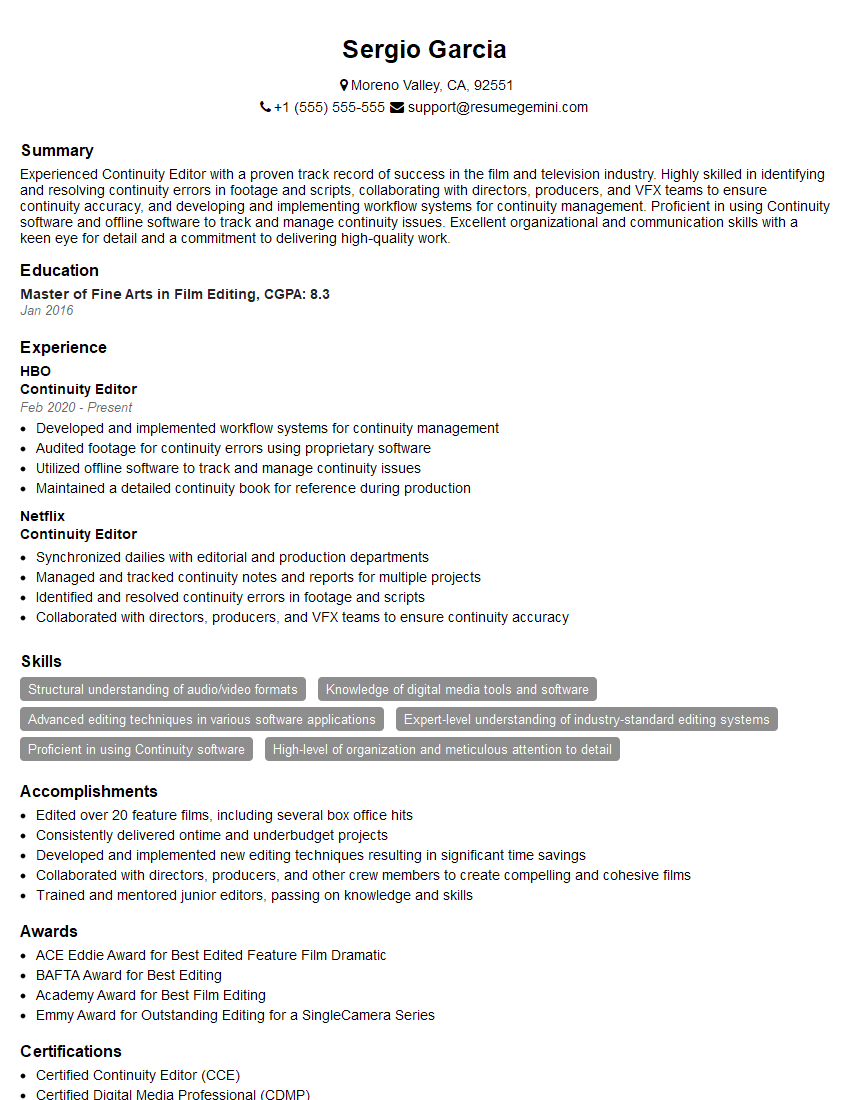
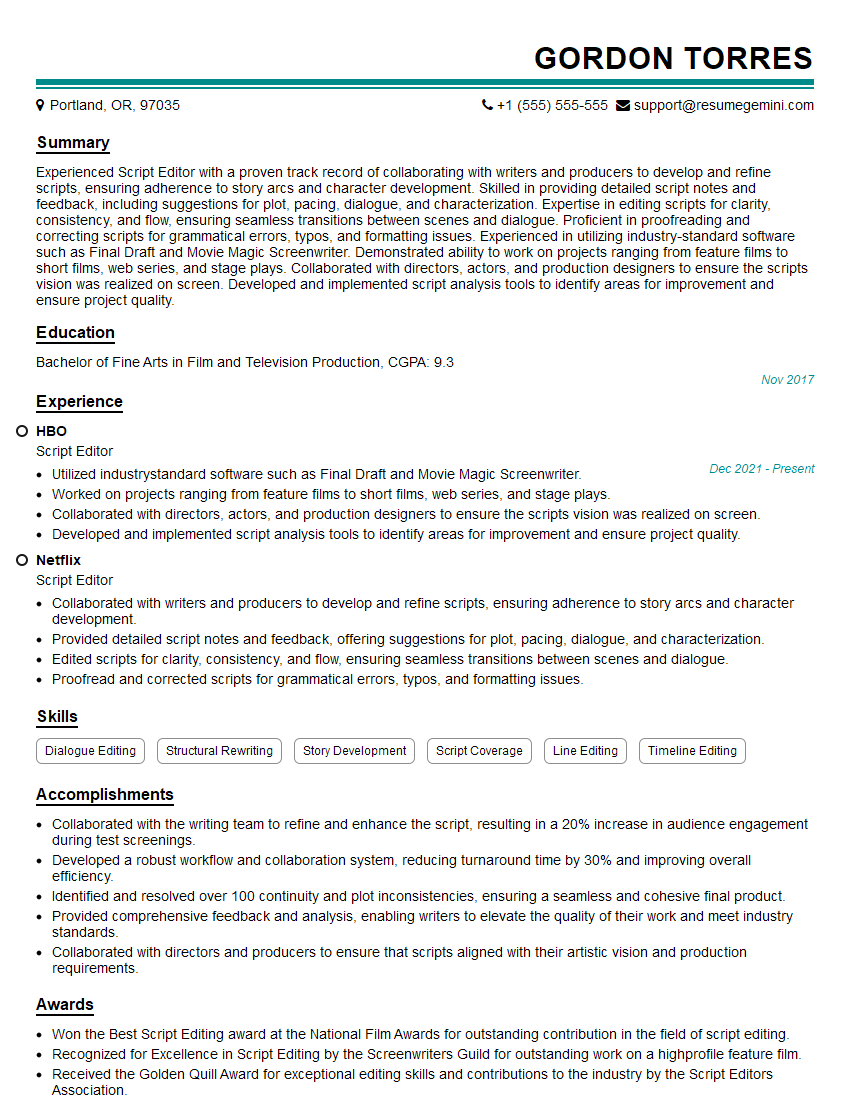
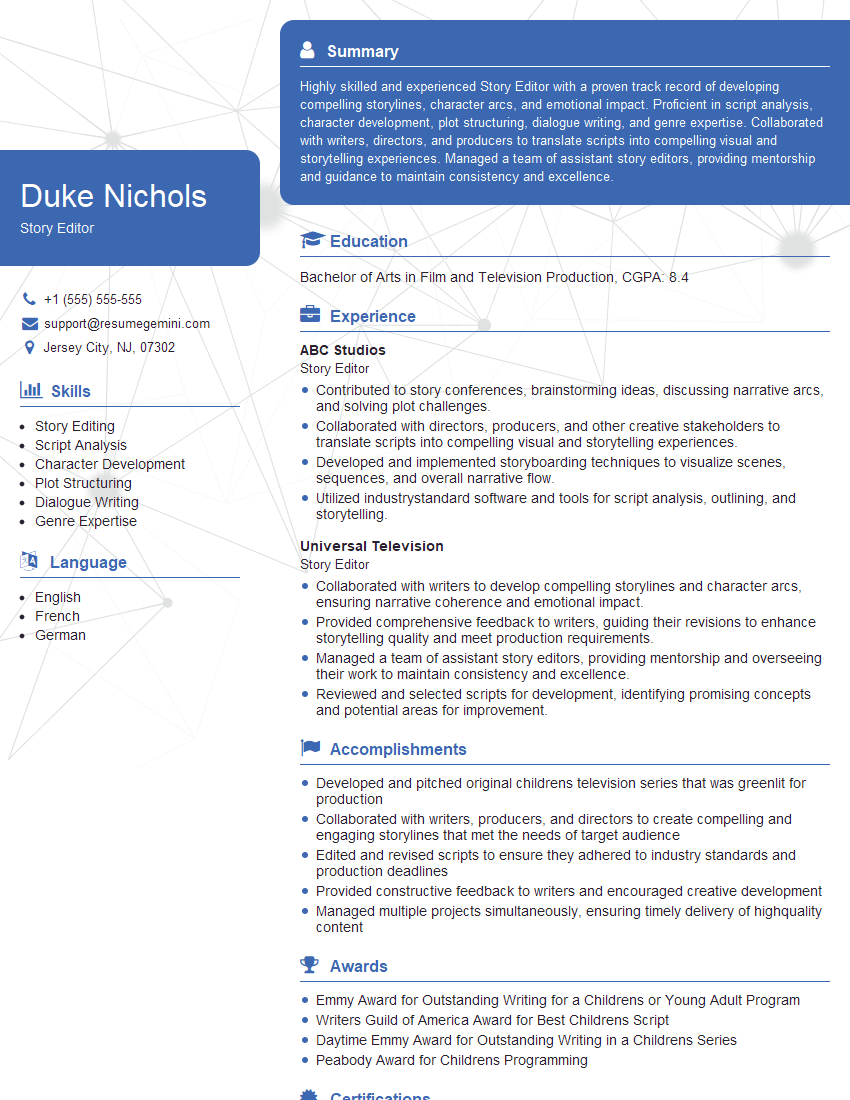
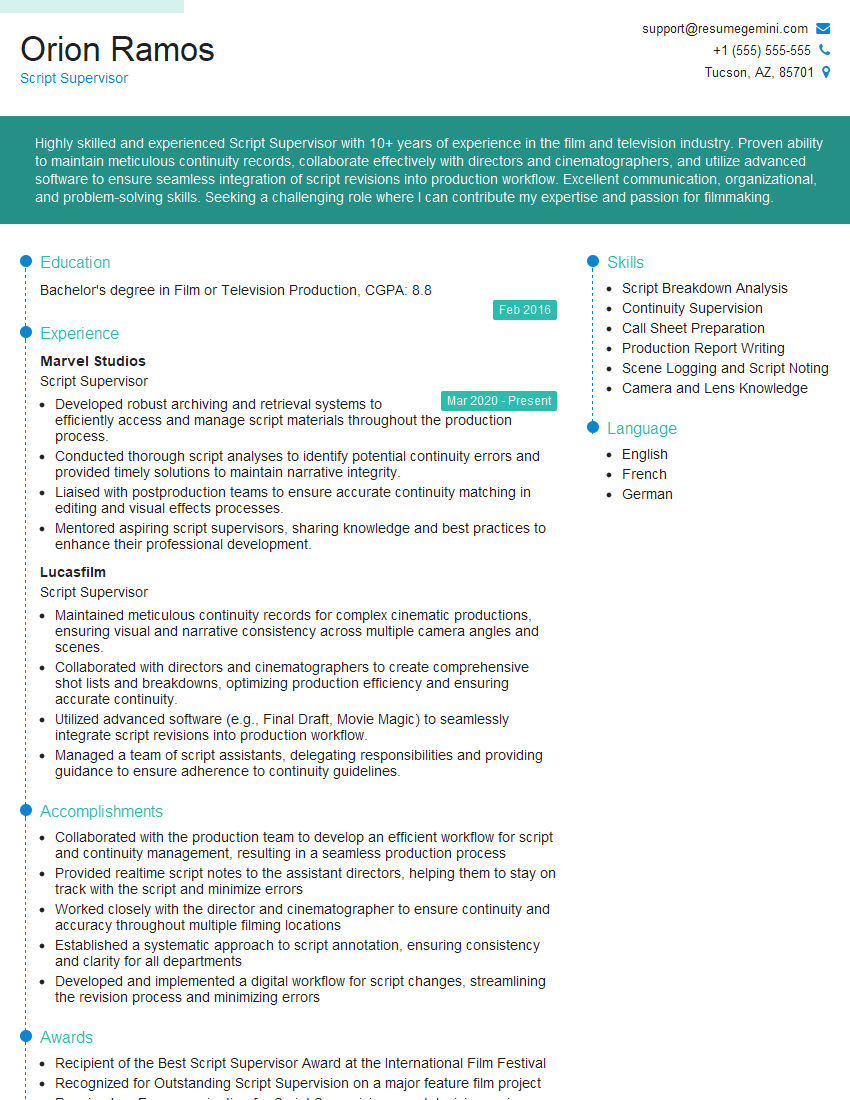
Mastering script revising is crucial for career advancement in the film, television, and theatre industries, opening doors to exciting opportunities and collaborative projects. A strong resume is your key to unlocking these opportunities. To make sure your skills and experience shine, crafting an ATS-friendly resume is essential. ResumeGemini is a trusted resource to help you build a professional and effective resume that grabs the attention of hiring managers. We offer examples of resumes tailored specifically to Script Revising to help guide you.
Explore more articles
Users Rating of Our Blogs
Share Your Experience
We value your feedback! Please rate our content and share your thoughts (optional).
What Readers Say About Our Blog
Amazing blog
Interesting Article, I liked the depth of knowledge you’ve shared.
Helpful, thanks for sharing.