Every successful interview starts with knowing what to expect. In this blog, we’ll take you through the top Title and Boundary Research and Analysis interview questions, breaking them down with expert tips to help you deliver impactful answers. Step into your next interview fully prepared and ready to succeed.
Questions Asked in Title and Boundary Research and Analysis Interview
Q 1. Explain the difference between a metes and bounds description and a lot and block description.
Metes and bounds and lot and block are two fundamentally different ways to describe the boundaries of a piece of land. Think of it like giving directions: metes and bounds is like giving detailed walking instructions, while lot and block is like providing a street address.
A metes and bounds description uses distances (metes) and directions (bounds) to define a property’s perimeter. It starts at a known point of beginning (POB) and follows a series of courses and distances, often referencing natural or man-made monuments like trees, rocks, or streets. This method is often used for irregularly shaped parcels or in areas where a plat map doesn’t exist. For example, a metes and bounds description might read: “Beginning at the iron pin at the northwest corner of Section 12… thence South 100 feet to a large oak tree… thence East 150 feet to a concrete monument…”
A lot and block description, on the other hand, refers to a plat map – a recorded map showing subdivided land. It identifies a property by its lot number and block number within a specific subdivision. This method is much simpler and more concise. For instance: “Lot 12, Block 3, Sunny Acres Subdivision, as recorded in Plat Book 2, Page 15, County Recorder’s Office.” This description assumes that the plat map clearly shows the boundaries of Lot 12 in Block 3.
The key difference lies in their detail and reliance on existing maps. Metes and bounds requires precise measurements and descriptions, while lot and block relies on the accuracy and availability of the plat map.
Q 2. Describe your experience with researching and interpreting legal descriptions of property.
Throughout my career, I’ve extensively researched and interpreted countless legal descriptions, ranging from simple lot and block descriptions to complex metes and bounds surveys involving multiple deeds and conflicting information. I’m proficient in deciphering ambiguous language, identifying potential errors, and reconciling discrepancies between different documents. One memorable case involved a property with a description that referenced a now-nonexistent landmark. By researching old maps and conducting a field survey, I was able to accurately locate the original boundary. My experience extends to interpreting descriptions from various jurisdictions, understanding local surveying practices, and recognizing inconsistencies arising from historical surveying methods.
I also leverage modern technology. I am skilled in utilizing online deed research platforms, Geographic Information Systems (GIS) software, and various mapping programs to cross-reference information and identify potential problems early in the research process. This technology integration allows for efficient and comprehensive analysis.
Q 3. How do you identify and resolve discrepancies between recorded documents and on-the-ground conditions?
Discrepancies between recorded documents and on-the-ground conditions are common in property research and often require a systematic approach to resolution. My process starts with a thorough review of all available documents – deeds, plats, surveys, and other relevant records – to identify any inconsistencies or conflicts.
Next, I conduct a field survey to verify the existing physical features and boundaries. I use GPS technology and other survey instruments to accurately measure distances and angles. Comparing the survey data to the documented descriptions helps pinpoint any discrepancies. This can be anything from a minor measurement error to a significant boundary conflict.
Depending on the nature of the discrepancy, the resolution may involve additional research, further surveys, analysis of historical records, and possibly legal intervention. If the discrepancy is minor, adjustments might be possible through a boundary line agreement between neighboring property owners. For larger discrepancies, a court-ordered boundary survey or legal action might be necessary.
For instance, a discrepancy might be found where a deed mentions a fence as a boundary, but the fence is actually several feet from the described location. Investigating old photos, surveyor notes, and interviews with long-term residents can help determine the original intent and solve the discrepancy.
Q 4. What are the common sources of title defects or boundary disputes?
Title defects and boundary disputes can stem from a variety of sources, often involving errors or ambiguities in the chain of title. Common sources include:
- Errors in original surveys: Old surveys often lack precision, using less accurate equipment or relying on unreliable landmarks.
- Ambiguous legal descriptions: Vague or conflicting language in deeds can lead to boundary disputes.
- Encroachments: Structures or improvements that extend onto neighboring properties.
- Adverse possession: Unlawful occupancy of land for a long period, potentially leading to a claim of ownership.
- Mistakes in recording documents: Clerical errors in the recording process can result in title flaws.
- Missing or incomplete records: Gaps in the chain of title make it difficult to establish clear ownership.
- Fraudulent conveyances: Deeds or other documents obtained through forgery or deception.
Understanding these sources is crucial in preventing and resolving title and boundary issues. A thorough title search and survey are vital in identifying potential problems.
Q 5. How familiar are you with various surveying methods and equipment?
I’m very familiar with a wide range of surveying methods and equipment. My experience includes working with both traditional and modern techniques.
Traditional Methods: I’m proficient in understanding and interpreting data from transit and level instruments, using them to measure angles, distances, and elevations. I understand the principles of triangulation, traversing, and other classic survey techniques.
Modern Methods: I’m highly experienced with GPS (Global Positioning System) and GNSS (Global Navigation Satellite System) technology, including real-time kinematic (RTK) surveying, providing highly accurate measurements. I understand the complexities of data processing and error correction. I am also familiar with LiDAR and other advanced surveying techniques and technologies.
Equipment: I’m comfortable using total stations, electronic distance meters (EDMs), GPS receivers, data collectors, and various software packages for data processing and analysis. My knowledge encompasses both the practical use and the limitations of this technology.
Q 6. Explain your process for validating title information from multiple sources.
Validating title information from multiple sources requires a methodical approach to ensure accuracy and completeness. My process begins with identifying all relevant sources, including but not limited to:
- Deeds
- Plat maps
- Surveys
- Mortgages
- Easements
- Tax records
- Court records
I then meticulously review each document, comparing them for consistency and identifying any discrepancies. I use a hierarchical approach, prioritizing information from the most reliable sources – for example, official government records over privately-held documents. I pay close attention to dates, names, property descriptions, and any potential conflicts. I use cross-referencing and correlation techniques to find patterns and resolve any conflicting data. Any ambiguity or discrepancy is investigated further. The ultimate goal is to create a complete and accurate picture of the property’s history and current status.
For instance, if there is a conflict between the recorded deed and a prior survey, I would investigate further to understand why the conflict occurred and to determine which document is more accurate given the available evidence.
Q 7. Describe your experience with GIS software and its application to title and boundary analysis.
I’m highly proficient in using GIS software for title and boundary analysis. GIS allows me to visualize spatial data, overlay various map layers, and perform sophisticated spatial analysis tasks to understand complex property relationships. For example, I can overlay parcel maps with deed descriptions, historical maps, and aerial imagery to identify discrepancies or potential boundary conflicts. I use GIS to create accurate maps, analyze property ownership patterns, and prepare presentations for clients or stakeholders.
Specific applications include:
- Data Visualization: Creating clear and concise maps to illustrate property boundaries, easements, and other spatial features.
- Spatial Analysis: Identifying potential overlaps, encroachments, or gaps in ownership.
- Data Management: Organizing and managing large datasets of property information.
- Report Generation: Producing professional reports with maps, tables, and analysis.
Software experience includes ArcGIS, QGIS, and other relevant platforms. GIS is an indispensable tool in my workflow, enhancing both the accuracy and efficiency of title and boundary research.
Q 8. How do you handle conflicting survey data or differing interpretations of legal descriptions?
Resolving conflicting survey data or differing interpretations of legal descriptions requires a methodical approach that prioritizes accuracy and legal precedence. I begin by meticulously reviewing all available data, including multiple surveys, deeds, plats, and any relevant court documents. I then analyze the discrepancies, identifying potential sources of error such as outdated surveys, inaccurate measurements, or conflicting interpretations of ambiguous language in legal descriptions.
For example, if one survey shows a property line extending further than another, I would investigate the methodology used in each survey, looking for evidence of errors in measurement or data collection. I might also examine the history of the property to see if any prior boundary disputes have been resolved through legal action, as those resolutions often establish precedent.
Once I’ve identified the inconsistencies, I utilize my expertise in surveying principles and legal interpretation to weigh the evidence. This may involve consulting with other experts, such as licensed surveyors or legal professionals, if the conflict is complex. Ultimately, the goal is to arrive at a reasoned conclusion that is supported by the preponderance of evidence and aligns with established legal principles.
Q 9. What is your experience with reviewing easements, rights-of-way, and other encumbrances on property?
My experience with easements, rights-of-way, and other encumbrances is extensive. I’ve reviewed hundreds of documents encompassing a wide variety of encumbrances. This includes reviewing the legal description of the encumbrance itself to ensure accurate identification and location. I also analyze the scope and limitations of each encumbrance, understanding its impact on the property’s usability and potential value. For instance, a utility easement might restrict building within a specific area, while a right-of-way could impact access to a portion of the property.
A critical aspect of this review involves determining the validity and enforceability of each encumbrance. This includes checking for proper recording, compliance with applicable regulations, and any potential issues regarding its creation or subsequent modification. For example, I would scrutinize a deed to determine if an easement was properly granted and whether it meets the requirements of the relevant state law. I always ensure the documents are properly recorded and indexed with relevant county authorities.
Q 10. Describe your knowledge of relevant legal precedents and statutes related to land ownership.
My knowledge of relevant legal precedents and statutes is crucial to my work. I am familiar with state and federal laws concerning land ownership, including those relating to adverse possession, boundary disputes, easements, and title insurance. I stay current on relevant case law, understanding how court decisions have shaped the interpretation and application of these statutes. This understanding ensures my analyses are legally sound and my conclusions defensible.
For example, understanding the requirements of adverse possession — the legal principle allowing someone to claim ownership after prolonged, open, and notorious use of another’s property — is essential. I’m also familiar with the specific legal requirements and standards of evidence for proving a claim of ownership based on adverse possession in the relevant jurisdiction. This knowledge allows me to accurately assess the potential risks associated with such claims when reviewing a title.
Q 11. How do you prioritize conflicting interests in resolving title and boundary issues?
Prioritizing conflicting interests in resolving title and boundary issues is a delicate balance requiring careful consideration of legal principles and factual evidence. My approach is guided by a strict adherence to the legal hierarchy of evidence. This generally means that recorded documents, such as deeds and surveys, hold greater weight than oral testimony or less formal evidence. I analyze each piece of conflicting evidence, assessing its reliability and credibility.
For example, if a recent survey conflicts with an older deed, I would carefully examine both documents, considering factors such as the surveyor’s qualifications, the date of the survey, and any potential errors in the deed’s description. I might also consider any improvements made to the property that may provide evidence of established boundary lines. Ultimately, my priority is to arrive at a conclusion that is both legally sound and practical, minimizing the impact on all parties involved while upholding fairness and due process.
Q 12. Explain your experience in preparing title reports or boundary surveys.
I have extensive experience in preparing both title reports and boundary surveys. A title report is a comprehensive summary of the ownership history of a property, including any encumbrances, liens, or other claims against it. My title reports detail every element affecting the title’s marketability. I conduct thorough title searches, examining all relevant documents to identify any potential problems, such as clouds on the title.
Boundary surveys, on the other hand, involve physically locating and mapping the property’s boundaries. This includes reviewing all relevant legal descriptions, surveys, and historical records. I use advanced surveying equipment to determine the exact location of the property lines on the ground. I create precise maps and legal descriptions that accurately depict the property’s boundaries. My work ensures that the boundaries are clearly defined and legally defensible, crucial for resolving potential disputes and protecting property rights.
Q 13. How would you approach a situation where a property line is unclear or disputed?
When a property line is unclear or disputed, my approach is systematic and thorough. I begin by collecting and reviewing all available evidence, including deeds, surveys, plats, tax records, and any other relevant documents. I also examine any physical evidence on the ground, such as fences, markers, or improvements that might indicate the location of the boundary.
If the evidence is conflicting or insufficient, I may need to employ additional techniques, such as researching historical records, interviewing neighbors or long-term residents who may have knowledge of the boundary, or conducting a new survey using modern surveying technology. In cases of significant dispute, I may recommend mediation or legal action to resolve the matter. The goal is to achieve a mutually agreeable solution that aligns with the evidence and applicable law, offering clear and legally-defensible boundaries.
Q 14. Describe your process for identifying and analyzing potential risks associated with a property’s title.
Identifying and analyzing potential risks associated with a property’s title is a core component of my work. My process involves a comprehensive review of the title history, searching for any potential issues that could affect the marketability or ownership of the property. These risks include, but are not limited to, liens, judgments, unpaid taxes, encroachments, easements that restrict usage, and questions regarding proper chain of title.
For each potential risk, I evaluate its severity and likelihood, considering factors such as the age of the encumbrance, the legal status of the claim, and any steps that might be taken to resolve it. My analysis includes a detailed assessment of the legal ramifications of each risk, along with recommendations for mitigating those risks. This might involve obtaining releases from lien holders, resolving boundary disputes, or obtaining title insurance to protect against unforeseen issues. The ultimate goal is to provide clients with a clear understanding of the risks and potential costs associated with purchasing or owning the property.
Q 15. What is your experience with using public records to research title and boundary information?
My experience with public records for title and boundary research is extensive. I’m proficient in navigating various county recorder’s offices, both physically and online, to access crucial documents like deeds, plats, surveys, and assessor’s maps. I understand the nuances of different record-keeping systems across jurisdictions and can effectively interpret often-ambiguous historical documents. For instance, I recently worked on a case where a misplaced deed reference led to a discrepancy in property lines. By cross-referencing multiple records, including older handwritten deeds and updated digital maps, I was able to pinpoint the correct boundary and resolve the issue. I also regularly utilize online databases and GIS systems to enhance my research, providing a comprehensive approach to uncovering accurate and reliable information.
My workflow typically involves:
- Identifying relevant record sources.
- Systematically reviewing documents for accuracy and completeness.
- Analyzing information to identify potential discrepancies or title issues.
- Documenting findings in a clear and concise report.
Career Expert Tips:
- Ace those interviews! Prepare effectively by reviewing the Top 50 Most Common Interview Questions on ResumeGemini.
- Navigate your job search with confidence! Explore a wide range of Career Tips on ResumeGemini. Learn about common challenges and recommendations to overcome them.
- Craft the perfect resume! Master the Art of Resume Writing with ResumeGemini’s guide. Showcase your unique qualifications and achievements effectively.
- Don’t miss out on holiday savings! Build your dream resume with ResumeGemini’s ATS optimized templates.
Q 16. How familiar are you with different types of property ownership (fee simple, life estate, etc.)?
I have a thorough understanding of various property ownership types. ‘Fee simple’ is the most common, representing absolute ownership with complete control over the property. A ‘life estate’, on the other hand, grants ownership only for the duration of a specific person’s life, after which the property reverts to another designated individual (remainderman) or entity. Other examples include:
- Joint Tenancy: Two or more individuals own the property equally with the right of survivorship (ownership automatically transfers to the surviving owner upon death).
- Tenancy in Common: Similar to joint tenancy, but without the right of survivorship. Shares can be passed on through a will.
- Tenancy by the Entirety: Similar to joint tenancy, but only available to married couples. Creditors of one spouse cannot claim the property.
Understanding these nuances is critical in assessing the legal rights and responsibilities associated with a property, especially during a transaction or dispute. For example, a client considering purchasing a property with a life estate needs to carefully consider the potential implications on their ownership once the life tenant passes away.
Q 17. How would you handle a situation involving a boundary encroachment?
Boundary encroachments are handled carefully and methodically. The first step involves a thorough investigation to verify the encroachment exists. This includes reviewing existing surveys, deeds, and other relevant documents. I then conduct a field investigation, often using GPS and surveying equipment to pinpoint the precise location of the property lines and the encroachment. Following this, a legal strategy is developed based on the severity and nature of the encroachment and the relationship between the affected parties.
Possible solutions might include:
- Negotiation: The most desirable solution, where the parties work together to find a mutually agreeable resolution, perhaps involving a boundary line adjustment.
- Legal Action: If negotiation fails, legal action might be necessary to obtain a court order to resolve the issue. This could involve filing a lawsuit for trespass or seeking a court-ordered survey.
- Easement: A legal agreement granting one party the right to use a portion of the other party’s land.
Throughout the process, clear and open communication with all parties is crucial. Documentation of every step is paramount for future reference and legal proceedings.
Q 18. Describe your experience with preparing legal documentation related to title and boundary issues.
I have extensive experience preparing legal documentation for title and boundary issues. This includes drafting legal descriptions of property, preparing affidavits, and creating exhibits for court cases. I am familiar with various legal formats and standards, ensuring accuracy and clarity. For example, I recently prepared a legal description for a boundary line adjustment that needed to be submitted to the county for approval. This involved using specific language and precise measurements to accurately define the new boundary line. The accuracy of this document was crucial for the success of the adjustment, and my expertise ensured that everything was correctly documented.
I also prepare comprehensive reports outlining title searches, survey analysis, and my conclusions, providing all stakeholders with the essential information needed to make informed decisions.
Q 19. How would you explain complex title and boundary issues to a non-technical audience?
Explaining complex title and boundary issues to non-technical audiences requires clear, concise communication and relatable analogies. I avoid jargon whenever possible, and instead use visual aids like maps and diagrams to illustrate key concepts. For example, when explaining adverse possession, I might use the analogy of a neighbor unknowingly using a small strip of your land for a long period, potentially gaining ownership through that prolonged use. Similarly, when discussing easements, I might explain it as a ‘right of way’ granted to someone to cross your property. Breaking down complex legal concepts into simpler terms empowers clients to fully grasp the situation and make informed decisions.
Q 20. What is your experience with working with clients or stakeholders to resolve title and boundary disputes?
My experience in resolving title and boundary disputes with clients and stakeholders is extensive. I believe in fostering open communication and understanding to find mutually acceptable solutions. I act as a neutral mediator, helping them understand the legal implications of their positions and exploring various options before resorting to litigation. This often involves active listening, collaborative problem-solving, and negotiation. For example, I successfully mediated a dispute between two neighboring landowners over a fence line, guiding them towards a compromise that respected their individual property rights while maintaining a positive relationship.
My goal is always to find the most efficient and cost-effective solution while safeguarding my clients’ interests.
Q 21. What is your understanding of the legal principles of adverse possession?
Adverse possession is a legal doctrine that allows someone to acquire ownership of another person’s property by openly, continuously, and exclusively possessing it for a specific period (usually a number of years, varying by jurisdiction) under certain conditions. The possessor must demonstrate that their possession was hostile (without the owner’s permission), actual (physical presence on the land), open and notorious (visible to the owner), exclusive (not shared with others), and continuous (uninterrupted for the statutory period).
Think of it as a ‘squatter’s rights’ scenario, but with strict legal requirements. For instance, if a neighbor consistently uses a portion of your land without your knowledge or permission for many years, under the right circumstances, they might be able to claim ownership through adverse possession. It’s a complex area of law that requires careful examination of all the facts and applicable statutes.
Q 22. How do you ensure the accuracy and completeness of your title and boundary research?
Ensuring accuracy and completeness in title and boundary research is paramount. It’s like solving a complex puzzle where every piece matters. My approach is multi-faceted and involves several key steps:
- Multiple Source Verification: I never rely on a single source. I cross-reference information from multiple databases, including county recorders’ offices, tax assessors’ records, and state land records. This helps identify discrepancies and confirms the validity of information.
- Chain of Title Examination: For title research, I meticulously trace the ownership history of a property back to its origin, looking for any breaks, gaps, or encumbrances. Think of it as creating a detailed family tree for the property.
- Survey Review and Analysis: Boundary research requires a thorough review of all available surveys. I analyze the survey plats, looking for inconsistencies, errors, or ambiguities in descriptions and monument locations. This often includes verifying the accuracy of bearings, distances, and coordinates.
- Legal Description Interpretation: I have extensive experience interpreting legal descriptions, which can often be complex and ambiguous. Understanding the nuances of legal language is critical for accurate boundary determination.
- Quality Control Checks: I implement rigorous quality control checks throughout the research process, including peer reviews and internal audits. This ensures the final product is accurate and complete.
For example, I once discovered a discrepancy between a tax assessment map and a recorded deed. By cross-referencing with older survey plats, I found an error in the tax map, preventing a potentially costly mistake for my client.
Q 23. Describe your experience working with different types of mapping software.
My experience with mapping software is extensive, encompassing both traditional CAD software and modern GIS platforms. I’m proficient in using programs like AutoCAD, ArcGIS, and QGIS.
- AutoCAD: I use AutoCAD for precise drafting, digitizing plats, and creating accurate boundary representations. It’s invaluable for analyzing survey data and preparing maps for clients.
- ArcGIS/QGIS: These GIS platforms are crucial for spatial analysis. I utilize their capabilities for overlaying different datasets, such as property lines, aerial imagery, and topographic maps, to identify potential conflicts or inconsistencies. For instance, ArcGIS Pro’s spatial analysis tools allow for identifying overlaps or gaps between adjacent parcels.
- Other Software: My experience extends to other relevant software such as Google Earth Pro for visual reference and analysis of terrain and surrounding features.
The choice of software depends on the specific project requirements. For simple boundary analysis, AutoCAD may suffice. However, for complex projects involving numerous datasets, ArcGIS or QGIS’s spatial analysis tools are far more efficient.
Q 24. What is your experience with the process of conducting a title search?
Conducting a title search involves a systematic investigation of the public records to determine the ownership history and any encumbrances affecting a property. This is much like researching a family history, but for a piece of land.
- Accessing Public Records: This typically starts with county recorder’s offices, where deeds, mortgages, liens, and other documents are recorded. Online access to these records has streamlined the process considerably.
- Tracing the Chain of Title: This involves meticulously following the chain of ownership, from the current owner back to the original grant or patent. Each link in the chain represents a transfer of ownership, and any issues, like missing links, need to be thoroughly investigated.
- Identifying Encumbrances: The process aims to uncover any liens, easements, judgments, or other encumbrances that could affect the property’s ownership or value. This is extremely important for buyers.
- Document Review and Interpretation: Careful review and interpretation of each document is crucial. Errors, omissions, or conflicting information must be identified and addressed.
- Title Report Preparation: The final stage often involves creating a summary report that details the findings of the title search. This report becomes essential for legal and financial transactions.
For example, I recently uncovered a previously unrecorded easement during a title search, which would have significantly affected the property’s use and marketability had it not been discovered.
Q 25. Explain the importance of due diligence in title and boundary research.
Due diligence in title and boundary research is paramount; it’s like performing a thorough health check on a property before making a significant investment. It minimizes risks and protects clients from potential financial losses.
- Identifying Potential Issues: Due diligence identifies potential problems such as encroachments, boundary disputes, easements, liens, or title defects that could impact the property’s value or usability.
- Mitigating Risks: By identifying and addressing these issues early, you can mitigate the risks associated with property acquisition, development, or financing.
- Legal Protection: Comprehensive due diligence protects both the buyer and the seller from potential legal challenges and disputes that might arise later.
- Informed Decision Making: Due diligence empowers clients to make informed decisions based on a complete understanding of the property’s legal and physical characteristics.
Neglecting due diligence can lead to costly legal battles, delays in transactions, and even loss of investment. It’s simply not worth the risk.
Q 26. How familiar are you with the concept of a survey monument?
A survey monument is a physical marker, like an iron pin, a concrete monument, or a naturally occurring feature, used to define a point on the ground that’s referenced in a property’s legal description. They are the physical evidence of a property’s boundaries. Think of them as the anchors of a property’s location.
It’s crucial to understand how survey monuments are described in legal descriptions and how their location impacts the actual boundaries. I regularly use information from survey plats to locate, or research the location of, these monuments. Knowing the type of monument, its location, and its condition is important when verifying boundaries.
For instance, a missing or damaged monument can create boundary uncertainties, requiring further investigation, often involving additional surveying.
Q 27. Describe a challenging title or boundary issue you’ve encountered and how you resolved it.
One of the most challenging cases involved a property with conflicting survey data. Two different surveys, performed decades apart, showed significantly different property lines. This created a boundary dispute with the neighboring property owner.
To resolve this, I followed a methodical approach:
- Comprehensive Data Gathering: I gathered all available survey data, including the conflicting surveys, older deeds, and any historical maps.
- On-Site Investigation: I conducted a thorough on-site inspection to locate any existing survey monuments and assess their condition. This involved verifying monument locations against the survey data.
- Legal Research: I researched the history of the property and its boundaries to understand the origin of the discrepancies. This included reviewing historical documents to trace the boundary lines over time.
- Expert Consultation: In this specific case, I consulted with a licensed surveyor to perform a new boundary survey. This survey clarified the discrepancies and ultimately resolved the dispute.
- Negotiation and Mediation: Finally, I worked with both property owners to negotiate a mutually agreeable resolution based on the findings of the new survey.
This case highlighted the importance of using multiple sources of information, understanding the history of a property, and, when necessary, relying on expert opinion to resolve complex boundary issues. The successful resolution preserved a good working relationship between neighboring property owners.
Key Topics to Learn for Title and Boundary Research and Analysis Interview
- Legal Descriptions and Metes and Bounds: Understanding the intricacies of legal descriptions, including metes and bounds surveys, plat maps, and their interpretation. This includes identifying potential ambiguities and discrepancies.
- Survey Principles and Practices: Familiarize yourself with fundamental surveying techniques, coordinate systems (e.g., State Plane Coordinate System), and the application of surveying data in boundary analysis. Be prepared to discuss different types of surveys and their limitations.
- Research Methods and Data Analysis: Demonstrate proficiency in researching property records (e.g., deeds, plats, easements), analyzing conflicting information, and drawing accurate conclusions based on available evidence. This includes understanding the hierarchy of evidence in boundary disputes.
- Boundary Disputes and Resolution: Discuss common sources of boundary disputes and various methods for resolving them, including negotiation, mediation, and litigation. Understand the role of expert witnesses in boundary litigation.
- Geographic Information Systems (GIS) and its Application: Showcase your understanding of GIS software and its role in visualizing and analyzing spatial data related to property boundaries. Be prepared to discuss your experience with relevant GIS software and techniques.
- Real Estate Law and its Relevance: Possessing a foundational understanding of relevant real estate laws and regulations is crucial. Be prepared to discuss how these laws impact boundary research and analysis.
Next Steps
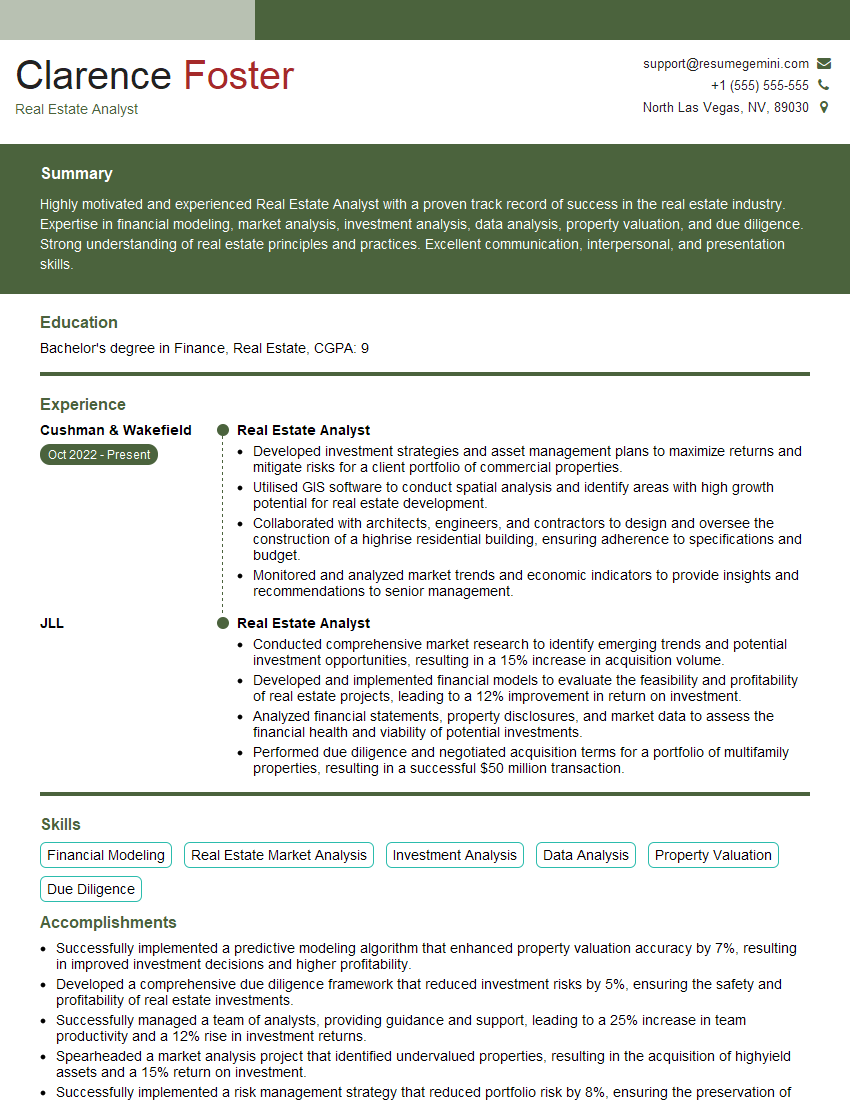
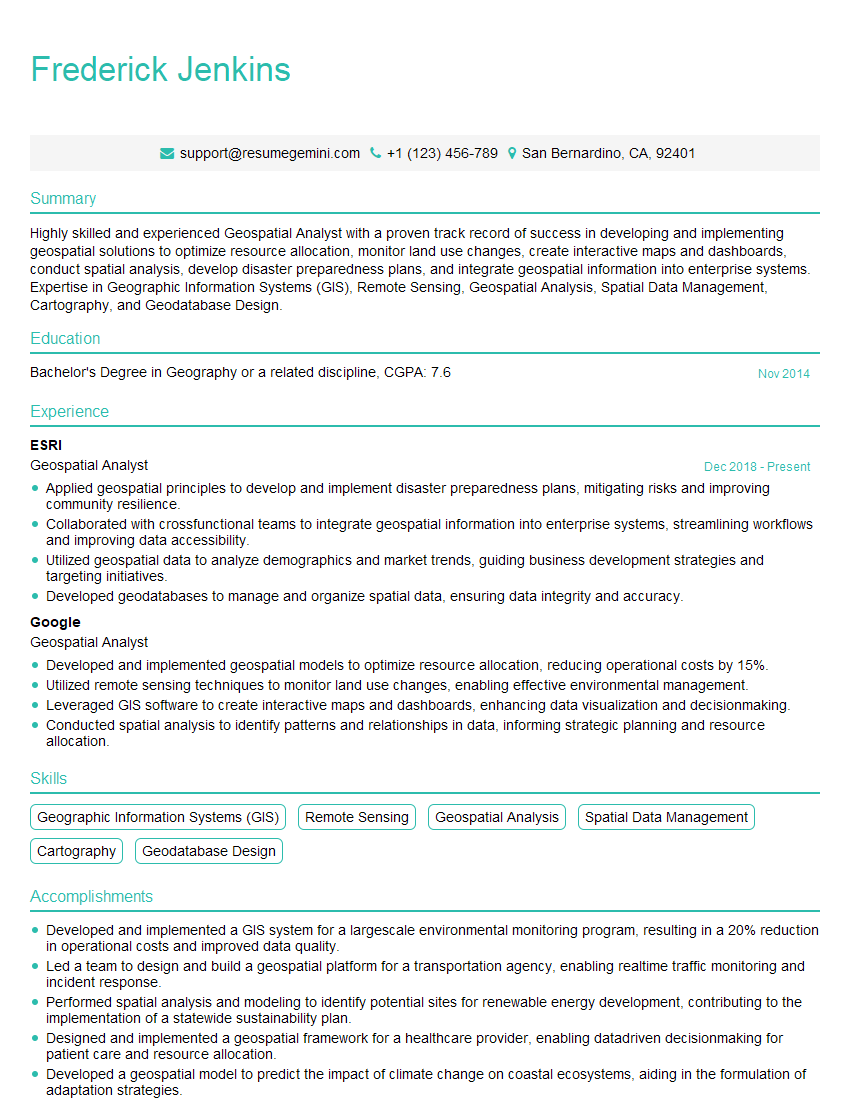
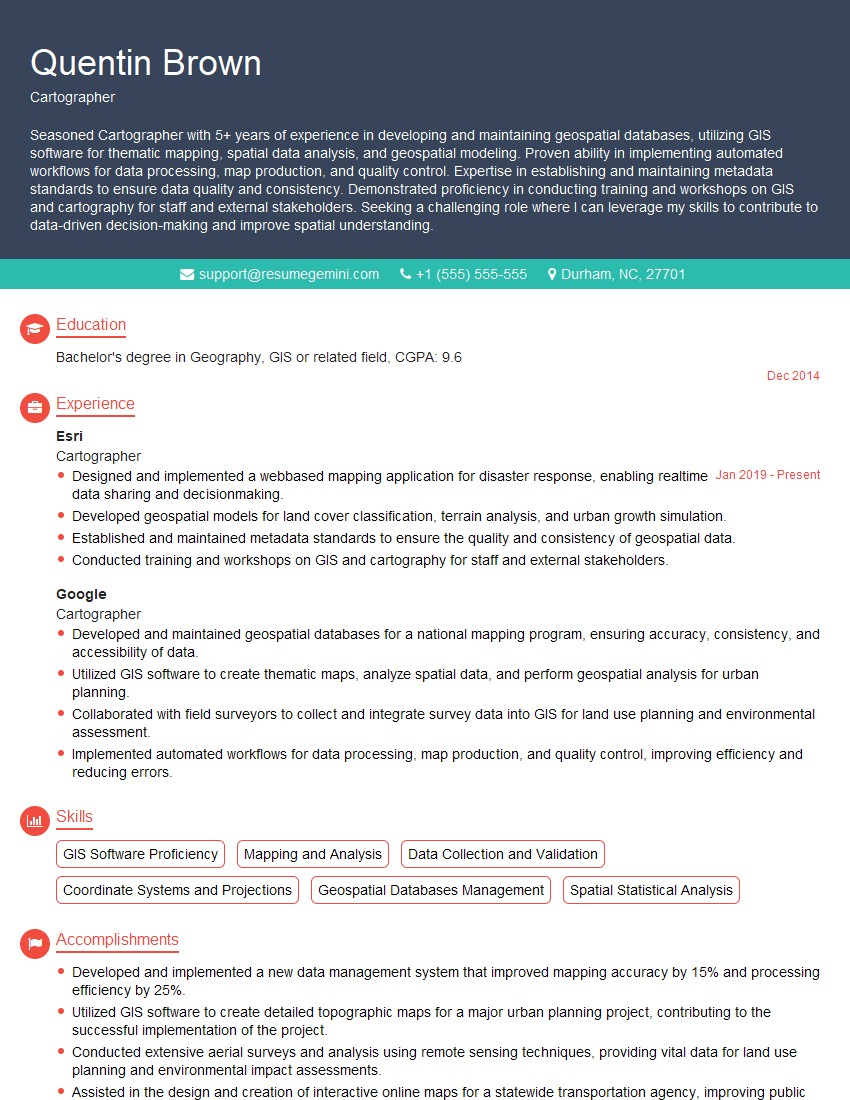
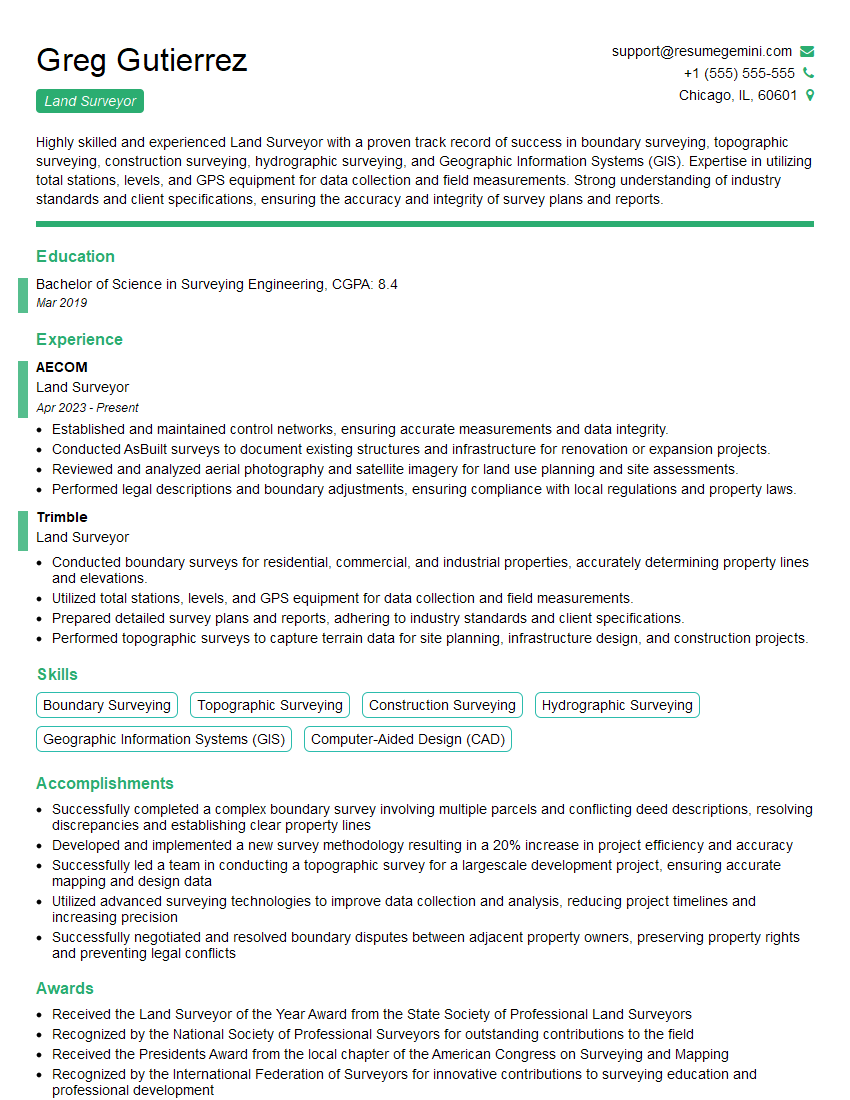
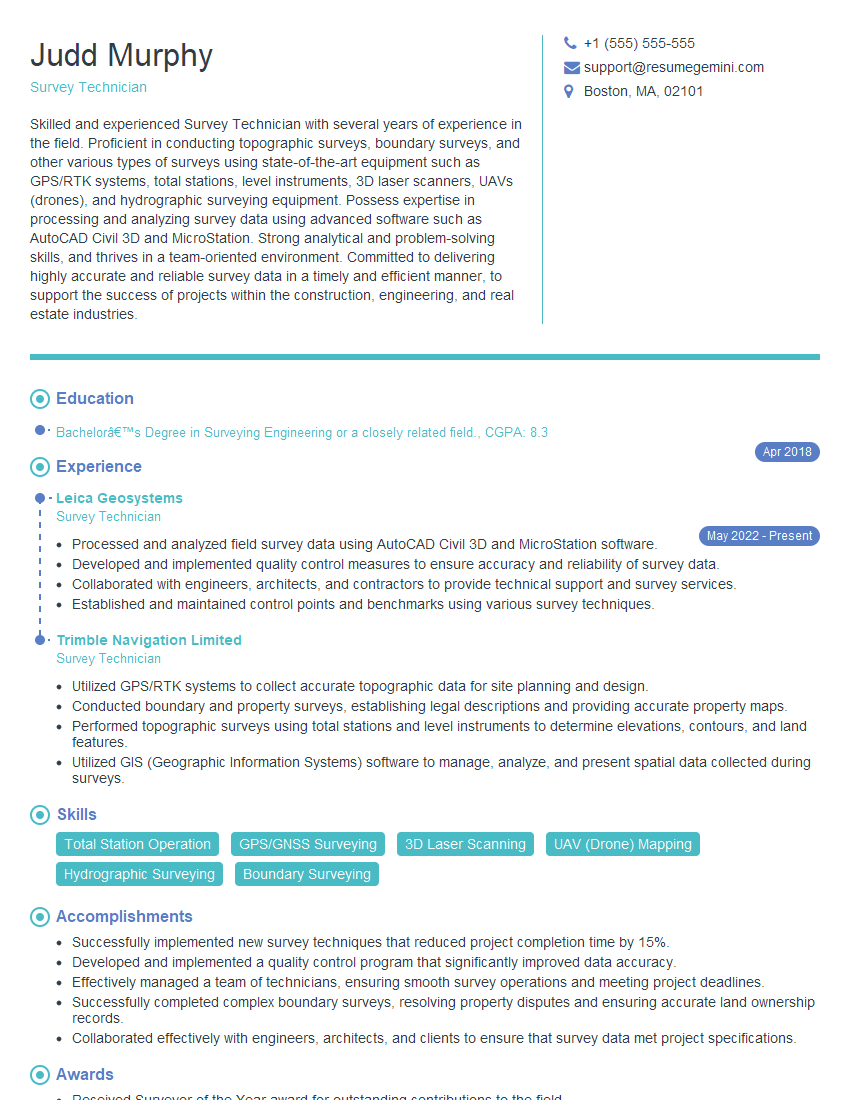
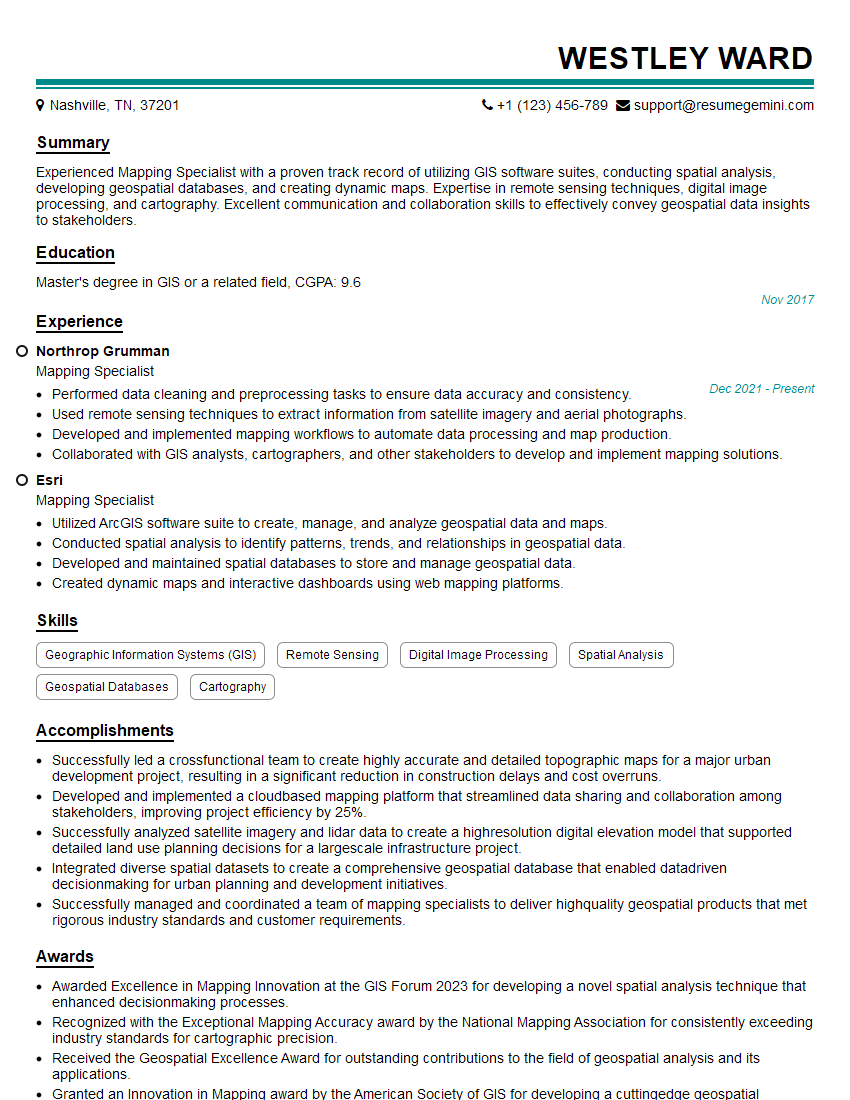
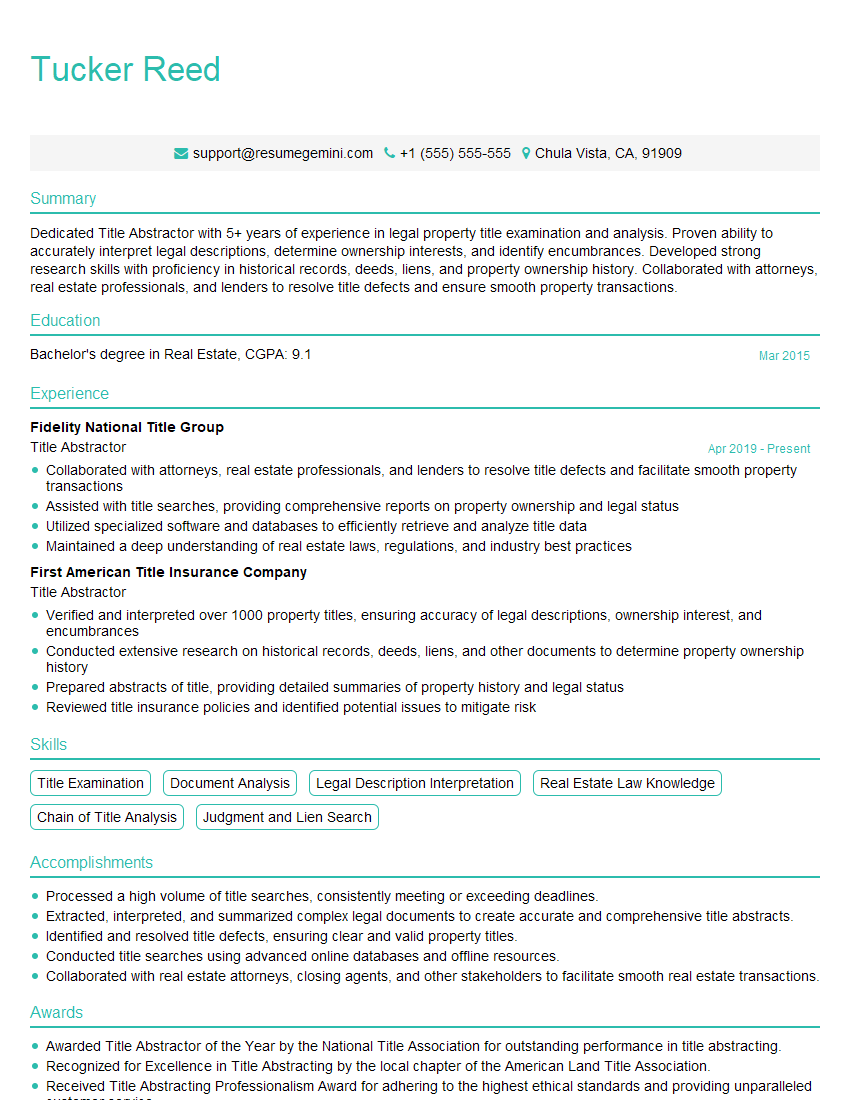
Mastering Title and Boundary Research and Analysis opens doors to exciting career opportunities in land surveying, real estate, and legal fields. It demonstrates a high level of analytical and problem-solving skills, highly valued in today’s competitive job market. To maximize your job prospects, creating an ATS-friendly resume is essential. ResumeGemini is a trusted resource that can help you build a compelling resume that highlights your unique skills and experience. ResumeGemini provides examples of resumes tailored to Title and Boundary Research and Analysis, helping you present your qualifications effectively. Invest the time to build a strong resume – it’s your first impression to potential employers.
Explore more articles
Users Rating of Our Blogs
Share Your Experience
We value your feedback! Please rate our content and share your thoughts (optional).
What Readers Say About Our Blog
Amazing blog
hello,
Our consultant firm based in the USA and our client are interested in your products.
Could you provide your company brochure and respond from your official email id (if different from the current in use), so i can send you the client’s requirement.
Payment before production.
I await your answer.
Regards,
MrSmith
hello,
Our consultant firm based in the USA and our client are interested in your products.
Could you provide your company brochure and respond from your official email id (if different from the current in use), so i can send you the client’s requirement.
Payment before production.
I await your answer.
Regards,
MrSmith
These apartments are so amazing, posting them online would break the algorithm.
https://bit.ly/Lovely2BedsApartmentHudsonYards
Reach out at BENSON@LONDONFOSTER.COM and let’s get started!
Take a look at this stunning 2-bedroom apartment perfectly situated NYC’s coveted Hudson Yards!
https://bit.ly/Lovely2BedsApartmentHudsonYards
Live Rent Free!
https://bit.ly/LiveRentFREE
Interesting Article, I liked the depth of knowledge you’ve shared.
Helpful, thanks for sharing.
Hi, I represent a social media marketing agency and liked your blog
Hi, I represent an SEO company that specialises in getting you AI citations and higher rankings on Google. I’d like to offer you a 100% free SEO audit for your website. Would you be interested?