Interviews are more than just a Q&A session—they’re a chance to prove your worth. This blog dives into essential Affiliate Campaign Analysis interview questions and expert tips to help you align your answers with what hiring managers are looking for. Start preparing to shine!
Questions Asked in Affiliate Campaign Analysis Interview
Q 1. Explain the key performance indicators (KPIs) you use to evaluate the success of an affiliate campaign.
Evaluating the success of an affiliate campaign hinges on tracking the right Key Performance Indicators (KPIs). These metrics provide a clear picture of campaign performance and inform optimization strategies. My approach focuses on a holistic view, combining several crucial KPIs:
- Cost Per Acquisition (CPA): This measures the cost of acquiring a customer through the affiliate channel. A lower CPA indicates higher efficiency. For example, if a CPA is $50, it means it costs $50 to acquire one customer via affiliate marketing. We constantly aim to lower this cost.
- Return on Ad Spend (ROAS): This represents the revenue generated for every dollar spent on the affiliate campaign. A higher ROAS signifies a profitable campaign. An ROAS of 3 means that for every dollar invested, $3 is generated in revenue.
- Conversion Rate: This KPI shows the percentage of visitors or clicks that result in a desired action (e.g., purchase, sign-up). A higher conversion rate signifies a more effective campaign and often indicates improvements in landing page optimization or targeting.
- Click-Through Rate (CTR): This measures the percentage of people who click on an affiliate link compared to the number of people who see it. A higher CTR indicates compelling and relevant ads and a well-targeted audience.
- Customer Lifetime Value (CLTV): This represents the total revenue expected from a single customer over their relationship with the business. High CLTV, even with a higher initial CPA, can indicate long-term profitability.
- Affiliate Partner Performance: We also monitor individual affiliate performance, using metrics like CPA, conversion rate, and revenue generated per affiliate. This enables us to identify top performers and underperforming partners, allowing for targeted optimization.
By analyzing these KPIs together, we get a comprehensive understanding of the campaign’s health and can make data-driven decisions to improve its effectiveness.
Q 2. How do you identify and analyze fraudulent affiliate activity?
Identifying and analyzing fraudulent affiliate activity requires a multi-pronged approach. It’s a crucial aspect of managing affiliate campaigns, as fraudulent activity can significantly impact ROI and brand reputation.
- Monitoring Click Patterns: Unusual spikes in clicks from specific IP addresses, geographic locations, or devices can indicate potential fraud. For instance, a sudden surge in clicks originating from a single IP address or a country not targeted by the campaign would trigger a review.
- Conversion Rate Analysis: An unusually high conversion rate from a single affiliate or a group of affiliates, particularly without commensurate traffic, is a red flag. We examine the source of traffic and engagement to determine the legitimacy of conversions.
- Cookie Stuffing and Spoofing: We employ techniques to identify and prevent cookie stuffing, where affiliates try to artificially inflate conversions by inserting cookies into users’ browsers without genuine engagement. We also look for IP address spoofing attempts.
- Data Validation: Rigorous data validation is crucial. We cross-reference data from different sources, such as affiliate networks, website analytics, and CRM systems, to identify inconsistencies that might hint at fraudulent behavior.
- Affiliate Partner Vetting: Thorough due diligence is carried out before onboarding new affiliates. We carefully review their websites, traffic sources, and past performance to mitigate risks.
When suspicious activity is detected, I investigate further, potentially contacting the affiliate to address concerns. In cases of confirmed fraud, we terminate the partnership immediately and take necessary steps to prevent future occurrences. Regular monitoring and proactive measures are essential to minimize fraudulent activity.
Q 3. Describe your experience with different affiliate marketing models (CPA, CPL, CPS, etc.).
I have extensive experience with various affiliate marketing models. Each model has its unique advantages and disadvantages, and selecting the right model depends on the specific campaign goals and product/service.
- Cost Per Acquisition (CPA): The advertiser pays only when a specific action occurs, such as a sale or lead generation. This model is highly results-oriented. It’s particularly effective for campaigns focused on acquiring new customers. For example, a CPA of $20 means that the advertiser only pays $20 per lead generated.
- Cost Per Lead (CPL): Similar to CPA, but focuses on lead generation. The advertiser pays for each qualified lead generated. This model is best for businesses with a longer sales cycle where nurturing leads is vital.
- Cost Per Sale (CPS): A commission-based model where the advertiser pays a percentage of each sale generated by the affiliate. This model aligns the interests of both the advertiser and the affiliate. This works well for products with high profit margins.
- Pay Per Click (PPC): Affiliates earn a commission for each click on their affiliate link. While simple to implement, it can be less effective if clicks don’t translate into conversions.
- Hybrid Models: Many campaigns utilize hybrid models combining elements of different payment structures, optimizing for various key performance indicators.
My experience involves selecting and negotiating the best model based on the campaign’s goals, market conditions, and the capabilities of the affiliate network and partners. I understand the nuances of each model and can tailor the approach to maximize efficiency and profitability.
Q 4. How do you track and attribute conversions across multiple affiliate channels?
Tracking and attributing conversions across multiple affiliate channels necessitates a robust tracking system. This involves utilizing various tools and techniques to accurately pinpoint the source of each conversion.
- Unique Affiliate Links: Each affiliate receives a unique link with specific tracking parameters. This enables us to identify the precise affiliate who drove the conversion.
Example: www.example.com/?affiliate_id=123 - UTM Parameters: Using UTM parameters in affiliate links allows tracking of campaigns and specific sources within each channel.
Example: www.example.com/?utm_source=affiliate&utm_medium=banner&utm_campaign=summer_sale - Affiliate Network Tracking: Most affiliate networks offer sophisticated tracking solutions, which integrate with our internal analytics systems. This ensures accurate tracking of conversions attributed to each network.
- Data Aggregation and Analysis: Once data is collected, we use tools like Google Analytics and custom dashboards to aggregate and analyze data from all sources. This provides a unified view of performance across various channels.
- Attribution Modeling: We employ appropriate attribution models (e.g., last-click, first-click, linear) to determine the credit for conversions across multiple touchpoints. The choice depends on the campaign goals and customer journey.
Accurate attribution is essential to assess the effectiveness of each affiliate channel and optimize resource allocation. The system provides a transparent view of the contribution of each affiliate and channel, aiding strategic decision-making.
Q 5. What tools and technologies are you proficient in for affiliate campaign analysis (e.g., Google Analytics, Adobe Analytics)?
My affiliate campaign analysis expertise relies on proficiency with various tools and technologies. I’m highly skilled in using the following:
- Google Analytics: Essential for website traffic analysis, conversion tracking, audience segmentation, and identifying traffic sources. I’m adept at configuring Google Analytics to track affiliate marketing campaigns effectively.
- Adobe Analytics: Provides more advanced analytics capabilities, particularly beneficial for large-scale campaigns with complex data requirements. I use it for deep dives into campaign performance, identifying trends, and uncovering insights not readily available in Google Analytics.
- Affiliate Network Platforms: I’m proficient in using various affiliate network platforms, including those from ShareASale, CJ Affiliate, and ClickBank. Each platform has its own interface and reporting features, which I’m well-versed in navigating.
- Data Visualization Tools: I leverage tools like Tableau and Power BI to create visually compelling dashboards and reports that present complex data in an easily understandable format.
- Spreadsheet Software (Excel, Google Sheets): For data manipulation, cleaning, and advanced calculations to uncover insights and correlations.
My skillset allows me to effectively analyze data, generate meaningful reports, and use findings to optimize campaigns and increase ROI.
Q 6. How do you segment affiliate partners for targeted campaign optimization?
Segmenting affiliate partners is vital for targeted campaign optimization. It allows us to tailor messaging and offers to different groups of affiliates based on their audience, performance, and niche.
- Performance-Based Segmentation: Grouping affiliates based on their historical performance, such as CPA, conversion rate, and revenue generated. Top-performing affiliates receive greater support and incentives, while underperforming affiliates undergo performance reviews and coaching.
- Audience-Based Segmentation: Categorizing affiliates based on their audience demographics, interests, and online behavior. This allows us to tailor campaign messaging and offerings to resonate with specific audiences. For example, affiliates with a younger audience might receive campaigns featuring trendy products.
- Niche-Based Segmentation: Grouping affiliates who specialize in specific niches or verticals. This enables us to send relevant products or services to affiliates whose audiences are most likely to be interested.
- Geo-location Segmentation: Targeting affiliates based on their geographic location. This allows tailoring messaging and offers based on regional preferences and cultural nuances.
- Communication Strategy Tailoring: Different communication strategies are implemented for various segments. High-performing affiliates might receive premium support and exclusive deals, while low-performing affiliates might receive tailored guidance and training.
By segmenting affiliate partners, we enhance campaign relevance, improve conversion rates, and foster stronger relationships with key players.
Q 7. Describe your approach to identifying underperforming affiliate partners.
Identifying underperforming affiliate partners is a crucial step in optimizing affiliate marketing campaigns. My approach is systematic and data-driven.
- Regular Performance Monitoring: Consistent monitoring of key metrics like CPA, conversion rate, and revenue generated per affiliate is essential. We set benchmarks and regularly analyze performance against those benchmarks.
- Comparative Analysis: We compare the performance of individual affiliates with each other and against overall campaign averages. This helps identify outliers and pinpoint partners significantly lagging behind.
- Traffic Source Analysis: Examining the quality and source of traffic from each affiliate helps determine if low performance stems from issues like low-quality traffic or lack of targeted audience.
- Communication and Feedback: We regularly communicate with underperforming affiliates, providing constructive feedback and support to address potential issues, whether it is improving their promotional materials or better targeting their audience.
- Data-Driven Decision Making: We use data to inform decisions about whether to optimize underperforming partnerships, provide additional support or resources, or ultimately terminate partnerships that consistently fail to meet expectations.
The goal is not just to identify underperformers but to understand the reasons behind their poor performance and develop strategies to improve outcomes. Sometimes, providing better training or resources is sufficient. However, in cases where performance remains consistently low despite support, it may be necessary to reconsider the partnership.
Q 8. How do you handle discrepancies in reporting between different affiliate networks?
Discrepancies in reporting between affiliate networks are unfortunately common. They stem from differences in tracking methods, cookie durations, and even the definition of a ‘conversion’. My approach is systematic and involves several steps. First, I meticulously examine the reporting methodologies of each network. I look for differences in attribution windows (the timeframe for assigning a sale to a specific click), and how they handle duplicate clicks or conversions. Second, I try to identify common ground. Are there specific campaigns or affiliates where the discrepancy is most pronounced? This helps isolate the source. Third, I cross-reference data with my own server-side tracking whenever possible. This independent data provides a crucial benchmark for comparison and helps identify which network’s reporting is most accurate. If the discrepancies are persistent, I engage directly with the network’s support team, providing detailed data and requesting a reconciliation. Often, this simply involves clarifying differences in reporting definitions. For example, one network might count a lead as a conversion, while another requires a sale. By clarifying these details, I create a more accurate, holistic picture of campaign performance.
Q 9. Explain how you would investigate a sudden drop in affiliate conversion rates.
A sudden drop in conversion rates is like a red flag – it demands immediate investigation. My process is akin to a detective investigation. First, I look at the timing of the drop. Did it coincide with a change in the campaign, such as a new creative, a change in targeting, or a platform update? These could be the culprits. Second, I segment the data. Was the drop across all traffic sources, or is it concentrated in a specific channel, like one affiliate network or a particular geographic region? This helps pinpoint the source of the problem. Third, I analyze website data. Were there any site issues, like increased bounce rates or technical errors around the time the drop occurred? Fourth, I examine the quality of the affiliate traffic. Is the conversion rate down because of a lower-quality audience, or is there a problem with the affiliate links themselves? Using tools like Google Analytics and heatmaps can help with website analysis and user behavior identification. Fifth, I reach out to my top-performing affiliates to discuss any potential issues they’re experiencing. This collaborative approach often yields valuable insights. Sometimes, the answer is simple – a broken link or a change in the landing page. Other times, it may involve deeper investigation of market trends, competitor activity, or seasonal factors. The key is a systematic review of all potential factors and a commitment to quick action.
Q 10. How do you use A/B testing to improve the performance of affiliate campaigns?
A/B testing is crucial for optimizing affiliate campaigns. It allows for controlled experimentation to improve conversion rates. I use A/B testing across several areas. Firstly, on creative assets. This involves testing different banner designs, ad copy, or even the placement of affiliate links. I might test a high-resolution image against a simpler design, or different call-to-actions. Secondly, on landing pages. I test variations in page layout, headline, and calls-to-action to find what resonates best with visitors. Thirdly, on offer pages. I’ll even test small changes within the affiliate offer page. For example, if it’s an e-commerce product, I might test variations in product images or pricing models. The key is to only change one variable at a time. For example, in an A/B test comparing two banner ads, ensure all other aspects of the campaign (targeting, landing page, etc.) remain consistent. I use tools like Optimizely or VWO to conduct these tests, setting a significance level (e.g., 95%) and a sample size to ensure reliable results. The goal isn’t to test everything at once, but to make well-informed iterative improvements based on data.
Q 11. What is your experience with affiliate commission structures and negotiations?
My experience with affiliate commission structures is extensive. I’m familiar with various models, including CPA (Cost Per Acquisition), CPL (Cost Per Lead), CPS (Cost Per Sale), and hybrid models. Understanding the nuances of each is crucial. For example, CPA is ideal when a high conversion rate is expected and payment is tied to achieving that. Negotiating commission structures depends on many factors such as affiliate performance, volume, and exclusivity. I always start by researching industry benchmarks for similar campaigns. I then build a strong case for my proposed commission structure, highlighting the value the campaign brings to the affiliate and to the advertiser. I often present data showing the potential revenue and ROI for both parties, demonstrating the mutual benefit of a fair and collaborative agreement. I also negotiate based on performance. For high-performing affiliates, I might offer tiered commission structures, with higher rates for exceeding targets, promoting loyalty and incentivizing increased effort. It’s a business partnership, and fostering that mindset in negotiations creates stronger, more sustainable relationships.
Q 12. Describe your process for building and maintaining relationships with affiliate partners.
Building and maintaining strong affiliate relationships is paramount. It’s not just about transactions; it’s about building a partnership. I prioritize open communication and transparency. This means regular updates on campaign performance, prompt payment of commissions, and proactive sharing of resources like marketing materials or insights. I also offer personalized support to my affiliates, addressing their concerns, and helping them troubleshoot any issues they encounter. I actively celebrate successes, recognizing and rewarding top performers. This can involve bonuses, early access to new campaigns, or even featured placement on my website. In addition to regular communication, I invest time in personal connection. I attend industry events, engage in online forums, and make a point of reaching out to affiliates on a personal level. By building trust and demonstrating mutual respect, I cultivate long-term partnerships that significantly benefit both parties. This approach goes beyond transactional relationships and builds loyalty, resulting in more consistent and profitable campaigns.
Q 13. How do you measure the ROI of an affiliate marketing campaign?
Measuring ROI in affiliate marketing requires a clear understanding of both costs and revenue. The formula is simple: ROI = (Revenue - Cost) / Cost * 100%. However, accurately determining ‘cost’ and ‘revenue’ requires careful consideration. Costs include affiliate commissions, marketing materials, management fees, and any other expenses related to the campaign. Revenue, of course, is the direct sales generated by the affiliate program. But it’s not just about the monetary value. Other metrics, like customer lifetime value (CLTV) and brand awareness, should also be considered, particularly for long-term strategies. For example, a high-CLTV customer might justify a higher commission cost initially, given the potential for recurring revenue. Ultimately, it’s about evaluating the total value generated by the campaign – both immediate and long-term – against the total investment. Analyzing data from both affiliate networks and internal systems is crucial in developing an accurate ROI picture.
Q 14. How do you interpret and utilize data from affiliate network dashboards?
Affiliate network dashboards are treasure troves of data. My approach to utilizing them is methodical. First, I focus on key metrics like conversion rates, click-through rates (CTR), and cost per acquisition (CPA). These provide a quick snapshot of campaign health. Second, I drill down into specific campaign segments. I analyze data by geography, device, traffic source, and even time of day. This granular view reveals patterns and opportunities for optimization. Third, I pay attention to trends. Are conversion rates increasing or decreasing? Is there a particular affiliate that consistently outperforms others? Understanding trends allows for proactive adjustments. Fourth, I use the data to inform decisions. Should I adjust bidding strategies, switch creative assets, or allocate budget to high-performing affiliates? The dashboard isn’t just for observation; it’s for action. Finally, I always compare data across different networks, looking for anomalies or patterns that might point to potential issues in tracking or reporting. Remember to always consider the limitations of the data provided; it’s a snapshot in time, and should be used in conjunction with other data sources to create the most accurate picture of campaign performance.
Q 15. How do you stay updated on the latest trends and best practices in affiliate marketing?
Staying ahead in affiliate marketing requires a multi-pronged approach. I consistently monitor industry publications like Affiliate Marketing World, Awin’s blog, and similar resources for the latest trends and best practices. I actively participate in relevant online communities and forums, engaging in discussions with other professionals and learning from their experiences. Attending webinars and conferences is another crucial element, providing opportunities to network with experts and gain firsthand insights into innovative strategies. Finally, I conduct regular competitive analysis, studying successful campaigns to identify key takeaways and adapt them to my own strategies. For instance, recently I noticed a surge in the use of influencer marketing within affiliate campaigns, which led me to incorporate this strategy in a recent project, resulting in a significant boost in conversion rates.
Career Expert Tips:
- Ace those interviews! Prepare effectively by reviewing the Top 50 Most Common Interview Questions on ResumeGemini.
- Navigate your job search with confidence! Explore a wide range of Career Tips on ResumeGemini. Learn about common challenges and recommendations to overcome them.
- Craft the perfect resume! Master the Art of Resume Writing with ResumeGemini’s guide. Showcase your unique qualifications and achievements effectively.
- Don’t miss out on holiday savings! Build your dream resume with ResumeGemini’s ATS optimized templates.
Q 16. Describe your experience with affiliate program compliance and regulations.
Compliance is paramount in affiliate marketing. My experience encompasses a deep understanding of FTC regulations concerning disclosures, GDPR implications for data privacy, and other relevant legal frameworks. I have a proven track record of ensuring all affiliate campaigns adhere to these regulations. This involves meticulously reviewing affiliate program terms and conditions, implementing clear and transparent disclosure practices within promotional materials, and ensuring all data handling aligns with privacy laws. For example, in a past campaign, I meticulously tracked and documented all data processing activities to ensure full compliance with GDPR, thus avoiding potential legal issues and maintaining the integrity of our brand partnerships.
Q 17. How do you identify and leverage the strengths of different affiliate partners?
Identifying and leveraging affiliate partner strengths is crucial for campaign success. My approach involves a thorough evaluation process. I analyze each partner’s audience demographics, their engagement metrics (e.g., website traffic, social media reach), their content quality and style, and their past performance. For example, a partner with a highly engaged audience on Instagram might be ideal for a visually-driven product. Another with a blog focused on detailed product reviews might be better suited for a product that benefits from in-depth explanations. I then tailor communication strategies, provide customized creative assets, and offer training to maximize their potential. This personalized approach fosters strong partnerships and leads to better campaign outcomes.
Q 18. Explain your experience with different affiliate marketing platforms and software.
I’m proficient in using various affiliate marketing platforms and software. My experience ranges from large-scale networks like CJ Affiliate and ShareASale to smaller, niche platforms. I’m comfortable with tracking and analytics tools such as Google Analytics, Adobe Analytics, and various affiliate tracking software like Impact Radius and HasOffers. I understand how to effectively leverage these platforms to monitor campaign performance, track conversions, and manage affiliate relationships. The choice of platform depends heavily on the campaign’s specific needs and the type of affiliate partners involved. For instance, a large-scale campaign might benefit from a robust platform like CJ Affiliate, while a smaller, niche campaign could use a more streamlined platform.
Q 19. How do you handle budget allocation for different affiliate channels?
Budget allocation requires a data-driven approach. I start by analyzing historical campaign data, identifying high-performing channels and partners. I also consider factors such as the cost per acquisition (CPA) for each channel, potential return on investment (ROI), and the target audience of each channel. For instance, if data shows a high ROI from influencer marketing on TikTok, I might allocate a larger portion of the budget to that channel compared to a less effective channel, such as a generic banner ad network. The process often involves iterative adjustments based on ongoing performance monitoring. This ensures that resources are utilized efficiently and allocated to the channels that deliver the best results.
Q 20. How do you use data to inform strategic decisions in affiliate marketing?
Data is the cornerstone of strategic decision-making in affiliate marketing. I utilize various data points, including click-through rates (CTR), conversion rates, CPA, ROI, and customer acquisition cost (CAC) from various tracking platforms. I use this data to identify trends, pinpoint underperforming areas, and optimize campaigns in real-time. For example, if the CTR for a specific creative asset is low, I might A/B test different versions to improve its performance. Regular reporting and dashboards are crucial for visualizing this data and communicating insights to stakeholders. This enables me to make data-driven adjustments, maximizing campaign effectiveness and ensuring that budget investments are strategically aligned.
Q 21. What is your experience with fraud detection in affiliate marketing?
Fraud detection is a critical aspect of affiliate marketing. My approach involves a multi-layered strategy. This begins with careful partner selection and due diligence; I check for a history of suspicious activities. I also utilize fraud detection tools integrated into affiliate networks and tracking platforms, which often flag anomalies such as unusual click patterns or high volumes of invalid traffic. I continuously monitor key metrics for inconsistencies, such as unusually high conversion rates or an imbalance between clicks and conversions. Finally, I regularly review affiliate reports for inconsistencies and take appropriate action to investigate any suspicious activity, perhaps even resorting to manual review of transaction logs. Proactive fraud detection is essential for maintaining campaign integrity and protecting the advertiser’s investment.
Q 22. Explain your understanding of attribution modeling in affiliate marketing.
Attribution modeling in affiliate marketing is the process of assigning credit for a conversion (e.g., a sale or signup) to the various touchpoints a customer interacts with before completing the desired action. It’s crucial because multiple affiliates might influence a single customer’s journey, and accurately determining which affiliate deserves credit impacts payment and campaign optimization.
Several models exist, each with its strengths and weaknesses:
- Last-Click Attribution: This simple model credits the last affiliate a customer interacted with before converting. While easy to understand, it ignores the influence of prior affiliates.
- First-Click Attribution: This model assigns all credit to the first affiliate a customer interacts with. It’s useful for understanding initial brand awareness but overlooks subsequent interactions.
- Linear Attribution: This model distributes credit equally among all affiliates involved in the conversion path. It provides a more balanced view but might not reflect the true impact of each affiliate.
- Time-Decay Attribution: This model gives more weight to affiliates closer to the conversion, gradually reducing credit for earlier touchpoints. It recognizes the recency bias in customer decisions.
- Position-Based Attribution: This assigns greater weight to the first and last click, acknowledging their significant roles in the conversion process.
Choosing the right model depends on your specific campaign goals and data. For example, if you are focused on building brand awareness, first-click might be appropriate. If driving immediate sales is your priority, last-click or time-decay models would be better suited. Sophisticated models like algorithmic attribution use machine learning to dynamically allocate credit based on various factors. Careful analysis and experimentation are key to selecting and refining the optimal model.
Q 23. How do you optimize affiliate campaigns for different devices and platforms?
Optimizing affiliate campaigns across different devices and platforms requires a multi-pronged approach that considers user behavior and platform-specific capabilities.
- Responsive Design: Ensure your affiliate’s creatives (banners, landing pages) are responsive, adapting seamlessly to different screen sizes and resolutions. A poorly optimized mobile experience can significantly hinder conversion rates.
- Platform-Specific Strategies: Tailor your messaging and creative assets to suit each platform. What works on Instagram might not be effective on Facebook or YouTube. For instance, short-form video content might perform well on TikTok, while detailed blog posts are better suited for platforms like LinkedIn.
- Device-Specific Targeting: Use tracking mechanisms to identify the devices your target audience predominantly uses and optimize campaigns accordingly. You might adjust bidding strategies or utilize different creative assets based on device type (mobile, desktop, tablet).
- Deep Linking: Utilize deep linking to direct users directly to relevant product pages on your website, based on the device and affiliate source. This improves the user experience and conversion rate.
- A/B Testing: Conduct rigorous A/B testing across different devices and platforms to compare the performance of various creative assets and messaging. Track key metrics like click-through rate (CTR) and conversion rate to identify what resonates best with each audience segment.
For instance, if you notice significantly lower conversion rates on mobile, you might need to improve the mobile user interface, simplify the checkout process, or implement a more streamlined mobile landing page experience.
Q 24. Describe a time when you identified and solved a problem related to an affiliate campaign.
In a previous campaign promoting a subscription service, we noticed a significant drop in conversions from a particular affiliate. Initial analysis showed no obvious issues with the affiliate’s traffic source. However, after deeper investigation, we discovered that the affiliate’s landing page contained outdated pricing information. This mismatched information was confusing potential customers, leading to abandoned subscriptions.
To solve the problem, we implemented a two-pronged approach:
- Immediate Correction: We promptly contacted the affiliate and worked with them to update their landing page with the correct pricing information.
- Proactive Monitoring: We established a more robust system for monitoring affiliate landing page content, regularly checking for consistency and accuracy. This involved automated checks alongside scheduled manual reviews, ensuring real-time updates.
Following these steps, conversions from that affiliate rebounded significantly within a week. This highlighted the importance of proactive monitoring and communication to identify and resolve issues affecting campaign performance quickly.
Q 25. How do you measure the effectiveness of different affiliate marketing strategies?
Measuring the effectiveness of different affiliate marketing strategies requires tracking key performance indicators (KPIs) across various stages of the customer journey.
- Click-Through Rate (CTR): This measures the percentage of users who click on an affiliate’s link. A higher CTR indicates more engaging content or effective targeting.
- Conversion Rate: This shows the percentage of clicks that result in a desired action (purchase, signup, etc.). A high conversion rate demonstrates effective landing pages and compelling offers.
- Cost Per Acquisition (CPA): This represents the cost incurred for each conversion. A lower CPA suggests a more cost-effective affiliate strategy.
- Return on Ad Spend (ROAS): This reflects the revenue generated for every dollar spent on the campaign. A higher ROAS indicates a profitable strategy.
- Customer Lifetime Value (CLTV): This measures the total revenue generated from a single customer over their entire relationship with the business. This metric helps assess the long-term value of affiliate acquisitions.
- Affiliate Performance Metrics: Track individual affiliate performance using KPIs like commission earned, conversion rates, and traffic volume to identify top performers and underperforming affiliates.
Utilizing these KPIs allows us to compare and contrast the effectiveness of various affiliate strategies, such as different affiliate types (influencers, content creators, coupon sites), promotional methods (email marketing, social media, content marketing), and payment models (CPA, CPC, revenue share).
Q 26. What are some common challenges faced in affiliate campaign analysis, and how do you overcome them?
Common challenges in affiliate campaign analysis include:
- Data Silos: Affiliate data might be scattered across multiple platforms, making comprehensive analysis difficult. We overcome this by integrating data from different sources into a central data warehouse.
- Data Inconsistency: Different affiliates may use different tracking methods or report data differently, leading to inaccuracies. We implement standardized tracking protocols and regular data validation checks.
- Attribution Complexity: Determining which affiliate deserves credit for a conversion can be complex, particularly with multiple touchpoints. Employing sophisticated attribution models helps to address this.
- Fraudulent Activity: Some affiliates might engage in fraudulent activities, such as click spamming or cookie stuffing. Robust fraud detection systems and regular audits help mitigate these risks.
- Lack of Transparency: Some affiliates might lack transparency in their reporting processes. Building strong relationships with affiliates and employing clear reporting protocols helps address this.
Solutions often involve implementing a robust data management system, using advanced analytics tools, and fostering strong relationships with affiliates to ensure data accuracy and consistent reporting.
Q 27. How do you ensure data accuracy and integrity in your affiliate campaign analysis?
Ensuring data accuracy and integrity is paramount. We use a multi-faceted approach:
- Standardized Tracking: Implementing consistent tracking methods across all affiliate channels, using a single, reliable tracking platform, reduces inconsistencies.
- Data Validation: Regularly validating data against known sources and conducting cross-checks to identify and correct discrepancies.
- Fraud Detection Systems: Employing sophisticated systems that detect and flag suspicious activities like click spamming and cookie stuffing.
- Regular Audits: Conducting periodic audits of affiliate data to verify accuracy and identify potential issues.
- Data Governance Policies: Establishing clear policies that govern data collection, storage, and usage, ensuring consistency and compliance.
- Secure Data Storage: Storing data in secure environments, with appropriate access controls, protects data integrity and confidentiality.
These measures help ensure that the insights derived from the analysis are reliable and can inform effective decision-making.
Q 28. Describe your approach to presenting affiliate campaign performance data to stakeholders.
Presenting affiliate campaign performance data requires a clear, concise, and visually engaging approach tailored to the audience’s understanding. I typically use a combination of techniques:
- Clear Visualizations: Employing charts, graphs, and dashboards to effectively communicate key findings. Data visualization tools help simplify complex datasets and make key trends easily identifiable.
- Key Metrics Focus: Highlighting the most crucial KPIs, such as ROAS, CPA, and conversion rates, that are relevant to the stakeholders’ objectives.
- Comparative Analysis: Presenting data in a comparative manner, showing the performance of different affiliates, strategies, or platforms. This allows for better identification of successful and underperforming areas.
- Storytelling Approach: Instead of simply presenting numbers, narrating a story around the data, highlighting significant achievements and challenges. This makes the data more relatable and easier to comprehend.
- Actionable Insights: Providing actionable recommendations based on the analysis, suggesting specific improvements or strategies for optimization.
- Interactive Dashboards: If possible, utilize interactive dashboards that allow stakeholders to explore the data at their own pace and drill down into specific areas of interest.
The goal is to create a presentation that is not only informative but also persuasive, inspiring confidence in the data and the resulting recommendations.
Key Topics to Learn for Affiliate Campaign Analysis Interview
- Understanding Key Performance Indicators (KPIs): Learn to identify and interpret essential metrics such as CPA, ROI, conversion rates, click-through rates, and customer lifetime value (CLTV) within the context of affiliate marketing.
- Data Analysis & Reporting: Master the practical application of analyzing data from various sources (e.g., affiliate platforms, Google Analytics) to identify trends, pinpoint areas for improvement, and make data-driven decisions regarding campaign optimization.
- Affiliate Network Management: Understand the dynamics of working with different affiliate networks, negotiating agreements, and managing relationships with affiliates to maximize campaign performance.
- Attribution Modeling: Grasp various attribution models (last-click, first-click, linear, etc.) and their impact on campaign analysis. Be prepared to discuss the strengths and weaknesses of each and how to choose the most appropriate model for a given situation.
- Fraud Detection & Prevention: Learn to recognize and mitigate common affiliate marketing fraud techniques, ensuring data accuracy and campaign integrity.
- Campaign Optimization Strategies: Explore various strategies for optimizing affiliate campaigns, including A/B testing, targeting adjustments, creative optimization, and budget allocation.
- Technology & Tools: Familiarize yourself with common affiliate marketing platforms, analytics tools, and reporting dashboards used for campaign analysis.
- Return on Investment (ROI) Analysis and Reporting: Develop the ability to accurately calculate and report on ROI, demonstrating a clear understanding of campaign profitability and effectiveness.
Next Steps
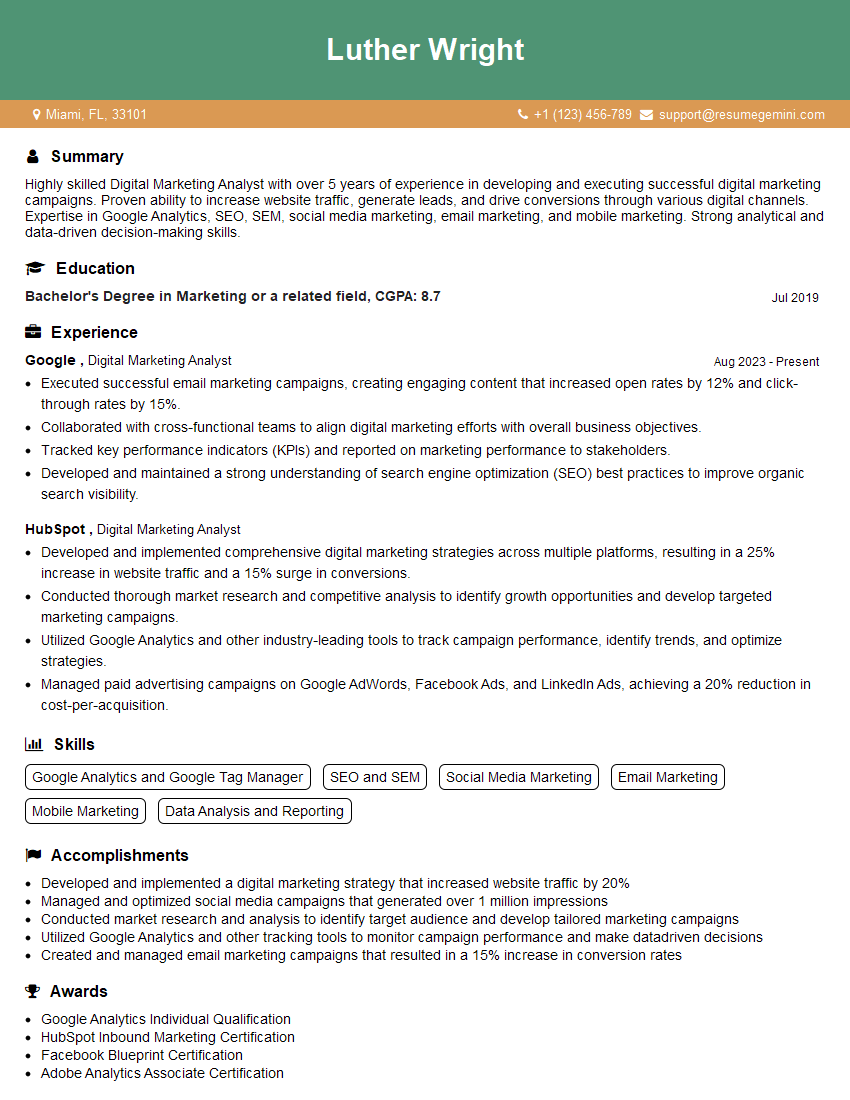
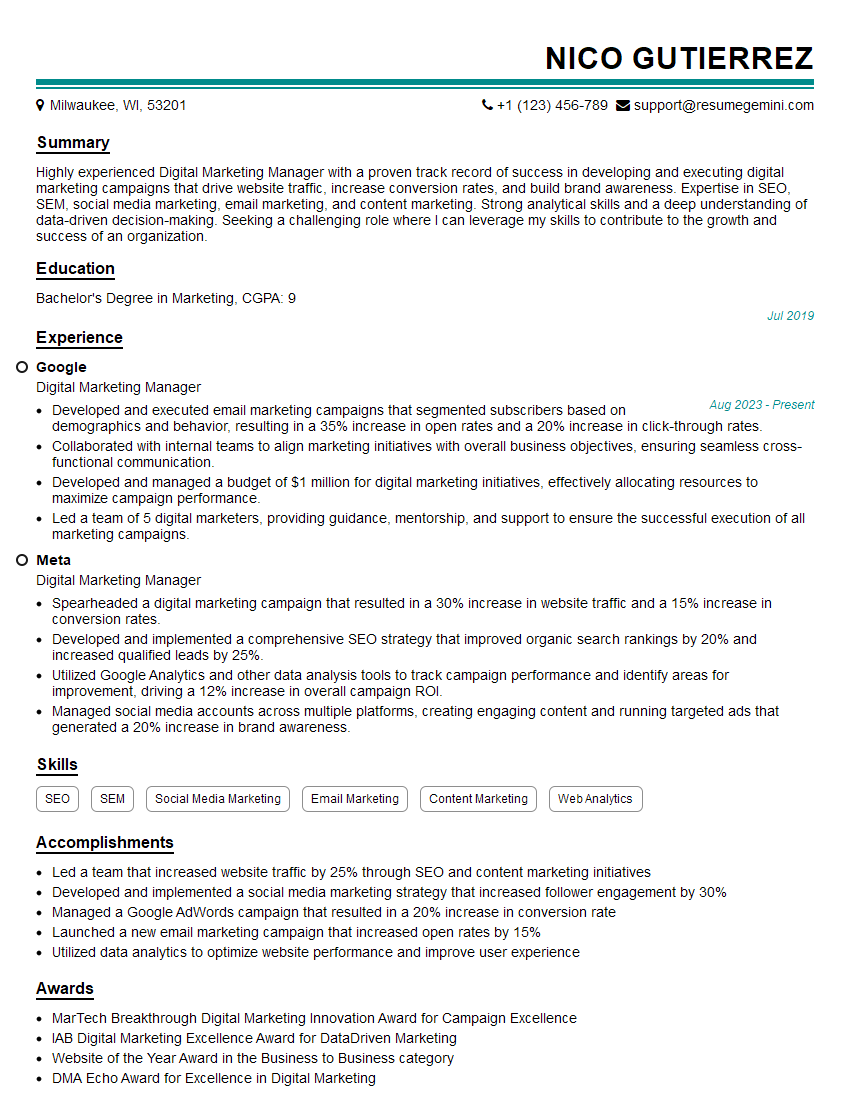
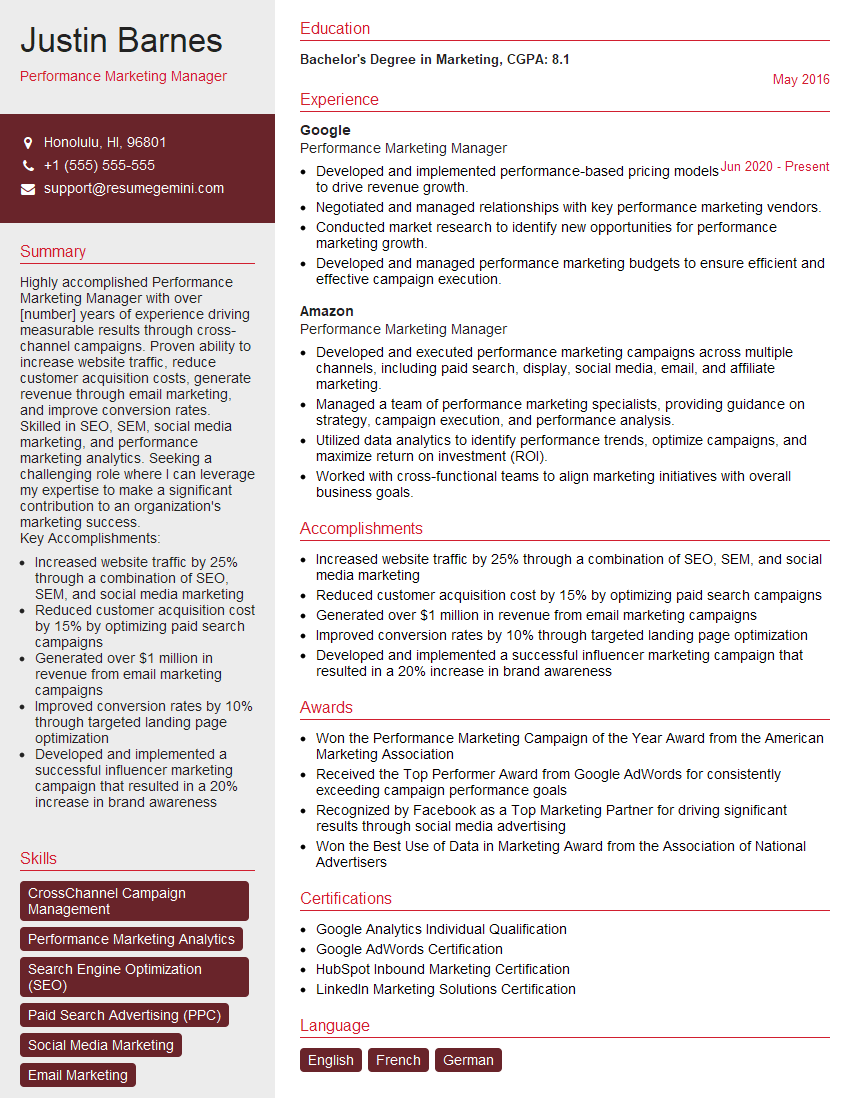
Mastering Affiliate Campaign Analysis is crucial for career advancement in the dynamic digital marketing landscape. It demonstrates a valuable skill set highly sought after by employers. To significantly increase your job prospects, creating a strong, ATS-friendly resume is essential. ResumeGemini can help you build a professional and impactful resume that highlights your skills and experience effectively. Examples of resumes tailored to Affiliate Campaign Analysis are available through ResumeGemini to guide you in showcasing your expertise. Invest time in crafting a compelling resume; it’s your first impression on potential employers.
Explore more articles
Users Rating of Our Blogs
Share Your Experience
We value your feedback! Please rate our content and share your thoughts (optional).
What Readers Say About Our Blog
Amazing blog
Interesting Article, I liked the depth of knowledge you’ve shared.
Helpful, thanks for sharing.