Every successful interview starts with knowing what to expect. In this blog, we’ll take you through the top Applying stains and finishes interview questions, breaking them down with expert tips to help you deliver impactful answers. Step into your next interview fully prepared and ready to succeed.
Questions Asked in Applying stains and finishes Interview
Q 1. Explain the difference between a stain and a paint.
The key difference between stain and paint lies in their function and how they interact with the wood. Stain penetrates the wood’s pores, enhancing the natural grain and color while allowing the wood texture to remain visible. Think of it like dyeing fabric – the color is absorbed, not just sitting on the surface. Paint, on the other hand, forms a solid opaque layer on top of the wood, completely concealing the grain and texture. It’s like covering the wood with a film. A stained piece of furniture will still show the wood’s character, while a painted piece will look uniformly colored, regardless of the wood type.
For example, if you want to highlight the beautiful grain of a cherry wood table, you would use a stain. If you want to completely change the color and hide the wood’s texture – say, to paint a pine board bright red – then paint is the better choice.
Q 2. Describe the process of preparing wood for staining.
Preparing wood for staining is crucial for achieving a beautiful and even finish. It’s a multi-step process that ensures the stain penetrates uniformly and lasts. First, you must clean the wood thoroughly. This could involve removing dust, dirt, or any previous finishes with a suitable cleaner or sander. Then, you need to sand the wood to create a smooth surface. This helps the stain absorb evenly and prevents blotchiness. Start with a coarser grit sandpaper (like 80-grit) to remove imperfections and gradually move to finer grits (120-grit or higher) to achieve a smooth finish. After sanding, it’s vital to remove all sanding dust with a tack cloth or vacuum. Leaving any dust behind can cause an uneven finish. Finally, pre-conditioning the wood, especially with porous woods like pine, can help prevent blotchiness by creating an even base for the stain to absorb.
Q 3. What are the different types of wood stains available?
There’s a wide variety of wood stains available, each with its own characteristics. Oil-based stains penetrate deeply, offering rich color and durability, but they take longer to dry and require more ventilation. Water-based stains are easier to clean up, dry faster, and have less odor, making them a popular choice. They often have less penetrating power than oil-based stains, however. Gel stains are thicker than oil or water-based stains, making them ideal for vertical surfaces, as they don’t run or drip as easily. They also offer excellent hiding power to cover blemishes. NGR (No Grain Raise) stains are specifically designed to minimize grain raising which is the swelling of wood fibers when exposed to moisture. This is helpful for surfaces that need a super smooth finish. Finally, pigmented stains contain pigments that offer greater color opacity, while dye stains provide transparent color penetration for more subtle changes to the wood’s tone.
Q 4. How do you achieve a consistent stain application?
Achieving a consistent stain application requires careful preparation and technique. Start by applying thin, even coats using a high-quality brush, rag, or sprayer, working with the grain of the wood. Avoid over-applying stain, as this can lead to blotchiness and uneven absorption. Allow sufficient drying time between coats, as specified by the manufacturer. For large projects, work in manageable sections to prevent the stain from drying before you can apply a consistent coat. Always test your stain on a scrap piece of the same wood to check the color and absorption rate before applying it to your project. Using a pre-stain conditioner can also greatly assist in preventing inconsistent absorption, particularly in woods that are very porous or have a lot of variation in density. For a perfectly even application, particularly on larger projects, an HVLP (High Volume Low Pressure) sprayer can be a game-changer.
Q 5. What are the common issues encountered during staining, and how do you address them?
Common issues encountered during staining include blotchiness, uneven color, and raised grain. Blotchiness often results from uneven wood absorption or insufficient preparation. Addressing this involves pre-conditioning, careful application, and using appropriate stain. Uneven color can be caused by varying wood densities or insufficient sanding. Ensure the wood is properly sanded and pre-conditioned. Raised grain occurs when wood fibers swell due to moisture in the stain. Mitigation involves sanding the wood lightly after the stain dries and before applying a topcoat. Another common problem is dust nibs, tiny particles of dust embedded in the wet stain. This is why meticulous cleaning is crucial before applying stain. If any problems occur, lightly sanding before applying additional coats can often remedy the issue.
Q 6. Explain the importance of proper ventilation when applying stains and finishes.
Proper ventilation is paramount when applying stains and finishes due to the presence of volatile organic compounds (VOCs). These chemicals, found in many stains and finishes, can release harmful fumes that can cause respiratory irritation, headaches, and other health problems. Adequate ventilation, such as opening windows and doors or using exhaust fans, removes these fumes and creates a safer working environment. Always refer to the manufacturer’s safety data sheet (SDS) for specific ventilation recommendations and wear appropriate personal protective equipment (PPE), including respirators. In a professional setting, working in well-ventilated booths or spaces specifically designed for this purpose is essential. Never underestimate the importance of a clean and well-ventilated working area, particularly in closed spaces.
Q 7. Describe your experience with different types of wood sealers.
My experience encompasses a wide range of wood sealers, including polyurethane, varnish, shellac, and lacquer. Polyurethane is a very popular choice due to its durability and water resistance. It’s available in both oil-based and water-based formulations. Varnish is similar to polyurethane, but typically offers a slightly more glossy finish. Shellac is a natural resin-based sealer that provides a beautiful, warm finish, though it’s less durable than polyurethane. Finally, lacquer dries extremely fast, offering a very hard, durable finish, but it requires more skill to apply properly. The choice of sealer depends largely on the project’s requirements, the desired finish, and the type of wood being treated. For instance, if I am working on a highly used kitchen countertop I would lean towards a durable polyurethane, while for a delicate antique I might opt for shellac to preserve the wood’s character.
Q 8. How do you choose the right finish for a particular wood type and application?
Choosing the right finish depends on several factors: the wood type’s porosity, the desired aesthetic, and the intended use of the finished piece. For example, open-grained woods like oak benefit from a finish that accentuates their texture, like a penetrating oil or a varnish that allows the grain to show through. Close-grained woods like maple might be better suited to a smooth, even finish like lacquer or shellac. Consider the piece’s function too: a kitchen table requires a durable finish that can withstand scratches and spills, whereas a delicate jewelry box might only need a protective clear coat. Finally, the desired look plays a significant role: a satin finish offers a subtle sheen, while a high-gloss finish creates a dramatic, reflective surface.
Examples:
- Oak: Penetrating oil, polyurethane varnish, tung oil.
- Maple: Lacquer, shellac, polyurethane.
- Pine: Polyurethane, paint (for increased durability).
Choosing the wrong finish can lead to issues like uneven absorption, poor durability, or an undesirable aesthetic. Thorough research and testing on a sample piece are always recommended before committing to a finish for a larger project.
Q 9. What safety precautions do you follow when working with stains and finishes?
Safety is paramount when working with stains and finishes. This means always working in a well-ventilated area, ideally outdoors or with proper respiratory protection like an approved respirator. Eye protection, such as safety glasses, is also crucial to prevent splashes from getting into your eyes. Wearing gloves is essential to protect your skin from harsh chemicals and solvents. Proper clothing, covering as much skin as possible, is recommended. Finally, always read and follow the manufacturer’s instructions meticulously, paying close attention to warnings and safety precautions. I always ensure adequate cleanup of spills and dispose of waste materials responsibly according to local regulations. I’ve had instances where a lack of ventilation led to headaches and dizziness, reinforcing the critical importance of safety precautions.
Q 10. Explain the process of applying a clear coat finish.
Applying a clear coat finish involves several steps. First, the wood must be properly prepared – sanded smooth to remove any imperfections and cleaned to remove dust. The type of sanding (e.g., fine grit sandpaper) will depend on the desired smoothness. Next, choose the right clear coat finish; polyurethane is popular due to its durability. Applying thin, even coats is key to prevent runs and drips. I usually apply 2-3 coats, allowing each coat to dry thoroughly before applying the next. A light sanding with fine grit sandpaper between coats can help to create a smooth surface. The drying time will vary depending on the finish type and environmental conditions. For example, polyurethane can take several hours to dry per coat in optimal conditions. Once completely dry, the surface is ready for use.
Process summary:
- Prepare the wood surface (sanding, cleaning)
- Apply first coat of clear finish (thin and even)
- Allow to dry completely
- Lightly sand between coats (optional, depending on the finish and desired smoothness)
- Repeat steps 2-3 for subsequent coats
- Final inspection and clean up
Q 11. How do you troubleshoot uneven staining?
Uneven staining is a common problem, often caused by variations in the wood’s porosity, insufficient preparation, or inconsistent application. Troubleshooting involves identifying the cause and addressing it. For example, if the wood is too dry, a pre-stain wood conditioner can help even out the absorption. If the stain was applied unevenly, it may require sanding and re-application. Sometimes the wood itself has inconsistencies; in that case, careful preparation and multiple thin coats are necessary. In some cases, the wood’s natural grain can lead to uneven absorption, which is sometimes difficult to prevent completely. I once encountered uneven staining on a cherry table, due to differences in wood density. Using a conditioner before the stain and meticulously applying thin coats solved the problem.
Troubleshooting Steps:
- Identify the cause (wood porosity, application technique, wood preparation).
- Address the cause (pre-stain conditioner, re-application, sanding).
- Apply more coats if necessary to achieve a uniform color.
- Consider using a stain blocking agent for particularly problematic areas
Q 12. Describe your experience with spray finishing techniques.
Spray finishing offers a superior finish compared to brush or rag application, resulting in a smooth, even surface. However, it requires specialized equipment and a controlled environment. I have extensive experience with HVLP (High Volume Low Pressure) spray systems, which provide excellent atomization and minimize overspray, resulting in less material waste and a cleaner finish. Preparation is key in spray finishing; proper masking and surface preparation are essential to avoid overspray and ensure a professional-looking finish. Safety is especially important with spray finishing due to the inhalation risk of airborne particles and solvents. Therefore, I always use respiratory protection and work in a well-ventilated area or spray booth.
Advantages of Spray Finishing:
- Even application
- Smooth finish
- Faster application (for large projects)
- Minimal brush strokes
Q 13. How do you match a stain to an existing finish?
Matching a stain to an existing finish can be challenging. It requires careful observation and testing. I start by assessing the existing finish’s color, sheen, and overall appearance under different lighting conditions. Then, I select potential stain colors from a reputable brand and test them on a small, inconspicuous area of the wood. It’s often impossible to achieve a perfect match due to the natural variation in wood and aging of the finish, but I always try to get as close as possible. Mixing stains to achieve the required color is a skill often needed in these situations. Multiple thin coats often help achieve a closer match. If the existing finish is severely damaged, a complete refinishing might be necessary.
Q 14. What are the different types of brushes and applicators you have used?
My experience encompasses a wide range of brushes and applicators, each suited for specific applications and finishes. For staining, I frequently use natural bristle brushes for their ability to hold and distribute stain evenly, especially on larger surfaces. For finer work or detailed areas, I prefer synthetic bristle brushes that offer better control and prevent excess stain buildup. For applying clear coats, foam brushes can provide a smooth, even finish, minimizing brush marks, while a high-quality synthetic brush is also suitable. For larger projects or spray finishing, I utilize HVLP spray guns. I also utilize rags for applying penetrating oils and wiping off excess stain.
Types of Brushes and Applicators:
- Natural bristle brushes
- Synthetic bristle brushes
- Foam brushes
- Rags
- HVLP Spray Guns
Q 15. How do you clean and maintain your finishing equipment?
Maintaining finishing equipment is crucial for achieving a high-quality finish and prolonging the lifespan of your tools. My cleaning process is meticulous and varies slightly depending on the equipment, but generally involves these steps:
- Spray Guns: Immediately after use, I thoroughly clean my spray guns with the appropriate solvent for the finish used (e.g., lacquer thinner for lacquer, mineral spirits for oil-based polyurethane). I disassemble the gun, paying close attention to the nozzle and air cap, and use a brush to remove any residual finish. I then run a cleaning solvent through the gun several times, followed by a final rinse with a thinner or suitable cleaner to prevent residue buildup. Finally, I reassemble and lightly lubricate moving parts.
- HVLP Systems: Similar to spray guns, I clean the HVLP system immediately after use, focusing on the filter and the air passages. A regular compressed air blast helps clear debris, followed by careful wiping with a clean lint-free cloth. The filter should be replaced regularly, and any internal components should be disassembled, cleaned, and dried meticulously.
- Other Equipment: For brushes and rollers, I clean them immediately with the appropriate solvent and then wash thoroughly with soap and water. I ensure they are completely dry before storage to prevent damage or mildew growth. Sanding blocks and abrasives are cleaned by removing any dust using compressed air or a brush. I also replace worn sandpaper regularly.
Regular maintenance, including lubrication of moving parts and careful storage, minimizes wear and tear, ensuring consistent performance and preventing costly repairs or replacements. Think of it like taking care of a fine instrument – the better you maintain it, the better it performs.
Career Expert Tips:
- Ace those interviews! Prepare effectively by reviewing the Top 50 Most Common Interview Questions on ResumeGemini.
- Navigate your job search with confidence! Explore a wide range of Career Tips on ResumeGemini. Learn about common challenges and recommendations to overcome them.
- Craft the perfect resume! Master the Art of Resume Writing with ResumeGemini’s guide. Showcase your unique qualifications and achievements effectively.
- Don’t miss out on holiday savings! Build your dream resume with ResumeGemini’s ATS optimized templates.
Q 16. Describe your experience with different types of finishing equipment (e.g., spray guns, HVLP systems).
I have extensive experience with various finishing equipment, including conventional spray guns, HVLP (High Volume Low Pressure) systems, and even airless sprayers for larger projects. Each has its strengths and weaknesses:
- Conventional Spray Guns: These offer good control and atomization, suitable for fine finishes. However, they tend to use more material due to higher pressure and overspray. I use these for intricate details and smaller projects where precision is paramount.
- HVLP Systems: These are my go-to for most projects. HVLP systems offer a significant reduction in overspray, saving both material and minimizing environmental impact. The lower pressure also makes them safer and easier to control, resulting in a more even finish. This reduces the risk of runs and sags.
- Airless Sprayers: I use airless sprayers for large-scale projects where speed and coverage are crucial, like coating entire floors or large pieces of furniture. While they offer rapid application, they require more skill to avoid runs and an uneven finish. Proper technique and material selection are critical to success.
My proficiency extends beyond just operating these systems; I understand the intricacies of adjusting pressure, fluid flow, and nozzle size to achieve optimal results for different finishes and wood types. I’ve learned through experience that the right tool for the job significantly impacts the final finish.
Q 17. What is your experience with lacquer, polyurethane, and shellac finishes?
Lacquer, polyurethane, and shellac are all popular wood finishes, each with distinct properties:
- Lacquer: A fast-drying finish known for its durability and clarity. It’s ideal for projects where a quick turnaround is necessary. However, it can be sensitive to moisture and requires careful application to avoid runs. I often use lacquer on furniture and smaller projects.
- Polyurethane: A durable and versatile finish available in water-based and oil-based varieties. Oil-based polyurethane offers superior durability and water resistance, while water-based options are lower in VOCs (Volatile Organic Compounds) and easier to clean up. Polyurethane is a good choice for high-traffic areas or outdoor applications. I prefer water-based for indoor projects to reduce the strong smell.
- Shellac: A natural finish made from the secretions of the lac insect. It offers a warm, amber tone and is easily applied and repaired. It’s less durable than lacquer or polyurethane but is perfect for projects where a more traditional or antique look is desired. Shellac is an excellent choice for delicate woodworking.
My experience encompasses working with all three, and I select the finish based on the project’s specific requirements and desired aesthetic.
Q 18. How do you handle different wood grain patterns during staining?
Wood grain presents unique challenges when staining. Different species and patterns require tailored approaches to achieve a consistent, even color:
- Open-grained woods (e.g., oak, ash): These woods require a pre-stain wood conditioner to ensure the stain penetrates evenly, preventing blotchiness. The conditioner fills in the open pores, providing a more uniform absorption of the stain. I often use a brush to apply stain to open-grained woods, ensuring I work the stain into the grain.
- Closed-grained woods (e.g., maple, cherry): These woods often absorb stain more quickly and evenly. While a conditioner might not be necessary, I still prefer to test the stain on a scrap piece of wood first to determine the absorption rate and make any necessary adjustments to the stain application technique or dilution. I frequently use a rag or spray gun for application on these woods for a smooth, even finish.
- Figured woods (e.g., birdseye maple, curly maple): These woods showcase unique grain patterns that can highlight or mask the stain. I often use wiping techniques to control stain absorption and preserve the wood’s natural beauty, using a slightly diluted stain to avoid overpowering the grain.
Understanding the wood’s characteristics is paramount. Proper preparation and careful application are key to achieving a professional finish that accentuates the wood’s natural beauty.
Q 19. What is your experience with color mixing and achieving specific shades?
Color mixing is both an art and a science. Achieving precise shades requires a thorough understanding of color theory and practical experience:
- Understanding Color: I rely on a good understanding of primary and secondary colors and how they interact. I use color charts and mixing guides provided by stain manufacturers as a starting point. However, I also rely on my own experience to make adjustments for different wood species and desired outcomes.
- Test Patches: I always create test patches on scrap wood before applying stain to the final project. This allows me to evaluate how the mixed color reacts with the wood and make necessary adjustments to the mixture before committing to the main project.
- Methodical Mixing: I start by adding small amounts of colorant to the base stain and mix thoroughly. I test the mixture repeatedly until the desired shade is achieved. I keep meticulous notes on the ratios used for future reference.
Achieving a specific shade is an iterative process. Precision and careful observation are essential to ensure the final color accurately reflects the client’s or project’s vision. I always prioritize accurate color matching for a perfect finish.
Q 20. How do you determine the appropriate number of coats for a project?
The number of coats required depends on several factors: the type of finish used, the desired level of durability, the wood’s porosity, and the opacity of the finish.
- Finish Type: Lacquer often requires multiple thin coats to build up a durable finish, while polyurethane may need fewer coats due to its thicker consistency.
- Desired Durability: High-traffic areas or outdoor applications might necessitate more coats to withstand wear and tear, whereas less-used items might require fewer.
- Wood Porosity: Open-grained woods typically absorb more stain and finish, requiring more coats to achieve full coverage. Closed-grained woods may require fewer.
- Opacity: Opaque finishes tend to require fewer coats to achieve full coverage compared to transparent finishes that reveal the wood grain.
As a general rule, I always begin with a minimum of two coats to ensure sufficient protection and build up of finish. I assess the coverage after each coat dries, adding more coats as needed until the desired level of coverage and durability is achieved. Always follow the manufacturer’s recommendations for drying times between coats.
Q 21. Explain your process for sanding between coats of finish.
Sanding between coats is critical for achieving a smooth, flawless finish. It removes any imperfections from the previous coat, such as dust nibs or brush strokes, allowing subsequent coats to adhere better and create a consistent surface. My process usually involves:
- Allowing Sufficient Drying Time: I let each coat dry completely according to the manufacturer’s instructions. Rushing this step can result in sanding through the finish and causing problems.
- Choosing the Right Grit: I start with a higher-grit sandpaper (e.g., 220-grit) to remove any larger imperfections and gradually move to finer grits (e.g., 320-grit, then 400-grit) to achieve a smooth surface. The choice of grit depends on the finish and the level of smoothness required.
- Light, Even Pressure: I use light and even pressure to avoid sanding through the finish or creating uneven surfaces. I work with the grain of the wood. Excessive pressure can also lead to sanding marks which become visible in subsequent coats.
- Dust Removal: After each sanding step, I meticulously remove all dust using a tack cloth or compressed air. Dust particles left on the surface can compromise the adhesion of subsequent coats and create imperfections.
Sanding between coats is a crucial step. Paying attention to detail ensures a superior, professional-looking finish free of imperfections.
Q 22. Describe your understanding of the drying times for different finishes.
Drying times for finishes vary significantly depending on the type of finish, the environmental conditions (temperature and humidity), and the thickness of the application. Think of it like baking a cake – a thinner layer will bake faster than a thicker one. Here’s a breakdown:
- Oil-based finishes (e.g., polyurethane, varnish): These generally require longer drying times, often 24 hours or more between coats, with full cure taking several days or even weeks depending on the product. High humidity can significantly extend this time.
- Water-based finishes (e.g., acrylic, latex): These typically dry much faster, often allowing for recoating within 4-6 hours. However, full cure still requires a few days. Lower humidity can speed this up.
- Shellac: This dries incredibly quickly, often within an hour, but multiple thin coats are usually necessary. It’s highly sensitive to humidity.
- Lacquer: Known for its fast drying time, lacquer typically dries within minutes to hours, allowing for multiple coats in a single day. However, it’s sensitive to dust and requires a clean environment.
Always check the manufacturer’s instructions for the specific product you’re using, as drying times can vary greatly. I always factor in extra time, especially in humid climates, to ensure complete curing and avoid problems.
Q 23. How do you ensure a smooth, blemish-free finish?
Achieving a smooth, blemish-free finish involves meticulous preparation and application techniques. It’s all about creating a perfect canvas before you even start painting. Think of it as preparing a fine dining meal – you wouldn’t just slap the ingredients together!
- Surface Preparation: This is the most crucial step! Thoroughly sanding the wood to remove imperfections, filling any dents or gaps with wood filler and sanding smooth again is paramount. The smoother the surface, the better the finish will look.
- Proper Application: Using the right tools is key. I often use quality brushes or spray equipment for even application. Avoid overloading the brush or sprayer – thin, even coats are better than thick, gloopy ones. This prevents runs and sags.
- Environmental Control: Dust and debris are the enemy! Work in a clean environment, minimizing dust particles. A well-ventilated area is also important for proper drying and to avoid breathing in harmful fumes.
- Multiple Thin Coats: Applying multiple thin coats, allowing each coat to dry completely, is far superior to one thick coat. This approach helps to build up a durable and even finish.
For example, I once worked on a high-end dining table where meticulous sanding and multiple thin coats of high-gloss polyurethane were critical to achieving the mirror-like finish requested by the client. The effort paid off – the final product was absolutely stunning.
Q 24. What are the different methods for repairing finish imperfections?
Repairing finish imperfections requires a careful, methodical approach, tailored to the specific problem. It’s like solving a puzzle – you need the right pieces and techniques to put it back together.
- Light Scratches: These can often be buffed out with fine steel wool or automotive rubbing compound. For deeper scratches, sanding with progressively finer grits may be necessary, followed by re-application of the finish.
- Dents: Small dents can sometimes be carefully steamed out. For larger dents, you may need to fill them with wood filler, sand, and refinish the area.
- Runs and Sags: These need to be carefully sanded smooth and the area re-coated. Using a razor blade to carefully cut away excess finish can be helpful.
- Chips: Matching the finish colour perfectly is tricky. You will often need to completely repair the area, which may involve color matching and filling the chip with a suitable material.
For example, I recently repaired a water ring on a client’s antique table by carefully sanding the area, applying a touch-up pen to match the finish color, and then applying a protective topcoat. It took time and attention to detail, but the repair was barely noticeable.
Q 25. Explain your experience working with high-end or specialty finishes.
I have extensive experience working with a wide range of high-end and specialty finishes, including French polishing, high-gloss lacquers, and various types of ebonizing. Each requires specific techniques and attention to detail.
- French polishing: This traditional method requires patience and precision, building up multiple thin layers of shellac using a special technique and pad. It creates a beautiful, deep, lustrous finish.
- High-gloss lacquers: These demand a spotless environment and precise application to avoid imperfections. Multiple thin coats, careful sanding between coats and a final polishing stage is crucial.
- Ebonizing: This technique creates a rich, dark black finish using special stains and sealers. Getting the consistent, deep color requires attention to detail and the right products.
One memorable project involved refinishing a set of antique French doors with a high-gloss lacquer. The client was exceptionally demanding, but the final result, a mirror-like shine on the rich wood, was immensely satisfying.
Q 26. How do you handle large-scale finishing projects?
Managing large-scale finishing projects requires careful planning, organization, and a skilled team. It’s akin to orchestrating a symphony – every instrument (person) needs to play their part in perfect harmony.
- Project Management: Detailed planning, including material sourcing, scheduling, and team coordination, is critical. This often includes creating detailed timelines and checklists.
- Workflow Optimization: Efficient workflow helps maintain a consistent pace and prevents bottlenecks. This may involve setting up assembly lines for repetitive tasks.
- Teamwork: A well-trained and organized team, with clearly defined roles and responsibilities, is essential for efficiency and quality control. Communication is crucial for seamless collaboration.
- Quality Control: Regular inspections and quality checks at various stages help identify and correct issues early, preventing major problems later. Detailed documentation helps track progress and maintain accountability.
For example, I oversaw the finishing of all the interior woodwork in a large hotel. This involved managing a team of six finishers, meticulous scheduling of work, and close oversight of quality control. The project was completed on time and to the client’s satisfaction.
Q 27. Describe your experience with troubleshooting and solving finish problems.
Troubleshooting finish problems requires a systematic approach, starting with identifying the root cause. It’s like diagnosing a medical condition – you need to understand the symptoms before you can find the cure.
- Identify the Problem: Carefully examine the finish defect – is it bubbling, cracking, blushing (milky appearance), or something else?
- Investigate the Cause: Was there insufficient drying time, incorrect application, improper surface preparation, or use of incompatible materials?
- Develop a Solution: Based on the cause, devise a plan to fix the issue, whether it involves sanding, recoating, or using a specialized product.
- Test and Refine: Before applying the solution to the entire piece, test it on a small, inconspicuous area to ensure it works effectively.
For example, I once encountered a project where the finish was blushing due to high humidity. By identifying the cause, I was able to correct the problem by allowing for extended drying times and applying a de-blushing solution. This highlights the importance of understanding the environmental factors that can influence the finishing process.
Q 28. What are your preferred methods for ensuring quality control in your finishing work?
Maintaining quality control is paramount. I use a multi-faceted approach to ensure every project meets the highest standards. Think of it as a quality assurance system in manufacturing – every step is carefully monitored.
- Material Selection: Using high-quality materials is foundational. I always verify materials meet specifications and are appropriate for the project.
- Process Documentation: Meticulous record-keeping is key. I maintain detailed records of each step, including materials used, application techniques, and drying times.
- Regular Inspections: Regular inspections throughout the finishing process help identify issues early on. This allows for timely corrective action.
- Client Communication: Keeping the client informed about the progress and addressing concerns promptly helps to build trust and confidence. This is especially crucial for high-value projects.
- Final Inspection: A thorough final inspection, often in collaboration with the client, is the final step to ensure the finished product meets expectations.
By consistently implementing these quality control measures, I ensure the long-term durability and aesthetic appeal of my work.
Key Topics to Learn for Applying Stains and Finishes Interview
- Wood Preparation: Understanding the importance of surface preparation (sanding, cleaning) for optimal stain and finish adhesion. Practical application includes identifying different wood types and their specific preparation needs.
- Stain Selection and Application: Knowing the differences between water-based, oil-based, and gel stains; understanding how to achieve desired color and depth; mastering application techniques (brushing, wiping, spraying). Practical application includes troubleshooting common issues like uneven color or blotchiness.
- Finish Types and Application: Familiarity with various finishes (polyurethane, lacquer, varnish, shellac); understanding the properties and applications of each; mastering application techniques for different finishes. Practical application includes selecting the appropriate finish for specific projects and environmental conditions.
- Safety Procedures and Regulations: Understanding and adhering to safety protocols when handling stains, finishes, and related tools; awareness of relevant industry safety regulations and best practices. Practical application includes demonstrating safe handling and disposal of materials.
- Troubleshooting and Problem Solving: Identifying and resolving common issues encountered during staining and finishing, such as drips, runs, bubbles, and uneven color. Practical application includes explaining strategies for correcting mistakes and preventing future problems.
- Tools and Equipment: Familiarity with various tools and equipment used in staining and finishing (brushes, rags, sprayers, sanders); understanding proper maintenance and care. Practical application includes demonstrating proficiency in using various tools safely and effectively.
Next Steps
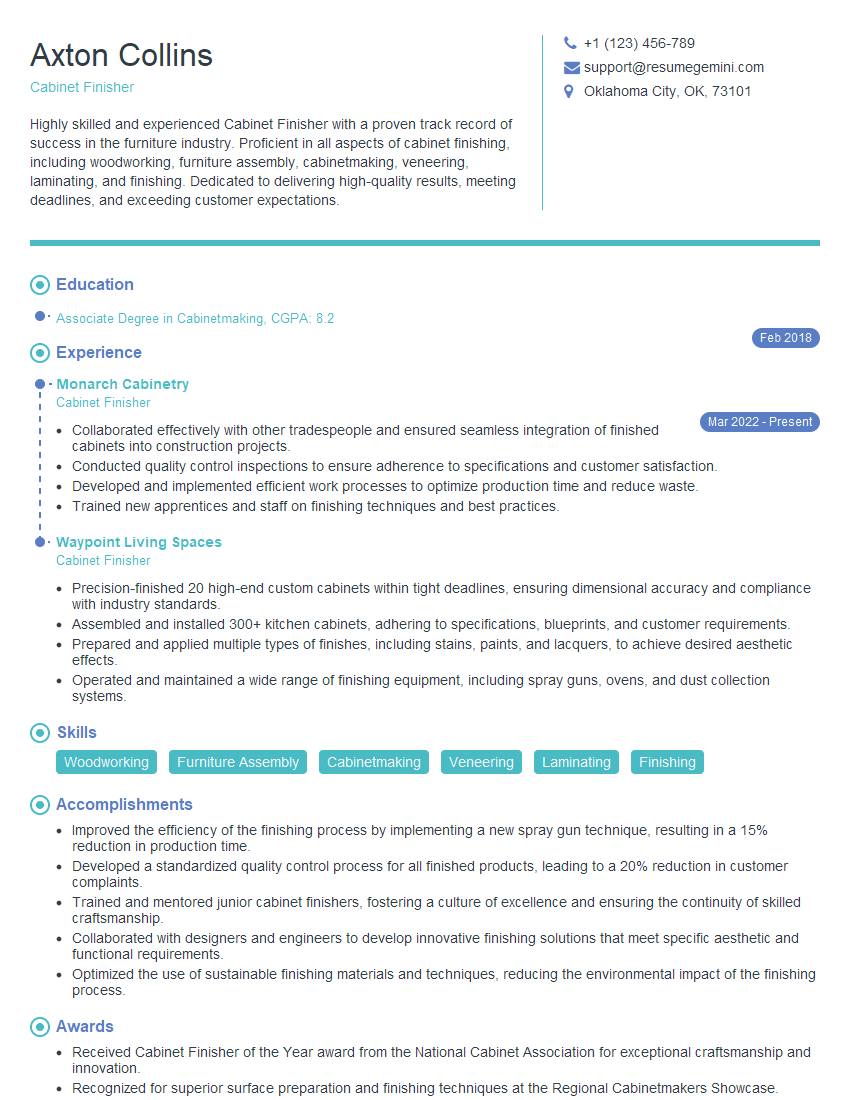
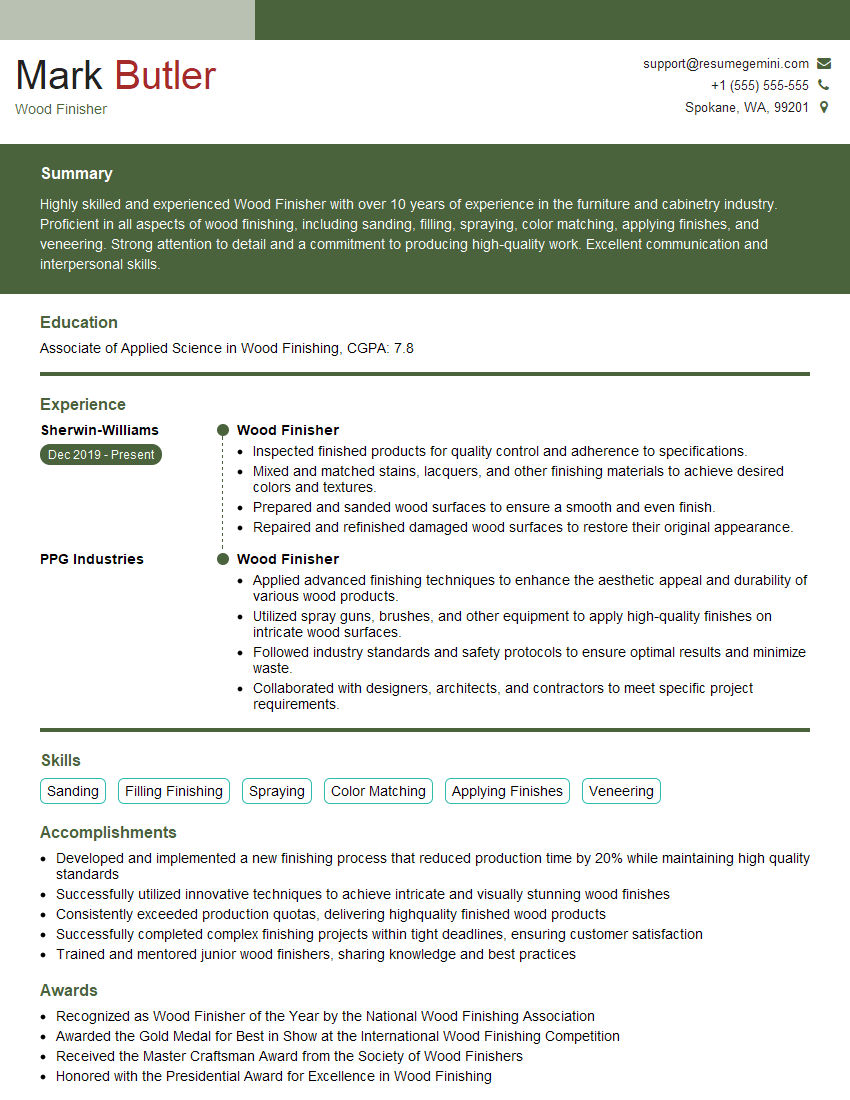
Mastering the art of applying stains and finishes opens doors to exciting career opportunities in woodworking, furniture restoration, and various construction fields. A strong understanding of these techniques is highly valued by employers. To increase your chances of landing your dream job, creating an ATS-friendly resume is crucial. ResumeGemini is a trusted resource that can help you build a professional and impactful resume that highlights your skills and experience effectively. Examples of resumes tailored to applying stains and finishes are available to guide you through the process.


Explore more articles
Users Rating of Our Blogs
Share Your Experience
We value your feedback! Please rate our content and share your thoughts (optional).
What Readers Say About Our Blog
Amazing blog
hello,
Our consultant firm based in the USA and our client are interested in your products.
Could you provide your company brochure and respond from your official email id (if different from the current in use), so i can send you the client’s requirement.
Payment before production.
I await your answer.
Regards,
MrSmith
hello,
Our consultant firm based in the USA and our client are interested in your products.
Could you provide your company brochure and respond from your official email id (if different from the current in use), so i can send you the client’s requirement.
Payment before production.
I await your answer.
Regards,
MrSmith
These apartments are so amazing, posting them online would break the algorithm.
https://bit.ly/Lovely2BedsApartmentHudsonYards
Reach out at BENSON@LONDONFOSTER.COM and let’s get started!
Take a look at this stunning 2-bedroom apartment perfectly situated NYC’s coveted Hudson Yards!
https://bit.ly/Lovely2BedsApartmentHudsonYards
Live Rent Free!
https://bit.ly/LiveRentFREE
Interesting Article, I liked the depth of knowledge you’ve shared.
Helpful, thanks for sharing.
Hi, I represent a social media marketing agency and liked your blog
Hi, I represent an SEO company that specialises in getting you AI citations and higher rankings on Google. I’d like to offer you a 100% free SEO audit for your website. Would you be interested?