Cracking a skill-specific interview, like one for Computer Aided Design (CAD) Tools, requires understanding the nuances of the role. In this blog, we present the questions you’re most likely to encounter, along with insights into how to answer them effectively. Let’s ensure you’re ready to make a strong impression.
Questions Asked in Computer Aided Design (CAD) Tools Interview
Q 1. What CAD software are you proficient in?
My proficiency in CAD software spans several leading platforms. I’m highly experienced with AutoCAD, a cornerstone for 2D drafting and 3D modeling, particularly in the architectural and mechanical engineering sectors. I’m also proficient in SolidWorks, excelling in 3D parametric modeling, crucial for complex product design and simulations. My experience further extends to Revit, specifically for Building Information Modeling (BIM), allowing for integrated design and collaboration on large-scale construction projects. Finally, I have working knowledge of Fusion 360, a cloud-based CAD/CAM/CAE software ideal for rapid prototyping and collaborative design.
Q 2. Describe your experience with 2D drafting techniques.
My 2D drafting experience encompasses a wide range of techniques, from creating basic floor plans and elevations to detailed shop drawings and assembly instructions. I’m adept at using various tools like layers, blocks, and xrefs to manage complex drawings effectively. For example, I once used nested blocks within a large-scale site plan to manage various elements such as buildings, landscaping, and utilities, ensuring easy modification and consistency across the entire project. My understanding extends to precise dimensioning and annotation techniques, adhering to industry standards and creating clear, unambiguous drawings. I’m also familiar with utilizing hatch patterns and line weights effectively to enhance drawing readability.
Q 3. Explain your experience with 3D modeling techniques.
My 3D modeling skills encompass both parametric and direct modeling techniques. In SolidWorks, I regularly utilize parametric modeling to create parts and assemblies, leveraging features like extrudes, revolves, and sweeps to build complex geometries. This approach allows for easy modification and iterative design changes. I’ve extensively used this in designing custom mechanical parts, where I needed to ensure precise tolerances and interoperability with existing components. I also have experience with surface modeling, sculpting organic shapes and creating realistic representations of products. For example, I’ve used surface modeling in creating detailed renderings of consumer electronics products, focusing on aesthetic aspects and preparing marketing materials. My understanding extends to advanced techniques such as creating and managing complex assemblies, applying constraints and simulations, and generating manufacturing-ready drawings.
Q 4. How do you manage large CAD files?
Managing large CAD files requires a multi-pronged approach. First, I utilize techniques to optimize file structure. This includes proper use of layers and blocks to organize complex geometries, as well as xrefs for managing external references. I also employ techniques to purge unnecessary data, cleaning up unused blocks, layers, and other elements to reduce file size. Secondly, I utilize external references (xrefs) in AutoCAD or linked components in SolidWorks for large projects to break down a larger design into manageable sections. For very large assemblies, I employ techniques for simplifying and representing parts using simplified geometry or proxies to improve performance. Finally, high-performance computing (workstations with greater RAM and processing power) are critical for efficient working with large CAD files. I understand and can implement strategies to leverage this hardware to maximize my productivity.
Q 5. What are your preferred methods for creating detailed technical drawings?
Creating detailed technical drawings necessitates a structured approach. I start by defining the purpose and target audience of the drawing to determine the necessary level of detail. Then, I ensure consistency in dimensioning, annotation, and labeling, following industry standards (e.g., ANSI, ISO). I leverage advanced annotation tools provided within the CAD software for creating detailed views, sections, and exploded assemblies. For complex assemblies, I create detailed assembly drawings along with individual part drawings, ensuring all necessary information is included for manufacturing. Finally, I always conduct thorough quality checks to ensure accuracy and clarity, verifying dimensions, tolerances, and annotations for any discrepancies before finalizing the drawings. My approach also includes using layers effectively to organize the different aspects of the drawing and improving the visual clarity.
Q 6. Describe your experience with CAD file formats (e.g., DWG, DXF, STEP).
I have extensive experience working with various CAD file formats. DWG is the native format for AutoCAD and is widely used for 2D drawings. DXF is a more universal exchange format, compatible with many CAD applications. I often use DXF for transferring drawings between different platforms, ensuring compatibility with collaborators using different software. STEP (Standard for the Exchange of Product model data) is a crucial format for 3D models, providing a neutral format for exchanging complex data between different CAD systems and facilitating seamless collaboration across multiple disciplines. I understand the nuances of each format and choose the most suitable one based on the project’s specific requirements and collaborative needs. I am also aware of the potential limitations and compatibility issues with different versions of each format.
Q 7. How do you handle revisions and version control in CAD projects?
Version control is essential in CAD projects to manage revisions, track changes, and avoid conflicts. My approach involves utilizing a robust version control system, such as Autodesk Vault or similar cloud-based solutions. These systems allow for the tracking of changes, the ability to revert to previous versions, and the ability to maintain a complete audit trail of the project’s history. Within the CAD software itself, I use features for saving versions and creating backups regularly to mitigate the risk of data loss. Clear naming conventions for files and revisions (e.g., using revision numbers and dates) are critical. I maintain a thorough documentation trail of changes, including descriptions of modifications and the reasons behind them. This meticulous approach guarantees efficient collaboration and helps prevent costly errors.
Q 8. Explain your experience with CAD rendering and visualization techniques.
CAD rendering and visualization are crucial for transforming 2D designs into realistic 3D models, allowing for better communication and design review. My experience encompasses a wide range of techniques, from basic wireframe rendering to photorealistic visualizations using advanced rendering engines.
I’m proficient in using various rendering styles, including:
- Wireframe Rendering: Useful for early-stage design reviews, showing the basic structure and geometry.
- Hidden-Line Removal: Creates a clearer image by removing lines hidden from the viewer’s perspective.
- Shaded Rendering: Adds surface shading to enhance the visual appeal and understanding of form.
- Ray Tracing and Path Tracing: Advanced techniques that simulate the behavior of light, producing highly realistic images with accurate reflections, refractions, and shadows. I’ve used these extensively with software like V-Ray and Arnold to create photorealistic renders for client presentations and marketing materials.
- Real-time Rendering: This is important for interactive design review and virtual reality applications, allowing for immediate feedback on design changes. I have experience using game engines like Unreal Engine for this purpose.
For example, in a recent project designing a new office building, I used ray tracing to create stunning visuals showcasing the building’s exterior at different times of day, highlighting its architectural features and surrounding landscape. This helped secure client approval and attracted potential investors.
Q 9. How familiar are you with CAD standards and best practices?
Adherence to CAD standards and best practices is essential for efficient collaboration, data exchange, and project success. My familiarity extends to industry-standard file formats (like STEP, IGES, DXF), layer management, naming conventions, and data organization strategies. I understand the importance of:
- Consistent Units and Precision: Maintaining consistent units (e.g., millimeters, inches) and appropriate decimal precision throughout the design process prevents errors during manufacturing.
- Clear Layer Management: Organizing layers logically improves project organization and simplifies design modifications. A well-structured layer system makes it much easier to find specific parts of a model and prevents accidental modifications.
- Meaningful Naming Conventions: Using descriptive names for layers, components, and files ensures clarity and understanding across the design team.
- Data Backup and Version Control: Regularly backing up designs and using version control systems (like Autodesk Vault or similar) safeguards against data loss and enables efficient collaboration.
For instance, I’ve implemented a robust layer management system based on ISO standards on a large-scale infrastructure project, facilitating seamless collaboration among multiple engineering disciplines and avoiding conflicts during design iterations.
Q 10. Describe your experience with parametric modeling.
Parametric modeling is a powerful technique that allows for creating and modifying designs based on parameters or variables. This approach enables greater design flexibility and automation. My experience includes creating and managing complex parametric models using software like Autodesk Inventor and SolidWorks.
I understand how to define parameters and relationships between design elements, enabling automatic updates when parameters change. This is extremely useful for:
- Design Exploration: Quickly exploring design variations by modifying parameters. For example, changing the dimensions of a component will automatically update all related parts.
- Automation: Automating repetitive tasks, such as generating multiple design options or creating families of parts.
- Design Optimization: Fine-tuning designs based on specific criteria, like minimizing weight or maximizing strength.
In a previous project, I developed a parametric model of a complex mechanical assembly. By modifying a few key parameters, we were able to quickly generate several design alternatives and select the most efficient option based on stress analysis results. This saved significant time and resources compared to traditional modeling techniques.
Q 11. How do you troubleshoot CAD software issues?
Troubleshooting CAD software issues requires a systematic approach. My first step involves identifying the problem’s nature – is it a software bug, a hardware limitation, or a user error? I then systematically investigate the cause, employing the following steps:
- Reproducing the Issue: Attempting to reproduce the error to understand the conditions that trigger it.
- Checking Software Updates and Drivers: Ensuring the CAD software and graphics drivers are up to date.
- Reviewing System Requirements: Verifying that the system meets the software’s minimum and recommended specifications.
- Seeking Online Resources: Searching for solutions in online forums, help documentation, or knowledge bases.
- Contacting Support: If the problem persists, contacting the software vendor’s support team.
- Testing with a Simplified Model: Creating a simplified version of the model to isolate the problem’s source.
For example, I once encountered a rendering issue in a complex model. By isolating the problem to a specific component and simplifying its geometry, I discovered a corrupted file. Deleting and recreating the component resolved the issue.
Q 12. What are your experience with CAD data management?
Effective CAD data management is critical for large projects and collaborative teams. My experience includes using various data management strategies and tools to maintain data integrity and accessibility. This includes:
- Version Control: Utilizing version control systems to track changes, revert to previous versions, and manage multiple revisions of designs.
- Data Storage and Organization: Implementing a structured system for organizing CAD files, using folder structures and naming conventions.
- Data Backup and Recovery: Establishing a robust backup strategy to protect against data loss.
- Data Security: Implementing security measures to prevent unauthorized access to CAD data.
- PLM Systems (Product Lifecycle Management): Experience working with PLM systems to manage the entire product lifecycle, from design to manufacturing.
In a past project involving a team of 15 engineers, we used a centralized PLM system to manage all CAD data, ensuring everyone worked with the most up-to-date versions and preventing design conflicts. This improved collaboration significantly and avoided costly rework.
Q 13. Describe your experience with creating and utilizing CAD libraries.
Creating and utilizing CAD libraries is essential for streamlining the design process and improving efficiency. My experience involves developing and managing libraries of standard components, parts, and symbols for reuse across multiple projects. This includes:
- Component Creation: Developing accurate and well-documented CAD models of standard components.
- Library Organization: Structuring the library logically using a clear naming convention and categorization system.
- Library Management: Maintaining and updating the library to ensure accuracy and compatibility.
- Library Implementation: Integrating the library into design workflows and training team members on its usage.
For example, I developed a library of standard mechanical components for a manufacturing company. This library included screws, nuts, bolts, and other frequently used parts. The availability of these pre-made, high-quality components significantly reduced design time and improved consistency across projects.
Q 14. How do you ensure accuracy and precision in your CAD work?
Accuracy and precision are paramount in CAD work, as errors can have significant consequences in manufacturing and functionality. To ensure accuracy, I employ several strategies:
- Precise Input of Dimensions: Carefully entering dimensions using the appropriate units and precision.
- Geometric Constraints: Using geometric constraints to define relationships between design elements and ensure dimensional accuracy.
- Regular Checks and Verification: Periodically checking dimensions, tolerances, and clearances using measurement tools.
- Design Reviews: Conducting design reviews with colleagues to identify potential errors.
- Simulation and Analysis: Using simulation software to verify design performance and identify potential problems.
- Tolerance Analysis: Understanding and incorporating tolerances into the design to account for manufacturing variations.
For example, in a precision engineering project, I used a combination of geometric constraints and tolerance analysis to ensure that all components would fit together within the specified tolerances. This prevented costly errors during assembly.
Q 15. Explain your workflow for a typical CAD project.
My CAD workflow is highly iterative and project-specific, but generally follows these key stages:
- Requirements Gathering & Conceptualization: This initial phase involves understanding the project goals, constraints (budget, time, materials), and client needs. I’ll often sketch initial concepts and discuss them with stakeholders to ensure alignment.
- Design Development: Using the chosen CAD software (SolidWorks, AutoCAD, or similar, depending on project needs), I’ll create and refine the 3D model. This involves feature creation, constraint definition, and parametric modeling to ensure design flexibility.
- Simulation & Analysis: Depending on the project, I’ll run simulations (FEA, CFD) to verify design strength, fluid flow, thermal behavior, etc. This step is crucial to identify and correct potential flaws early on. For instance, in designing a bridge, FEA would be essential to assess its structural integrity.
- Detailing & Documentation: I’ll generate detailed 2D drawings (blueprints) with precise dimensions, tolerances, and material specifications. This is critical for manufacturing and assembly. I also create assembly instructions and other necessary documentation.
- Design Review & Iteration: Throughout the process, I conduct regular design reviews with the team, incorporating feedback and making necessary revisions. This collaborative aspect is key to successful project completion.
- Finalization & Delivery: Once the design is finalized and approved, I deliver the final 3D model, 2D drawings, and documentation in the agreed-upon format.
For example, on a recent project involving the design of a custom robotic arm, I utilized SolidWorks’ simulation tools to optimize the arm’s strength-to-weight ratio, ensuring it met the required load capacity while minimizing material usage.
Career Expert Tips:
- Ace those interviews! Prepare effectively by reviewing the Top 50 Most Common Interview Questions on ResumeGemini.
- Navigate your job search with confidence! Explore a wide range of Career Tips on ResumeGemini. Learn about common challenges and recommendations to overcome them.
- Craft the perfect resume! Master the Art of Resume Writing with ResumeGemini’s guide. Showcase your unique qualifications and achievements effectively.
- Don’t miss out on holiday savings! Build your dream resume with ResumeGemini’s ATS optimized templates.
Q 16. How do you collaborate with other team members on CAD projects?
Collaboration is fundamental in CAD projects. We leverage various tools and strategies:
- Cloud-Based Platforms: We utilize platforms like Autodesk A360 or similar cloud storage solutions to share files and ensure everyone works with the latest version. This eliminates version control issues and promotes real-time collaboration.
- Version Control Systems: For complex projects, we use version control systems like Git (often integrated with CAD data management tools) to track changes, revert to earlier versions if needed, and manage design iterations efficiently. Imagine a team working on a complex aircraft design; Git would be invaluable.
- CAD Software Collaboration Features: Most modern CAD packages incorporate features that allow multiple users to work simultaneously on the same model, with built-in conflict resolution mechanisms. This significantly streamlines the collaboration process.
- Regular Meetings & Communication: Frequent meetings, both in-person and virtual, keep everyone informed about progress, address concerns, and facilitate decision-making. Clear and consistent communication is paramount.
For instance, in a recent automotive design project, we used Autodesk A360 to share large CAD assemblies, allowing multiple engineers to work concurrently on different components while maintaining version control.
Q 17. How do you handle conflicting design requirements?
Conflicting design requirements are common and require careful negotiation and prioritization. My approach involves:
- Clearly Defining and Documenting Requirements: The first step is to meticulously document all requirements, identifying any potential conflicts. This often involves creating a requirements traceability matrix.
- Prioritization and Trade-off Analysis: Based on the project’s goals and constraints, I’ll prioritize requirements, understanding that some compromises may be necessary. A weighted scoring system or a decision matrix can help in this process. For example, we might prioritize functionality over aesthetics in a medical device.
- Creative Problem Solving: I’ll brainstorm alternative solutions that address the conflicting requirements. This might involve exploring new technologies, modifying existing designs, or proposing different design approaches.
- Collaboration and Communication: Open and transparent communication with stakeholders is essential to reach a consensus and resolve the conflicts. This includes clearly explaining the trade-offs and obtaining buy-in from all parties involved.
- Documentation of Decisions: All decisions made regarding conflicting requirements are meticulously documented to ensure transparency and provide a clear audit trail.
For example, on a consumer product, we had conflicting requirements for cost reduction and improved ergonomics. We resolved this by optimizing the design using generative design tools, which explores various design alternatives within the specified constraints.
Q 18. Describe your experience with CAD automation and scripting.
I possess extensive experience in CAD automation and scripting, leveraging languages such as Python and VBA (Visual Basic for Applications). I use these skills to:
- Automate Repetitive Tasks: Scripting automates tasks like generating reports, creating drawing sheets, and manipulating geometry, significantly improving efficiency. For instance, I wrote a Python script that automatically generates bill of materials (BOM) from a 3D model, saving considerable time.
- Create Custom Tools and Macros: I develop custom tools and macros to streamline workflows and enhance productivity within the CAD software. A custom macro could automate a complex assembly process.
- Integrate CAD with Other Software: Scripting enables seamless integration between CAD and other software tools, such as data analysis programs or simulation packages. I’ve used Python to connect CAD data with finite element analysis (FEA) software for automated model import and analysis.
- Data Extraction and Analysis: I use scripting to extract relevant data from CAD models for further analysis, such as dimensions, volumes, and material properties. This extracted data could be used for cost estimation.
Example Python code (simplified):
import adsk.core # assuming Autodesk Fusion 360
app = adsk.core.Application.get()
doc = app.documents.add(adsk.core.DocumentTypes.FusionDesignDocumentType)
# ... further code to manipulate the document ...
This snippet demonstrates how to initiate a Fusion 360 document using Python. The full script would then contain code to perform specific actions on the design.
Q 19. How do you stay up-to-date with the latest CAD technologies and trends?
Staying current in the rapidly evolving field of CAD requires a proactive approach:
- Professional Development Courses & Workshops: I regularly participate in online courses and workshops offered by CAD software vendors and industry organizations. This ensures I am familiar with the latest features and functionalities of the software.
- Industry Conferences & Trade Shows: Attending industry conferences and trade shows provides exposure to cutting-edge technologies and trends, allowing for networking with other professionals.
- Online Resources & Publications: I actively follow industry blogs, journals, and online forums to stay informed about new developments, best practices, and emerging technologies.
- Self-Learning and Experimentation: I dedicate time to self-learning and experimentation with new CAD tools and techniques. This hands-on approach solidifies my understanding and allows me to explore innovative approaches to design problems.
- Following Key Industry Players: Keeping up with announcements from major CAD software companies (Autodesk, Dassault Systèmes, Siemens) and industry leaders is crucial.
For example, I recently completed a course on generative design, a powerful technique that uses algorithms to explore a wide range of design options based on specified constraints. This allows for more efficient and innovative designs.
Q 20. What is your experience with CAD-related quality control processes?
CAD quality control is paramount. My experience encompasses:
- Dimensional Accuracy Verification: I rigorously check for dimensional accuracy, tolerances, and surface finish using various CAD tools and techniques. This includes utilizing model checking features within the CAD software and conducting manual inspections.
- Design Rule Checks (DRC): I use DRC to automate the process of identifying potential design flaws, such as collisions, interferences, and clearance issues. This is especially critical in complex assemblies.
- Model Cleanup and Optimization: I perform regular model cleanup to remove unnecessary geometry, improve file size, and enhance performance. This reduces errors and improves overall quality.
- Data Integrity and Consistency: Maintaining data integrity and consistency is crucial. I employ best practices to ensure the CAD models and drawings are accurate and up-to-date.
- Documentation and Version Control: Maintaining detailed documentation and version control ensures traceability and simplifies troubleshooting. This helps to pinpoint the source of errors if any arise.
For instance, in a recent medical device project, rigorous quality control measures were critical to ensure the device met stringent regulatory requirements. We used automated design rule checks (DRCs) and comprehensive dimensional analysis to ensure compliance.
Q 21. Describe your experience working with CAD in a manufacturing environment.
My experience with CAD in manufacturing environments spans various aspects:
- Design for Manufacturing (DFM): I incorporate DFM principles to ensure designs are manufacturable, cost-effective, and meet production requirements. This includes considering factors like material selection, tooling, and assembly processes.
- Collaboration with Manufacturing Engineers: I work closely with manufacturing engineers to ensure seamless transition from design to production. This often involves reviewing manufacturing processes and providing feedback on design modifications.
- Generating Manufacturing Documentation: I create detailed manufacturing documentation, including drawings, assembly instructions, and bills of materials (BOMs), tailored to the specific manufacturing processes.
- Tolerance Analysis and Control: I perform tolerance analysis to ensure designs can be manufactured within acceptable tolerances. This is critical to maintain product quality and functionality.
- CAM Integration: I’m experienced in integrating CAD with Computer-Aided Manufacturing (CAM) software to generate CNC toolpaths and other manufacturing instructions. This streamlines the transition from design to manufacturing.
For example, on a project involving the production of custom injection-molded plastic parts, my DFM expertise ensured the designs were optimized for moldability, minimizing production costs and lead times.
Q 22. Explain how you ensure your CAD models are compatible with manufacturing processes.
Ensuring CAD model compatibility with manufacturing is paramount. It’s not just about creating a visually appealing design; it’s about creating a design that can be reliably and efficiently produced. This involves considering several key aspects throughout the design process.
- Manufacturing Processes Understanding: Before even starting the design, I thoroughly research the intended manufacturing methods (e.g., CNC machining, 3D printing, injection molding). Each process has limitations – minimum wall thicknesses, draft angles, undercuts – that must be considered. For example, a design intended for injection molding needs draft angles to allow for easy part removal from the mold. Ignoring this would lead to a non-manufacturable part.
- Material Selection: The choice of material directly impacts manufacturability. Steel behaves differently during machining than plastic during injection molding. I carefully select materials based on their properties and compatibility with the chosen manufacturing process. This often involves consulting material data sheets and collaborating with manufacturing engineers.
- Design for Manufacturing (DFM) Principles: I strictly adhere to DFM principles. This involves simplifying geometries, avoiding complex features, and ensuring that parts can be easily assembled. For instance, I prefer simple, robust joinery methods over intricate interlocking mechanisms that might be difficult and expensive to manufacture.
- Tolerance Definition: Precisely defining tolerances is crucial. Overly tight tolerances can increase manufacturing costs and time, while overly loose tolerances might result in parts that don’t meet specifications. I use GD&T (Geometric Dimensioning and Tolerancing) standards to accurately communicate dimensional requirements to manufacturers.
- Model Verification: Before finalizing the design, I conduct thorough simulations and analyses, often using FEA (Finite Element Analysis) software to validate the design’s structural integrity and predict its performance under different loads. This helps identify potential manufacturing issues early on.
For instance, in a recent project designing a plastic housing for an electronic device, I used injection molding simulation software to predict potential sink marks and warping, allowing me to adjust the wall thicknesses and add reinforcing ribs to create a manufacturable and functional design. This proactive approach saved considerable time and resources during the manufacturing phase.
Q 23. How do you ensure the accuracy of dimensions and tolerances in your CAD models?
Accuracy in dimensions and tolerances is absolutely critical in CAD modeling. Inaccurate models lead to costly errors in manufacturing and assembly. I employ several techniques to maintain precision:
- Use of Constraints and Relations: I extensively utilize constraints and parametric modeling techniques. This creates a relationship between different design elements, ensuring that if one dimension changes, related dimensions update automatically, maintaining consistency and accuracy. This prevents errors caused by manual updates.
- Model-Based Definition (MBD): I utilize MBD whenever feasible, embedding all necessary dimensions and tolerances directly within the 3D model. This eliminates the need for separate 2D drawings and minimizes the chances of discrepancies between the model and the drawing.
- GD&T Application: Geometric Dimensioning and Tolerancing (GD&T) is fundamental. I apply GD&T symbols and annotations to precisely specify the allowable variations in form, orientation, location, and runout of features. This provides unambiguous instructions to manufacturers.
- Regular Model Checks: I regularly check for model inconsistencies and errors. Built-in CAD tools, such as interference detection, are used to spot problems early on. I also perform manual checks of critical dimensions and tolerances, comparing them to design specifications.
- Reference to Standards: I adhere to relevant industry standards and best practices, ensuring that dimensions and tolerances are expressed according to accepted conventions (e.g., ISO standards).
For example, when designing a precision part for a medical device, I used a combination of parametric modeling and GD&T to define dimensions with very tight tolerances. This ensured that the manufactured parts met the stringent accuracy requirements necessary for the device’s functionality.
Q 24. What are some common challenges you encounter when using CAD software and how do you overcome them?
CAD software, while powerful, presents several challenges. Overcoming these requires a combination of skill, experience, and problem-solving techniques.
- Software Complexity: The sheer number of features and commands can be daunting for beginners and even experienced users sometimes struggle with optimizing workflow. Solution: Continuous learning, focusing on mastering core functionalities, exploring tutorials, and utilizing the software’s help system.
- File Size and Management: Large and complex assemblies can lead to slow performance and difficulties in managing files. Solution: Employing efficient modeling techniques, using component-based design, saving in optimized file formats (like STEP or IGES for data exchange), and regularly archiving files.
- Software Crashes and Data Loss: This is always a risk, especially with large assemblies. Solution: Regularly saving work, utilizing version control systems, and employing data backups.
- Geometric Inconsistencies: Small errors in geometry can propagate through the model, leading to significant problems later on. Solution: Rigorous quality control during modeling, using CAD tools for geometry checks, and employing external validation tools.
- Interoperability Issues: Different CAD software packages may not always exchange data perfectly. Solution: Sticking to widely used formats like STEP or IGES for data exchange and being prepared for some manual rework during data translation.
I once encountered a significant software crash during the final stages of a major project. Thankfully, my practice of saving frequently and backing up my work prevented significant data loss. This reinforced the importance of proactive data management.
Q 25. Describe your experience using CAD for design review and presentations.
CAD is indispensable for design review and presentations. It transforms complex technical information into clear and visually engaging material.
- High-Quality Visualizations: I use CAD software to create photorealistic renderings and animations to clearly showcase the design’s appearance and functionality. This is especially effective for clients or stakeholders who are not technically inclined.
- Interactive Presentations: CAD models can be easily manipulated during presentations, allowing me to demonstrate how components move, assemble, and interact. This facilitates effective communication and collaboration.
- Section Views and Exploded Views: I create detailed section views and exploded views to highlight internal components and assembly sequences. This helps to understand complex designs quickly.
- Markup and Annotation: I use CAD’s annotation tools to add design notes, comments, and specifications directly onto the model during reviews, streamlining the feedback process.
- Virtual Reality and Augmented Reality: In certain cases, I leverage VR/AR to create immersive experiences for design reviews, particularly beneficial for reviewing large or complex assemblies.
In a recent presentation to a client, a 360° rendered animation of the product significantly improved their understanding and confidence in our design. This visually compelling approach surpassed the effectiveness of traditional 2D drawings.
Q 26. How do you use CAD to create detailed assembly drawings?
Creating detailed assembly drawings in CAD involves a structured approach that ensures clarity and accuracy. It’s more than just placing parts together; it’s about creating a comprehensive technical document.
- Assembly Modeling: I start by creating a well-defined assembly model in the CAD software, ensuring that all parts are correctly positioned and constrained. This is often a bottom-up approach, starting with individual components and progressively assembling them.
- Exploded Views: Generating exploded views helps to clearly show the order of assembly and the relationship between individual components. This is invaluable for manufacturing and maintenance.
- Bill of Materials (BOM): The CAD software automatically or semi-automatically generates a BOM, listing all the parts, their quantities, and their unique identifiers. This is crucial for procurement and manufacturing.
- Detailed Drawings: I generate detailed 2D drawings from the 3D model, including views, sections, and dimensions. I meticulously annotate these drawings with all necessary information such as tolerances, materials, surface finishes, and manufacturing notes.
- GD&T Application: As mentioned earlier, GD&T is crucial for accurately conveying dimensional requirements and tolerances on the assembly drawings.
- Revision Control: All drawings are properly managed through a revision control system to track changes and ensure everyone is working with the latest version.
For instance, when creating assembly drawings for a complex piece of machinery, I used exploded views to clearly demonstrate the assembly sequence, reducing the risk of errors during manufacturing. This streamlined the assembly process and reduced the likelihood of rework.
Q 27. What is your experience integrating CAD with other software applications (e.g., CAM, FEA)?
Integration of CAD with other software applications, such as CAM (Computer-Aided Manufacturing) and FEA (Finite Element Analysis), is vital for a comprehensive design process. This collaborative approach enhances efficiency and quality.
- CAM Integration: Directly transferring CAD models to CAM software streamlines the manufacturing process. The CAM software uses the CAD data to generate CNC machining toolpaths or other manufacturing instructions. This automation reduces errors and increases efficiency.
- FEA Integration: Exporting CAD models to FEA software enables engineers to simulate the behavior of the design under various loads and conditions. This helps identify potential weaknesses and optimize the design for strength and durability. I often use FEA to validate designs before manufacturing, ensuring that they can withstand the intended loads.
- Data Exchange Formats: Standard neutral formats like STEP, IGES, and Parasolid are used to exchange data between different software applications, minimizing the risk of data corruption or loss of information.
- Collaboration Tools: Cloud-based collaboration tools facilitate seamless data sharing and version control among design teams and external stakeholders.
In a recent project, I used CAD to design a structural component, then integrated the model with FEA to simulate its response to stress. The analysis revealed a potential weakness that I addressed in the design before moving on to manufacturing. This prevented costly failures and ensured product robustness.
Q 28. How would you approach creating a detailed CAD model from a hand-drawn sketch?
Creating a detailed CAD model from a hand-drawn sketch requires a systematic approach combining technical skills and creativity.
- Sketch Interpretation: Carefully analyze the sketch, identifying key features, dimensions, and tolerances. Understanding the design intent is paramount.
- Dimensioning and Tolerancing: Add missing dimensions and tolerances based on the sketch’s context and the intended function of the part. This might involve making reasonable assumptions or consulting with the sketch’s originator.
- 2D Sketching in CAD: Use the CAD software’s 2D sketching tools to recreate the sketch accurately, adding necessary construction geometry. Pay close attention to accuracy and consistency.
- 3D Modeling: Extrude, revolve, or use other 3D modeling tools to create the 3D model from the 2D sketch. Ensure that the 3D model aligns with the original sketch’s intent and dimensions.
- Validation: Conduct a thorough check for errors in geometry and dimensions. Use CAD’s built-in verification tools. Compare the 3D model with the original sketch to verify that it accurately represents the design.
Imagine recreating a complex mechanical part from a hand-drawn engineering sketch. I would start by scanning the sketch and importing it into the CAD software. I would then meticulously trace it, adding dimensions and constraints, and finally, generate the 3D model, carefully validating each step.
Key Topics to Learn for Computer Aided Design (CAD) Tools Interview
- Fundamentals of CAD Software: Understanding the user interface, navigation, and basic drawing tools across various platforms (AutoCAD, SolidWorks, Revit, etc.). This includes proficiency in 2D and 3D modeling techniques.
- Geometric Modeling Techniques: Mastering concepts like constraints, parameters, and features. Be prepared to discuss your experience with creating and modifying complex geometries, including Boolean operations and surface modeling.
- Drafting and Documentation: Demonstrate your skills in creating detailed drawings, including dimensions, annotations, and creating technical specifications. Understanding different drawing standards (e.g., ASME, ISO) is crucial.
- Design for Manufacturing (DFM): Show your understanding of how design choices impact manufacturing processes. Discuss concepts like tolerances, material selection, and manufacturability analysis.
- CAD Software Specifics: Depending on the job description, deep dives into specific software features and functionalities will be essential. Research the software used by the company you’re interviewing with.
- Problem-Solving and Design Thinking: Be ready to discuss your approach to complex design problems. Highlight your ability to troubleshoot errors, optimize designs, and iterate based on feedback.
- Data Management and Collaboration: Showcase your understanding of version control, data exchange formats (e.g., DXF, STEP), and collaborative workflows in CAD environments.
Next Steps
Mastering Computer Aided Design (CAD) tools is paramount for a successful career in engineering, architecture, and many other design-related fields. It opens doors to exciting projects and accelerates your professional growth. To maximize your job prospects, ensure your resume is ATS-friendly and effectively showcases your skills and experience. We strongly recommend using ResumeGemini to build a professional and impactful resume that highlights your CAD expertise. ResumeGemini provides examples of resumes tailored to Computer Aided Design (CAD) Tools professionals, helping you craft a document that stands out from the competition.
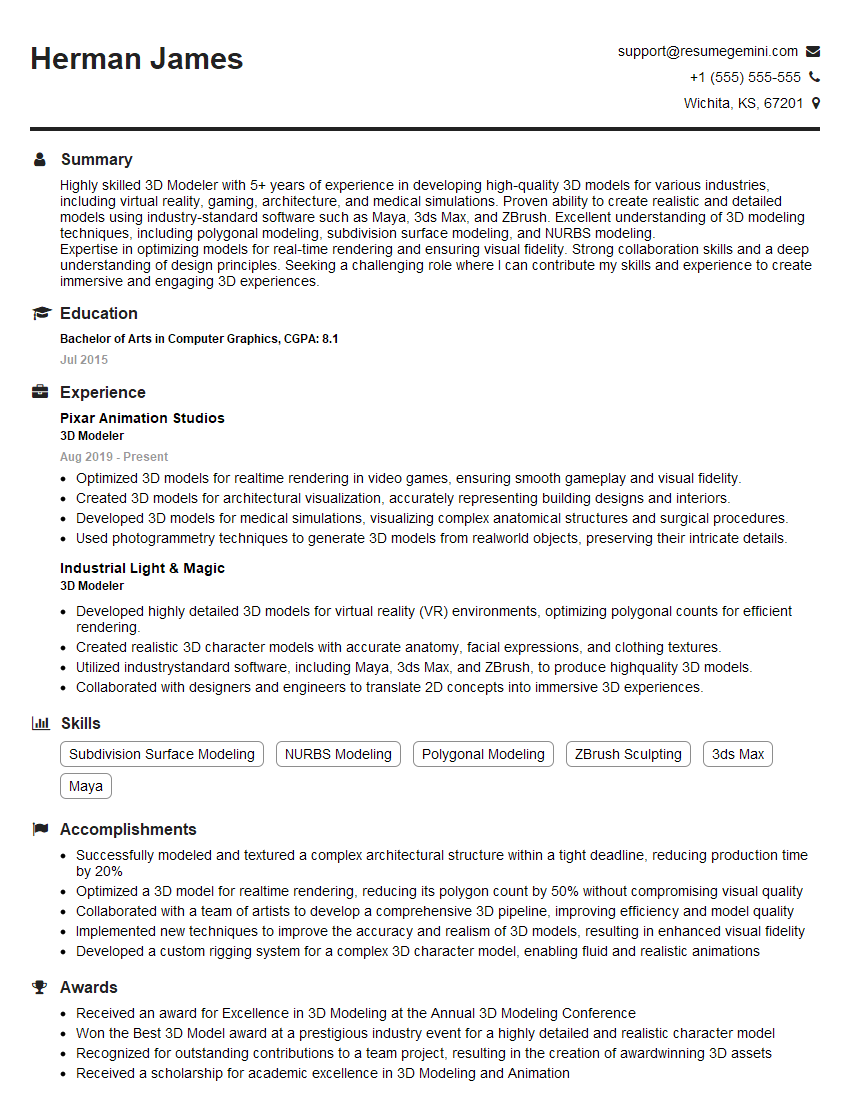
Explore more articles
Users Rating of Our Blogs
Share Your Experience
We value your feedback! Please rate our content and share your thoughts (optional).
What Readers Say About Our Blog
Amazing blog
hello,
Our consultant firm based in the USA and our client are interested in your products.
Could you provide your company brochure and respond from your official email id (if different from the current in use), so i can send you the client’s requirement.
Payment before production.
I await your answer.
Regards,
MrSmith
hello,
Our consultant firm based in the USA and our client are interested in your products.
Could you provide your company brochure and respond from your official email id (if different from the current in use), so i can send you the client’s requirement.
Payment before production.
I await your answer.
Regards,
MrSmith
These apartments are so amazing, posting them online would break the algorithm.
https://bit.ly/Lovely2BedsApartmentHudsonYards
Reach out at BENSON@LONDONFOSTER.COM and let’s get started!
Take a look at this stunning 2-bedroom apartment perfectly situated NYC’s coveted Hudson Yards!
https://bit.ly/Lovely2BedsApartmentHudsonYards
Live Rent Free!
https://bit.ly/LiveRentFREE
Interesting Article, I liked the depth of knowledge you’ve shared.
Helpful, thanks for sharing.
Hi, I represent a social media marketing agency and liked your blog
Hi, I represent an SEO company that specialises in getting you AI citations and higher rankings on Google. I’d like to offer you a 100% free SEO audit for your website. Would you be interested?