Are you ready to stand out in your next interview? Understanding and preparing for Conservation Education Programs interview questions is a game-changer. In this blog, we’ve compiled key questions and expert advice to help you showcase your skills with confidence and precision. Let’s get started on your journey to acing the interview.
Questions Asked in Conservation Education Programs Interview
Q 1. Describe your experience developing and implementing conservation education programs.
Developing and implementing conservation education programs involves a multi-stage process, from initial needs assessment to long-term evaluation. It begins with identifying a target audience and their specific needs regarding conservation awareness. For instance, a program for school children will differ significantly from one designed for adult volunteers. Then, I develop a curriculum that aligns with learning objectives. This might involve creating engaging lesson plans, designing interactive workshops, and developing hands-on activities. Implementation includes securing necessary resources, recruiting instructors, and managing logistics. For example, I once coordinated a large-scale citizen science project involving hundreds of volunteers to monitor bird populations across a national park. This required careful planning, training, data collection protocols, and community outreach.
After implementation, ongoing monitoring and adjustments are crucial. Gathering feedback through surveys and observations enables refinement of the program’s effectiveness. I’ve found that flexibility is vital; being able to adapt to unexpected challenges and changing needs is essential for a successful program.
Q 2. How do you assess the effectiveness of your conservation education programs?
Assessing the effectiveness of conservation education programs is crucial to demonstrating impact and improving future initiatives. This involves a multifaceted approach combining quantitative and qualitative methods. Quantitative methods may include pre- and post-program surveys measuring changes in knowledge, attitudes, and behaviors related to conservation. For example, we might compare participants’ understanding of biodiversity before and after a workshop using a standardized test. Qualitative data, such as focus group discussions and interviews, offer richer insights into participant experiences and perspectives. This helps us understand the nuances of learning and identify areas for improvement.
Analyzing participation rates, program completion rates, and volunteer engagement metrics provides further insights into the program’s reach and effectiveness. A robust assessment strategy helps demonstrate the program’s return on investment and inform future funding proposals.
Q 3. What strategies do you employ to engage diverse audiences in conservation initiatives?
Engaging diverse audiences requires a nuanced understanding of the various cultural backgrounds, learning styles, and accessibility needs within a community. I tailor programs to resonate with specific groups by using culturally relevant examples and adapting communication styles. For example, when working with Indigenous communities, I prioritize incorporating traditional ecological knowledge and ensuring respectful engagement with cultural practices. Employing multiple communication channels, such as social media, community events, and collaborations with local organizations, enhances outreach and accessibility. This is particularly crucial for reaching underserved populations. Offering programs in multiple languages and adapting materials for different literacy levels is also critical for inclusivity.
Partnering with community leaders and organizations builds trust and facilitates access to diverse audiences. I’ve found that co-creation of programs, where community members actively participate in the design and implementation, fosters a sense of ownership and increases engagement.
Q 4. Explain your approach to creating age-appropriate curriculum for conservation education.
Creating age-appropriate curriculum requires careful consideration of developmental stages and learning capacities. For younger children (e.g., elementary school), I emphasize hands-on activities, storytelling, and simple concepts. For example, we might use games to teach about the food web or a nature walk to explore local habitats. As children get older, the curriculum incorporates more complex concepts, critical thinking skills, and problem-solving activities. For teenagers, participatory projects, like environmental advocacy campaigns or community restoration efforts, are particularly engaging. Adults benefit from more in-depth discussions, scientific information, and opportunities for leadership development.
I also ensure that the learning environment is supportive and engaging. Different learning styles are catered to through varied activities, and opportunities for peer interaction and mentorship are incorporated.
Q 5. How do you integrate technology into your conservation education programs?
Technology plays an increasingly important role in conservation education. I use interactive simulations, online learning platforms, and virtual field trips to enhance engagement and accessibility. For example, we might use a virtual reality experience to immerse students in a rainforest or a GIS mapping exercise to analyze habitat changes. Social media platforms are used for communication, community building, and promoting conservation initiatives. Mobile apps provide access to educational resources and citizen science projects. Online databases and data visualization tools can empower participants to analyze real-world environmental data and contribute to conservation efforts.
However, careful consideration of digital literacy and access to technology is crucial to ensure equitable participation. Offline resources and alternative formats are provided to those with limited access to technology.
Q 6. Describe your experience with grant writing for conservation education projects.
Grant writing is an essential skill for securing funding for conservation education projects. My approach involves identifying appropriate funding opportunities that align with the project goals and target audience. This requires thorough research into various grant-making organizations and their funding priorities. I then craft a compelling narrative that highlights the project’s significance, innovation, and potential impact. A well-structured proposal clearly articulates the project’s budget, timeline, evaluation plan, and sustainability strategy.
Strong proposals demonstrate a clear understanding of the problem, proposed solutions, and the expected outcomes. I emphasize the project’s community engagement and collaboration aspects, as this is often a key criterion for grant selection. Building strong relationships with grant reviewers and providing timely follow-up communication are essential.
Q 7. How do you measure the impact of your conservation education efforts on participants?
Measuring the impact of conservation education efforts goes beyond simply assessing knowledge gains. It requires tracking changes in attitudes, behaviors, and ultimately, environmental outcomes. We use various methods to assess the long-term impact on participants. Pre- and post-program surveys can measure changes in environmental knowledge, attitudes, and pro-environmental behaviors. Tracking participants’ involvement in conservation activities after the program (e.g., volunteering, advocacy, sustainable practices) provides additional insight. For example, we may track the number of participants who adopt water conservation strategies or participate in local environmental clean-up events after completing our program.
Longitudinal studies can track changes over a longer period, revealing the lasting effects of the program. Qualitative feedback through interviews and focus groups helps understand the deeper impact on participants’ values and commitment to conservation.
Q 8. What are some of the common challenges faced in conservation education, and how do you address them?
Conservation education faces numerous challenges, primarily stemming from the complex interplay of societal, economic, and environmental factors. One significant hurdle is limited funding, often restricting program reach and quality. Another is audience engagement; capturing and maintaining the attention of diverse learners, particularly younger generations, requires creative and adaptable teaching methods. Furthermore, measuring the impact of conservation education programs can be difficult, making it challenging to demonstrate their effectiveness to funders and stakeholders. Finally, the ever-evolving nature of environmental issues necessitates continuous curriculum updates to reflect current scientific understanding and best practices.
To address these challenges, I employ a multi-pronged approach. Firstly, I actively seek diverse funding streams, including grants, corporate sponsorships, and community fundraising. Secondly, I use innovative teaching techniques – gamification, storytelling, interactive simulations – to make learning engaging and memorable. Thirdly, I employ robust evaluation methods, including pre- and post-program assessments and long-term follow-ups, to measure program outcomes and inform future improvements. Lastly, I maintain a commitment to continuous professional development, staying abreast of the latest research and best practices in conservation education.
Q 9. How do you incorporate hands-on learning experiences into your conservation education programs?
Hands-on learning is crucial for effective conservation education. It fosters a deeper understanding and appreciation for environmental issues by engaging multiple senses and promoting active participation. My programs incorporate a variety of hands-on experiences, including:
- Citizen science projects: Participants actively contribute to real-world conservation efforts by collecting data, monitoring species populations, or participating in habitat restoration activities. For instance, we’ve successfully involved students in monitoring local bird populations and reporting their findings to a national database.
- Outdoor field trips and nature walks: Direct interaction with nature allows learners to observe ecosystems firsthand, identify species, and appreciate the interconnectedness of life. We’ve organized several nature walks focusing on local flora and fauna, teaching participants about biodiversity and ecological processes.
- Environmental art projects: Creating art using natural materials encourages creative expression while promoting awareness of environmental resources. One project involved students building sculptures from recycled materials, emphasizing waste reduction and resource conservation.
- Experiments and simulations: Engaging with hands-on experiments or simulations allows students to test concepts and understand ecological principles in a practical way. For example, we’ve used water filtration experiments to explore water quality issues.
Q 10. Explain your experience working with volunteers in a conservation education setting.
Volunteers play a vital role in my conservation education programs, providing invaluable support and expanding our reach. I’ve successfully managed volunteer teams of various sizes and skill sets, focusing on clear communication, effective training, and mutual respect.
My approach involves:
- Thorough training: Volunteers receive comprehensive training on program objectives, safety procedures, and best practices in interacting with participants. This ensures consistency and quality in the program delivery.
- Clear roles and responsibilities: Each volunteer is assigned specific tasks and responsibilities, fostering a sense of ownership and accountability. This could range from leading activities to assisting with logistics and administrative tasks.
- Regular communication and feedback: I maintain open and consistent communication with volunteers, providing regular updates and soliciting feedback. This creates a collaborative environment and allows for ongoing improvement.
- Recognition and appreciation: Volunteers’ contributions are acknowledged and appreciated through regular expressions of gratitude, social events, and opportunities for professional development.
For example, in a recent habitat restoration project, volunteers played a crucial role in planting native species and removing invasive weeds, significantly contributing to the success of the initiative. Their dedication and passion were instrumental in achieving our environmental goals.
Q 11. Describe your understanding of different conservation philosophies and approaches.
My understanding of conservation philosophies and approaches is multifaceted, recognizing the diverse perspectives and methodologies employed in protecting biodiversity and natural resources. I’m familiar with various approaches, including:
- Preservationism: This philosophy emphasizes the intrinsic value of nature, advocating for strict protection of pristine areas with minimal human intervention. I understand its importance in safeguarding biodiversity hotspots and critical ecosystems.
- Conservationism: This approach prioritizes the sustainable use of natural resources, balancing human needs with environmental protection. It recognizes the need for responsible resource management and the integration of ecological principles into human activities.
- Restoration ecology: This focuses on repairing damaged ecosystems and returning them to a healthier state. I’ve used techniques from restoration ecology in hands-on projects like habitat restoration.
- Community-based conservation: This participatory approach engages local communities in conservation planning and management, recognizing their traditional knowledge and empowering them to protect their natural resources.
My programs are informed by these various approaches, adapting to the specific context and goals of each initiative. A holistic approach, considering both ecological and social factors, is crucial for achieving long-term conservation success.
Q 12. How do you adapt your conservation education programs to meet the needs of specific communities?
Adapting conservation education programs to meet the needs of specific communities is critical for effectiveness. This involves understanding the cultural context, local environmental issues, and the unique learning styles of the target audience.
My approach to adaptation involves:
- Needs assessment: I conduct thorough needs assessments to understand the specific environmental challenges faced by the community, their existing knowledge and attitudes towards conservation, and their preferred learning methods.
- Culturally relevant content: I incorporate culturally relevant examples, stories, and teaching materials to make the learning experience more engaging and meaningful for the community members.
- Language accessibility: I ensure that program materials and instruction are available in the language(s) spoken by the community.
- Community participation: I actively involve community members in the design, implementation, and evaluation of the programs, fostering a sense of ownership and ensuring the program’s relevance.
For example, when working with an indigenous community, I’ve incorporated their traditional ecological knowledge into the program curriculum, recognizing its importance in understanding and managing local ecosystems.
Q 13. How do you build partnerships with local organizations to support your conservation education work?
Building strong partnerships with local organizations is essential for effective conservation education. These partnerships provide access to resources, expertise, and a wider reach, enhancing the impact of our programs. My strategy focuses on:
- Identifying potential partners: I actively seek out organizations with shared goals and complementary expertise, including local government agencies, NGOs, schools, and community groups.
- Establishing clear communication: I maintain open and transparent communication with partners, ensuring alignment on program goals, activities, and responsibilities.
- Collaborative planning: I work collaboratively with partners in developing and implementing programs, leveraging their knowledge and resources.
- Mutual benefit: I strive to create partnerships that are mutually beneficial, ensuring that each partner gains value from the collaboration.
For instance, a successful partnership with a local school provided access to classrooms and students, while a collaboration with a nature center allowed us to utilize their facilities and expertise for outdoor field trips. This multifaceted approach significantly expanded our outreach and effectiveness.
Q 14. What are your strategies for promoting environmental stewardship among participants?
Promoting environmental stewardship involves fostering a sense of responsibility and connection to nature among participants. My strategies focus on:
- Experiential learning: Hands-on activities and direct interaction with nature foster a deeper understanding and appreciation for the environment, leading to a stronger sense of responsibility.
- Values clarification: Discussions and activities that explore personal values and ethical considerations related to environmental issues promote responsible decision-making.
- Action-oriented learning: Encouraging participants to take concrete actions – such as volunteering, advocating for environmental policies, or making sustainable lifestyle choices – reinforces their commitment to environmental stewardship.
- Long-term engagement: Maintaining contact with participants after the program concludes and providing opportunities for continued involvement fosters long-term commitment to environmental stewardship. For example, establishing an alumni network or creating opportunities for continued volunteering encourages ongoing participation.
Ultimately, promoting environmental stewardship is about empowering individuals to become active agents of change, taking ownership of their relationship with the environment.
Q 15. How do you address misconceptions and misinformation about conservation issues?
Addressing misconceptions in conservation education requires a multi-pronged approach focusing on evidence-based communication and fostering critical thinking. It’s not just about correcting falsehoods, but about helping learners understand the underlying scientific principles and the process of scientific inquiry itself.
- Fact-checking and source verification: We start by identifying the prevalent misconceptions. For example, many believe recycling solves the plastic problem entirely. We then systematically present the facts, citing reputable sources like scientific journals and government reports to demonstrate the limitations of recycling in addressing the larger issue of plastic pollution.
- Interactive learning activities: Passive listening isn’t effective. We use activities like interactive games, simulations, and debates to engage learners actively. A recent workshop involved a simulation where participants had to manage a fictional town’s waste management system, experiencing firsthand the challenges of effective recycling and waste reduction.
- Addressing emotional barriers: Misinformation often stems from fear, apathy, or distrust. We build trust through transparency and open dialogue, acknowledging the complexities of environmental issues and validating learners’ concerns. For instance, we might address eco-anxiety by highlighting success stories and empowering participants to take concrete action.
- Promoting media literacy: We equip learners with the skills to critically evaluate information sources. This involves teaching them to identify bias, recognize logical fallacies, and distinguish between credible and unreliable information online. We might analyze different news articles about deforestation, comparing their factual accuracy and perspectives.
Career Expert Tips:
- Ace those interviews! Prepare effectively by reviewing the Top 50 Most Common Interview Questions on ResumeGemini.
- Navigate your job search with confidence! Explore a wide range of Career Tips on ResumeGemini. Learn about common challenges and recommendations to overcome them.
- Craft the perfect resume! Master the Art of Resume Writing with ResumeGemini’s guide. Showcase your unique qualifications and achievements effectively.
- Don’t miss out on holiday savings! Build your dream resume with ResumeGemini’s ATS optimized templates.
Q 16. Describe your experience in developing and delivering presentations on conservation topics.
I have extensive experience developing and delivering engaging presentations on diverse conservation topics, tailoring my approach to the specific audience and context. My presentations are rarely just lectures; they are interactive experiences.
- Visual aids: I incorporate compelling visuals like photographs, videos, and interactive maps to enhance understanding and engagement. For example, a presentation on climate change might feature before-and-after images of glacier melt, accompanied by data visualizations.
- Case studies and real-world examples: I use real-world examples of successful conservation initiatives to inspire and demonstrate the impact of collective action. I recently showcased the successful reintroduction of wolves in Yellowstone National Park, emphasizing the ecological benefits and the importance of community involvement.
- Interactive elements: I incorporate interactive elements like Q&A sessions, quizzes, and group discussions to encourage participation and knowledge retention. A recent presentation on sustainable agriculture involved a hands-on activity where participants planted seeds in biodegradable pots.
- Different formats: I adapt my presentation style based on the audience and setting, using various formats including webinars, workshops, and in-person talks. For example, I’ve delivered shorter, more impactful presentations at conferences and longer, more in-depth workshops for educators.
Q 17. How do you utilize storytelling and narrative to enhance your conservation education programs?
Storytelling is a powerful tool for connecting with audiences on an emotional level and making complex conservation issues relatable. Narratives help people understand the ‘why’ behind conservation efforts.
- Personal stories: I often incorporate personal anecdotes and stories from conservationists and community members to personalize the message. For example, I might share a story of a local farmer who transitioned to sustainable agriculture, highlighting the challenges and rewards of this journey.
- Animal narratives: Animal stories are inherently engaging. A presentation on endangered species might feature the story of a specific animal facing extinction, highlighting the threats it faces and the conservation efforts being made to protect it.
- Historical narratives: I weave historical context into my stories, illustrating the evolution of environmental issues and the successes and failures of past conservation efforts. For example, I might discuss the history of deforestation in a specific region, explaining how human activity has impacted the ecosystem.
- Metaphors and analogies: I use metaphors and analogies to explain complex scientific concepts in a simple, understandable way. For example, I might compare the Earth’s climate system to a thermostat to illustrate the concept of climate change feedback loops.
Q 18. How do you assess the learning outcomes of your conservation education initiatives?
Assessing the learning outcomes of my conservation education initiatives is crucial for ensuring program effectiveness and making data-driven improvements. We use a combination of formative and summative assessment methods.
- Pre- and post-tests: We use pre- and post-tests to measure changes in knowledge and understanding of key concepts. These tests might include multiple-choice questions, short answer questions, and essay questions.
- Observations and anecdotal evidence: During workshops and field trips, we observe participants’ engagement and interactions, noting their questions, comments, and overall level of participation.
- Surveys and feedback forms: We collect feedback from participants through surveys and feedback forms, asking them to rate their learning experience and identify areas for improvement. We might ask questions about their level of understanding, their confidence in taking action, and their overall satisfaction.
- Project-based assessments: Some programs involve project-based assessments where participants develop and implement conservation projects, demonstrating their practical application of learned knowledge. For example, participants might design a community garden or develop a plan for reducing their carbon footprint.
Q 19. Explain your experience managing budgets for conservation education programs.
Budget management is essential for ensuring the successful implementation of conservation education programs. My experience involves developing detailed budgets, securing funding, and managing program expenditures responsibly.
- Budget development: I have experience developing detailed budgets that accurately reflect program costs, including personnel, materials, travel, and other expenses. I typically use spreadsheet software to track expenses and manage financial records.
- Grant writing and fundraising: I have secured funding for conservation education programs through grant writing and fundraising activities. I am proficient in researching funding opportunities and crafting compelling grant proposals.
- Financial reporting and tracking: I maintain meticulous financial records and prepare regular financial reports to demonstrate program accountability and transparency. This involves tracking income and expenditures, reconciling bank statements, and preparing financial statements.
- Cost-effective strategies: I employ cost-effective strategies to maximize the impact of limited resources, such as partnering with other organizations, utilizing volunteer labor, and seeking in-kind donations.
Q 20. Describe your experience with creating and maintaining educational resources for conservation education.
Creating and maintaining high-quality educational resources is crucial for disseminating conservation knowledge effectively. My experience encompasses diverse methods of resource development.
- Development of educational materials: I have developed a range of educational materials including brochures, fact sheets, lesson plans, activity guides, and online modules. For example, I recently developed a series of online modules on climate change adaptation for high school students.
- Website and online platform management: I am experienced in managing websites and online platforms that provide access to conservation education resources. This includes content creation, website design, and platform maintenance.
- Curriculum development: I have developed curricula for schools and other educational institutions, incorporating conservation themes into existing subjects. For instance, I designed a curriculum integrating environmental concepts into science classes.
- Resource evaluation and update: I regularly evaluate and update educational resources to ensure their accuracy, relevance, and effectiveness. This involves reviewing scientific literature, soliciting feedback, and adapting materials to new learning technologies.
Q 21. How do you ensure inclusivity and accessibility in your conservation education programs?
Inclusivity and accessibility are paramount in conservation education. Ensuring that programs are accessible to diverse learners regardless of their background, ability, or location is essential for creating a truly equitable and impactful program.
- Culturally relevant content: I develop culturally relevant content that reflects the diversity of my audience. For example, I incorporate indigenous knowledge and perspectives into my programs, acknowledging the traditional ecological knowledge of various communities.
- Accessibility features: I incorporate accessibility features into all educational materials and programs, including large print materials, audio descriptions, sign language interpretation, and captions for videos. We aim for WCAG (Web Content Accessibility Guidelines) compliance in all digital resources.
- Adaptive learning strategies: I use adaptive learning strategies to meet the diverse learning needs of my participants. This might involve offering different learning modalities, such as visual, auditory, and kinesthetic learning activities.
- Community engagement: I actively engage with diverse communities, working with local organizations and community leaders to ensure that our programs are relevant and accessible to all members of society. This might involve collaborating with community centers, schools, and faith-based organizations.
Q 22. Explain your understanding of relevant environmental regulations and policies.
Understanding environmental regulations and policies is crucial for effective conservation education. My expertise encompasses a range of legislation, from the Endangered Species Act (ESA) in the US, which protects threatened and endangered species, to international conventions like CITES (Convention on International Trade in Endangered Species of Wild Fauna and Flora) that regulate wildlife trade. I’m familiar with the nuances of these policies, including permitting requirements for research, habitat restoration projects, and educational activities involving protected species. For example, a program teaching about bald eagles would need to ensure compliance with ESA stipulations regarding observation distances and disturbance limitations. Additionally, I understand the interplay between national and local regulations, understanding how zoning laws might affect access to natural areas used in educational programs.
Beyond specific acts, I grasp the broader principles of environmental law, like the precautionary principle – prioritizing action to prevent environmental damage even with incomplete scientific certainty. This understanding informs my program design, encouraging proactive conservation behaviors.
Q 23. How do you utilize data and metrics to improve your conservation education program’s effectiveness?
Data and metrics are essential for evaluating and refining conservation education programs. We use a mixed-methods approach, combining quantitative and qualitative data. Quantitative data might include pre- and post-program surveys measuring changes in participants’ knowledge, attitudes, and behaviors towards conservation. For instance, we might track the increase in participants’ understanding of sustainable practices, measured through a scored questionnaire. We also employ metrics like program participation rates and reach, analyzing demographic information to assess equity and accessibility.
Qualitative data provides richer insights. We conduct focus groups and interviews to understand participants’ experiences, challenges, and perceived impact of the program. This helps us understand not just *what* changed, but *how* and *why*. For instance, a focus group might reveal unforeseen barriers preventing participants from adopting newly learned sustainable practices. Analyzing this data helps us tailor programs to be more relevant and effective.
Q 24. Describe your experience with evaluating the long-term impact of your conservation education programs.
Evaluating the long-term impact of conservation education is challenging but vital. We use a longitudinal approach, tracking participants over several years post-program participation. This involves follow-up surveys and interviews, exploring how the program’s influence persists. We might observe long-term changes in individual behaviors, like consistent recycling, reduced water consumption, or active participation in conservation initiatives. For instance, one program we tracked observed increased participation in citizen science projects among participants five years later, demonstrating the sustained influence of the program’s ethos.
Furthermore, we evaluate broader community impact, considering changes in environmental policy, community engagement with conservation efforts, or shifts in resource management practices. While attributing these larger changes directly to our program is difficult, we analyze correlational data and qualitative evidence to assess our contribution to the overall change.
Q 25. How do you stay up-to-date on current trends and best practices in conservation education?
Staying current in conservation education requires continuous learning. I actively participate in professional development opportunities, such as conferences, workshops, and online courses offered by organizations like the North American Association for Environmental Education (NAAEE). This ensures I’m familiar with the latest research, pedagogical approaches, and technological tools relevant to the field. I also subscribe to leading journals and publications in environmental education and conservation biology, keeping abreast of innovative strategies and emerging challenges.
Furthermore, I engage in professional networks, attending webinars, participating in online forums, and collaborating with colleagues to share best practices and learn from their experiences. This collaborative approach is essential for staying at the forefront of this dynamic field.
Q 26. Describe your experience working with diverse stakeholders to achieve conservation goals.
Collaboration with diverse stakeholders is essential. My experience encompasses working with government agencies, non-profit organizations, community groups, educators, businesses, and landowners. For instance, a recent project involved collaborating with a local municipality to integrate conservation themes into school curricula, partnering with local businesses to sponsor educational events, and engaging community members in habitat restoration projects.
Effective stakeholder engagement requires open communication, mutual respect, and shared goals. I facilitate collaborative planning processes, incorporating diverse perspectives and ensuring everyone feels their input is valued. This inclusive approach leads to more impactful and sustainable conservation outcomes. For example, involving local landowners in conservation planning ensures realistic and locally relevant solutions.
Q 27. What are your strategies for fostering a sense of community and collaboration among participants?
Fostering community and collaboration among participants is paramount. We use a variety of strategies, including creating opportunities for social interaction, both within and outside of program activities. This might involve group projects, team-based challenges, or social events that encourage networking and building relationships among participants. The shared experience of learning and working towards a common goal significantly strengthens community bonds.
We also use technology to facilitate communication and collaboration. Online platforms enable ongoing interaction, sharing of resources, and continued engagement beyond the formal program. We actively promote ongoing communication and build an online community for continuous learning and sharing of experiences.
Q 28. How do you address ethical considerations in conservation education?
Ethical considerations are central to conservation education. We prioritize inclusivity and equity, ensuring our programs are accessible and relevant to diverse audiences, avoiding perpetuating stereotypes or biases. We also emphasize responsible wildlife viewing and interaction, teaching respect for animals and their habitats. For instance, we emphasize the importance of observing wildlife from a distance, minimizing disturbance and avoiding feeding wild animals.
We uphold academic integrity by using accurate and up-to-date scientific information, acknowledging uncertainties and acknowledging diverse perspectives. Furthermore, we promote transparency in our funding sources and program activities, ensuring ethical conduct in all aspects of our work.
Key Topics to Learn for Conservation Education Programs Interview
- Curriculum Development & Design: Understanding principles of adult and youth learning, creating engaging and effective educational materials (worksheets, presentations, field guides), aligning curriculum with conservation goals.
- Program Implementation & Evaluation: Managing logistics, facilitating educational activities (workshops, field trips, outreach events), collecting data to assess program impact and make improvements. This includes understanding various evaluation methodologies.
- Environmental Communication & Interpretation: Effectively communicating complex environmental issues to diverse audiences, using storytelling, visual aids, and interactive techniques to foster understanding and engagement. Consider different communication styles and strategies.
- Community Engagement & Partnerships: Building relationships with stakeholders (community groups, schools, agencies), collaborating on projects, and leveraging community resources to advance conservation education initiatives.
- Conservation Principles & Practices: Demonstrating a solid understanding of key conservation concepts (e.g., biodiversity, habitat restoration, sustainable resource management), and their application in educational settings.
- Diversity, Equity, Inclusion & Accessibility (DEIA): Creating inclusive and accessible learning environments that cater to diverse learners, incorporating DEIA principles into program design and implementation.
- Fundraising & Grant Writing (if applicable): Securing funding for conservation education programs through grant proposals and other fundraising activities. Understanding budgeting and financial management.
- Technology Integration: Utilizing technology effectively in conservation education (e.g., GIS, online learning platforms, interactive simulations) to enhance learning experiences.
Next Steps
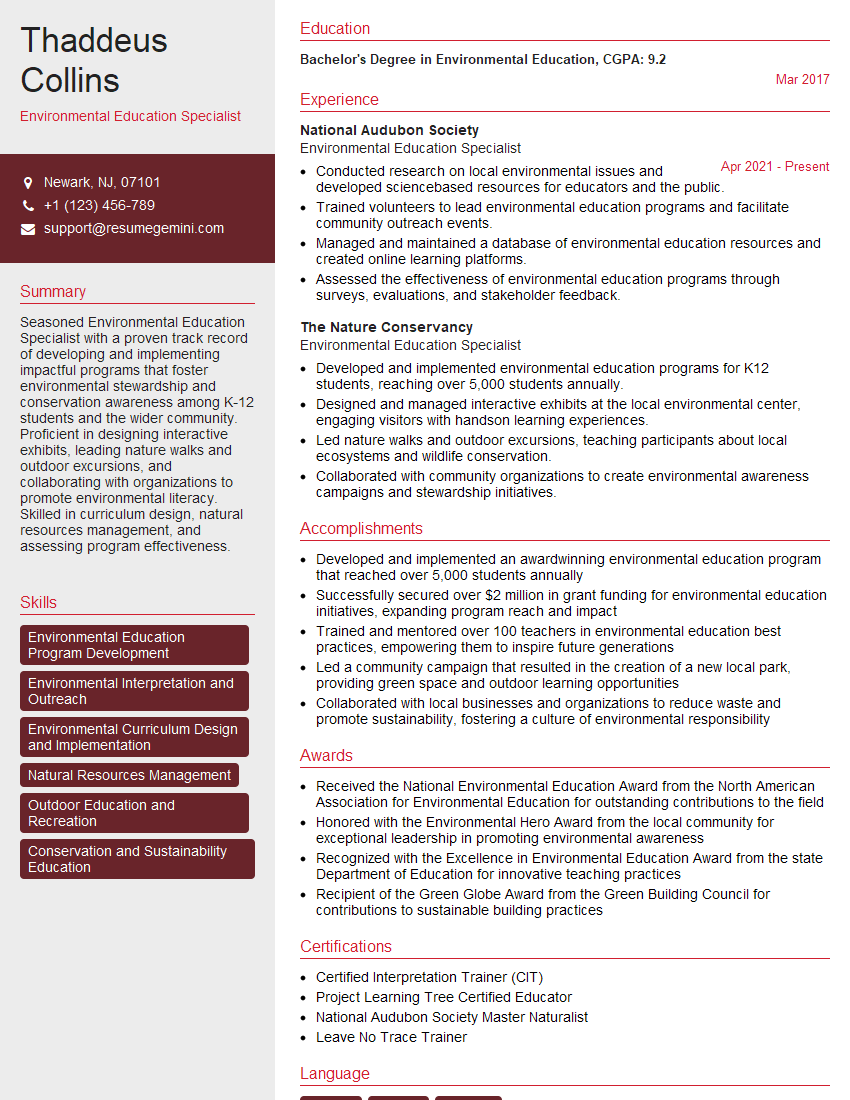
Mastering Conservation Education principles is crucial for a successful and rewarding career. It allows you to contribute meaningfully to environmental stewardship while impacting the next generation of conservationists. To significantly boost your job prospects, crafting a strong, ATS-friendly resume is paramount. ResumeGemini is a trusted resource that can help you build a professional resume that showcases your skills and experience effectively. Examples of resumes tailored to Conservation Education Programs are available to help you get started, providing templates and guidance for a successful application.

Explore more articles
Users Rating of Our Blogs
Share Your Experience
We value your feedback! Please rate our content and share your thoughts (optional).
What Readers Say About Our Blog
Amazing blog
Interesting Article, I liked the depth of knowledge you’ve shared.
Helpful, thanks for sharing.