Every successful interview starts with knowing what to expect. In this blog, we’ll take you through the top Cutting and Seaming Carpet interview questions, breaking them down with expert tips to help you deliver impactful answers. Step into your next interview fully prepared and ready to succeed.
Questions Asked in Cutting and Seaming Carpet Interview
Q 1. Explain the different types of carpet seaming techniques.
Carpet seaming techniques depend heavily on the type of carpet and the installation scenario. Generally, we have two main approaches: seam binding and heat seaming.
Seam Binding: This is a more traditional method, best suited for low-pile carpets. It involves carefully aligning the carpet edges, applying seam binder adhesive (a strong, flexible adhesive specifically designed for carpet), and then firmly pressing the seam together. It creates a strong, secure bond but may leave a slightly visible seam. Think of it like sewing two pieces of fabric together – the seam binder acts as the thread, holding the pieces firmly in place.
Heat Seaming: This technique is preferred for medium to high-pile carpets. It uses a specialized heat seaming iron to melt the carpet fibers along the edges, creating a nearly invisible, very strong seam. The iron melts a small area of the fibers, fusing them together. This creates a near-perfect blend, ideal for high-traffic areas and rooms where a seamless look is critical. Imagine it like welding two pieces of plastic together – heat fuses them into one.
Choosing the right technique is crucial. For example, heat seaming wouldn’t work well with a very delicate carpet, while seam binding might be visible on a luxurious, high-pile carpet. Experience helps in determining the best approach for each specific job.
Q 2. Describe your experience with power stretching carpet.
Power stretching is essential for creating a smooth, taut carpet surface and minimizing wrinkles. I’ve extensive experience using power stretchers, both the knee-kicker type and the electric power stretcher. The knee kicker is a great tool for smaller areas, allowing for precise control and manipulation. The electric stretcher is a real workhorse for larger projects, making quick work of stretching carpet across broad areas. I use the knee kicker when precision is paramount, such as in areas with intricate wall shapes, while the electric stretcher is ideal when working in large, open spaces. I’ve used them to solve many stretching challenges – for instance, in a recent project where a particularly stubborn section refused to flatten, I employed the electric stretcher, carefully working along the edges until the wrinkles were completely removed.
Beyond the technical skill, safe operation is paramount. Power stretching involves applying considerable force; understanding the stretcher’s mechanics and safety procedures is critical to prevent accidents and ensure quality work.
Q 3. How do you ensure a seamless transition between carpet sections?
Achieving a seamless transition requires meticulous planning and execution. It starts with accurate measurements and careful cutting of the carpet pieces, ensuring the pattern and color match perfectly. I always make sure the fibers are aligned along the seam line, preventing an unsightly mismatch. The chosen seaming technique (heat or binding) then plays a pivotal role. For heat seaming, perfectly aligned edges are critical for a truly invisible seam. For seam binding, careful adhesive application and firm pressure ensure a flat, strong bond. After seaming, I take the time to carefully groom the carpet fibers, using a power brush to blend the seam and remove any visible adhesive residue. The final step is checking the overall appearance, ensuring a continuous and natural look that’s indistinguishable from a single piece of carpet.
In essence, it’s a blend of precise cutting, proper seaming technique, and skillful finishing. This combination leads to a completely seamless, professional finish that hides the joins entirely.
Q 4. What types of adhesives are suitable for carpet seaming?
The right adhesive is critical for a durable and long-lasting seam. Different adhesives have different properties that make them suited for different carpet types and installation environments. I often use a high-quality, water-based seam binder adhesive designed for carpet. It provides excellent adhesion and flexibility, resisting cracking even with expansion and contraction of the carpet due to temperature changes. For heat seaming, specific tapes and backing materials are often required depending on the carpet. I always make sure the adhesive is compatible with the carpet fibers; checking manufacturer’s recommendations and performing small tests before applying on a large scale is a part of my routine. Choosing the wrong adhesive can lead to a weak seam, visible adhesive residue, or even damage to the carpet itself. My expertise helps me select the optimal adhesive based on the carpet type, location, and expected wear and tear.
Q 5. What tools and equipment are essential for precise carpet cutting and seaming?
Precision in carpet cutting and seaming relies on having the right tools. Essential equipment includes:
- Sharp Carpet Knives: These are crucial for clean, precise cuts. I prefer using utility knives with replaceable blades, ensuring consistent sharpness.
- Measuring Tapes and Squares: Accurate measurements are fundamental for avoiding errors.
- Seaming Iron (for heat seaming): This tool is vital for creating invisible seams in medium to high-pile carpets.
- Power Stretcher: This is critical for creating a smooth, taut carpet surface.
- Seam Binder Adhesive and Applicator: High-quality adhesive is essential for lasting seams.
- Power Brush: This is used for grooming the carpet after seaming and removing any visible adhesive residue.
- Knee Kicker: A secondary power stretching tool for more precise control.
Maintaining these tools is equally important. Sharp blades and a clean iron are essential for clean cuts and consistent results. Using dull tools can lead to uneven cuts and tearing, which ultimately affects the quality of the finished product.
Q 6. How do you handle difficult seaming situations, such as irregular walls or corners?
Irregular walls and corners present unique challenges, demanding more creative solutions. I often use templates and patterns, meticulously crafting carpet sections to fit the contours precisely. This is where precision cutting becomes vital. In some cases, I’ll need to create multiple smaller sections to fit snugly around awkward shapes. Power stretching skills are also crucial to pulling the carpet around corners and into tight spaces, eliminating gaps and wrinkles. Sometimes, specialized adhesive techniques or additional filler might be required. There’s no one-size-fits-all solution; adapting my approach based on the specific situation and utilizing my problem-solving skills is what sets me apart.
For example, in a recent project with a bay window, I created a custom-cut template to ensure a perfect fit. This involved careful measurement, multiple cuts, and precise alignment of the carpet sections. The final result was a beautifully installed carpet that seamlessly integrated with the window’s unique shape.
Q 7. Describe your process for calculating carpet quantities.
Accurate carpet calculation is the foundation of a successful project. It avoids costly material waste and ensures sufficient coverage. My process begins with detailed room measurements. I measure the length and width of each room meticulously, taking into account any irregularities. Then I add extra material for waste, considering factors like pattern matching, seam allowances and possible cutting errors. Complex shapes often require breaking down the area into smaller, manageable sections, measuring and calculating each one separately. I always round up calculations to ensure I have enough carpet to cover the area completely.
For example, if a room is 12 ft x 15 ft, the calculation would be 180 square feet, but I would add extra material for waste and pattern matching, probably arriving at a final quantity of at least 200 square feet.
Accurate calculation prevents costly mistakes and ensures a smooth project execution. It is an integral part of my approach, helping in providing a reliable quote to my clients.
Q 8. How do you measure and cut carpet to minimize waste?
Minimizing carpet waste requires meticulous planning and precise cutting. It starts with accurate measurements of the room. I always measure multiple times, using a laser measure for accuracy, and recording the dimensions in several places on my paperwork, accounting for any irregularities in the walls or floor. Then, I create a detailed layout diagram, considering the carpet’s roll width and the room’s shape to optimize placement. This helps determine the best way to arrange the pieces to minimize seams and leftover scraps. For instance, if a room is oddly shaped, I’ll try to position the longest pieces to utilize the maximum length of the carpet roll before cutting. This diagram acts as a roadmap, showing me exactly how much carpet to cut and where to place each piece.
After calculating the total square footage needed and factoring in waste, I add an extra 5-10% to account for unexpected issues or adjustments. This helps avoid running short during the installation. For example, if a room needs 100 square feet of carpet, I would order 105-110 square feet to be safe. Using a sharp, specialized carpet knife and a straight edge ensures clean, precise cuts, further reducing material waste. Finally, I always keep the leftover pieces for potential future repairs or small projects, further maximizing the use of materials.
Q 9. What safety precautions do you follow when using sharp tools?
Safety is paramount when handling sharp tools like carpet knives and utility knives. I always start by inspecting the blades to make sure they’re sharp and undamaged; a dull blade requires more force, increasing the risk of slips and cuts. I then wear appropriate safety gear, including sturdy work gloves with cut-resistant properties and safety glasses to protect my eyes from flying debris. When cutting, I maintain a firm grip on the knife and use a steady, controlled motion, never rushing the process. I also ensure a clean and clutter-free workspace to prevent accidental trips or falls. The carpet is always securely positioned before I begin cutting, and I never cut towards myself or anyone else. Once I finish cutting, I immediately sheathe the knife properly to prevent accidental cuts.
Finally, I always clean up any debris immediately after cutting to minimize the chance of someone stepping on a sharp piece. Following these procedures reduces the risk of injury considerably.
Q 10. How do you ensure the carpet is properly stretched and secured?
Proper stretching and securing of the carpet is crucial for a long-lasting, wrinkle-free installation. I utilize a power stretcher, a specialized tool that effectively pulls the carpet taut and ensures a snug fit against the floor. I begin by installing the carpet’s perimeter, using tack strips to secure the edges. These tack strips are nailed to the floor around the perimeter of the room, and the carpet is carefully tucked under them. This establishes a stable base for stretching.
Next, using the power stretcher, I gradually work from one wall to another, systematically stretching and pulling the carpet. This eliminates wrinkles and ensures even tension across the entire surface. As the carpet is stretched, I ensure that it lies flat and seamlessly fits around any existing features, such as doorways or thresholds. To further secure the carpet, I use adhesive, often a carpet adhesive that is appropriate for the subfloor. I use the correct adhesive for the type of floor to ensure that there is a perfect bonding. This creates a firm, lasting bond that prevents future issues like lifting or bubbling. Regular quality checks during the stretching process ensure there are no visible seams or bumps along the way.
Q 11. How do you deal with seams that become loose or unravel over time?
Loose or unraveling seams are a common issue, often caused by insufficient stretching, improper seaming techniques, or heavy foot traffic. Addressing them requires a careful approach. First, I inspect the affected area closely to determine the extent of the damage and the cause of the problem. If the seam has just come slightly loose, I can usually re-secure it by injecting carpet seam sealer into the gap, ensuring a strong bond between the two carpet pieces. This is a quick and effective solution. However, if the seam is significantly damaged or unraveling extensively, a more involved repair is needed.
In such cases, I may need to carefully lift the affected section, clean the area, and re-apply seam binder before resealing it with additional seam sealer. This provides a durable, long-lasting repair. If the damage is really severe, and the original seam is beyond repair, I may have to cut out the section and replace it with a fresh piece of carpet. The key to success is proper preparation and the use of high-quality materials to ensure a robust and invisible repair.
Q 12. Explain your experience with different types of carpet fibers.
My experience encompasses a wide range of carpet fibers, each with unique properties impacting installation and longevity. Nylon is a durable, versatile fiber resistant to stains and wear, making it suitable for high-traffic areas. I have installed many different types of nylon carpet. Polyester is a softer, more affordable option known for its resilience and moisture resistance, great for families. Olefin (polypropylene) is another common choice, prized for its stain resistance and affordability. However, it’s less durable than nylon. Wool is a luxurious, natural fiber offering exceptional softness, resilience, and insulation. But it’s more expensive and requires specialized cleaning. I’ve worked with all these fibers and consider the needs of the customer when recommending a suitable carpet for the space.
Understanding fiber characteristics allows me to tailor my installation techniques. For example, wool may require more gentle handling to avoid damage, while nylon’s durability allows for more aggressive stretching. This adaptability based on fiber type has enhanced my ability to handle any carpet installation challenge successfully.
Q 13. How do you match patterns and textures when seaming carpets?
Matching patterns and textures across seams is crucial for a seamless, aesthetically pleasing result, especially with patterned carpets. Before cutting, I carefully plan the layout of the carpet pieces, paying close attention to the pattern repeat—the distance it takes for the pattern to fully repeat itself. I measure this repeat and use it as a guide to ensure accurate alignment across the seams. Then, using large sections of the carpet, I make sure that the patterns perfectly match before making any cuts. This may involve creating temporary markings on the carpet to guide precise cutting. This meticulous approach avoids creating noticeable misalignments at seams.
For complex patterns, I may use pattern matching tools or templates to achieve perfect alignment. Furthermore, it is important to check the lighting and the angles of the light when matching the patterns. Lighting can easily distort patterns and seams. The goal is to make the seam virtually invisible from any angle, resulting in a beautiful and professional-looking finish.
Q 14. What are common challenges encountered during carpet installation?
Several challenges can arise during carpet installation. Uneven subfloors are a common problem, requiring leveling or the use of additional underlayment to create a smooth, stable base for the carpet. This prevents unevenness from showing up in the finished product. Difficult room shapes or layouts may also demand creative cutting and seaming techniques to minimize waste and maintain aesthetic appeal. Dealing with existing features, such as stairways, thresholds, and built-in cabinets, requires careful measuring and precise cutting, especially when matching patterns. Unexpected obstacles, like pipes or electrical wiring embedded in the floor, can add complications. And, finally, working with poorly-manufactured carpets with defects or inconsistent coloring may also impact the final result. To mitigate these challenges, careful planning, a meticulous approach, and problem-solving abilities are needed.
I always conduct a thorough pre-installation assessment to identify potential problems. It allows me to address any issues proactively and develop a plan to overcome them. Having the proper tools and materials and my years of experience help me navigate these challenges smoothly and deliver a satisfactory outcome.
Q 15. How do you troubleshoot issues like ripples or wrinkles in the finished carpet?
Ripples and wrinkles in finished carpet are frustrating, but usually stem from issues during installation. They indicate insufficient stretching, improper subfloor preparation, or inconsistent padding. Troubleshooting involves systematically checking each step.
- Subfloor Assessment: First, examine the subfloor for unevenness. A poorly leveled subfloor is a major culprit. Use a long straight edge to detect high or low spots. Significant inconsistencies necessitate subfloor repair before carpet installation.
- Padding Check: Uneven or inadequate padding can cause ripples. Ensure the padding is smooth, properly installed, and free of lumps or wrinkles. Replacing the padding is sometimes necessary.
- Seaming Issues: Poorly seamed carpet sections can create visible ridges. Re-examine the seams; improper seaming techniques or using incorrect seam tape can lead to bulging. Sometimes, slight lifting of the seam is enough to cause ripples; re-adhering the seam might resolve it.
- Stretching and Tacking: Inadequate stretching during installation is a frequent cause of wrinkles. The carpet should be firmly stretched and tacked along the perimeter to prevent bunching or sagging. If the carpet wasn’t properly stretched, it may require re-stretching using a power stretcher.
- Moisture Issues: Excessive moisture in the subfloor or padding can cause the carpet to expand and wrinkle. Addressing moisture problems is crucial; this might require the use of a moisture meter and professional advice.
Think of it like draping a sheet – if the surface isn’t flat, or the sheet isn’t properly smoothed and secured, you’ll get wrinkles. Carpet installation is similar; attention to detail in every step is critical.
Career Expert Tips:
- Ace those interviews! Prepare effectively by reviewing the Top 50 Most Common Interview Questions on ResumeGemini.
- Navigate your job search with confidence! Explore a wide range of Career Tips on ResumeGemini. Learn about common challenges and recommendations to overcome them.
- Craft the perfect resume! Master the Art of Resume Writing with ResumeGemini’s guide. Showcase your unique qualifications and achievements effectively.
- Don’t miss out on holiday savings! Build your dream resume with ResumeGemini’s ATS optimized templates.
Q 16. What is your experience with carpet seaming tape and its application?
Carpet seaming tape is essential for creating strong and invisible seams. My experience spans various types, including pressure-sensitive adhesive tapes, hot-melt tapes, and double-sided tapes. The choice depends on the carpet fiber and installation environment.
- Application Technique: Clean both carpet edges thoroughly before application. This eliminates dust and debris that can hinder adhesion. Apply the tape evenly, ensuring complete contact with both carpet sections. Use a seam roller to firmly press the tape and carpet together, ensuring strong adhesion.
- Tape Selection: Different tapes are suited for different carpet types and conditions. For instance, thicker carpets might need a stronger adhesive tape, while thinner carpets may benefit from a less aggressive adhesive. High-traffic areas might require more durable options.
- Maintaining Straight Seams: Accurate measurement and precise cutting are crucial before taping. Precise cutting tools and a consistent approach are needed to minimize the visibility of the seam. This is where experience in estimating carpet placement and cutting contributes to the best possible outcome.
I’ve found that proper tape selection and application is often overlooked, but it’s the key to a professional-looking, long-lasting carpet installation. It’s not just about sticking the pieces together; it’s about creating a seamless transition that won’t unravel or become noticeable over time.
Q 17. Explain your understanding of carpet padding and its role in installation.
Carpet padding plays a vital role in carpet installation, extending its lifespan and enhancing comfort. It acts as a cushion between the carpet and the subfloor.
- Comfort and Cushioning: Padding significantly enhances underfoot comfort by providing a softer feel. It reduces the hardness of the subfloor, making the carpet more plush and luxurious.
- Extended Carpet Life: Padding absorbs impact and reduces wear on the carpet fibers. It protects the carpet from the indentations of furniture and foot traffic, helping it last longer.
- Insulation: Some padding materials offer insulation properties, improving energy efficiency by reducing heat transfer through the floor.
- Sound Dampening: Padding reduces noise transmission, making the room quieter. It helps absorb sounds from foot traffic, furniture movement, and other sources.
- Types of Padding: Various padding types exist, including foam, rebond, and high-density foam. The choice depends on factors like budget, desired comfort level, and the carpet type.
Think of it as a mattress for your carpet. A good mattress makes your sleep more comfortable and extends its life. Similarly, good padding boosts comfort and extends the carpet’s lifespan, adding significant value to the installation.
Q 18. How do you prepare the subfloor for optimal carpet installation?
Subfloor preparation is crucial; a poorly prepared subfloor leads to a subpar carpet installation. The process involves several steps:
- Cleaning: Thoroughly clean the subfloor to remove dirt, debris, and old adhesive residue. A clean subfloor ensures proper adhesion of the padding and carpet.
- Leveling: Assess the subfloor’s levelness using a long straight edge. Repair any significant unevenness by filling low spots with self-leveling compound. This creates a smooth and even base for optimal carpet installation.
- Moisture Testing: Check for excessive moisture using a moisture meter. Excessive moisture can damage the carpet and padding. Addressing moisture problems – such as drying the floor or using a moisture barrier – is essential.
- Repairing Damage: Repair any damage to the subfloor such as cracks or holes, ensuring a solid foundation. Patching and filling are crucial here to prevent the carpet from sinking or causing trip hazards.
- Priming (If Needed): Depending on the subfloor material, priming might be necessary to enhance adhesion. This step ensures a smooth and even surface for the installation of padding.
Imagine building a house – you wouldn’t build it on an unstable foundation. Similarly, a properly prepared subfloor is the cornerstone of a successful carpet installation, ensuring that the carpet lays flat and lasts for years.
Q 19. What are the different types of carpet seaming equipment?
Carpet seaming equipment varies depending on the seaming method. However, common tools include:
- Power Stretchers: These tools are essential for stretching carpet to remove wrinkles and create a taut surface. They provide power and precision in stretching, especially for larger areas.
- Knee Kickers: These hand-held tools are used to manually stretch and position the carpet during seaming, especially in tight spaces. They work by leveraging the installer’s body weight to stretch the carpet firmly.
- Seam Irons or Heat Sealers: Used for heat seaming, these devices apply heat and pressure to melt the adhesive backing of the carpet, creating a strong and nearly invisible seam. They are crucial for a neat and lasting finish.
- Seam Rollers: Used after seaming, they help to press the seams flat and ensure proper adhesion of the tape or the heat-sealed seam. Their weight is important in compressing the seams firmly and making them secure.
- Carpet Knives and Shears: Sharp blades are essential for precise cutting to create straight seams. This contributes to the overall neatness of the carpet installation.
Just like a surgeon needs specialized instruments, carpet installers rely on these tools to ensure a professional and long-lasting result. The quality of the equipment directly impacts the quality of the seaming process.
Q 20. Describe your experience with heat seaming.
Heat seaming is a superior method for joining carpet sections. It involves applying heat and pressure to melt the adhesive on the back of the carpet, creating a strong, nearly invisible bond.
- Process: The edges of the carpet sections are carefully aligned and the seam iron is used to melt the adhesive. The precise application of heat and pressure is essential to achieve a smooth, continuous surface.
- Advantages: Heat seaming results in stronger and more durable seams compared to adhesive tapes. It is cleaner and yields a more aesthetically pleasing result because the seam is almost invisible.
- Equipment: Specialized seam irons are used, which have temperature controls and pressure settings. Maintaining the correct temperature is crucial to avoid damaging the carpet fibers or creating imperfections in the seam.
- Experience: It takes practice to master the technique and achieve consistent results. Controlling heat and pressure is critical for a strong and invisible seam, minimizing the visibility of the join.
Heat seaming, to me, is the gold standard in carpet seaming. While more specialized, the outcome – a virtually seamless floor – more than justifies the added effort. It’s a testament to the quality of the installation.
Q 21. How do you maintain a clean and organized work area?
Maintaining a clean and organized workspace is crucial for efficiency and safety. It is an integral part of the carpet installation process.
- Pre-Installation Organization: Before starting, I lay out all my tools and materials in a logical order. This ensures I can easily access what I need, reducing downtime and increasing efficiency.
- Waste Management: Carpet scraps and other waste materials are collected and disposed of properly throughout the process. This helps prevent tripping hazards and ensures a safe working environment.
- Tool Organization: Tools are kept clean and organized. This helps in preventing damage to the tools themselves as well as reducing the risk of damaging the carpet during the installation.
- Post-Installation Cleanup: After completion, I perform a thorough cleanup of the work area, removing all debris and waste materials. This leaves the space clean and ready for the client.
- Safety Precautions: All safety precautions are followed meticulously, including using appropriate personal protective equipment (PPE) and ensuring a clear and safe pathway around the work area. This ensures a safe working environment and prevents injury.
A clean and organized space isn’t just aesthetically pleasing; it’s essential for efficiency and safety. It allows me to focus on the job at hand, minimizing the chance of accidents and producing the best quality results.
Q 22. How do you handle customer complaints or issues?
Handling customer complaints is crucial for maintaining positive client relationships. My approach is centered around active listening, empathy, and finding practical solutions. First, I carefully listen to the client’s concerns without interruption, ensuring they feel heard and understood. Then, I calmly explain the situation from a professional perspective, offering possible explanations for the issue. For example, if a seam is slightly visible, I might explain the challenges of working with specific carpet types or the potential impact of subfloor imperfections. Finally, I work collaboratively with the client to find a mutually acceptable solution, whether it’s a minor adjustment, a partial re-installation, or a fair compensation. Documentation of the complaint, resolution, and customer feedback is vital for continuous improvement.
I always aim for a win-win scenario; resolving the issue promptly and professionally demonstrates commitment to customer satisfaction. Even if the complaint isn’t entirely justifiable, maintaining a respectful and understanding tone prevents escalation and fosters trust.
Q 23. What are your preferred methods for removing carpet seams?
Removing carpet seams requires precision and care to avoid damaging the surrounding carpet. My preferred method depends on the type of seam and the adhesive used. For seams secured with heat-weld adhesive, I use a sharp utility knife, carefully scoring the adhesive along the seam line before gently lifting the carpet apart. For seams glued with a water-based adhesive, I often use a seam lifter tool, applying gentle pressure to separate the carpet sections. This tool helps prevent tearing and preserves the integrity of the carpet fibers.
In both cases, I always start with a small section to assess the strength of the adhesive and adjust my technique accordingly. Protecting the surrounding carpet with a drop cloth is also essential to prevent accidental damage during removal. Safety is paramount, so I always use appropriate personal protective equipment, like gloves and safety glasses.
Q 24. Explain your understanding of different carpet installation methods (e.g., direct glue, tack strip).
Carpet installation methods vary depending on the type of carpet, the subfloor, and the client’s preferences. Two common methods are direct glue-down and tack strip installation.
- Direct Glue-Down: This method involves applying an adhesive directly to the subfloor and then adhering the carpet to it. It’s suitable for smooth, level subfloors and provides a very flat, seamless finish. This is ideal for commercial applications or when a completely flat surface is required. The adhesive used must be appropriate for both the subfloor and the carpet backing.
- Tack Strip Installation: This involves using a tack strip, a wooden strip with embedded tacks, along the perimeter of the room. The carpet is then stretched and secured to the tack strip using a knee kicker or power stretcher. This is a more traditional method, generally suitable for residential applications and allows for some subfloor imperfections to be accommodated. The carpet is then trimmed to fit and secured to the tack strip, creating a snug fit.
Choosing the correct method is a critical step that requires a thorough assessment of the project requirements. Factors such as the type of carpet, the condition of the subfloor, and the client’s budget all play a crucial role in determining the most appropriate installation technique.
Q 25. What experience do you have with various carpet styles (e.g., Berber, plush, textured)?
My experience encompasses a wide range of carpet styles. I’ve worked extensively with:
- Berber: This style is known for its durability and low-pile texture. I understand the importance of precise cutting and seaming to ensure a consistent look, as imperfections are more visible in this type of carpet.
- Plush: Plush carpets are luxurious and soft, but they can be more challenging to install due to their sensitivity to stretching and potential for show-through of seams. Accurate measurements and careful seaming are vital to maintain the consistent appearance and feel of the plush surface.
- Textured: Textured carpets offer both style and durability. The varied textures can sometimes make seaming a bit trickier, requiring attention to detail to ensure a seamless transition between carpet sections.
Working with different carpet styles requires adaptability and a deep understanding of their individual characteristics to achieve optimal results.
Q 26. How do you calculate the cost of materials for a carpet installation project?
Calculating material costs for a carpet installation project involves several steps. First, I accurately measure the area to be carpeted, usually in square feet. I then add a percentage for waste, typically 5-10%, depending on the complexity of the room and the carpet pattern. This accounts for cuts, seams, and potential mistakes. The total square footage is then multiplied by the cost per square foot of the chosen carpet.
In addition to the carpet itself, I factor in the cost of padding (underlayment), which provides cushioning and insulation. This cost is calculated based on the square footage and the type of padding selected. Finally, I include the costs of any necessary adhesives, tack strips, seam binding, and other installation materials. I provide the client with a detailed breakdown of all costs, ensuring transparency and building trust.
For example: If the area is 200 sq ft, with 10% waste (20 sq ft), the carpet cost is $5/sq ft, and padding costs $2/sq ft, the material cost would be (220 sq ft * $5/sq ft) + (220 sq ft * $2/sq ft) = $1540. Additional materials might add another $50-100.
Q 27. Describe your experience working within a team and adhering to deadlines.
Teamwork is essential in carpet installation, especially for larger projects. My experience involves collaborating effectively with installers, project managers, and clients. I communicate openly and clearly, contributing my expertise to ensure the project runs smoothly and meets deadlines. I’m comfortable taking the lead on tasks requiring specialized skills, while readily supporting team members in other areas.
For example, on a recent large commercial project, we had a tight deadline. By proactively identifying potential bottlenecks and coordinating with the other installers, we managed to complete the installation ahead of schedule. This required constant communication, flexible scheduling, and a willingness to help out wherever needed.
My commitment to punctuality and meeting deadlines is unwavering. I understand that delays can impact subsequent stages of a project and may inconvenience clients. I proactively manage my time, prioritize tasks, and maintain a realistic schedule to ensure project completion on time.
Q 28. How do you ensure the finished carpet meets the client’s expectations and industry standards?
Ensuring client satisfaction and adherence to industry standards is my top priority. Before commencing any project, I discuss the client’s expectations in detail, confirming their understanding of the chosen carpet style, color, and installation method. I show samples, address any questions, and confirm all measurements to prevent misunderstandings. During the installation, I maintain meticulous attention to detail, carefully aligning seams, ensuring proper stretching, and checking for any imperfections.
After installation, I conduct a thorough inspection with the client, addressing any concerns and obtaining their final approval. I am always mindful of industry best practices, using appropriate tools and materials, adhering to safety regulations, and maintaining a clean and organized worksite. Client feedback is valuable for continuous improvement and helps me refine my processes to consistently meet and exceed expectations.
Key Topics to Learn for Cutting and Seaming Carpet Interview
- Carpet Types and Properties: Understanding different carpet fibers (nylon, polyester, wool), pile heights, and their impact on cutting and seaming techniques.
- Measuring and Estimating: Accurately measuring spaces, calculating carpet yardage, and estimating material needs for efficient job completion. This includes understanding waste factors and allowances for seams.
- Cutting Techniques: Mastering various cutting methods using different tools (knives, shears, power cutters) to achieve precise and clean cuts, minimizing waste and ensuring accurate seam alignment.
- Seaming Methods: Proficiency in different seaming techniques (e.g., heat-sealing, adhesive bonding) for creating strong, invisible seams that maintain carpet integrity and aesthetic appeal.
- Pattern Matching and Layout: Understanding how to effectively match patterns and arrange carpet pieces to minimize waste and create a visually appealing finished product. This includes working with different carpet layouts and orientations.
- Problem-Solving and Troubleshooting: Identifying and resolving common issues such as mismatched seams, uneven cuts, and material defects. Demonstrating practical problem-solving skills is crucial.
- Safety Procedures and Equipment: Knowledge of safe handling of cutting tools and equipment, adhering to safety regulations, and understanding potential hazards associated with the job.
- Industry Standards and Best Practices: Familiarity with relevant industry standards, best practices for carpet installation, and quality control procedures.
Next Steps
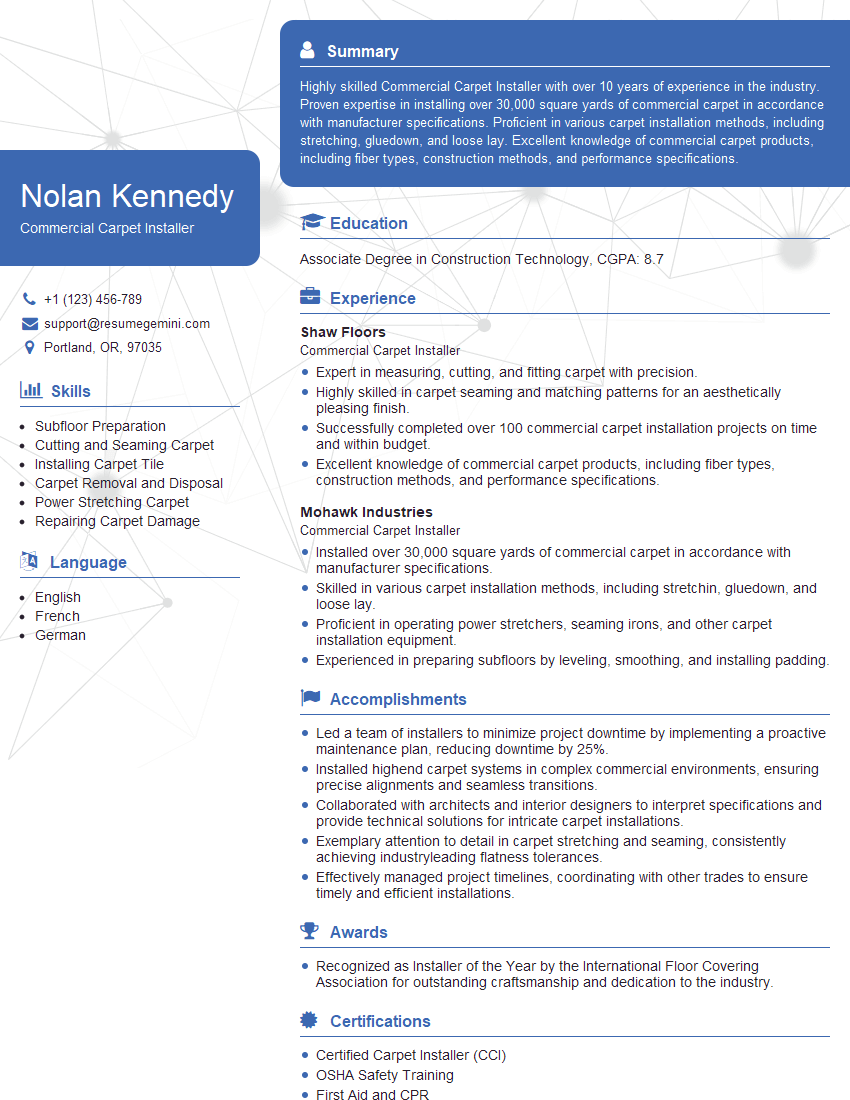
Mastering cutting and seaming carpet skills opens doors to a rewarding career with excellent growth potential. From entry-level installer to project manager, your expertise in this field is highly valued. To maximize your job prospects, creating a strong, ATS-friendly resume is essential. ResumeGemini is a trusted resource that can help you build a professional and impactful resume that highlights your skills and experience effectively. Examples of resumes tailored to the Cutting and Seaming Carpet industry are available to guide you through the process.




Explore more articles
Users Rating of Our Blogs
Share Your Experience
We value your feedback! Please rate our content and share your thoughts (optional).
What Readers Say About Our Blog
Amazing blog
Interesting Article, I liked the depth of knowledge you’ve shared.
Helpful, thanks for sharing.