The right preparation can turn an interview into an opportunity to showcase your expertise. This guide to Door Varnishing interview questions is your ultimate resource, providing key insights and tips to help you ace your responses and stand out as a top candidate.
Questions Asked in Door Varnishing Interview
Q 1. What types of varnish are best suited for interior and exterior doors?
Choosing the right varnish depends heavily on the location and the type of door. For interior doors, you have a wider variety of options, including water-based varnishes, which are low-odor and easy to clean up, and oil-based varnishes, known for their durability and rich finish. Water-based varnishes are often preferred for their ease of use and low environmental impact. However, oil-based varnishes provide superior protection against moisture and wear, making them a good choice for high-traffic areas. For exterior doors, the key is weather resistance. Exterior-grade polyurethane varnish is essential as it provides excellent protection against UV rays, moisture, and extreme temperatures. It’s crucial to look for varnishes explicitly labeled for exterior use to ensure longevity and prevent damage to the door.
Think of it like choosing paint – interior paint is designed for indoor conditions, while exterior paint has additives to withstand the elements. The same principle applies to varnish.
Q 2. Explain the process of preparing a door for varnishing.
Preparing the door is just as crucial as the varnishing itself. A poorly prepared surface will result in a poor finish. The process typically involves these steps:
- Cleaning: Thoroughly clean the door’s surface to remove dust, dirt, grease, and any previous finishes. A mild detergent and water are usually sufficient. Allow to dry completely.
- Repairing: Fill any holes, cracks, or imperfections with wood filler. Once dry, sand it smooth.
- Sanding: Sand the entire surface using progressively finer grit sandpaper (starting with coarser grit like 80-100, then moving to 120-150, and finishing with 220-240). This creates a smooth surface for better varnish adhesion. Between each grit, remove dust thoroughly with a tack cloth. Remember to sand with the grain of the wood to avoid scratches.
- Priming (Optional but Recommended): A primer helps to seal the wood, improve adhesion of the varnish, and ensure a more even color. Choose a primer compatible with your varnish (water-based primer for water-based varnish, etc.).
Imagine preparing a canvas before painting – you wouldn’t start painting directly on a rough, dirty canvas, right? The same logic applies here. Proper preparation ensures a flawless finish.
Q 3. What are the common problems encountered during the varnishing process and how do you address them?
Common problems include:
- Brush Strokes/Uneven Finish: This often arises from using too much varnish, applying it unevenly, or not sanding sufficiently. Solution: Use thin coats, feather the edges, and ensure proper sanding.
- Runs and Drips: These occur when applying too thick a coat or working in too hot an environment. Solution: Apply thinner coats and work in cooler temperatures.
- Dust Nibs: Tiny pieces of dust that get embedded in the wet varnish. Solution: Work in a dust-free environment, use a tack cloth regularly, and consider using a spray varnish.
- Poor Adhesion: This happens if the surface isn’t properly prepared or if incompatible products are used. Solution: Ensure thorough cleaning, sanding, and primer application; use compatible products.
Troubleshooting these issues involves understanding the root cause and addressing it systematically. Patience and attention to detail are crucial.
Q 4. How do you ensure a smooth, even finish when applying varnish?
Achieving a smooth, even finish involves a combination of techniques:
- Thin Coats: Multiple thin coats are better than one thick coat. This allows each layer to dry properly, reducing the chances of runs and drips.
- Proper Application Technique: Use smooth, even strokes, feathering the edges of each stroke to blend seamlessly into the next. Work with the grain of the wood.
- Sanding Between Coats: Lightly sanding between coats with fine-grit sandpaper helps to level the surface, ensuring a flawless finish. Always remove the dust thoroughly before applying the next coat.
- High-Quality Varnish and Tools: Using a good quality varnish and appropriate brushes or spray equipment makes a noticeable difference.
Think of it like layering cake frosting; multiple thin layers create a smooth, even surface, far better than one thick layer.
Q 5. What safety precautions should be taken when working with varnish?
Safety is paramount when working with varnish. Always:
- Work in a well-ventilated area: Varnish fumes can be harmful. Consider working outdoors or using respirators.
- Wear appropriate protective gear: Gloves, safety glasses, and a respirator are essential to protect your skin, eyes, and respiratory system.
- Store varnish properly: Keep varnish away from sources of ignition and out of reach of children and pets.
- Follow manufacturer instructions: Carefully read and follow the instructions on the varnish container, paying close attention to safety precautions and drying times.
- Dispose of waste responsibly: Varnish and cleaning materials should be disposed of according to local regulations.
Remember, prevention is key. Taking these safety measures will protect you and the environment.
Q 6. What are the different methods of applying varnish (brush, spray, roller)? What are the advantages and disadvantages of each?
Several methods can be employed for applying varnish:
- Brush Application: This is a traditional method, offering good control and suitability for detailed work. Advantages: precise application, good for smaller areas. Disadvantages: can leave brush marks if not applied carefully, more labor-intensive.
- Roller Application: Efficient for large, flat surfaces. Advantages: fast coverage. Disadvantages: can leave roller marks, less control over application.
- Spray Application: Provides an even, smooth finish, ideal for large projects. Advantages: even coat, fast application. Disadvantages: requires specialized equipment, can be messy if not done carefully, may require more protective gear due to overspray.
The best method depends on the size and complexity of the project, your skill level, and the desired finish.
Q 7. How do you achieve a high-gloss finish?
Achieving a high-gloss finish requires attention to detail and the right technique:
- Use a high-gloss varnish: The type of varnish is crucial; choose a varnish specifically formulated for a high-gloss finish.
- Multiple thin coats: Apply several thin coats, sanding lightly between each coat with fine-grit sandpaper (320-400 grit) to create a perfectly smooth surface.
- Proper sanding: Meticulous sanding is key. Any imperfections will show through the high gloss finish.
- Controlled environment: Work in a dust-free environment to avoid dust nibs.
- Spray application (recommended): Spray application usually yields a superior high-gloss finish compared to brushing or rolling, due to the even coat it delivers.
A high-gloss finish is like a mirror reflecting light – any imperfections will be magnified. Careful preparation and application are essential for a truly stunning result.
Q 8. How do you achieve a matte finish?
Achieving a matte finish on a varnished door relies on selecting the right varnish in the first place. A matte varnish is specifically formulated to produce a low-sheen, non-reflective surface. Avoid high-gloss or satin varnishes as these will inherently produce a shine. The application technique itself is also important. Applying thin, even coats is crucial to prevent build-up, which can lead to an unwanted sheen even with a matte varnish. Think of it like painting a wall – multiple thin coats are better than one thick coat. Finally, the sanding process plays a role; a light sanding between coats with very fine grit sandpaper (around 320-400 grit) can help remove any imperfections and subtly reduce the sheen.
In short: Choose a matte varnish, apply thin coats, and lightly sand between coats for the best matte result.
Q 9. How do you handle drips and runs during varnish application?
Drips and runs are the bane of any varnishing project. Preventing them is far better than dealing with them after the fact. The key is to use the correct varnish consistency. If it’s too thick, it’s more prone to dripping. Similarly, overloading your brush with varnish is a recipe for disaster. Aim for a consistent, thin coat. If you do have drips or runs, don’t panic! The best approach is to act quickly. Before the varnish dries, gently wipe away the excess using a clean, soft cloth or a brush dipped in a bit of varnish thinner (always check the thinner recommendation on your varnish can). Work slowly and carefully, using a light touch to avoid disturbing the surrounding finish. For larger runs, you might need to gently scrape them away with a sharp tool such as a putty knife, taking care not to damage the surrounding area. Once the area is clean, you can apply a touch up varnish once it’s thoroughly dry to blend in.
Remember: Prevention is key. Use the right consistency, avoid overloading the brush, and act quickly if drips occur.
Q 10. How do you clean your brushes and equipment after varnishing?
Cleaning your brushes and equipment immediately after varnishing is essential to prolong their lifespan and avoid varnish hardening which makes them useless. For oil-based varnishes, you’ll need a solvent like mineral spirits or turpentine. For water-based varnishes, warm soapy water is sufficient. Thoroughly wash the brushes until the water or solvent runs clear, ensuring all varnish residue is removed. Then reshape the brushes and allow them to dry completely. For equipment like rollers and trays, the same cleaning method applies, but you might need to scrub more vigorously to remove any stubborn varnish. Always follow the manufacturer’s recommendations on the varnish can for the best cleaning practices, as some varnishes may have specific requirements.
Tip: Store brushes in a container with their bristles immersed in the appropriate thinner or cleaning solution to further help prevent them from hardening.
Q 11. Describe your experience with different types of wood and their specific varnishing requirements.
Different woods have unique porosity and grain structures, demanding a tailored approach to varnishing. For instance, hardwoods like oak and maple are generally denser and require fewer coats to achieve a smooth finish compared to softer woods such as pine or fir. Softwoods are more porous and might absorb more varnish, needing extra coats to achieve the desired level of protection. Furthermore, some woods have more prominent grain patterns which may require more care during the application process to ensure uniform coverage and to prevent the varnish from settling unevenly into the grain. Woods with open grain (like oak) may benefit from a wood filler before varnishing to create a smoother surface. Always test a small inconspicuous area of the door before beginning to ensure compatibility between the wood and the chosen varnish.
Example: I once worked on a project involving a highly figured mahogany door. Its complex grain required extra care, thin coats, and meticulous brushwork to highlight its beauty without obscuring the detail. For a pine door, however, I could get away with slightly thicker coats as the grain is more uniform and less prone to blemishes
Q 12. How do you determine the appropriate number of coats of varnish needed?
Determining the number of varnish coats depends on several factors, including the wood type, the desired level of protection, the opacity of the varnish and the finish quality. A general rule is to aim for at least two coats. However, more coats are often needed for better protection, particularly in areas exposed to heavy wear and tear. Softwoods usually require more coats than hardwoods. The desired level of gloss also plays a role. A high gloss usually needs more coats to build up the desired shine. Inspect the door after each coat to assess the coverage and smoothness. If there are any visible imperfections, another coat will be necessary. Once the finish looks even and complete and provides the desired level of protection, you can stop. This is often a matter of personal preference and experience.
Example: For an exterior door, I would typically apply three or even four coats for optimal protection against the elements. For an interior door in a low-traffic area, two coats might suffice.
Q 13. What is the ideal drying time between coats of varnish?
The ideal drying time between coats of varnish varies depending on the type of varnish, temperature, and humidity. Always consult the manufacturer’s instructions on the varnish can for precise drying times. Generally, oil-based varnishes require a longer drying time (often 24 hours or more) between coats compared to water-based varnishes, which may dry in as little as 4-6 hours. However, it’s best to err on the side of caution. Rushing the process can lead to a poor finish or even peeling. Make sure the previous coat is completely dry and dust-free before applying the next. Touching the surface lightly should reveal no tackiness.
Recommendation: It’s always safer to wait slightly longer than the minimum recommended drying time to ensure proper adhesion between coats.
Q 14. What are the signs of varnish failure, and how can they be prevented?
Varnish failure can manifest in several ways, including peeling, cracking, blistering, and discoloration. Peeling often indicates poor surface preparation or insufficient drying time between coats. Cracking might be a result of using an incompatible varnish type or applying it too thickly. Blistering usually stems from moisture trapped under the varnish. Discoloration can be caused by exposure to sunlight or other environmental factors. Prevention is crucial and involves proper surface preparation (cleaning, sanding, priming where necessary), selecting the right varnish for the application (interior vs. exterior), applying thin even coats, and allowing sufficient drying time between coats. Regular maintenance, such as cleaning and occasional reapplication, helps prolong the life of the varnish.
Example: Blistering on an exterior door suggests trapped moisture. This could be prevented by ensuring the wood is completely dry before varnishing and using a varnish specifically designed for exterior use.
Q 15. How do you handle different types of wood grain?
Handling different wood grains effectively is crucial for a professional finish. Different grains absorb and show varnish differently. For instance, a smooth, closed-grain wood like maple requires a different approach than an open-grained wood like oak.
- Closed-grain woods: These accept varnish smoothly. I typically use a high-quality brush or sprayer to apply thin, even coats, ensuring minimal build-up to avoid obscuring the natural beauty of the grain. Any sanding between coats should be very light with fine-grit sandpaper (like 320 or higher).
- Open-grain woods: Open-grained woods like oak need to be filled before varnishing to create a smooth surface. I often use wood filler appropriate for the wood type, allowing it to dry completely before sanding it down to level. This prevents uneven varnish absorption and a blotchy finish. I usually use a stain before filling and finishing with varnish to enhance the wood’s color and grain.
- Figured woods: Woods with dramatic grain patterns like burl or quilted maple require careful consideration. The goal is to highlight, not hide, the figure. Multiple thin coats with very fine sanding in between help achieve this. I’ll often use a wiping varnish for better control and less chance of obscuring the delicate pattern.
Remember, proper preparation is key. Regardless of the wood type, I always ensure the wood is clean, dry, and properly sanded before applying any varnish.
Career Expert Tips:
- Ace those interviews! Prepare effectively by reviewing the Top 50 Most Common Interview Questions on ResumeGemini.
- Navigate your job search with confidence! Explore a wide range of Career Tips on ResumeGemini. Learn about common challenges and recommendations to overcome them.
- Craft the perfect resume! Master the Art of Resume Writing with ResumeGemini’s guide. Showcase your unique qualifications and achievements effectively.
- Don’t miss out on holiday savings! Build your dream resume with ResumeGemini’s ATS optimized templates.
Q 16. What are your experiences with different types of varnish (oil-based, water-based, etc.)?
My experience encompasses a wide range of varnishes, each with its own advantages and disadvantages:
- Oil-based varnishes: These offer excellent durability, depth of color, and a beautiful, warm finish. They are self-leveling and tend to produce a smoother finish without as much sanding between coats. However, they have a strong odor, take longer to dry, and require solvents for cleanup. I use them when maximum durability and a rich look are essential, especially on doors exposed to harsh conditions.
- Water-based varnishes: These are low-odor, fast-drying, and easy to clean up with water. They are environmentally friendlier and offer good durability. However, they can sometimes raise the grain more than oil-based varnishes, requiring extra sanding. They are my go-to choice for interior doors and projects where fast turnaround is important, especially in homes with children or pets.
- Polyurethane varnishes: Polyurethane varnishes offer exceptional durability and scratch resistance. They come in both oil-based and water-based formulas. I choose them for doors in high-traffic areas, and select the oil- or water-based version based on project requirements and environmental concerns.
- Shellac: Shellac is a natural resin-based varnish, offering a warm, amber-toned finish. It’s a very delicate finish that requires careful handling. I reserve this for high-end projects where its unique qualities are appreciated and valued.
The choice of varnish always depends on the specific project requirements, the type of wood, the desired finish, and environmental considerations.
Q 17. How do you maintain a clean and organized work area?
Maintaining a clean and organized work area is paramount for efficiency and safety. My approach involves:
- Dedicated space: I have a designated area for varnishing, separated from other tasks to minimize cross-contamination and accidental spills.
- Proper ventilation: Good ventilation is crucial to avoid inhaling varnish fumes. I always work in a well-ventilated area or use respirators, especially when working with oil-based products.
- Organized tools: My tools are kept neatly arranged and easily accessible. This saves time and reduces frustration during the varnishing process. Brushes, rags, sandpaper and other supplies are well organized and labeled
- Clean-up procedures: I have a dedicated container for waste materials and use appropriate solvents for cleaning brushes and equipment immediately after use. This helps prevent build up and ensures my work area remains functional and safe. Spills are cleaned up immediately.
A clean workspace promotes efficiency, accuracy, and minimizes the risk of accidents or defects in the finished product.
Q 18. How do you manage your time effectively when varnishing multiple doors?
Varnishing multiple doors requires meticulous planning and efficient execution. My strategy involves:
- Prioritization: I prioritize doors based on deadlines and urgency. Urgent projects take precedence.
- Batching: I group similar doors together to streamline the process. For example, I’ll varnish all doors requiring the same type of varnish and finish consecutively. This reduces the time spent switching between materials and techniques.
- Staggering coats: Instead of applying multiple coats to one door and moving on, I apply one coat to multiple doors, allowing adequate drying time before the second coat. This ensures effective use of my time and allows all doors to progress in tandem
- Scheduling: I create a detailed schedule indicating the tasks for each day, allowing ample time for drying between coats and other tasks.
This systematic approach minimizes downtime and ensures timely completion of all projects.
Q 19. Describe your experience working with specialized varnishing equipment.
My experience with specialized varnishing equipment includes using:
- Sprayers (HVLP and airless): Sprayers provide a uniform finish and are efficient for large surfaces. HVLP (High Volume Low Pressure) sprayers minimize overspray and waste. Airless sprayers are faster but require more careful control and are suitable for larger projects where speed is critical. I choose the appropriate sprayer based on the job and the varnish type.
- Brush applicators: For detailed work and smaller surfaces, high-quality brushes are still indispensable. I use different brush types depending on the varnish and desired finish.
- Sanding tools (orbital sanders): Orbital sanders are essential for achieving a smooth surface between coats. I use various grits depending on the stage of the project. I prefer random orbital sanders for their effectiveness in avoiding swirl marks.
Proficiency with these tools ensures professional-quality results and speeds up the varnishing process.
Q 20. How do you troubleshoot common problems like bubbles or uneven surfaces?
Troubleshooting common problems is a vital skill. Here’s how I handle some:
- Bubbles: Bubbles usually result from applying varnish too thickly or working in a dusty environment. To prevent this, I apply thin, even coats and ensure the work area is clean. If bubbles appear, I gently pop them with a needle after they’ve partially dried and then lightly sand the area before applying another coat.
- Uneven surfaces: Uneven surfaces often indicate improper sanding or uneven varnish application. I always sand between coats, ensuring a smooth surface before each subsequent coat. Using appropriate sanding tools and techniques for the wood grain, and being careful not to sand through previous coats are critical
- Runs or drips: Runs or drips are often caused by applying too much varnish or working too slowly. I apply thin coats and allow each coat to dry completely before applying the next. Excess varnish should be removed before drying.
- Dust nibs: Dust nibs are small imperfections that appear from dust settling on a wet coat of varnish. Maintaining a clean work environment and using proper ventilation are key. These can sometimes be removed with careful sanding between coats.
Careful attention to each stage of the process and quick responses to these problems prevent major rework and assure a successful outcome.
Q 21. What are your methods for protecting the surrounding area from varnish spills?
Protecting the surrounding area is essential to avoid costly cleanups and damage. My methods include:
- Drop cloths: I use heavy-duty drop cloths to cover the floor and surrounding surfaces. I make sure they extend far enough to completely protect the area. Plastic sheeting is useful, but some paints and varnishes can dissolve it, so I avoid that unless I know it won’t be a problem.
- Masking tape: I use painter’s masking tape to protect areas that cannot be covered with drop cloths, such as door frames, hinges, and hardware. I ensure the tape is applied neatly to prevent paint bleeding under it.
- Plastic sheeting and sealant: For particularly sensitive areas or expensive materials, I employ plastic sheeting and sealant to ensure complete protection against accidental spills. This is particularly useful in high-end projects.
- Careful application: I prioritize meticulous application of varnish, avoiding overspray and dripping. This minimizes the need for extensive cleanup. This is my first line of defence!
Combining these preventative measures with careful work habits minimizes the risk of spills and simplifies cleanup.
Q 22. Describe your experience with different sanding techniques for pre and post-varnishing.
Sanding is crucial for a flawless varnish finish. Pre-varnishing sanding removes imperfections and ensures proper varnish adhesion. Post-varnishing sanding smooths between coats, eliminating brush strokes and imperfections. I use a variety of techniques depending on the wood and desired finish.
Pre-Varnishing: I start with coarser grit sandpaper (e.g., 80-120 grit) to remove major imperfections and then progressively move to finer grits (e.g., 180-220 grit) for a smoother surface. For very delicate woods, I might start even finer. I always sand with the grain to avoid scratches. This is like preparing a canvas before painting – you wouldn’t start with a rough texture!
Post-Varnishing (between coats): This involves much finer grits (e.g., 220-320 grit or even higher, depending on the varnish). The goal here is to lightly smooth out any imperfections from the previous coat without removing too much of the varnish itself. This is like refining a sculpture – careful work is needed for the final polished surface. I always use a tack cloth to remove sanding dust before applying each subsequent coat. This prevents dust particles from getting embedded in the varnish.
Sanding Techniques: I employ both hand sanding (for intricate areas) and power sanding (for larger, flat surfaces). Power sanders need to be used with utmost care to avoid sanding too deeply or creating uneven surfaces. I always test my sanding technique on an inconspicuous area first.
Q 23. How do you handle touch-ups after the initial varnishing is complete?
Touch-ups are inevitable, especially on doors prone to damage. My approach involves careful matching of the varnish and a meticulous application process.
Color Matching: I always keep a small sample of the original varnish, so that if a touch-up is needed, I can make sure the colour is precisely matched. Sometimes a little experimentation is needed to get the perfect shade.
Surface Preparation: The area needs to be meticulously cleaned and lightly sanded (with very fine grit sandpaper) to ensure the new varnish bonds smoothly. I use a fine brush to avoid introducing additional texture or leaving brush strokes.
Application: I apply the varnish thinly and evenly, allowing ample drying time. Multiple thin coats are always preferable to one thick coat to prevent runs and drips. If the area is very small, a toothpick or a very fine art brush might be used for precise application.
Blending: After the touch-up dries, I lightly sand the area again with ultra-fine grit sandpaper and blend it seamlessly with the surrounding area, making sure the transition is invisible.
Q 24. Explain your process for quality control during and after the varnishing process.
Quality control is paramount. I implement checks throughout the entire varnishing process.
Wood Preparation: Before starting the varnishing process, I thoroughly inspect the door for any imperfections or damage that needs to be addressed, such as dents, scratches, or knots.
Sanding Check: After each sanding stage, I visually and tactilely inspect the surface to ensure smoothness and evenness. I look for any remaining scratches or imperfections that might affect the final finish.
Varnish Application: During varnish application, I carefully monitor for runs, drips, or uneven coats, adjusting my technique as needed. I maintain consistent application to ensure an even finish.
Drying and Curing: I allow sufficient drying time between coats, following the manufacturer’s recommendations for the specific type of varnish. Proper curing is essential for achieving a durable and long-lasting finish. Temperature and humidity also affect the drying process.
Final Inspection: Once the varnishing is complete, I conduct a thorough final inspection under various lighting conditions. I check for any imperfections, blemishes, or inconsistencies in the finish. I also make sure the sheen level is consistent across the surface.
Q 25. What is your experience with stain and varnish combination finishes?
Stain and varnish combinations offer a wide array of customization options, allowing for both color and protection. I have extensive experience with various techniques.
Pre-Stain Sanding: Before staining, thorough sanding is crucial for even stain absorption. Uneven sanding can lead to blotchy results.
Stain Application: I apply the stain following the manufacturer’s instructions, ensuring even coverage and avoiding pooling. Multiple thin coats are better than one thick coat. I use different application methods depending on the wood grain and desired effect.
Drying Time: I allow ample drying time between stain and varnish applications. Insufficient drying can result in the varnish lifting the stain.
Varnish Application: Once the stain is dry, I apply the varnish in thin, even coats, ensuring proper coverage. The varnish protects the stain and provides a durable finish.
Example: I recently completed a project where I used a dark walnut stain on a cherry wood door, followed by three coats of satin polyurethane varnish. The result was a beautiful, deep, rich color with a protective layer.
Q 26. How do you handle damaged or repaired areas of a door before varnishing?
Damaged or repaired areas require special attention before varnishing to ensure a seamless finish. My approach depends on the type and extent of the damage.
Minor Scratches/Dings: These can often be addressed with careful sanding and filling using wood filler that matches the door’s color. After the filler dries, I sand the area smooth and proceed with the varnishing process.
Significant Damage: More extensive damage might require wood patching or repair techniques. The repaired area should be completely integrated with the surrounding wood, smoothed, and sanded before any staining or varnishing. I use clamps to ensure the repaired section remains securely attached.
Primer: A primer can be beneficial for areas with significant damage or repairs. It provides a uniform base for better adhesion and prevents the underlying repair from showing through the varnish.
Color Matching: It’s essential to carefully match the color and texture of the repaired areas to the rest of the door to ensure an invisible repair.
Q 27. What is your understanding of different varnish sheen levels?
Varnish sheen levels significantly affect the final appearance of the door. My understanding encompasses the different options and their impact.
Flat/Matte: This sheen level provides a non-reflective surface, minimizing visible imperfections. It’s a great option for rustic or traditional styles.
Satin: Satin offers a low-luster finish with a subtle sheen, a balance between matte and gloss, suitable for a wide variety of styles.
Semi-Gloss: This level provides a moderate sheen, enhancing the richness of the wood’s grain and providing good durability. It is a popular choice for many settings.
Gloss: Gloss varnishes offer a high shine, emphasizing the wood’s beauty and providing maximum protection. It’s best for more modern and contemporary designs.
The choice depends on personal preference, the style of the door, and the surrounding décor. I always discuss sheen levels with the client to ensure they get the look they desire.
Q 28. Describe your experience working with polyurethane varnish.
Polyurethane varnish is a popular choice due to its durability and water resistance. I have extensive experience with its application and properties.
Types: Polyurethane comes in various forms, including oil-based and water-based. Water-based polyurethane is generally preferred for its lower odor and faster drying time, although oil-based provides greater durability in some cases. The choice depends on the specific project and client preferences.
Application: Application techniques vary slightly depending on the type of polyurethane used. I always follow the manufacturer’s instructions, including drying time between coats. Thin coats are crucial to prevent runs and drips.
Durability: Polyurethane provides excellent protection against scratches, water damage, and UV degradation. It’s ideal for high-traffic areas, particularly exterior doors. However, it is crucial to apply it correctly and follow all drying guidelines.
Cleaning: Cleaning up after working with polyurethane requires the appropriate solvent depending on whether you’re using an oil or water-based product.
Key Topics to Learn for Your Door Varnishing Interview
- Wood Preparation: Understanding different wood types, surface preparation techniques (sanding, cleaning), and the importance of a smooth finish before varnishing.
- Varnish Selection: Knowing the properties of various varnishes (oil-based, water-based, polyurethane), their suitability for different applications (interior/exterior, high-traffic areas), and their durability.
- Application Techniques: Mastering brushing, rolling, and spraying techniques; understanding the importance of even coats, avoiding drips and runs, and achieving a professional finish.
- Drying and Curing: Knowing the appropriate drying times for different varnishes, understanding environmental factors that affect drying, and recognizing signs of proper curing.
- Troubleshooting Common Issues: Identifying and resolving problems such as bubbling, brush marks, uneven gloss, and dust nibs.
- Safety and Regulations: Understanding relevant safety precautions (ventilation, personal protective equipment), disposal of waste materials, and adherence to industry regulations.
- Tools and Equipment: Familiarity with various tools and equipment used in door varnishing, including brushes, rollers, sprayers, sandpaper, and safety gear.
- Color Matching and Tinting: Understanding how to achieve specific color matches, using tints and color charts effectively.
- Finishing Techniques: Understanding different finishing techniques beyond basic varnishing, such as shellacing, lacquering, or using topcoats for added protection.
Next Steps
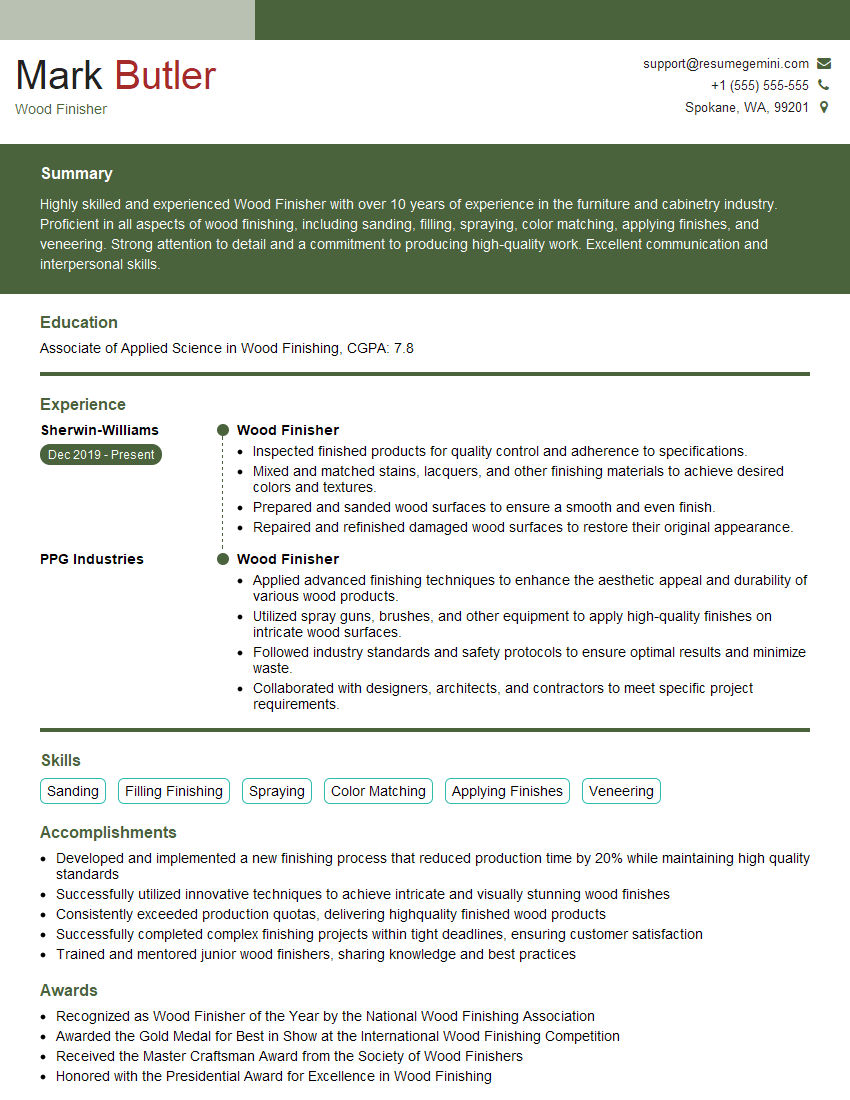
Mastering the art of door varnishing opens doors to exciting career opportunities in the woodworking and finishing industries. A strong understanding of these techniques demonstrates skill and attention to detail, highly valued by employers. To maximize your job prospects, crafting an ATS-friendly resume is crucial. ResumeGemini is a trusted resource to help you build a professional and effective resume that highlights your skills and experience. They offer examples of resumes tailored specifically to the Door Varnishing field to give you a head start. Invest the time in crafting a compelling resume – it’s your first impression with potential employers.


Explore more articles
Users Rating of Our Blogs
Share Your Experience
We value your feedback! Please rate our content and share your thoughts (optional).
What Readers Say About Our Blog
Amazing blog
hello,
Our consultant firm based in the USA and our client are interested in your products.
Could you provide your company brochure and respond from your official email id (if different from the current in use), so i can send you the client’s requirement.
Payment before production.
I await your answer.
Regards,
MrSmith
hello,
Our consultant firm based in the USA and our client are interested in your products.
Could you provide your company brochure and respond from your official email id (if different from the current in use), so i can send you the client’s requirement.
Payment before production.
I await your answer.
Regards,
MrSmith
These apartments are so amazing, posting them online would break the algorithm.
https://bit.ly/Lovely2BedsApartmentHudsonYards
Reach out at BENSON@LONDONFOSTER.COM and let’s get started!
Take a look at this stunning 2-bedroom apartment perfectly situated NYC’s coveted Hudson Yards!
https://bit.ly/Lovely2BedsApartmentHudsonYards
Live Rent Free!
https://bit.ly/LiveRentFREE
Interesting Article, I liked the depth of knowledge you’ve shared.
Helpful, thanks for sharing.
Hi, I represent a social media marketing agency and liked your blog
Hi, I represent an SEO company that specialises in getting you AI citations and higher rankings on Google. I’d like to offer you a 100% free SEO audit for your website. Would you be interested?