Every successful interview starts with knowing what to expect. In this blog, we’ll take you through the top Enterprise Application Integration (EAI) interview questions, breaking them down with expert tips to help you deliver impactful answers. Step into your next interview fully prepared and ready to succeed.
Questions Asked in Enterprise Application Integration (EAI) Interview
Q 1. Explain the concept of Enterprise Application Integration (EAI).
Enterprise Application Integration (EAI) is the process of connecting different software applications within an organization to enable seamless data exchange and business process automation. Imagine a large company with separate systems for inventory, sales, and customer relationship management. EAI acts as the glue, allowing these systems to communicate and share information, preventing data silos and improving efficiency. It’s about breaking down the walls between disparate applications, allowing them to work together harmoniously. This integration can be achieved through various methods, from simple point-to-point connections to sophisticated enterprise service buses (ESBs).
Q 2. What are the different EAI architectural patterns?
Several architectural patterns guide EAI design. Key patterns include:
- Point-to-Point Integration: A direct connection between two applications. Simple to implement for small-scale integration, but becomes complex and difficult to manage as the number of applications increases. Think of it like individual phone lines connecting each department – highly inefficient with many departments.
- Hub-and-Spoke: A central hub (often an ESB) connects multiple applications. This pattern offers better scalability and maintainability than point-to-point. Imagine a central switchboard directing calls between various departments.
- Enterprise Service Bus (ESB): A central messaging backbone that facilitates communication between applications using standardized protocols and formats. This is the most flexible and scalable approach, ideal for large, complex environments. Think of it as a sophisticated network connecting all applications allowing for easier management and updates.
- Message Queue: Applications asynchronously send messages to a queue where another application retrieves them. This pattern is excellent for decoupling applications and handling high volumes of messages. Like a post office, messages are stored until they are retrieved by the recipient application.
Q 3. Describe the benefits and challenges of using an Enterprise Service Bus (ESB).
Benefits of using an ESB:
- Centralized Management: Easier to manage and monitor integrations across the enterprise.
- Loose Coupling: Applications are loosely coupled, meaning changes in one application don’t necessarily impact others.
- Reusability: Services can be reused across different applications.
- Scalability: Easily scales to accommodate increasing numbers of applications and message volume.
- Standardization: Enforces standard messaging protocols and formats.
Challenges of using an ESB:
- Complexity: Can be complex to implement and manage, requiring specialized skills.
- Cost: ESB solutions can be expensive to purchase and maintain.
- Performance Bottlenecks: A poorly designed ESB can become a performance bottleneck.
- Vendor Lock-in: Choosing a specific ESB vendor can lead to vendor lock-in.
Q 4. Compare and contrast different integration approaches (e.g., point-to-point, message queue, ESB).
Let’s compare point-to-point, message queue, and ESB integration approaches:
| Feature | Point-to-Point | Message Queue | ESB |
|---|---|---|---|
| Complexity | Low (initially), increases rapidly | Medium | High |
| Scalability | Poor | Good | Excellent |
| Maintainability | Poor | Good | Good |
| Cost | Low (initially), increases rapidly | Medium | High |
| Coupling | Tight | Loose | Loose |
| Asynchronous Communication | No | Yes | Yes |
Point-to-point is suitable for simple integrations with few applications. Message queues offer better scalability and asynchronous communication, suitable for high-volume scenarios. ESBs provide the best scalability, maintainability, and flexibility for large, complex integrations but come with increased complexity and cost.
Q 5. What are the key considerations when designing an EAI solution?
Key considerations when designing an EAI solution include:
- Business Requirements: Clearly define the business goals and objectives of the integration project.
- Application Landscape: Thoroughly assess the existing application landscape and their capabilities.
- Data Mapping: Carefully map data elements between different applications to ensure data consistency.
- Security: Implement robust security measures to protect sensitive data during transmission.
- Error Handling: Design effective error handling mechanisms to address potential integration failures.
- Monitoring and Logging: Implement comprehensive monitoring and logging capabilities to track the performance and health of the integration.
- Scalability and Performance: Ensure the solution can scale to accommodate increasing data volumes and transaction rates.
- Technology Selection: Choose appropriate technologies based on the requirements and budget.
Q 6. Explain the role of message brokers in EAI.
Message brokers are central components in EAI, acting as intermediaries between applications. They receive messages from sender applications, store them temporarily (if needed), and forward them to the appropriate receiver applications. They handle message routing, transformation, and queuing, ensuring reliable message delivery. They decouple applications, allowing them to communicate asynchronously. Think of them as highly efficient post offices, managing the flow of messages between different applications ensuring that the right message gets to the right place at the right time.
Popular message brokers include RabbitMQ, Kafka, and ActiveMQ.
Q 7. How do you handle data transformation in EAI?
Data transformation is crucial in EAI because different applications often use different data formats and structures. This involves converting data from one format to another to ensure compatibility. Common transformation techniques include:
- Mapping: Defining the relationships between data elements in different systems.
- Data Conversion: Converting data types (e.g., string to integer, date to timestamp).
- Data Enrichment: Adding new data elements to existing data.
- Data Cleansing: Removing or correcting errors and inconsistencies in data.
Tools like XSLT, ETL (Extract, Transform, Load) processes, and specialized message transformation engines are used to perform these transformations. For example, if one system uses XML and another uses JSON, a transformation engine will convert the XML data into JSON before it is sent to the JSON-based application. A simple example using Python’s json library to convert a dictionary to JSON string:
import json
data = {'name': 'John Doe', 'age': 30}
json_data = json.dumps(data)
print(json_data)
Q 8. Describe your experience with different integration technologies (e.g., MuleSoft, IBM Integration Bus, Oracle ICS).
My experience spans several leading EAI platforms. I’ve extensively used MuleSoft, renowned for its Anypoint Platform and its ease of developing and deploying integrations using its visual flow designer. I’ve built numerous APIs and integrations connecting disparate systems, leveraging its robust connectors and transformation capabilities. For example, I integrated a legacy CRM with a modern e-commerce platform using MuleSoft, improving data flow and enhancing customer experience.
I also possess significant experience with IBM Integration Bus (IIB), a powerful ESB offering strong message transformation and routing capabilities. IIB’s strength lies in its ability to handle complex, high-volume message processing within large enterprise environments. I’ve used IIB to orchestrate transactions across multiple systems, including mainframes, significantly improving operational efficiency. A recent project involved using IIB to integrate a banking system’s core processing with its fraud detection system, resulting in a dramatic reduction in fraudulent transactions.
Finally, I’ve worked with Oracle Integration Cloud Service (ICS), a cloud-based iPaaS solution. ICS excels in its ease of use for cloud-native integrations, its pre-built connectors, and its strong security features. I used ICS to integrate a cloud-based marketing automation system with a cloud-based ERP system, leading to improved data visibility and marketing campaign performance. Each platform offers unique advantages, and my choice depends on the specific project requirements and client needs.
Q 9. What are some common EAI security concerns and how do you address them?
EAI security is paramount. Common concerns include unauthorized access to sensitive data, data breaches, denial-of-service attacks, and injection vulnerabilities (like SQL injection).
Addressing these requires a multi-layered approach. Firstly, strong authentication and authorization mechanisms are crucial. This involves using secure protocols like HTTPS, implementing robust access control lists (ACLs), and leveraging technologies like OAuth 2.0 or OpenID Connect for secure API access.
Secondly, data encryption both in transit (using TLS/SSL) and at rest is essential to protect sensitive information. Data masking and anonymization techniques can also be employed to reduce risk.
Thirdly, input validation and sanitization are vital to prevent injection attacks. Properly validating and escaping user inputs before they reach the database or other systems helps prevent malicious code execution. Regular security audits, penetration testing, and vulnerability scanning are necessary to identify and remediate security weaknesses proactively. Implementing robust logging and monitoring allows quick detection and response to security incidents.
Q 10. Explain the concept of API management in the context of EAI.
API management is the process of designing, publishing, documenting, analyzing, monitoring, and securing APIs. Within EAI, it’s critical for enabling seamless communication between different systems and applications, particularly in microservices architectures or when integrating with external partners.
An API management platform provides a centralized control point for managing the entire API lifecycle. This includes creating developer portals, managing API keys and access tokens, applying rate limiting and throttling to prevent abuse, monitoring API performance and usage, and enforcing security policies. Think of it as an air traffic control system for your APIs, ensuring smooth and efficient communication between applications.
In an EAI context, a well-managed API layer facilitates loose coupling between systems, improves maintainability, enhances scalability, and allows for more agile development and deployment of integration solutions. It enables organizations to expose their internal systems as reusable services, both internally and externally to partners and customers.
Q 11. How do you ensure data consistency and integrity in an EAI environment?
Maintaining data consistency and integrity in EAI is a critical challenge. Several techniques are used to address this.
Firstly, using message queues or event-driven architectures helps ensure that messages are processed reliably and exactly once. This prevents duplicate processing and ensures data remains consistent across systems.
Secondly, employing transactional mechanisms within integration processes guarantees atomicity. Either all parts of an integration succeed, or none do, preventing data inconsistencies caused by partial updates.
Thirdly, implementing data validation and transformation rules at the integration points helps ensure that data conforms to the expected format and constraints before being written to target systems.
Finally, using data reconciliation and auditing mechanisms allows detecting and resolving any discrepancies that might arise. This involves regularly comparing data across different systems and logging all data changes for traceability and auditing purposes. Regularly scheduled data quality checks can also identify and correct issues before they escalate.
Q 12. Describe your experience with different messaging protocols (e.g., JMS, AMQP, MQTT).
I’m proficient in various messaging protocols. JMS (Java Message Service) is a widely used API for enterprise messaging, offering features like guaranteed delivery and message persistence. I’ve used JMS in several Java-based integration projects to reliably exchange messages between applications.
AMQP (Advanced Message Queuing Protocol) offers a more standardized and interoperable approach to message queuing, supporting a broader range of programming languages and platforms. I’ve leveraged AMQP in situations requiring interoperability with systems not necessarily built on Java.
MQTT (Message Queuing Telemetry Transport) is a lightweight messaging protocol ideal for IoT (Internet of Things) and other resource-constrained environments. I’ve used MQTT in projects involving real-time data streaming from sensors and devices. The choice of protocol depends on factors such as performance requirements, message volume, system architecture, and the need for interoperability.
Q 13. How do you monitor and manage an EAI system?
Monitoring and managing an EAI system involves a combination of techniques. Real-time dashboards providing visibility into message flow, error rates, and system performance are essential.
Centralized logging and monitoring tools allow tracking messages, errors, and exceptions. This provides valuable insights into system health and helps in troubleshooting issues promptly. Automated alerts triggered by specific events, like high error rates or system failures, ensure rapid problem identification.
Regular performance testing and capacity planning help optimize system performance and scalability. This includes load testing to determine the system’s ability to handle peak volumes and stress testing to identify bottlenecks. Continuous integration and continuous delivery (CI/CD) pipelines facilitate automating deployment, testing, and monitoring processes, accelerating deployments and reducing downtime.
Finally, a well-defined incident management process is critical for handling issues effectively and minimizing disruption. This includes documented procedures for escalation, remediation, and post-incident analysis.
Q 14. Explain your experience with different integration testing methodologies.
My integration testing experience covers various methodologies. I frequently employ contract testing, verifying the interfaces between different services independently of their implementation. This ensures that services can communicate effectively without being directly coupled.
Component testing focuses on individual components of the integration solution. This ensures each part works correctly in isolation before they are combined. Integration tests, on the other hand, verify the interaction between different components. This includes testing message flows, transformations, and interactions with external systems.
End-to-end testing verifies the entire integration solution from start to finish, simulating real-world scenarios. This is often done using test automation frameworks to automate the execution and validation of test cases. Each methodology plays a vital role in ensuring the reliability and quality of the integrated system. The choice of methodology is driven by the specific requirements of the integration and the complexity of the system.
Q 15. How do you handle error handling and exception management in EAI?
Robust error handling and exception management are crucial in EAI to ensure system reliability and data integrity. Think of it like building a bridge – you need strong supports to prevent collapse. My approach involves a multi-layered strategy:
- Exception Handling at the Integration Point: Each integration component (e.g., message transformation, routing) should have its own error handling mechanism. This might involve try-catch blocks in code or configuring error handling within the integration platform itself. For example, if a data transformation fails due to invalid input, a specific error message is logged and a corresponding action (e.g., retry, rollback, notification) is triggered.
- Message Tracking and Auditing: Maintaining a detailed audit trail of all messages processed, including successful and failed attempts, is vital for debugging and troubleshooting. Tools like message brokers often provide built-in capabilities for this. This allows us to trace the flow of data and identify the source of errors.
- Centralized Error Handling and Monitoring: A central monitoring system aggregates error messages from different integration points. This provides a holistic view of the system’s health. Dashboards and alerts can be configured to notify administrators of critical errors requiring immediate attention. Think of it as a control tower for your integration system.
- Error Resolution and Recovery Strategies: Implementing strategies to automatically resolve common errors (e.g., network issues through retries) or escalate critical errors to human operators ensures business continuity. This is particularly important for high-availability systems.
- Message Queues and Dead-Letter Queues: Using message queues adds resilience by decoupling systems. Failed messages can be moved to a dead-letter queue for later investigation and manual intervention. This prevents single points of failure and allows for asynchronous processing.
For instance, in a project integrating an order management system with a shipping provider, I’ve used a combination of try-catch blocks in Java code and a dead-letter queue in RabbitMQ to handle situations like network outages or invalid addresses. The audit trail allowed us to swiftly identify and resolve the root cause of the integration failure.
Career Expert Tips:
- Ace those interviews! Prepare effectively by reviewing the Top 50 Most Common Interview Questions on ResumeGemini.
- Navigate your job search with confidence! Explore a wide range of Career Tips on ResumeGemini. Learn about common challenges and recommendations to overcome them.
- Craft the perfect resume! Master the Art of Resume Writing with ResumeGemini’s guide. Showcase your unique qualifications and achievements effectively.
- Don’t miss out on holiday savings! Build your dream resume with ResumeGemini’s ATS optimized templates.
Q 16. Describe your experience with different data formats (e.g., XML, JSON, CSV).
Experience with diverse data formats is essential in EAI. I’ve extensively worked with XML, JSON, and CSV, each with its strengths and weaknesses. Choosing the right format depends on factors like the data structure, performance requirements, and the systems being integrated.
- XML (Extensible Markup Language): Provides a structured and self-describing way to represent data. It is ideal for complex data hierarchies and situations needing schema validation. However, it can be verbose and less human-readable.
- JSON (JavaScript Object Notation): A lightweight and human-readable format commonly used for web services. It’s efficient for transferring data between systems, especially web applications. Schema validation is less strict than in XML.
- CSV (Comma Separated Values): A simple, tabular format suitable for transferring large datasets that don’t require complex structures. It’s easy to handle and read, but lacks schema definition and can be error-prone if data contains commas.
In a recent project, we used XML for integrating with a legacy system that required strict data validation. For a newer microservices architecture, we adopted JSON for its simplicity and ease of integration with various languages and platforms. I’ve also used CSV for data migration tasks where large volumes of data need to be imported or exported.
Q 17. Explain the concept of loose coupling in EAI.
Loose coupling is a fundamental principle in EAI, promoting flexibility and maintainability. Imagine building with LEGOs – loosely coupled components can be easily modified or replaced without affecting the entire structure. In EAI, loose coupling means that systems interact without being tightly dependent on each other’s internal implementation.
Key aspects of loose coupling include:
- Standardized Interfaces: Systems communicate through well-defined interfaces (e.g., APIs, message queues) that abstract away internal details. Changes to one system’s internal workings don’t necessarily impact others as long as the interface remains compatible.
- Asynchronous Communication: Systems exchange messages asynchronously, allowing them to operate independently. One system doesn’t have to wait for another to complete its task before proceeding, improving responsiveness and resilience.
- Message Brokers and ESBs: These middleware components facilitate communication between loosely coupled systems, decoupling them from each other.
Loose coupling significantly reduces the impact of changes. For example, if one system needs an upgrade, it can be done without affecting other integrated systems, as long as the interface remains unchanged. This simplifies maintenance, enhances scalability, and enables independent evolution of individual systems.
Q 18. How do you ensure scalability and performance in an EAI system?
Ensuring scalability and performance in an EAI system is critical for handling increasing data volumes and user demands. My approach focuses on several key areas:
- Asynchronous Processing: Asynchronous messaging patterns (like those using message queues) decouple systems and allow for parallel processing, enhancing throughput and responsiveness.
- Caching: Caching frequently accessed data reduces the load on backend systems and improves response times. This is especially important for data that changes infrequently.
- Load Balancing: Distributing the workload across multiple servers prevents bottlenecks and ensures that the system can handle peak demands.
- Database Optimization: Efficient database design, indexing, and query optimization are crucial for handling large datasets effectively. This may involve techniques like database sharding or read replicas.
- Message Size Optimization: Minimizing the size of messages exchanged between systems reduces network traffic and improves performance.
- Scalable Middleware: Choosing a scalable integration platform (e.g., cloud-based ESBs) that can easily handle increasing message volumes is essential. These platforms often offer automatic scaling features.
In a previous project involving a high-volume e-commerce platform, we implemented asynchronous processing using Kafka, which significantly improved the system’s ability to handle order processing spikes during peak shopping seasons. Load balancing and caching were also key to maintaining consistent performance.
Q 19. What are some common challenges in integrating legacy systems?
Integrating legacy systems presents unique challenges due to their age, often outdated technology, and lack of standardized interfaces. Think of it like trying to connect a vintage record player to a modern sound system – you need adapters and careful planning.
- Data Format Incompatibility: Legacy systems often use outdated data formats that aren’t compatible with modern systems. This requires data transformation or mapping to align data structures.
- Lack of Documentation: Comprehensive documentation is often missing or outdated, making it difficult to understand how the legacy system functions. Reverse engineering may be required.
- Limited APIs or Interfaces: Legacy systems might not have well-defined APIs or interfaces for integration. This necessitates custom solutions or point-to-point connections, which can be complex and fragile.
- Performance Bottlenecks: Legacy systems might be slow or inefficient, impacting the performance of the overall integration.
- Security Concerns: Legacy systems may lack up-to-date security protocols, creating vulnerabilities. This requires careful security assessment and remediation.
My approach involves careful analysis of the legacy system, identifying integration points, and developing suitable strategies for data transformation and communication. Often, this involves creating an abstraction layer that shields modern systems from the complexities of the legacy system. In one instance, we used an ETL (Extract, Transform, Load) process to migrate data from a COBOL-based legacy system to a modern data warehouse.
Q 20. Describe your experience with cloud-based integration platforms (e.g., Azure Integration Services, AWS MSK).
Cloud-based integration platforms offer significant advantages in terms of scalability, cost-effectiveness, and manageability. I have experience with both Azure Integration Services and AWS MSK (Kafka as a managed service). They both provide robust capabilities for building and deploying EAI solutions.
- Azure Integration Services: Offers a comprehensive suite of services for building and managing integration flows, including Logic Apps, Azure Service Bus, and Azure API Management. It’s particularly well-integrated with other Azure services, making it a great choice for organizations already heavily invested in the Azure ecosystem.
- AWS MSK (Managed Streaming for Kafka): Provides a fully managed Kafka service that excels in handling high-volume, real-time data streaming. It’s ideal for scenarios requiring high throughput and low latency. This can be crucial for situations involving event-driven architectures and real-time data integration.
Choosing the right platform depends on the specific needs of the project. For instance, for a project needing high-throughput real-time data processing, AWS MSK would be a better fit. For projects needing a broader range of integration capabilities and strong integration with other Azure services, Azure Integration Services would be preferred. In a recent project, we used Azure Logic Apps to build a serverless integration flow connecting various SaaS applications, leveraging its ease of use and scalability.
Q 21. How do you approach designing an EAI solution for a microservices architecture?
Designing an EAI solution for a microservices architecture requires a different approach compared to monolithic applications. The key is to maintain the loose coupling and independent deployability of microservices. The integration solution should act as a flexible and resilient glue.
My approach involves:
- Asynchronous Communication: Using message brokers like Kafka or RabbitMQ is essential for asynchronous communication between microservices. This ensures that services are decoupled and can operate independently.
- API Gateways: An API gateway acts as a central point of entry for external clients and can route requests to the appropriate microservices. This provides a consistent interface and simplifies management.
- Event-Driven Architecture: Implementing an event-driven architecture allows microservices to communicate through events, enabling loose coupling and scalability. Changes in one microservice are propagated through events.
- Lightweight Protocols: Choosing lightweight communication protocols like REST or gRPC optimizes performance and reduces overhead.
- API Management: Implementing API management tools enables monitoring, security, and lifecycle management of APIs used for microservice integration.
For example, in a project involving a microservices-based e-commerce platform, we used Kafka to handle order processing events. When an order is placed, an event is published to Kafka, triggering downstream services to update inventory, process payments, and manage shipping. This asynchronous, event-driven approach ensured high scalability and resilience.
Q 22. What are your preferred tools and techniques for debugging EAI problems?
Debugging EAI problems requires a systematic approach. My preferred tools and techniques depend heavily on the specific technology stack, but generally involve a combination of logging, monitoring, and specialized debugging tools. I start by examining logs from all involved systems – message brokers, application servers, databases – looking for error messages, slowdowns, or unusual patterns. Tools like ELK stack (Elasticsearch, Logstash, Kibana) are invaluable for centralized log management and analysis.
Next, I utilize monitoring tools to observe system performance metrics like message throughput, latency, and resource utilization. This helps pinpoint bottlenecks or identify failing components. Tools like Prometheus and Grafana are excellent for this. For message brokers like RabbitMQ or Kafka, their built-in monitoring interfaces are crucial for understanding message flow.
Finally, I often employ debuggers integrated into IDEs (like IntelliJ or Eclipse) or specialized debuggers for the specific integration technologies (e.g., a debugger for MuleSoft Anypoint Studio or IBM Integration Bus). Setting breakpoints in code allows me to step through execution, inspect variables, and understand the exact point of failure. Tracing tools, which allow monitoring the execution path of a message through a complex integration system, are also extremely helpful in complex scenarios. The key is a methodical approach, starting from the general overview and progressively zooming in to pinpoint the root cause.
Q 23. Explain the concept of orchestration and choreography in EAI.
Orchestration and choreography are two distinct approaches to managing interactions between different applications within an EAI system. Think of it like a symphony orchestra versus a jazz band.
Orchestration is a centralized approach where a central component (often an Enterprise Service Bus or ESB) controls the flow of messages between applications. This central conductor dictates the order of operations, making decisions and routing messages based on predefined rules. It’s like a conductor leading an orchestra, precisely orchestrating each instrument’s part.
Choreography, on the other hand, is a decentralized approach where applications interact autonomously, communicating directly with each other through predefined message exchanges. There’s no central conductor; each application knows its own part and reacts to messages from other applications. This is similar to a jazz band where each musician improvises within a shared framework, communicating implicitly through their music.
The choice between orchestration and choreography depends on factors like the complexity of the integration, the need for centralized control, and the level of autonomy required for individual applications. Orchestration offers better centralized control and easier monitoring, while choreography provides greater flexibility and scalability.
Q 24. How do you ensure data quality in an EAI environment?
Ensuring data quality in an EAI environment is paramount and requires a multi-faceted strategy. It’s like building a strong bridge; each component needs to be carefully constructed and tested.
- Data Validation: Implement rigorous validation rules at each stage of the integration process, checking for data types, ranges, formats, and constraints. This includes using schema validation (e.g., XML Schema Definition (XSD) or JSON Schema) and data integrity checks.
- Data Transformation: Carefully design data transformation rules to handle inconsistencies between different systems. This might involve data cleansing, normalization, and enrichment. Tools like ETL (Extract, Transform, Load) tools are vital for this.
- Data Quality Monitoring: Continuously monitor the data quality using dashboards and reports. Track key metrics such as data completeness, accuracy, consistency, and timeliness. Alerts should be set up to flag potential data quality issues.
- Error Handling and Logging: Develop robust error handling mechanisms to capture and report data quality problems. Detailed logging is essential for debugging and analyzing data quality issues.
- Master Data Management: For critical data elements, consider implementing a master data management (MDM) system to ensure data consistency across the enterprise. MDM is the central authority for critical data, ensuring all systems use the single source of truth.
Regular data audits and reconciliation are also crucial to identify and address data discrepancies over time.
Q 25. What are your experiences with different EAI design patterns?
My experience encompasses several EAI design patterns. I’ve worked with:
- Message Queues (e.g., RabbitMQ, Kafka): Used extensively for asynchronous communication, decoupling applications and enhancing scalability and resilience. For example, in an order processing system, an order confirmation message can be placed on a queue, allowing the order processing application to continue working without waiting for confirmation from an external system.
- Enterprise Service Bus (ESB): Implemented ESBs (like MuleSoft Anypoint Platform or IBM Integration Bus) for centralized message routing, transformation, and orchestration in complex integration scenarios. This is especially useful for managing multiple systems with varying protocols and formats.
- Microservices Architecture: Designed and implemented integrations leveraging RESTful APIs and lightweight messaging protocols between microservices. This architecture prioritizes loose coupling and independent deployment.
- Message Transformation Patterns (e.g., Content-Based Router, Message Filter): Utilized these patterns to route and process messages based on their content, enhancing flexibility and routing efficiency.
- API Gateway: Leveraged API gateways for managing API access, security, and rate limiting, providing a single entry point for external systems to access internal services.
The choice of pattern depends heavily on the specific integration requirements and the overall architecture.
Q 26. How do you handle data migration in an EAI project?
Data migration in EAI is a critical and often complex undertaking. It requires careful planning and execution to avoid data loss or corruption. I typically follow a phased approach:
- Assessment and Planning: This involves a thorough analysis of the source and target systems, including data structures, data volume, data quality, and business rules. We develop a comprehensive migration plan outlining the approach, timelines, and resources.
- Data Extraction: Extract data from the source system using appropriate methods, such as database queries, APIs, or file exports. We often use ETL tools to streamline this process.
- Data Transformation: Transform the data to match the target system’s structure and format. This might involve data cleansing, mapping, and validation. Data quality checks at this stage are crucial.
- Data Loading: Load the transformed data into the target system. We typically use incremental loading to minimize downtime and allow for ongoing data synchronization.
- Data Validation and Verification: After loading, perform rigorous validation to ensure data integrity and accuracy. This may involve data comparisons and reconciliation with the source system.
- Testing and Rollback Plan: A thorough testing phase is crucial to identify and resolve any issues before the migration goes live. A detailed rollback plan is also essential in case something goes wrong.
The specific techniques and tools used will depend on the complexity and scale of the migration. For very large datasets, data warehousing and specialized data migration tools may be necessary.
Q 27. Explain your experience with implementing security protocols (e.g., OAuth, SAML) in EAI.
Implementing security protocols like OAuth and SAML in EAI is critical for protecting sensitive data and ensuring secure communication between systems. My experience includes:
- OAuth 2.0: Used OAuth 2.0 for authorization, allowing applications to access protected resources on behalf of users without sharing their credentials. This is essential for APIs and microservices.
- SAML: Implemented SAML for single sign-on (SSO) and federation, allowing users to access multiple applications with a single set of credentials. This simplifies user access management and improves security.
- HTTPS: Ensured all communication channels use HTTPS to protect data in transit, encrypting messages to prevent eavesdropping.
- Message-Level Security: Applied message-level security techniques like digital signatures and encryption to protect message integrity and confidentiality.
- Access Control Lists (ACLs): Implemented ACLs on message brokers and APIs to control access to sensitive data and resources.
Security is a continuous process. Regular security audits, penetration testing, and vulnerability scanning are essential to identify and mitigate potential security risks.
Q 28. Describe your experience with CI/CD pipelines for EAI solutions.
My experience with CI/CD pipelines for EAI solutions focuses on automating the build, testing, and deployment process to improve efficiency and reduce errors. This typically involves:
- Automated Build Process: Using tools like Maven, Gradle, or Jenkins to automate the build process, compiling code, creating deployment packages, and running unit tests.
- Automated Testing: Implementing comprehensive automated testing, including unit tests, integration tests, and performance tests. Test automation is crucial to ensure the quality and reliability of the EAI solution.
- Continuous Integration (CI): Integrating code changes frequently into a shared repository, using CI tools to automate the build and test process. This ensures early detection of integration problems.
- Continuous Delivery/Deployment (CD): Automating the deployment process, allowing for frequent and reliable deployments to various environments (e.g., development, testing, production).
- Infrastructure as Code (IaC): Using tools like Terraform or Ansible to manage and provision infrastructure, automating the setup of servers, networks, and other resources needed for the EAI solution.
A well-defined CI/CD pipeline significantly improves the speed and reliability of EAI development and deployment, enabling faster iteration and faster time to market.
Key Topics to Learn for Enterprise Application Integration (EAI) Interview
- Message Queues and Brokers: Understand concepts like message queuing (e.g., RabbitMQ, Kafka), message brokers, and their role in asynchronous communication and decoupling applications. Consider practical applications like handling high-volume transactions or building event-driven architectures.
- API Management and Integration: Explore RESTful APIs, SOAP APIs, and their differences. Practice designing and implementing API integrations, considering security (OAuth, JWT) and versioning strategies. Understand API gateways and their benefits in managing and securing APIs.
- Integration Patterns: Familiarize yourself with common integration patterns like message transformation, data mapping, orchestration, and choreography. Consider how these patterns solve real-world challenges in connecting diverse systems.
- Enterprise Service Bus (ESB): Learn about the architecture and function of an ESB, its role in centralizing and managing integration processes, and the trade-offs compared to other integration approaches. Explore specific ESB platforms and their capabilities.
- Data Transformation and Mapping: Master techniques for transforming data between different formats and schemas (e.g., XML, JSON, CSV). Understand ETL (Extract, Transform, Load) processes and their importance in data integration.
- Security Considerations: Deeply understand security best practices within EAI, including authentication, authorization, encryption, and data validation. Be prepared to discuss how to secure various integration points and protect sensitive data.
- Monitoring and Logging: Learn about monitoring tools and techniques for tracking the performance and health of EAI systems. Understand the importance of effective logging for troubleshooting and debugging integration issues.
- Cloud-Based Integration: Explore cloud integration platforms (e.g., Azure Integration Services, AWS Mulesoft) and their capabilities for connecting on-premise and cloud-based applications. Understand the benefits and challenges of cloud-based integration.
Next Steps
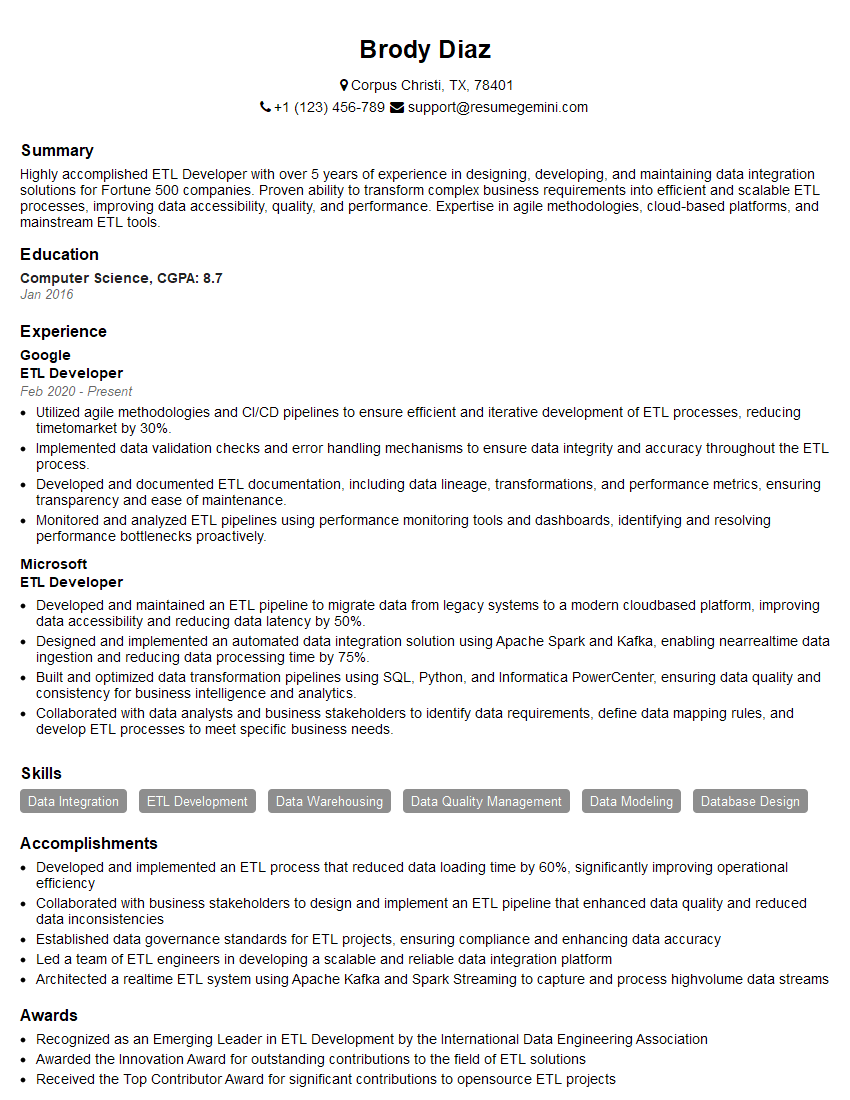
Mastering Enterprise Application Integration (EAI) is crucial for a successful career in today’s interconnected world. It opens doors to high-demand roles with significant growth potential. To maximize your job prospects, it’s vital to create an ATS-friendly resume that showcases your skills effectively. ResumeGemini is a trusted resource for building professional, impactful resumes that get noticed. They provide examples of resumes tailored specifically to Enterprise Application Integration (EAI) roles, helping you present your qualifications compellingly. Invest the time in crafting a strong resume—it’s your first impression on potential employers.
Explore more articles
Users Rating of Our Blogs
Share Your Experience
We value your feedback! Please rate our content and share your thoughts (optional).
What Readers Say About Our Blog
Amazing blog
Interesting Article, I liked the depth of knowledge you’ve shared.
Helpful, thanks for sharing.