The thought of an interview can be nerve-wracking, but the right preparation can make all the difference. Explore this comprehensive guide to Key Account Management (KAM) interview questions and gain the confidence you need to showcase your abilities and secure the role.
Questions Asked in Key Account Management (KAM) Interview
Q 1. Describe your experience managing a portfolio of key accounts.
My experience in managing a portfolio of key accounts spans over seven years, encompassing diverse industries including technology, finance, and healthcare. I’ve consistently exceeded targets by focusing on building deep, strategic partnerships rather than transactional relationships. For example, in my previous role at TechSolutions, I managed a portfolio of 15 key accounts, representing over 70% of the company’s revenue. My strategies involved proactively identifying each account’s unique needs and developing tailored solutions, resulting in a 15% year-on-year revenue growth for the portfolio.
This involved not just sales but also understanding their business challenges, aligning our solutions to their strategic objectives, and fostering a collaborative environment. I regularly conducted business reviews with key stakeholders, ensuring ongoing alignment and proactive issue resolution. I also implemented a robust CRM system to meticulously track interactions, opportunities, and account performance, enabling data-driven decision-making.
Q 2. How do you identify and prioritize key accounts?
Identifying and prioritizing key accounts requires a strategic approach combining quantitative and qualitative factors. I use a framework that considers factors like revenue potential, strategic fit, and long-term value.
- Revenue Potential: Accounts with high current revenue and significant growth potential are naturally prioritized.
- Strategic Fit: Alignment with the company’s overall strategic goals is crucial. Accounts that represent a strong market share or demonstrate a potential for innovation are highly valued.
- Long-Term Value: Assessing the potential for sustained partnership and future revenue streams is essential. This often involves considering factors like customer lifetime value and the potential for expansion within the account.
Once identified, accounts are prioritized using a scoring system that weights these factors based on their relative importance to the business. This allows for a clear understanding of which accounts require the most attention and resources.
Q 3. Explain your approach to building and maintaining strong client relationships.
Building and maintaining strong client relationships is paramount in KAM. My approach is built on trust, transparency, and mutual value creation. I believe in establishing a genuine connection with key stakeholders at all levels within the account. This goes beyond simple transactional interactions. It involves understanding their personal and professional goals, anticipating their needs, and proactively offering solutions.
- Regular Communication: Maintaining consistent communication through various channels – phone calls, emails, in-person meetings, and even social media – ensures the relationship remains vibrant.
- Proactive Problem-Solving: Addressing potential issues before they escalate is critical. This requires constant monitoring of account performance and proactive identification of potential roadblocks.
- Value-Added Services: Offering additional services or insights beyond the core product/service strengthens the relationship and demonstrates commitment.
- Building Rapport: Investing time in getting to know clients personally, understanding their perspectives and fostering mutual respect are key to long-term success.
For example, I regularly organize informal events or meetings with key decision-makers to foster trust and strengthen personal bonds, making the relationship far more collaborative and productive.
Q 4. How do you manage expectations with key accounts?
Managing expectations is crucial in KAM. This involves clear, consistent communication, setting realistic goals, and actively managing any changes or unforeseen circumstances. I use a combination of proactive communication and collaborative goal setting.
- Clearly Defined SLAs: Establishing Service Level Agreements that outline expectations and responsibilities for both parties provides a clear framework for performance.
- Regular Progress Updates: Providing regular updates and transparently communicating any potential delays or challenges helps maintain trust and alignment.
- Joint Planning Sessions: Collaboratively setting goals and reviewing progress ensures that both sides are on the same page and expectations are managed effectively.
- Proactive Risk Management: Identifying and mitigating potential risks before they impact expectations fosters trust and demonstrates proactive leadership.
It’s important to remember that under-promising and over-delivering often strengthens trust and builds confidence in the long term.
Q 5. Describe a time you had to negotiate a challenging contract with a key account.
In a previous role, we faced a challenging contract negotiation with a key account – a large financial institution. They initially requested a significant price reduction while simultaneously demanding enhanced service level agreements. This seemingly contradictory request threatened the project’s profitability.
My approach involved a structured negotiation process:
- Data-driven Approach: I presented data-backed evidence demonstrating the value proposition of our services and the cost implications of meeting their additional requirements.
- Value-added Negotiation: Instead of solely focusing on price, I highlighted the long-term value of our partnership and proposed alternative solutions, such as phased implementation or value-added services.
- Collaborative Problem-solving: I actively listened to their concerns and collaboratively explored options that addressed their needs while maintaining profitability for my company.
Ultimately, we reached a mutually agreeable outcome. While the initial price was adjusted slightly, we secured additional services contracts that more than compensated for the reduction in the initial price, and importantly, retained a valuable long-term client.
Q 6. How do you measure the success of your key account management efforts?
Measuring the success of KAM efforts requires a multi-faceted approach. I use a balanced scorecard that considers both qualitative and quantitative metrics.
- Financial Metrics: Revenue growth, customer lifetime value, profitability, and market share are key indicators of financial success.
- Relationship Metrics: Client satisfaction scores, the frequency of positive interactions, and the number of referrals reflect the strength of the client relationships.
- Operational Metrics: On-time delivery, project completion rates, and account retention rates indicate operational efficiency and the effectiveness of service delivery.
These metrics are regularly monitored and analyzed to track progress towards established goals, and the data informs continuous improvement strategies.
Q 7. How do you handle conflict with a key account?
Handling conflict with a key account requires a proactive and diplomatic approach. My strategy focuses on active listening, empathy, and collaborative problem-solving.
- Active Listening: Understanding the root cause of the conflict is crucial. I actively listen to the client’s perspective without interruption, seeking to understand their concerns and frustrations.
- Empathy and Validation: Acknowledging and validating their feelings helps de-escalate the situation. This doesn’t mean agreeing with their perspective, but rather showing understanding.
- Collaborative Problem-Solving: I work with the client to brainstorm solutions that meet both parties’ needs. This involves compromise and mutual concessions.
- Documentation: Maintaining a record of communications and agreed-upon solutions provides clarity and accountability.
In many cases, conflict can present opportunities for strengthening relationships by showing commitment to finding mutually beneficial solutions. This approach often strengthens the partnership and leads to a more robust and trusting relationship in the long run.
Q 8. How do you identify and address potential risks within your key accounts?
Identifying and addressing risks within key accounts is crucial for long-term success. It’s like navigating a ship – you need to anticipate storms and chart a safe course. I approach this systematically, using a combination of proactive monitoring and reactive problem-solving.
- Proactive Risk Identification: This involves regularly reviewing account performance against key metrics (e.g., revenue, customer satisfaction, market share). I also utilize SWOT analysis (Strengths, Weaknesses, Opportunities, Threats) to assess the account’s overall health and identify potential vulnerabilities. For example, a change in the key account’s internal leadership could signal a potential risk, requiring me to build new relationships and re-evaluate the account strategy.
- Reactive Risk Management: When risks emerge, I employ a structured approach: First, I assess the severity and likelihood of the risk. Then, I develop a mitigation plan, involving the necessary stakeholders, such as internal departments or the client’s key contacts. This might include renegotiating contracts, adjusting service levels, or developing alternative solutions.
- Examples: In a previous role, a key account faced a sudden economic downturn. By proactively monitoring their financial performance and communicating closely with their leadership, we were able to adjust our contract terms and ensure continued partnership. In another instance, a competitor launched a similar product, posing a threat. We countered this by highlighting our unique value proposition and strengthening our relationship through additional service offerings.
Q 9. Describe your experience using CRM software to manage key accounts.
CRM software is indispensable for managing key accounts. It acts as a central hub for all account-related information, ensuring nothing falls through the cracks. I’ve extensively used Salesforce and HubSpot, and both offer powerful features specifically tailored for KAM.
- Contact Management: CRMs allow for detailed tracking of all interactions and communications with key stakeholders within an account. This includes notes from calls, emails, and meetings, ensuring consistency and context across interactions.
- Opportunity Tracking: I use the opportunity pipeline to track the progress of potential deals, forecast revenue, and identify potential roadblocks.
- Reporting and Analytics: CRMs provide valuable insights into account performance, helping me identify trends and make data-driven decisions. This is invaluable for justifying investments and demonstrating the value I bring to the organization.
- Collaboration: CRMs facilitate communication and collaboration within my team and with other departments, ensuring everyone is on the same page.
For instance, using Salesforce’s reporting dashboards, I can quickly identify accounts falling behind on their targets, allowing me to proactively intervene and develop corrective actions.
Q 10. How do you stay up-to-date on industry trends relevant to your key accounts?
Staying updated on industry trends is paramount in KAM. It’s like being a weather forecaster for your accounts – anticipating shifts in the market can greatly impact your strategies. My approach is multi-faceted:
- Industry Publications and Research: I subscribe to relevant industry publications, both print and online. I regularly review market research reports and white papers to understand emerging trends and competitive landscapes.
- Conferences and Networking Events: Attending industry conferences and networking events allows me to gain firsthand insights and connect with key influencers and thought leaders.
- Online Communities and Forums: Participating in online communities and forums dedicated to my industry keeps me abreast of the latest discussions and emerging issues.
- Competitor Analysis: I regularly monitor my competitors’ activities, products, and marketing strategies to understand their strengths and weaknesses and identify potential threats or opportunities.
For example, by monitoring industry news about the rise of sustainable practices, I was able to identify an opportunity for my company to offer a new, eco-friendly product line to a key account, strengthening our partnership and generating new revenue streams.
Q 11. How do you forecast revenue and growth for your key accounts?
Revenue forecasting for key accounts is a critical component of KAM. Accurate forecasting requires a blend of art and science, combining historical data with informed predictions about future trends.
- Historical Data Analysis: I begin by analyzing past sales data, identifying trends and seasonality. This forms the foundation of my forecast.
- Market Research and Trends: I incorporate market research data and industry trends to understand the potential impact on my key accounts. For instance, economic forecasts or shifts in consumer behavior can significantly affect sales.
- Account-Specific Factors: I consider account-specific factors, such as upcoming projects, contract renewals, and changes in their business strategies.
- Sales Pipeline Analysis: I meticulously track the sales pipeline for each key account, assessing the likelihood of closing deals and their potential value.
- Qualitative Input: I also take into account qualitative factors, including discussions with key decision-makers within the accounts and insights from my sales team.
Typically, I utilize a combination of quantitative and qualitative methods to develop a range of forecast scenarios, presenting them with appropriate levels of uncertainty.
Q 12. Describe your experience with account planning and strategy development.
Account planning and strategy development are the cornerstones of effective KAM. It’s like creating a detailed roadmap for a long journey – ensuring you reach your destination efficiently and safely. My approach involves a collaborative, iterative process:
- Understanding the Account: I begin by thoroughly understanding the key account’s business, its challenges, and its objectives. This involves conducting thorough research, gathering data, and building strong relationships with key decision-makers.
- Defining Objectives and Key Results (OKRs): I work with the account team to define specific, measurable, achievable, relevant, and time-bound objectives, aligning them with the overall business strategy.
- Developing Action Plans: Based on the objectives, I develop comprehensive action plans that outline the necessary steps to achieve them. These plans often include specific tactics for relationship building, sales, marketing, and service delivery.
- Regular Monitoring and Review: I regularly monitor the progress of the account plan and make necessary adjustments based on performance data and changing market conditions. This could involve revisiting the strategy, reallocating resources, or adjusting the action plan.
For example, for a key account in the tech sector, we identified a need for improved cybersecurity. We developed a strategy focusing on educating the client, showcasing our security expertise, and tailoring our service offerings to meet their specific requirements. This resulted in a significant increase in revenue and strengthened our partnership.
Q 13. How do you identify opportunities for cross-selling and upselling within key accounts?
Identifying cross-selling and upselling opportunities within key accounts is about maximizing the value of existing relationships. It’s like offering a delicious dessert after a satisfying main course – enhancing the customer experience and increasing revenue.
- Understanding Account Needs: I regularly assess the key account’s evolving needs and identify potential gaps where our additional products or services could add value. This involves listening actively to their feedback and monitoring their business activities.
- Value Proposition Mapping: I develop a clear value proposition for each additional product or service, demonstrating its relevance and benefits to the specific account.
- Strategic Timing: I choose the right time to present cross-selling and upselling opportunities, often in conjunction with contract renewals or significant business milestones.
- Relationship Building: Strong relationships are crucial for successful cross-selling and upselling. By building trust and rapport, I can more effectively position additional offerings as solutions to the account’s needs.
For example, after establishing a successful partnership providing software solutions, I identified an opportunity to upsell consulting services to optimize the client’s usage of the software. This resulted in increased revenue and reinforced our position as a trusted advisor.
Q 14. How do you manage multiple key accounts simultaneously?
Managing multiple key accounts simultaneously requires strong organizational skills and a structured approach. It’s like managing multiple projects simultaneously – requiring careful planning and prioritization. My strategy revolves around:
- Prioritization and Time Management: I prioritize accounts based on their strategic importance, revenue potential, and risk profile. Effective time management techniques, such as time blocking and task prioritization, are essential.
- Account Segmentation: I segment my key accounts based on shared characteristics or needs, allowing for more efficient allocation of resources and development of tailored strategies.
- Technology and Tools: Leveraging CRM systems and other productivity tools is crucial for tracking progress, managing communications, and coordinating activities across multiple accounts.
- Teamwork and Collaboration: When managing a large portfolio, collaboration with team members is key. Clear communication and delegation of tasks ensure efficient workflow and consistent service delivery.
- Regular Review and Adjustment: I regularly review my account portfolio, adjusting priorities and strategies as needed to maximize overall performance and achieve business goals.
By employing these strategies, I can maintain strong relationships with each account and ensure each receives the attention and support it requires, fostering growth and maximizing value for all stakeholders.
Q 15. Describe your experience with presenting to executive-level clients.
Presenting to executive-level clients requires a different approach than presenting to lower-level stakeholders. It’s about demonstrating a deep understanding of their business challenges and presenting solutions that directly address their strategic priorities. My experience involves meticulously researching the client’s industry, their specific company performance, and their recent announcements. This informs my presentation, allowing me to tailor my message to resonate with their immediate concerns.
For example, in a recent presentation to the CEO of a Fortune 500 company, I began by highlighting their recent success in a particular market segment, then transitioned into how our solution could further enhance their market share by addressing a specific efficiency gap identified in their most recent quarterly report. This demonstrated that I understood their business at a strategic level and that I wasn’t just pitching a product but offering a strategic partnership. I always ensure my presentations are concise, data-driven, and focus on the quantifiable return on investment (ROI) for the client.
I focus on clear, visual aids, avoiding jargon and using plain language that everyone can understand. The presentation’s structure is crucial; I lead with a compelling value proposition, follow with clear evidence and data, and conclude with a strong call to action. Following up with tailored communication based on the discussion is vital to build lasting relationships.
Career Expert Tips:
- Ace those interviews! Prepare effectively by reviewing the Top 50 Most Common Interview Questions on ResumeGemini.
- Navigate your job search with confidence! Explore a wide range of Career Tips on ResumeGemini. Learn about common challenges and recommendations to overcome them.
- Craft the perfect resume! Master the Art of Resume Writing with ResumeGemini’s guide. Showcase your unique qualifications and achievements effectively.
- Don’t miss out on holiday savings! Build your dream resume with ResumeGemini’s ATS optimized templates.
Q 16. How do you handle objections from key accounts?
Handling objections from key accounts is a crucial skill in KAM. It’s not about avoiding objections, but rather about addressing them head-on with professionalism, empathy, and a solution-oriented approach. I typically begin by actively listening to the objection without interruption. This shows respect and allows me to fully understand their perspective.
Next, I rephrase the objection to ensure I understand it correctly, and then address it directly with evidence and facts. Sometimes, objections stem from misconceptions, and clearing these up with data is crucial. If it’s a legitimate concern, I explore alternative solutions or adjustments to our proposal.
For instance, if a client objects to the pricing, I might explore different package options, highlight the long-term cost savings or demonstrate the value proposition clearly by focusing on ROI or cost-benefit analysis. It’s crucial to maintain a positive and collaborative approach, even when facing difficult objections. Turning objections into opportunities for collaboration is key to building trust and stronger relationships. Remember, an objection is often a chance to further understand your client’s needs and tailor your solution even more effectively.
Q 17. How do you build a strong rapport with key decision-makers?
Building rapport with key decision-makers involves creating a genuine connection based on trust, mutual respect, and understanding. It goes beyond simply making a sale; it’s about establishing a long-term partnership. I always begin by deeply researching the individual, understanding their background, their professional goals, and even their personal interests (within professional boundaries, of course).
I use active listening skills to understand their perspectives and concerns. I ask insightful questions, not just to gather information, but to demonstrate genuine curiosity and engagement. Finding common ground—whether it’s industry trends or shared interests—can help break the ice and build a more personal connection. I ensure all communication is professional, timely, and responsive to their needs.
For example, I might initiate conversations beyond just business, perhaps by sharing relevant industry articles or inviting them to an industry event. I always follow up on promises and commitments promptly, showing consistency and reliability—these are the foundations of trust. This approach, while requiring time and effort, is crucial for developing deep, meaningful relationships with key decision-makers, who will be more receptive and willing to collaborate when they feel valued and understood.
Q 18. What is your approach to onboarding new key accounts?
Onboarding new key accounts is a critical phase that sets the tone for the entire client relationship. My approach involves a structured process ensuring a smooth transition and seamless integration. It starts with a thorough understanding of the client’s business needs, objectives, and expectations.
Next, I develop a customized onboarding plan outlining key milestones, timelines, and responsibilities. This plan includes regular communication checkpoints and feedback sessions to address any challenges proactively. We create a dedicated project team with clear roles and responsibilities. This structured approach allows for a highly efficient onboarding process and minimizes risks.
Training and support are also crucial. We provide comprehensive training on our products, services, and support processes, along with ongoing support to the client team. Finally, we establish clear communication channels and regular meetings to maintain open dialogue and build a strong, collaborative relationship. A successful onboarding process lays the foundation for a long-term partnership built on trust and mutual success.
Q 19. How do you manage customer churn within your key account portfolio?
Managing customer churn within a key account portfolio requires proactive monitoring and strategic intervention. The first step involves regularly tracking key metrics such as customer satisfaction (CSAT), Net Promoter Score (NPS), and account health indicators. This allows for early detection of potential issues.
When signs of churn emerge—such as declining engagement, negative feedback, or missed milestones—I initiate proactive conversations with the client to understand the root causes. This often requires actively listening, showing empathy, and collaboratively developing solutions.
For example, if the client expresses dissatisfaction with a particular aspect of our service, we might adjust our approach, offer additional training or support, or explore alternative solutions tailored to their needs. It’s also crucial to regularly assess the client’s evolving business needs and ensure our solutions remain aligned with their changing requirements. Addressing issues promptly and proactively demonstrates our commitment to the client’s success, which is vital to retain their business. Sometimes, despite our best efforts, a client chooses to end the relationship; it is important to gather feedback to learn from the experience and prevent similar situations in the future.
Q 20. Describe your experience with developing and implementing account-specific strategies.
Developing and implementing account-specific strategies is fundamental to successful KAM. A one-size-fits-all approach simply doesn’t work with key accounts. My approach begins with a deep dive into the client’s business—understanding their industry, competitive landscape, internal structure, and strategic goals. I use a variety of tools including SWOT analysis, stakeholder mapping and competitive analysis to formulate a clear understanding of their unique challenges and opportunities.
Based on this analysis, I develop a tailored strategy that outlines specific objectives, key performance indicators (KPIs), and action plans. This strategy is not static; it’s a dynamic document that evolves along with the client’s needs. Regular review and adjustment ensure the strategy remains relevant and effective. For example, for one key account, we realized their primary concern was enhancing operational efficiency. Our strategy focused on integrating our solutions directly into their existing workflows and providing comprehensive training to their staff, resulting in significant productivity improvements and demonstrably enhanced ROI for the client.
Implementing the strategy involves close collaboration with internal teams, ensuring everyone is aligned and working towards the same objectives. Regular progress tracking and reporting ensure accountability and provide insights for ongoing optimization.
Q 21. How do you leverage data and analytics to inform your key account management decisions?
Data and analytics are indispensable for making informed decisions in KAM. I leverage various data sources—including CRM systems, sales data, customer feedback, and market research—to gain a comprehensive view of the key accounts. This data helps us track performance, identify trends, and anticipate potential problems.
For example, by analyzing customer usage patterns, we can identify potential areas for improvement in our services or opportunities for cross-selling or upselling. Analyzing sales data can reveal trends in customer behavior, allowing us to anticipate their needs and adjust our offerings accordingly. Sentiment analysis of customer feedback provides valuable insights into their satisfaction levels and helps us address any concerns promptly.
Data visualization tools help to easily communicate insights to both internal teams and clients. This transparency builds trust and allows for collaborative problem-solving. The use of predictive analytics allows for proactive interventions, preventing potential churn and maximizing growth opportunities. Ultimately, leveraging data helps shift from reactive to proactive account management, ensuring long-term client success and building stronger, more profitable relationships.
Q 22. What is your experience with different types of key account contracts?
My experience encompasses a wide range of key account contracts, from simple transactional agreements to complex, multi-year partnerships with performance-based incentives. I’ve worked with contracts that focus on volume discounts, customized service level agreements (SLAs), and revenue-sharing models. For instance, at my previous role, we negotiated a contract with a major retailer that included a tiered pricing structure based on annual purchase volume, coupled with a guaranteed minimum order quantity. This allowed for predictable revenue streams for us while providing the retailer with significant cost savings. Conversely, I’ve also managed contracts that prioritize innovative solutions and collaborative development, where the focus was less on immediate financial gains and more on long-term strategic alignment and mutual growth. These involved more detailed SLAs outlining project milestones, intellectual property rights, and joint marketing activities.
Understanding the nuances of each contract type is critical. A transactional contract necessitates a focus on efficiency and operational excellence, while a strategic partnership demands a deeper understanding of the client’s business and long-term objectives. My approach always involves careful contract review, risk assessment, and clear communication with all stakeholders to ensure mutual understanding and compliance.
Q 23. Describe your experience in managing budgets for key account initiatives.
Budget management for key account initiatives requires a strategic and meticulous approach. It starts with a clear understanding of the overall business objectives and the specific goals for each key account. I typically develop detailed budget proposals that outline projected costs, including personnel, travel, marketing, and any specialized resources required. This proposal then undergoes a rigorous review process, often involving multiple stakeholders, to ensure alignment with company-wide financial targets.
Once the budget is approved, I employ a robust tracking and monitoring system to ensure that expenditures remain within the allocated limits. This includes regular reviews of actual versus projected costs, identifying potential variances and proactively addressing any deviations. For example, I might use project management software to track project timelines and expenses, enabling real-time analysis and adjustments. In one instance, I identified a potential budget overrun due to unexpected increases in travel costs. By quickly exploring alternative solutions, such as virtual meetings and streamlined travel arrangements, I managed to stay within the approved budget while maintaining the high level of service our key account expected.
Q 24. How do you ensure alignment between your company’s strategy and your key account plans?
Ensuring alignment between company strategy and key account plans is paramount. My approach involves a three-step process: Firstly, I actively participate in the development of the company’s overall strategic plan, ensuring a deep understanding of its priorities and objectives. Secondly, I meticulously analyze each key account’s unique needs and potential, mapping them to the company’s strategic goals. This allows me to identify synergistic opportunities and tailor account plans accordingly. Finally, I regularly review and update the key account plans to reflect any changes in the market, the client’s business, or the company’s overall strategy. This iterative process ensures that the key account plans remain relevant and contribute directly to the achievement of the company’s broader goals. For example, if the company’s strategy shifts towards sustainability, I would ensure our key account plans reflect this by emphasizing our environmentally friendly products and services.
Q 25. How do you handle complex or ambiguous situations with key accounts?
Complex or ambiguous situations with key accounts are inevitable. My approach involves a structured, problem-solving methodology: Firstly, I gather all relevant information from various sources, including the client, internal teams, and market research. This ensures a comprehensive understanding of the situation. Secondly, I clearly define the problem, identifying its root causes and potential impacts. This often involves stakeholder mapping to understand different perspectives and interests. Thirdly, I develop multiple potential solutions, evaluating their feasibility, risks, and potential benefits. This is where my experience in negotiation and conflict resolution is vital. Finally, I present the preferred solution to the key account, outlining its rationale and addressing any potential concerns. Open and transparent communication is key throughout this process.
For example, if a key account expresses dissatisfaction with a product performance, I wouldn’t simply offer a discount. I’d investigate the root cause, perhaps uncovering a manufacturing defect or a misunderstanding of product usage. Addressing the underlying issue builds trust and strengthens the long-term relationship.
Q 26. Describe a time you had to resolve a critical issue with a key account.
In a previous role, one of our key accounts experienced a significant production delay due to an unforeseen supply chain disruption. This threatened to significantly impact their production schedule and their overall project timeline. The situation was critical as this account represented a significant portion of our annual revenue. My immediate response was to convene a cross-functional team involving engineers, supply chain specialists, and account management to brainstorm solutions. We explored various options, including sourcing alternative components, adjusting production schedules, and providing temporary support to mitigate the impact. Through proactive communication, we kept the client informed of our progress and proposed solutions. Ultimately, we successfully mitigated the disruption through a combination of these strategies, minimizing the negative impact on the client and preserving the strong relationship. This experience highlighted the importance of swift action, proactive communication, and collaborative problem-solving in crisis management.
Q 27. How do you measure customer satisfaction within your key accounts?
Measuring customer satisfaction within key accounts requires a multi-faceted approach. We employ a combination of quantitative and qualitative methods. Quantitatively, we track key performance indicators (KPIs) such as customer satisfaction scores (CSAT) through regular surveys, Net Promoter Score (NPS), and retention rates. These metrics provide a numerical representation of customer sentiment. Qualitatively, we conduct regular business reviews, conducting in-depth discussions with key stakeholders to gain insights into their experiences and identify areas for improvement. These reviews also allow us to understand the client’s evolving needs and adjust our services accordingly. We also utilize feedback mechanisms such as regular check-in calls and customer relationship management (CRM) systems to monitor customer interactions and identify potential issues proactively. By combining quantitative and qualitative data, we gain a comprehensive understanding of customer satisfaction and can identify areas for improvement.
Q 28. What is your approach to continuous improvement in key account management?
Continuous improvement in key account management is an ongoing process. My approach centers around several key strategies: Firstly, I regularly review performance data, identifying trends and areas for improvement. This includes analyzing key account KPIs, customer feedback, and internal operational metrics. Secondly, I actively seek feedback from key account stakeholders, both formally and informally. This involves regular meetings, surveys, and informal conversations to identify pain points and areas for enhanced service delivery. Thirdly, I stay abreast of industry best practices and emerging technologies in key account management. This involves attending industry conferences, reading relevant publications, and participating in professional development opportunities. Finally, I actively experiment with new strategies and techniques, constantly seeking ways to optimize our processes and enhance client value. This iterative approach of learning, adapting, and refining our methods ensures that we are consistently providing the highest level of service to our key accounts.
Key Topics to Learn for Key Account Management (KAM) Interview
- Understanding Key Account Strategy: Defining and segmenting key accounts based on strategic value and potential. Developing tailored account plans that align with overall business objectives.
- Relationship Building & Management: Cultivating strong, long-term relationships with key account stakeholders at all levels. Proactive communication, active listening, and conflict resolution techniques.
- Negotiation & Contract Management: Mastering negotiation strategies to achieve mutually beneficial agreements. Understanding contract terms, managing expectations, and ensuring compliance.
- Value Proposition & Solution Selling: Articulating the unique value proposition for key accounts. Demonstrating a deep understanding of client needs and presenting tailored solutions.
- Account Planning & Forecasting: Developing comprehensive account plans with clear objectives, strategies, and timelines. Accurately forecasting sales and revenue for key accounts.
- Performance Measurement & Reporting: Tracking key performance indicators (KPIs) and providing regular reports to stakeholders. Analyzing data to identify areas for improvement and optimize account strategies.
- Problem-Solving & Risk Management: Identifying and proactively addressing potential challenges within key accounts. Developing contingency plans to mitigate risks and ensure successful outcomes.
- Cross-functional Collaboration: Effectively collaborating with internal teams (sales, marketing, product development) to deliver exceptional client experiences.
Next Steps
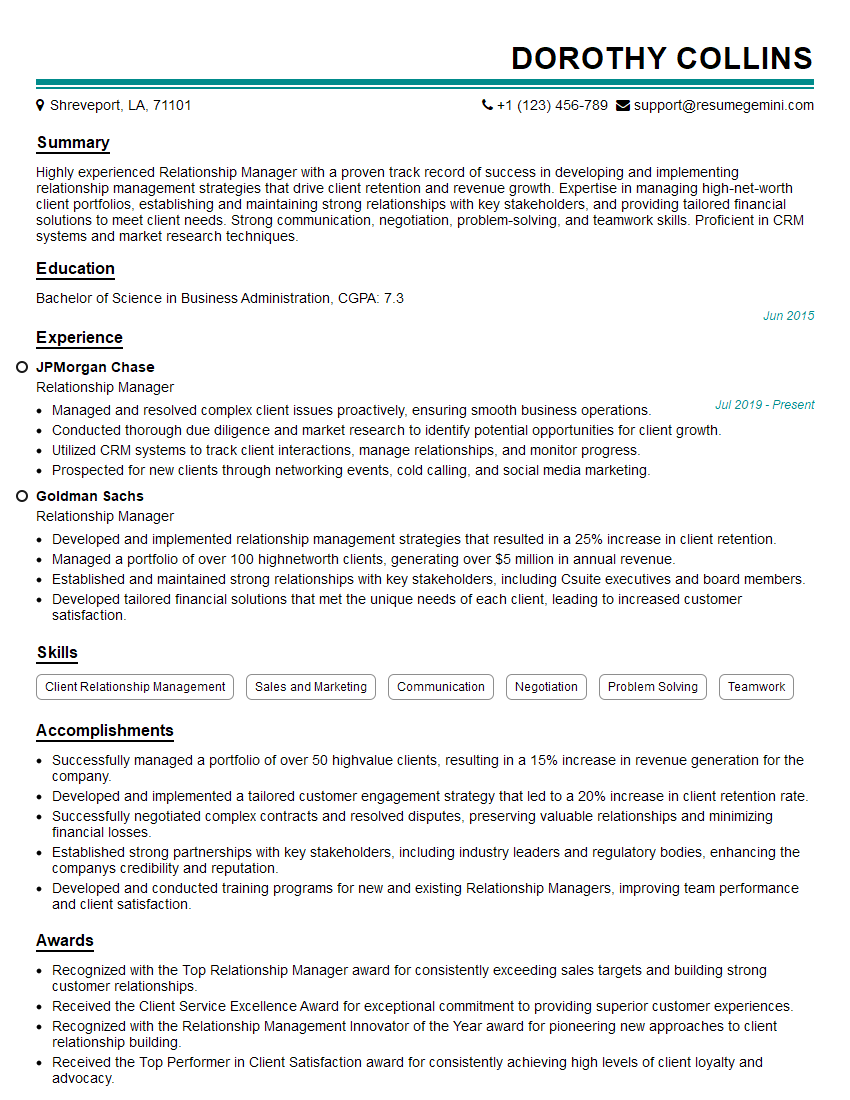
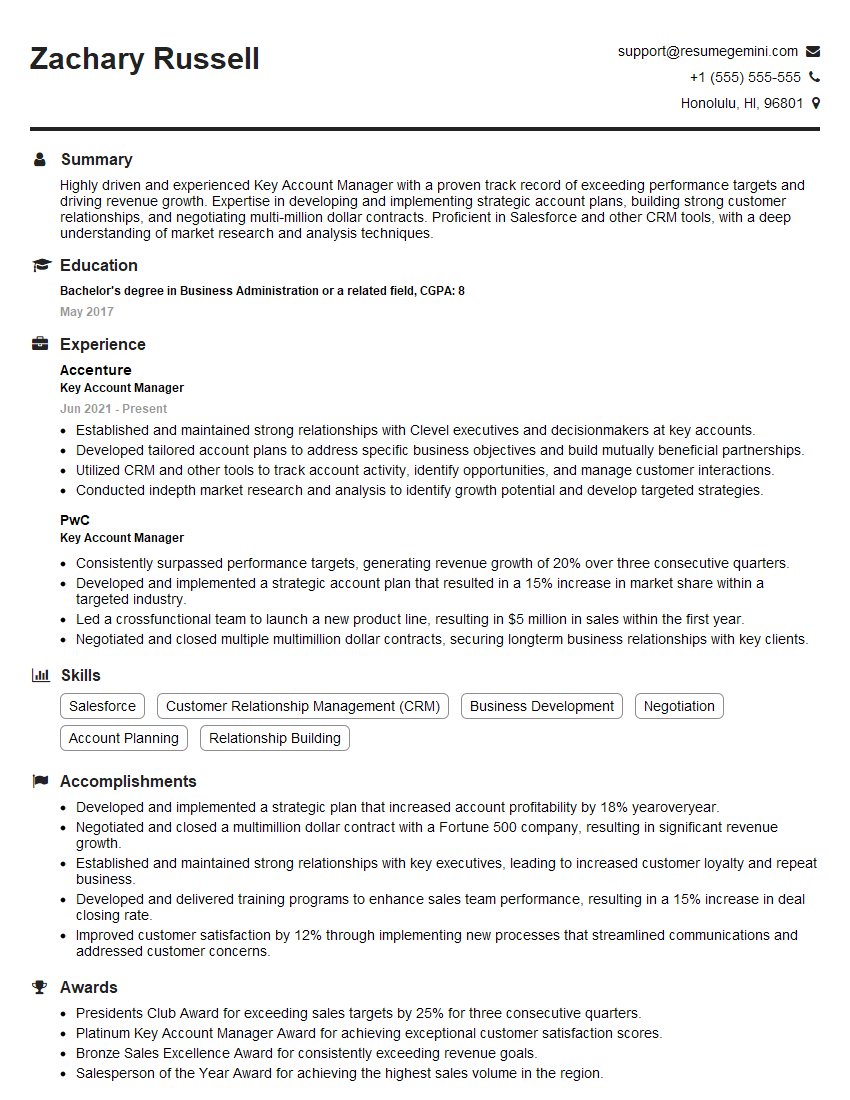
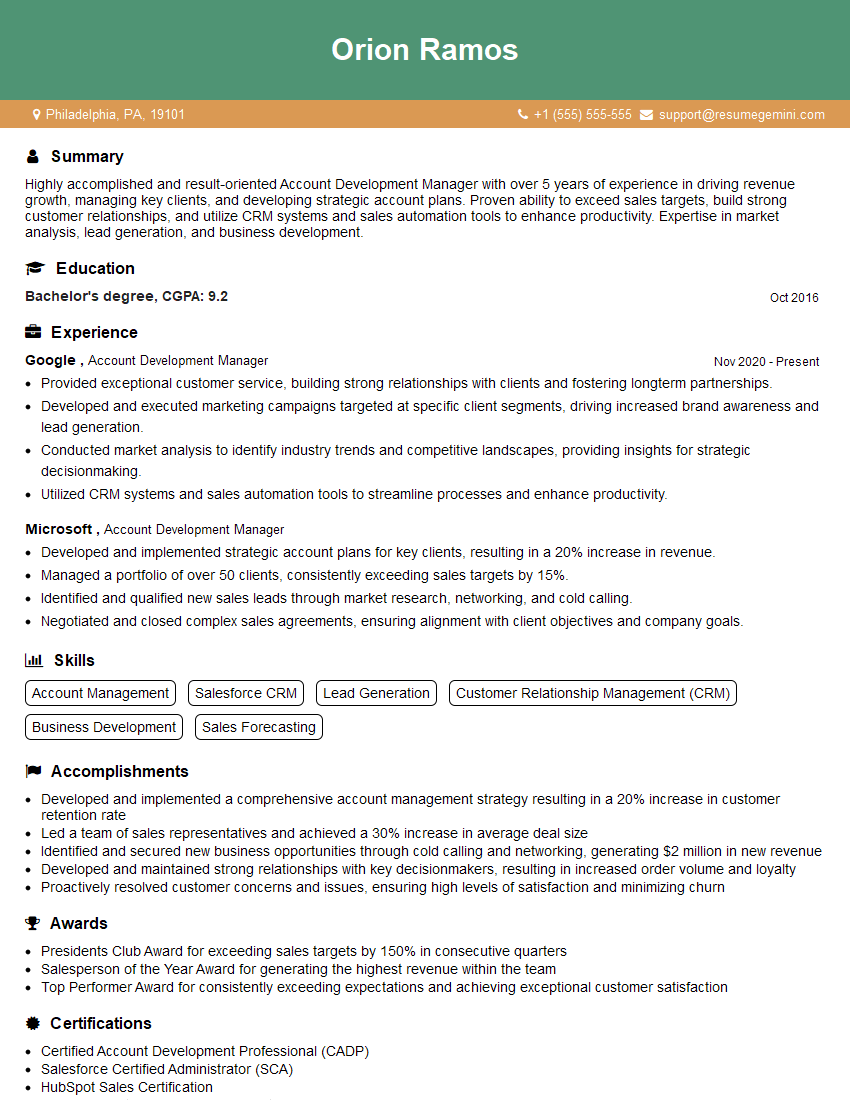
Mastering Key Account Management is crucial for accelerating your career growth. KAM professionals are highly sought after for their ability to build strong client relationships, drive revenue, and strategically manage critical accounts. To maximize your job prospects, focus on building a strong, ATS-friendly resume that highlights your KAM skills and experience. ResumeGemini is a trusted resource for creating professional, impactful resumes that get noticed. We offer examples of resumes tailored to Key Account Management, providing you with a template to showcase your qualifications effectively.
Explore more articles
Users Rating of Our Blogs
Share Your Experience
We value your feedback! Please rate our content and share your thoughts (optional).
What Readers Say About Our Blog
Amazing blog
hello,
Our consultant firm based in the USA and our client are interested in your products.
Could you provide your company brochure and respond from your official email id (if different from the current in use), so i can send you the client’s requirement.
Payment before production.
I await your answer.
Regards,
MrSmith
hello,
Our consultant firm based in the USA and our client are interested in your products.
Could you provide your company brochure and respond from your official email id (if different from the current in use), so i can send you the client’s requirement.
Payment before production.
I await your answer.
Regards,
MrSmith
These apartments are so amazing, posting them online would break the algorithm.
https://bit.ly/Lovely2BedsApartmentHudsonYards
Reach out at BENSON@LONDONFOSTER.COM and let’s get started!
Take a look at this stunning 2-bedroom apartment perfectly situated NYC’s coveted Hudson Yards!
https://bit.ly/Lovely2BedsApartmentHudsonYards
Live Rent Free!
https://bit.ly/LiveRentFREE
Interesting Article, I liked the depth of knowledge you’ve shared.
Helpful, thanks for sharing.
Hi, I represent a social media marketing agency and liked your blog
Hi, I represent an SEO company that specialises in getting you AI citations and higher rankings on Google. I’d like to offer you a 100% free SEO audit for your website. Would you be interested?