Cracking a skill-specific interview, like one for News Anchoring, requires understanding the nuances of the role. In this blog, we present the questions you’re most likely to encounter, along with insights into how to answer them effectively. Let’s ensure you’re ready to make a strong impression.
Questions Asked in News Anchoring Interview
Q 1. Describe your experience delivering breaking news updates.
Delivering breaking news requires a unique blend of speed, accuracy, and composure. My experience encompasses years of reporting on significant events, from natural disasters to political upheavals. I’ve learned to quickly grasp the core information, prioritize key facts, and present them concisely and clearly to viewers in a state of heightened anxiety or uncertainty. This includes understanding the evolving nature of breaking news and constantly updating information as it becomes available. For instance, during a major hurricane, I would receive constant updates from reporters on the ground, meteorologists tracking the storm’s path, and emergency officials coordinating the rescue efforts. My role was to synthesize this information, filter out speculation, and deliver a clear and informative update to the viewers, keeping them abreast of the situation and the potential impact on their lives.
One particularly memorable instance involved a sudden, unexpected political announcement. I had to quickly understand the implications, research the background information, and then craft a concise yet informative segment in a matter of minutes, while simultaneously staying calm and reassuring to viewers. This involved rapid information processing, verification of multiple sources, and a smooth transition between different segments of the broadcast.
Q 2. How do you maintain composure under pressure during live broadcasts?
Maintaining composure under pressure during live broadcasts is paramount. It’s a skill honed through practice and experience. My approach involves several key strategies. First, meticulous preparation is crucial. The more I know about a topic, the more confident I feel. Second, I practice deep breathing techniques to manage any anxiety. This helps regulate my heart rate and ensures a clear voice. Third, I focus on connecting with the viewers; remembering that I’m providing crucial information helps me maintain focus and professionalism. Finally, I’ve learned to trust my instincts and training – knowing I have the skills and experience to handle almost any situation is reassuring.
Imagine a situation where a technical glitch occurs mid-broadcast. Rather than panicking, I’ve learned to adapt quickly, either by filling the silence with a concise overview of the story or subtly guiding the conversation back on track once the issue is resolved. These skills are not innate but acquired through repeated practice and a genuine understanding of the importance of delivering accurate information during moments of great uncertainty.
Q 3. Explain your process for preparing for a news segment.
My preparation for a news segment is a multi-stage process. It begins with thorough research. This involves reading news articles, reports, and reviewing previous segments on the topic. I also verify sources and cross-reference information to ensure accuracy. Next, I work closely with the news team to craft the overall narrative and determine the best visual elements to complement the story. I then practice delivering the segment, refining my word choices and ensuring a smooth flow. This practice run is crucial, allowing me to identify potential issues or areas needing improvement. Finally, I review the teleprompter script one last time before going live, ensuring I’m completely familiar with the content and the sequence of information.
For example, when preparing for a segment on economic policy, I would review reports from financial institutions, consult economic experts, and even look at market trends before constructing my delivery. This thorough prep work allows me to present a well-rounded and informed perspective.
Q 4. How do you adapt your delivery to different types of news stories?
Adapting my delivery to different types of news stories is crucial. The tone and style I adopt will vary considerably depending on the subject matter. For example, a lighthearted feature story requires a more conversational and engaging tone, while reporting on a tragedy necessitates sensitivity and empathy. In the case of a breaking news event, I prioritize clarity and conciseness, while for a more in-depth analysis, I may adopt a slower pace and incorporate more detailed explanations. Maintaining professionalism and credibility is constant; however, my approach adapts to suit the narrative and the emotions involved.
I can easily transition from delivering a serious report on international affairs to presenting a more upbeat piece on local community events – maintaining the appropriate tone and energy level for each piece. This adaptability is essential for maintaining viewer engagement and trust.
Q 5. How do you handle unexpected interruptions during a live broadcast?
Handling unexpected interruptions during a live broadcast demands quick thinking and adaptability. My training emphasizes maintaining composure, responding professionally, and seamlessly navigating disruptions. This might involve a technical malfunction, a sudden change in the news cycle, or an unexpected guest appearance. My approach includes acknowledging the interruption calmly, improvising as needed, and quickly regaining control of the segment. This may involve gracefully pivoting to a different section of the news or providing a brief, informative update to fill any unexpected gaps in the program. I always strive to ensure the viewers feel informed and that the flow of the broadcast is minimally affected by unforeseen events.
I recall one instance where a guest’s microphone malfunctioned during a live interview. I responded immediately by briefly addressing the technical issue, then engaging the guest in a conversation to allow the audio team to resolve the problem, seamlessly bridging the gap with a brief summary of the story while maintaining viewer engagement.
Q 6. Describe your experience working with teleprompters.
Working with teleprompters is a fundamental aspect of news anchoring. Proficiency involves more than just reading the text; it requires maintaining eye contact with the camera, delivering the information naturally, and ensuring smooth transitions between sentences and segments. My approach focuses on practicing beforehand, understanding the pacing of the script, and incorporating my own voice and personality while adhering to the provided content. I try to avoid becoming overly reliant on the teleprompter, rather using it as a tool to ensure accuracy and consistency, without allowing it to hinder my natural communication style.
Efficient teleprompter use is also about understanding the technical aspects. This includes adjusting the speed, font size, and overall presentation to suit my preferences and the requirements of the particular news segment. This mastery ensures a smooth, natural presentation even under high-pressure situations.
Q 7. How do you ensure accuracy and fairness in your reporting?
Ensuring accuracy and fairness in reporting is the cornerstone of my professional ethics. It’s a commitment I take very seriously. This begins with verifying information from multiple credible sources. I always cross-check facts, scrutinize claims, and strive for impartiality. I avoid using biased language and present all sides of a story fairly, whenever possible. If there’s uncertainty or ambiguity in information, I explicitly state it to the viewers. Furthermore, I’m always aware of the potential impact of my words and strive to present information responsibly and ethically, minimizing harm and avoiding misinformation.
An example would be reporting on a controversial political issue. I wouldn’t just present one side’s argument but would offer a balanced representation of different viewpoints, making sure to cite the sources of my information, and avoiding any personal opinions or biases. Transparency and accountability are paramount.
Q 8. How do you build rapport with guests during interviews?
Building rapport with guests is crucial for a successful interview. It’s about creating a comfortable and trusting environment where they feel at ease sharing their thoughts and perspectives. This isn’t about being their friend, but establishing a professional connection based on mutual respect and understanding.
- Pre-Interview Research: Before the interview, I thoroughly research my guest and their background. Understanding their expertise and perspectives allows me to ask relevant and insightful questions, demonstrating that I value their time and knowledge. This shows respect and preparation, immediately building a foundation of trust.
- Active Listening: During the interview, I practice active listening, paying close attention to what the guest is saying, both verbally and nonverbally. I nod, maintain eye contact (while remembering to glance at the camera occasionally), and use verbal cues like “I understand,” or “That’s fascinating” to show engagement. This fosters a sense of connection and encourages them to elaborate.
- Clear and Concise Questions: I ask clear and concise questions that are easy to understand. Avoiding jargon or overly complex phrasing helps ensure the guest feels comfortable answering, and prevents any potential misunderstandings. I also avoid interrupting unless absolutely necessary.
- Humanizing the Conversation: Injecting a touch of humor or sharing a relatable anecdote (where appropriate) can help break the ice and create a more relaxed atmosphere. It shows I’m not just a detached interviewer but a person engaging with another person.
- Post-Interview Follow-Up: A simple thank you note or email after the interview reinforces the positive interaction and further solidifies the rapport.
For example, in an interview with a scientist discussing climate change, I might begin by acknowledging their significant contributions to the field, demonstrating my respect for their expertise. Then, during the conversation, I might share a brief personal anecdote about how the topic personally affects me, connecting with them on a human level.
Q 9. How do you handle difficult or controversial questions from guests?
Handling difficult or controversial questions requires a delicate balance of firmness, fairness, and respect. The goal is to elicit truthful answers while maintaining a professional and courteous environment.
- Remain Calm and Neutral: Even if the guest’s response is unexpected or controversial, I maintain a calm and neutral demeanor. My body language and tone of voice should convey professionalism and objectivity, preventing the interview from escalating into a debate.
- Rephrase or Clarify: If a question is unclear or if the guest’s response is vague, I politely rephrase the question or ask for clarification. This ensures that both the audience and I understand the point being made.
- Fact-Check in Real-Time (When Possible): If a guest makes a statement that seems questionable, I might subtly fact-check it during the interview, either by referring to previously established facts or by asking follow-up questions that challenge the statement. This doesn’t mean interrupting or accusing, but rather gently guiding the conversation toward accuracy.
- Time Constraints: In many cases, due to time constraints, I may have to cut short a controversial discussion and move on. However, I would make sure to ensure the statement remains within appropriate boundaries and isn’t presented as undisputed fact if I lack time to fully address the issues raised.
- Follow-Up: Sometimes, I may need to follow up with the guest after the interview to clarify certain points or address any inaccuracies. This is particularly important for controversial topics to avoid any misrepresentation.
For instance, if a politician makes a claim about their accomplishments, I might gently counter by asking for specific examples or data to support that claim. This ensures the audience receives a balanced perspective.
Q 10. Describe your experience working with a news team.
Working with a news team is a collaborative effort that requires strong communication and teamwork. My experience has been incredibly rewarding, teaching me the importance of every role within a newsroom.
- Producers: I work closely with producers to plan interviews, select topics, and develop the overall flow of a news segment. They are crucial in providing the background research, helping me formulate questions, and ensuring the story is told effectively.
- Editors: Editors play a crucial role in refining the story, ensuring accuracy, and shaping the final product. Their expertise is invaluable in ensuring the piece is clear, concise, and compelling.
- Camera Operators and Technicians: The technical crew ensures the smooth execution of the broadcast. Their skill and expertise behind the scenes are vital for a high-quality broadcast. I often work closely with them before interviews, ensuring lighting, sound and camera placement aligns with the story being told.
- Graphics and Digital Teams: These teams work behind the scenes to prepare supporting graphics, data visualizations and provide up-to-the-minute information during live broadcasts. Their seamless integration with the live broadcast is essential.
In one specific instance, our team had to cover a breaking news story — a major earthquake. The producer provided me with real-time updates from various sources while the cameraperson worked to quickly capture footage from the scene. Meanwhile, our graphics team displayed the quake’s magnitude and location seamlessly during the live segment. This team collaboration allowed us to present a comprehensive, accurate, and timely report under significant pressure.
Q 11. How do you manage your time effectively while working on multiple stories?
Effective time management is paramount in news anchoring, where multiple stories often need to be covered simultaneously. I utilize several strategies to manage my workload effectively.
- Prioritization: I prioritize stories based on their urgency and importance. Breaking news always takes precedence. I use a system to categorize and rank stories based on impact and deadlines.
- Planning and Scheduling: I meticulously plan my day, creating a schedule that allocates specific time slots for research, script writing, interview preparation, and rehearsal. I use digital calendars and to-do lists to track my progress and deadlines.
- Delegation (when applicable): When possible, I delegate tasks to other team members, such as research or fact-checking, freeing up my time to focus on other crucial aspects of my role.
- Time Blocking: I allocate specific time blocks for focused work on individual stories. This minimizes distractions and maximizes productivity.
- Efficient Research Techniques: I use efficient research techniques to gather information quickly and accurately. This includes utilizing reputable news sources, accessing databases, and interviewing experts.
For example, during a busy news cycle, I might dedicate the first hour to preparing for a breaking news story, the next two hours to writing scripts for other segments, and the remaining time for rehearsals and final checks before going on-air.
Q 12. How familiar are you with news writing style guides (e.g., AP Style)?
I am very familiar with major news writing style guides, particularly AP Style. Understanding and adhering to these style guides is fundamental to maintaining journalistic integrity and consistency.
AP Style provides standardized rules for grammar, punctuation, capitalization, and usage. It ensures clarity, accuracy, and consistency in reporting. My familiarity extends to:
- Numbers and numerals: Knowing when to spell out numbers versus using numerals.
- Dates and times: Using the correct format for dates and times.
- Abbreviations and acronyms: Knowing when to use abbreviations and acronyms and spelling them out correctly.
- Capitalization: Adhering to specific capitalization rules for titles, organizations, and locations.
- Punctuation: Following proper punctuation rules for clarity and readability.
Consistency in style is vital for credibility. Inconsistent usage can distract the audience and even cast doubt on the accuracy of the information being presented. I ensure every script and broadcast aligns with AP Style to maintain a professional standard.
Q 13. How do you fact-check your information before presenting it on-air?
Fact-checking is an integral part of my process, and I employ a multi-layered approach to ensure accuracy before presenting information on-air.
- Multiple Sources: I always rely on multiple credible sources to verify information. This helps corroborate facts and identify any potential biases or inaccuracies.
- Reputable Sources: I prioritize information from well-established and reputable news organizations, academic institutions, government agencies, and other trusted sources.
- Primary Sources (When Possible): Whenever possible, I seek out primary sources, such as official documents, eyewitness accounts, or direct quotes from individuals involved. This minimizes reliance on secondary interpretations.
- Cross-Referencing: I meticulously cross-reference information from various sources to ensure consistency and accuracy. Discrepancies are investigated further.
- Fact-Checking Tools: I leverage various fact-checking tools and websites to verify information independently.
For example, if a guest mentions a specific statistic, I wouldn’t just take their word for it. I’d immediately cross-reference that information with a reputable source like the World Bank or a relevant government agency. Any discrepancies would necessitate further investigation before I present that data on-air.
Q 14. How do you prioritize information during breaking news situations?
During breaking news situations, prioritizing information is critical. Speed and accuracy are paramount, but chaos can easily lead to mistakes. I employ a structured approach:
- Verify Information: The most important thing is to verify the information before broadcasting it. Even in a fast-paced environment, taking a moment to confirm facts from multiple sources prevents spreading misinformation.
- Identify Key Facts: I focus on the most critical and verifiable information first – who, what, when, where, why, and how. Less important details can be added later.
- Prioritize the Most Urgent Information: I prioritize information that has the greatest impact and is most time-sensitive. This might involve highlighting immediate risks, injuries, or ongoing events.
- Update Regularly: In breaking news, the situation is constantly evolving. I provide regular updates to keep the audience informed and ensure information is as current as possible.
- Remain Calm and Composed: Despite the pressure, maintaining composure is crucial to effectively convey information to viewers, reassuring them during times of uncertainty. My training focuses on maintaining calm under pressure and utilizing clear communication to relay information without panic.
Imagine a sudden large-scale power outage. Initially, I’d focus on confirming the extent of the outage, the affected areas, and whether there are any immediate safety concerns. Then, I’d provide updates on the cause of the outage and the efforts being made to restore power. Less important details, like specific numbers of affected customers, might come later as information becomes available.
Q 15. Describe your experience with social media and its role in news broadcasting.
Social media has become an indispensable tool for news broadcasting, transforming how we connect with audiences and gather information. It’s no longer enough to simply deliver news; we must engage with our viewers on the platforms they use daily.
My experience encompasses utilizing various platforms like Twitter, Facebook, and Instagram to share updates, behind-the-scenes glimpses, and engage in real-time discussions about breaking news. I use these platforms to promote our broadcasts, respond to viewer inquiries, and even gather feedback, which helps tailor our content to their needs. For instance, during a recent severe weather event, we used social media to share real-time updates and safety information, directly interacting with concerned citizens. This two-way communication is crucial for building trust and ensuring our news reaches a wider, more engaged audience. However, we also approach social media strategically, understanding the need for fact-checking and responsible reporting, particularly in the face of misinformation. Our team carefully monitors comments and reports, ensuring that all information shared online is accurate and responsible.
Career Expert Tips:
- Ace those interviews! Prepare effectively by reviewing the Top 50 Most Common Interview Questions on ResumeGemini.
- Navigate your job search with confidence! Explore a wide range of Career Tips on ResumeGemini. Learn about common challenges and recommendations to overcome them.
- Craft the perfect resume! Master the Art of Resume Writing with ResumeGemini’s guide. Showcase your unique qualifications and achievements effectively.
- Don’t miss out on holiday savings! Build your dream resume with ResumeGemini’s ATS optimized templates.
Q 16. How do you handle criticism or negative feedback about your work?
Criticism, even negative feedback, is a valuable learning opportunity. I view it as constructive criticism, especially if it’s well-articulated. Instead of taking it personally, I analyze the feedback to identify areas for improvement in my delivery, presentation, or even content selection. For example, if viewers find my pace too fast, I’ll consciously adjust it. If the criticism lacks specificity, I might use it as a prompt to seek more feedback or clarification, ensuring I understand the source of the concern. Ultimately, constructive criticism helps me refine my skills and better serve my audience. Ignoring criticism is never an option; engaging with it professionally, respectfully, and critically, however, is essential for growth.
Q 17. What are your strengths and weaknesses as a news anchor?
My strengths lie in my ability to remain calm under pressure, deliver information clearly and concisely, and connect with audiences on an emotional level. I pride myself on my thorough preparation and research, ensuring accuracy in my reporting. I’m also adaptable and quick-thinking, crucial in a fast-paced news environment. For example, during a live broadcast, I once had to improvise when a guest unexpectedly changed their prepared remarks. My ability to quickly adapt and maintain composure ensured a smooth continuation of the program.
However, like everyone, I have areas for improvement. One weakness I am actively working on is incorporating more diverse storytelling techniques to better engage diverse audiences. I also strive to improve my proficiency in using certain broadcast technologies to improve efficiency and storytelling capabilities.
Q 18. How do you maintain professionalism and ethical standards in your work?
Maintaining professionalism and ethical standards is paramount. This involves several key practices. First and foremost is fact-checking. Every piece of information I present is rigorously verified through multiple sources. I also ensure objectivity; I strive to avoid biased language or opinions, presenting facts impartially. Confidentiality is also critical, especially when handling sensitive information. Transparency in my reporting is also important; if a mistake is made, I acknowledge and correct it promptly. Lastly, adhering to journalistic ethics and the station’s internal guidelines is non-negotiable. For instance, I’ve had to decline interviews or stories when presented with potential conflicts of interest.
Q 19. How do you stay updated on current events and trends?
Staying updated is a continuous process. I begin each day by reviewing multiple reputable news sources, including international wire services, respected newspapers, and reliable online news outlets. I also utilize news aggregators and specialized apps that alert me to breaking news. Beyond traditional news sources, I engage with credible social media accounts of journalists and experts to keep my finger on the pulse of evolving events and trends. Additionally, I attend professional development workshops and conferences to stay abreast of the latest reporting techniques and best practices. Think of it as continuous professional development; it is essential for staying relevant and informing my audience accurately and efficiently.
Q 20. Describe your experience using broadcast technology (cameras, microphones, etc.)
My experience with broadcast technology is extensive. I’m proficient in operating various cameras, including studio cameras and ENG (electronic news gathering) cameras. I understand lighting techniques and camera angles, and I can work independently with a teleprompter. My microphone technique is refined, ensuring clear and audible delivery. I’m also familiar with various audio mixing boards and editing software. I am comfortable working with different broadcast equipment, ensuring seamless technical integration in live and pre-recorded segments. Understanding the technical aspects allows me to focus on my delivery and connect with the audience rather than get bogged down with equipment malfunctions. For example, I have used multiple video editing software programs, from professional grade software to those used on smaller production teams.
Q 21. What is your approach to conducting on-camera interviews?
My approach to on-camera interviews is centered on thorough preparation and active listening. Before the interview, I conduct detailed research on the interviewee and the topic at hand. I formulate a set of carefully crafted questions, but I also allow for flexibility and spontaneous follow-ups. During the interview, I aim to create a relaxed but professional atmosphere, establishing rapport with the guest. Active listening is key; it allows me to engage with the guest’s responses, follow-up appropriately, and redirect the conversation if necessary. I maintain a clear and concise interview style, ensuring the conversation remains focused and informative. For example, when conducting an interview with an expert about a complex scientific study, my preparation included familiarizing myself with the key findings, ensuring I could follow the scientific method and terminology the expert would use.
Q 22. How do you present complex information in a clear and concise manner?
Presenting complex information clearly and concisely involves breaking down intricate topics into digestible parts. Think of it like peeling an onion – layer by layer. I start by identifying the core message, the single most important takeaway. Then, I build outwards, adding supporting details and context in a logical sequence. This often involves using analogies or metaphors to explain abstract concepts in relatable terms. For example, explaining complex economic data by comparing it to a household budget. I also prioritize using simple language, avoiding jargon whenever possible. Finally, I ensure the information flows naturally, creating a narrative that keeps the viewer engaged.
For instance, if explaining a complicated court ruling, I wouldn’t just recite legal jargon. I’d start with the central issue, then explain the key arguments and evidence presented by each side, culminating in a clear explanation of the ruling’s implications for ordinary citizens.
Q 23. How do you respond to viewer feedback or complaints?
Viewer feedback is invaluable. I treat every comment, whether positive or negative, as an opportunity to improve. Positive feedback confirms we’re on the right track, while constructive criticism helps identify areas needing refinement. Negative feedback is handled with empathy and professionalism. I try to understand the source of the dissatisfaction and respond thoughtfully and directly. Sometimes, a simple acknowledgement and explanation suffices; other times, a more in-depth response or even a correction on air might be necessary. Transparency and a genuine desire to address concerns are key.
For example, if a viewer complained about the lack of clarity in a particular segment, I’d review the footage, consider their feedback, and perhaps adjust my delivery or presentation for future segments.
Q 24. What are your salary expectations for this role?
My salary expectations are commensurate with my experience and the demands of this role. Given my extensive background in news anchoring, including [mention specific achievements or accolades], I am seeking a competitive salary package that reflects my contributions and market value. I’m open to discussing this further and am confident we can reach a mutually agreeable figure. I’m more interested in a fair compensation package aligned with the value I provide than negotiating down to the lowest possible offer.
Q 25. How do you handle conflicting information from multiple sources?
Handling conflicting information requires a rigorous approach grounded in verification and fact-checking. I begin by identifying the source of each piece of information and assessing its credibility. This involves considering the reputation of the source, its potential biases, and the evidence it presents. If the discrepancies are significant, I delve deeper to find corroborating evidence or independent verification. If definitive verification isn’t possible, I present the conflicting information transparently, highlighting the uncertainty and acknowledging the limitations in available data. Maintaining journalistic integrity and avoiding speculative conclusions are paramount.
For example, if two sources provide differing casualty figures after a natural disaster, I wouldn’t simply report one over the other. I’d report both, while acknowledging that the official figure may change as information is verified.
Q 26. Describe a time you had to make a quick decision under pressure.
During a live broadcast, our network experienced a sudden technical malfunction. The teleprompter went down, and we had only seconds to react. I instantly switched to my notes, maintained a calm demeanor on-air, and seamlessly transitioned to ad-lib reporting, using my knowledge of the current events to keep the broadcast running smoothly. My years of experience helped me adapt swiftly, focusing on delivering accurate information despite the unexpected interruption. The incident highlighted the importance of preparedness and adaptability in live television.
Q 27. How do you incorporate visual aids effectively into your news segments?
Visual aids are crucial for enhancing audience engagement and understanding. I work closely with the production team to ensure that visuals are not only relevant but also aesthetically pleasing and easy to interpret. Graphics, maps, charts, and video clips should complement the narrative, not distract from it. It’s about finding the right balance: Too much visual clutter is overwhelming, too little can make the segment boring. The timing and placement of visual aids are also carefully considered to maintain the flow of the story.
For example, when reporting on climate change, I would use maps to show temperature changes over time, and graphs to demonstrate carbon emission levels, all while keeping the visuals concise and easy to understand.
Q 28. What are your long-term career goals in news broadcasting?
My long-term career goals involve continuing to grow as a respected and trusted news anchor. I aspire to increase my on-air presence, taking on greater responsibility and potentially becoming a lead anchor for a major news program. I’m also interested in developing my skills in investigative journalism and potentially mentoring junior colleagues. Ultimately, I aim to contribute significantly to the field of news broadcasting, ensuring accurate and impactful reporting that serves the public interest. Continuous learning and adaptation are crucial in this ever-evolving landscape, and I’m committed to remaining at the forefront of my profession.
Key Topics to Learn for News Anchoring Interview
- News Delivery & Presentation: Mastering vocal delivery, pacing, and inflection to engage viewers and convey information clearly and confidently. Practice delivering news stories with varying tones and emotions.
- Impromptu Speaking & Quick Thinking: Develop the ability to adapt to unexpected situations, such as last-minute script changes or breaking news updates. Practice improvising responses to hypothetical scenarios.
- Teleprompter Proficiency: Become highly proficient at reading from a teleprompter smoothly and naturally, maintaining eye contact with the camera. Practice with varying speeds and complexities of text.
- News Judgment & Ethics: Understand the principles of journalistic integrity, accuracy, and fairness. Develop the ability to assess the newsworthiness of stories and make sound editorial decisions.
- Understanding News Formats & Structures: Familiarize yourself with different news formats (e.g., hard news, feature stories, breaking news) and the structure of news packages. Practice structuring your own concise and impactful news reports.
- Body Language & On-Camera Presence: Project confidence and professionalism through posture, gestures, and facial expressions. Practice presenting news stories while maintaining a composed and engaging on-camera presence.
- Current Events & Global Awareness: Stay abreast of current affairs and global events. Demonstrate a broad understanding of political, economic, and social issues.
- Handling Difficult Questions & Interviews: Practice responding to challenging questions with grace and professionalism, maintaining composure under pressure. Consider how to handle difficult interview subjects or potentially controversial topics.
Next Steps
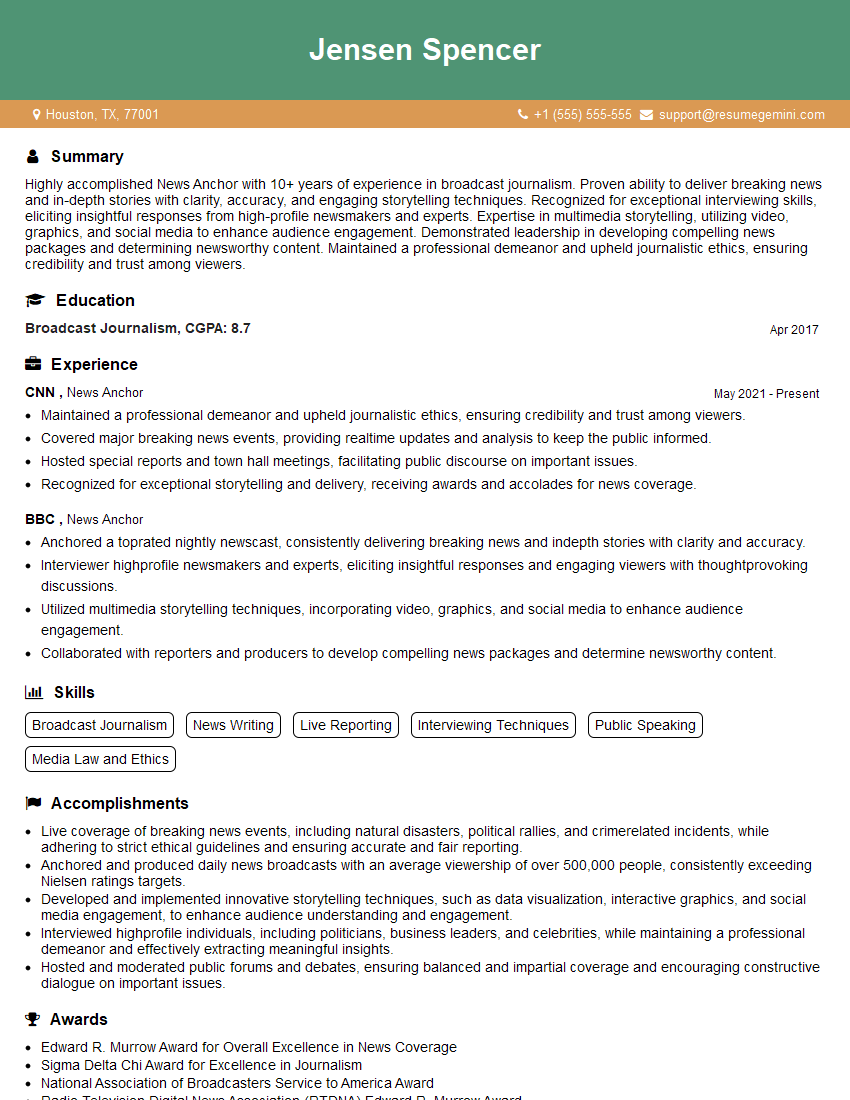
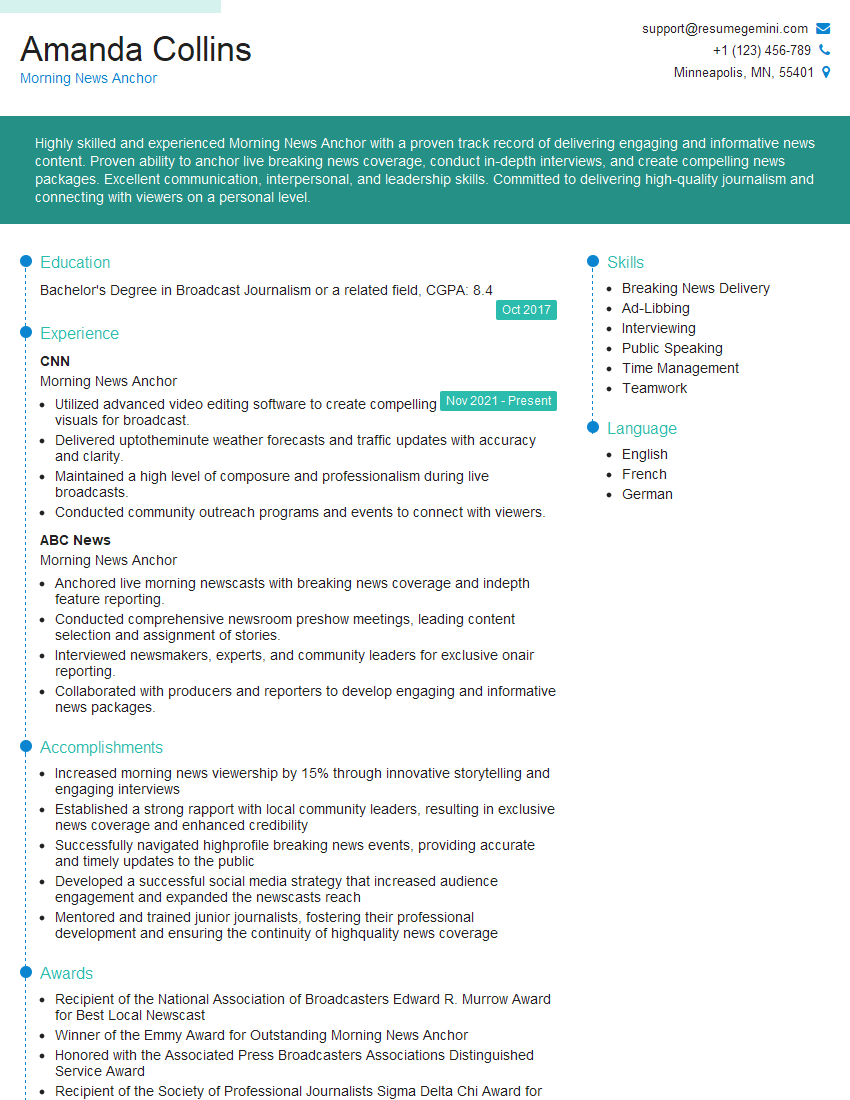
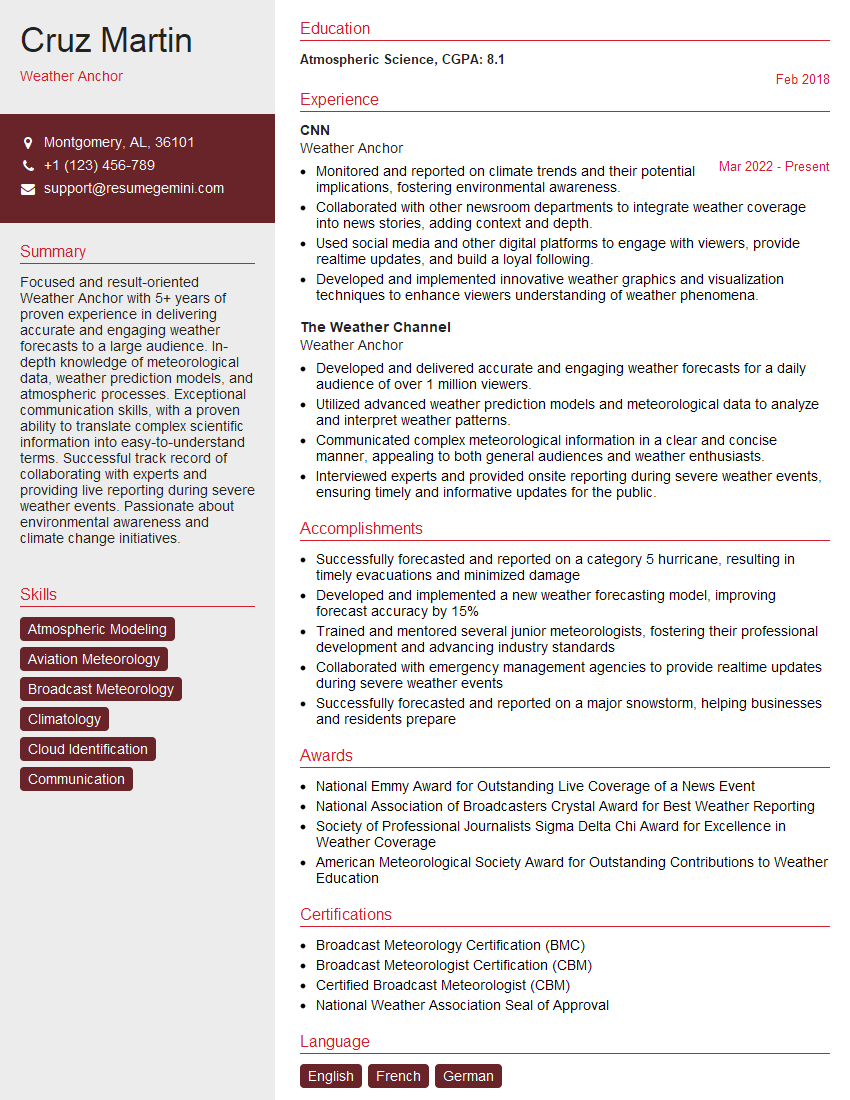
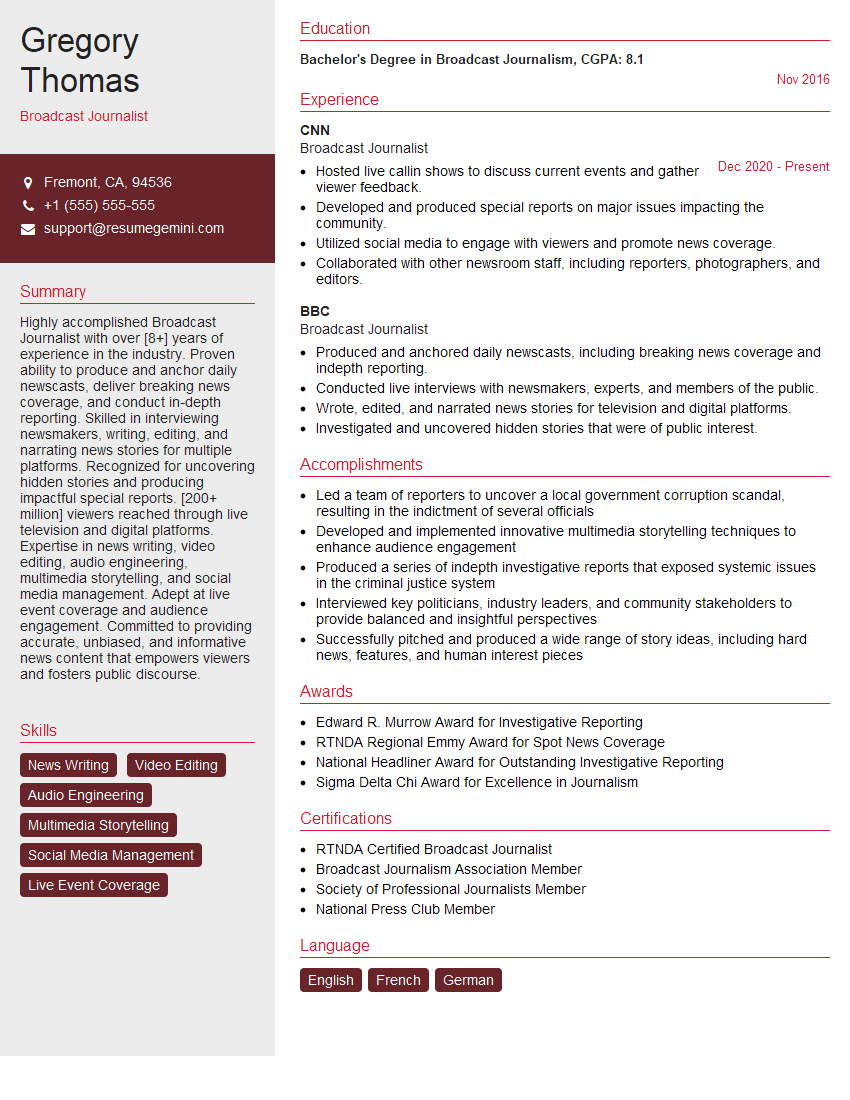
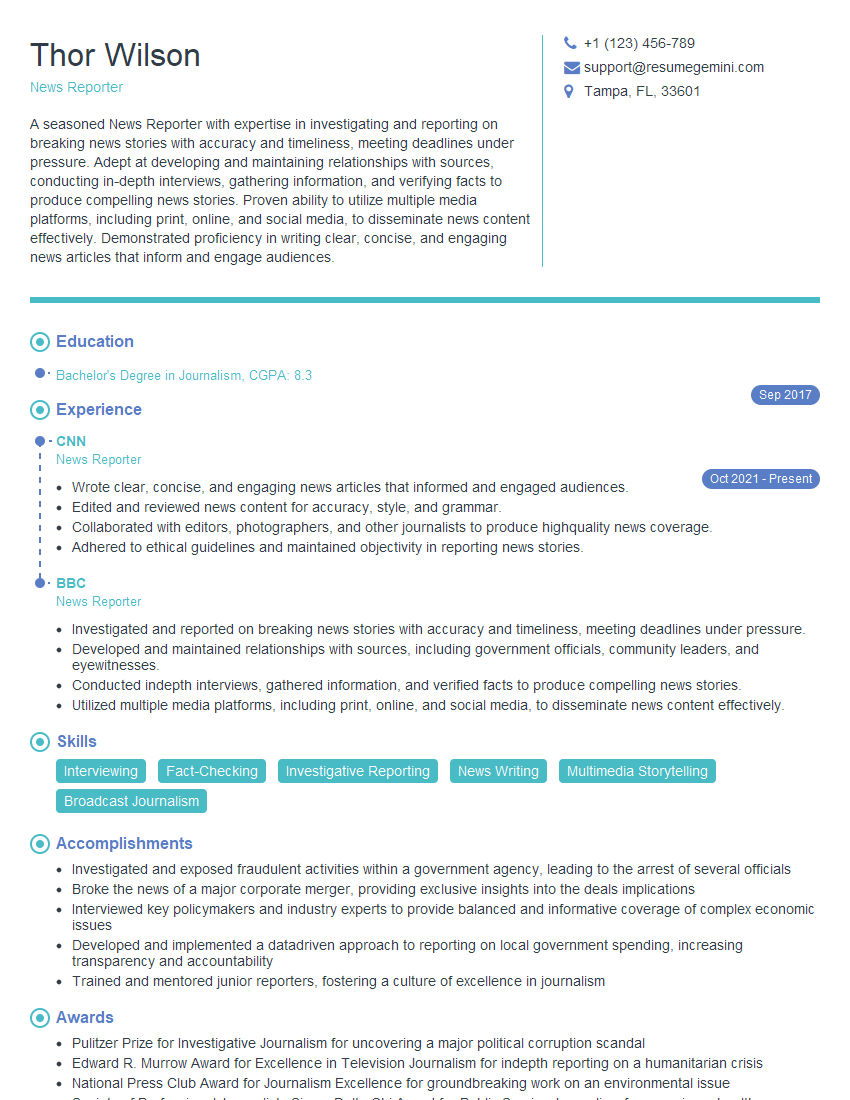
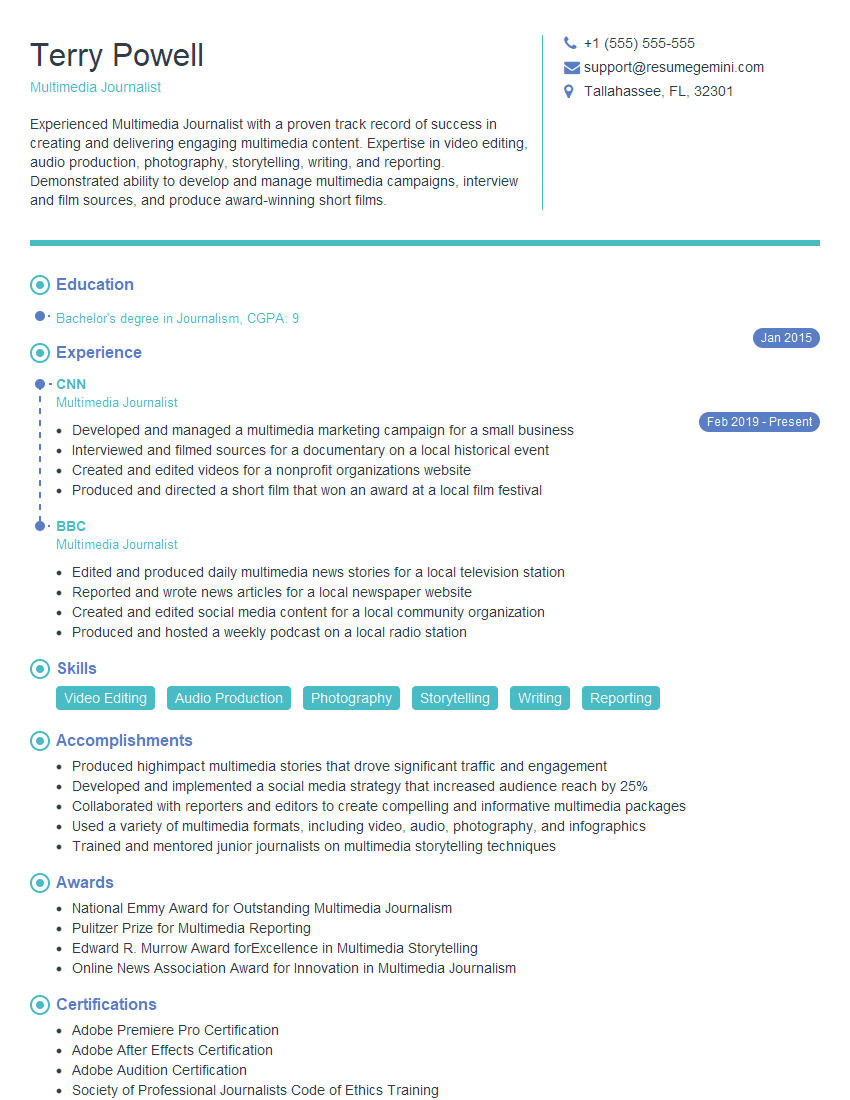
Mastering news anchoring can significantly boost your career prospects, opening doors to exciting opportunities in broadcasting and media. A well-crafted resume is crucial for showcasing your skills and experience effectively to potential employers. An ATS-friendly resume is essential for getting past initial screening systems and landing interviews. To help you create a standout resume that grabs the attention of recruiters, we strongly recommend using ResumeGemini. ResumeGemini provides tools and resources to build a professional, impactful resume, and you’ll find examples of resumes tailored to News Anchoring available to guide you. Take the next step towards your dream career – build your winning resume today!
Explore more articles
Users Rating of Our Blogs
Share Your Experience
We value your feedback! Please rate our content and share your thoughts (optional).
What Readers Say About Our Blog
Amazing blog
hello,
Our consultant firm based in the USA and our client are interested in your products.
Could you provide your company brochure and respond from your official email id (if different from the current in use), so i can send you the client’s requirement.
Payment before production.
I await your answer.
Regards,
MrSmith
hello,
Our consultant firm based in the USA and our client are interested in your products.
Could you provide your company brochure and respond from your official email id (if different from the current in use), so i can send you the client’s requirement.
Payment before production.
I await your answer.
Regards,
MrSmith
These apartments are so amazing, posting them online would break the algorithm.
https://bit.ly/Lovely2BedsApartmentHudsonYards
Reach out at BENSON@LONDONFOSTER.COM and let’s get started!
Take a look at this stunning 2-bedroom apartment perfectly situated NYC’s coveted Hudson Yards!
https://bit.ly/Lovely2BedsApartmentHudsonYards
Live Rent Free!
https://bit.ly/LiveRentFREE
Interesting Article, I liked the depth of knowledge you’ve shared.
Helpful, thanks for sharing.
Hi, I represent a social media marketing agency and liked your blog
Hi, I represent an SEO company that specialises in getting you AI citations and higher rankings on Google. I’d like to offer you a 100% free SEO audit for your website. Would you be interested?