Preparation is the key to success in any interview. In this post, we’ll explore crucial Scaffold Assembly and Dismantling interview questions and equip you with strategies to craft impactful answers. Whether you’re a beginner or a pro, these tips will elevate your preparation.
Questions Asked in Scaffold Assembly and Dismantling Interview
Q 1. Describe your experience with different types of scaffolding systems (e.g., tube and clamp, system scaffolding).
My experience encompasses a wide range of scaffolding systems, primarily focusing on tube and clamp and system scaffolding. Tube and clamp scaffolding, while offering great flexibility for adapting to complex structures, requires a high level of skill and attention to detail in assembly and dismantling due to its component-based nature. I’ve worked extensively on projects utilizing this method, from smaller residential renovations to large-scale commercial builds. System scaffolding, on the other hand, utilizes pre-engineered components with standardized connections, offering increased speed of erection and enhanced safety through its inherent design. I’m proficient in using various system scaffolding brands, each having its own unique features and benefits which I consider during project selection. For example, I’ve successfully employed Ringlock systems for their high load-bearing capacity on high-rise constructions, and Cuplock systems for projects requiring rapid assembly and disassembly.
- Tube and Clamp: Offers great flexibility and adaptability but requires more skilled labor and time.
- System Scaffolding (Ringlock, Cuplock, etc.): Faster erection and dismantling, increased safety, but may be less adaptable to complex geometries.
Q 2. Explain the process of erecting a scaffold according to safety regulations.
Erecting a scaffold safely involves a meticulous process that prioritizes worker safety and structural integrity. It begins with a thorough risk assessment identifying potential hazards specific to the worksite. Next, I ensure that the ground is level and stable, and I lay down a suitable base for the scaffold. The erection process then follows manufacturer’s instructions and relevant safety standards (like OSHA in the US or similar regulations in other countries). Each level is meticulously checked for plumb, level, and alignment before proceeding. We use appropriate tie-in points to secure the scaffold to the structure being worked on, preventing movement or collapse. All components are inspected for damage before use. Proper fall protection systems are implemented from the very beginning. Throughout the process, we maintain clear communication and teamwork to ensure everything is done safely and correctly. Once erected, a final inspection is crucial before any work commences on the scaffold.
- Ground Preparation: Level and stable base.
- Base Plate and Adjustment Screws: Ensures a stable foundation.
- Plumb and Level Checks: Regular checks throughout the erection process.
- Tie-ins: Secure connection to the main structure.
- Fall Protection: Guardrails, toe boards, and personal protective equipment (PPE).
Q 3. How do you ensure the stability and load-bearing capacity of a scaffold structure?
Stability and load-bearing capacity are paramount in scaffolding. I achieve this through several measures. First, proper base preparation, ensuring a level and stable foundation, is critical. Then, I meticulously follow the manufacturer’s specifications for component selection and assembly, ensuring the appropriate scaffold class and load ratings are used for the intended task. Regular checks using levels and plumb bobs maintain alignment and prevent instability. Adequate bracing is crucial to withstand lateral forces, especially in windy conditions. The correct number and placement of ties to the building are calculated to ensure stability and prevent overturning. Overloading the scaffold is avoided through careful planning and weight distribution; this often involves creating a detailed loading plan. I always consider the weight of the materials, tools, and personnel that will be on the scaffold. Using a load-bearing calculator is essential in ensuring a safe and sturdy scaffold.
- Proper Base Preparation: Level ground and appropriate base plates.
- Manufacturer’s Specifications: Adherence to guidelines for scaffold class and load ratings.
- Bracing: Diagonal bracing to enhance stability.
- Tie-ins: Secure connections to the building.
- Load Distribution: Avoiding overloading through careful planning and weight distribution.
Q 4. What are the key safety precautions you take during scaffolding assembly and dismantling?
Safety is my top priority. Before starting any scaffolding work, a detailed safety plan is developed and communicated to the entire team. This includes a comprehensive risk assessment, outlining potential hazards and the measures to mitigate them. We always use appropriate PPE, including hard hats, safety harnesses, and fall arrest systems. Regular communication between team members is crucial. Tools and materials are stored securely, preventing falls. We follow a strict ‘no unauthorized personnel’ policy. Regular inspections are conducted throughout the assembly and dismantling process, and any defects are immediately addressed. Specific to dismantling, we use a controlled and systematic approach, ensuring that components are carefully removed one at a time, minimizing the risk of falls. Dismantling should always proceed in the reverse order of erection, and a spotter is crucial when lowering heavy components.
- PPE: Hard hats, safety harnesses, gloves, and safety boots.
- Regular Inspections: Throughout the process.
- Controlled Dismantling: Systematic removal of components.
- Communication: Clear communication among team members.
- Secure Storage of Materials: Prevents falls and hazards.
Q 5. Describe your experience with scaffold inspections and identifying potential hazards.
My experience in scaffold inspections is extensive, involving both pre-use and regular inspections throughout a project’s lifecycle. A pre-use inspection meticulously checks every component for damage, wear, or any signs of weakness. I look for bent or cracked tubes, damaged fittings, loose connections, and inadequate bracing. Regular inspections are conducted at intervals to detect any potential hazards that may have arisen over time due to weather or use. During these inspections, I specifically check for signs of overloading, misalignment, or any deterioration of the components. I document all findings in a detailed report, highlighting any issues and recommending appropriate corrective actions. I also check the stability of the scaffold in relation to the structure it is attached to and verify that all safety measures (like guardrails) are in place and undamaged. Identifying potential hazards proactively avoids accidents.
Q 6. How do you handle unexpected problems or challenges during scaffolding work?
Unexpected problems can arise, ranging from adverse weather conditions to damaged components. My approach involves immediately halting work and assessing the situation. For instance, if I encounter a damaged component, it’s immediately replaced, and the affected section of the scaffold is carefully re-inspected. If faced with severe weather, work is immediately ceased until conditions improve, and the scaffold is secured to prevent damage or movement. Communication is key—I inform the supervisor and relevant parties of the problem and its solution. I always prioritize safety; if a problem cannot be solved immediately, I will stop work until a safe resolution is reached. Problem-solving relies on careful observation, quick thinking, and a deep understanding of scaffolding principles and regulations.
Q 7. What are the different types of scaffolding ties and their applications?
Scaffold ties are crucial for securing the scaffold to the structure being worked on. Different tie types are selected based on the specific structural requirements. Common types include:
- Through Ties: These pass through the building’s wall and connect to the scaffold, providing superior strength and stability, often used for brickwork.
- Rope Ties: Made of strong rope and used for light loads and situations where through ties aren’t feasible.
- Clamp Ties: Clamped around a structural member, offering easy installation and removal.
- Adjustable Ties: These adjust to different wall thicknesses, providing flexibility for varied structures.
- Roof Ties: Specifically designed for connecting to roofs and other angled surfaces.
The choice of tie depends on factors such as load capacity, building material, and ease of installation. Proper installation is critical for ensuring the scaffold’s stability and preventing accidents.
Q 8. Explain the importance of proper base plates and their installation.
Proper base plates are the foundation of a safe and stable scaffold. They distribute the weight of the entire structure evenly across the supporting surface, preventing point loading and potential collapse. Think of them as the feet of the scaffold – if the feet aren’t stable, the whole structure is at risk.
Installation involves selecting base plates appropriate for the ground conditions (e.g., using larger plates for soft ground). They must be placed on a level, firm surface, free from debris. Any adjustments needed for uneven ground should be done using shims (thin pieces of wood or metal) to create a level base. Incorrect placement or using unsuitable base plates can lead to instability and jeopardizes worker safety.
Example: On a construction site with soft soil, we’d use larger, heavier-duty base plates and might even consider using adjustable base jacks for extra stability. On a concrete slab, smaller base plates are suitable, but still need to be placed perfectly level.
Q 9. How do you calculate the required scaffold height and size for a given job?
Calculating scaffold height and size requires careful consideration of several factors. First, determine the required working height – the distance from the ground to the highest point where workers will be operating. Add to this the height of the scaffold platform itself, plus extra height for guardrails and other safety features. This gives the total scaffold height.
Next, consider the size of the work area. The scaffold must be large enough to comfortably accommodate all workers and materials, while maintaining sufficient clearance from walls and other obstacles. Regulations often specify maximum spans and the safe working load for each component. We also factor in the weight of the materials that will be on the scaffold.
Example: If we need to work on a wall 15 feet high, we’d add the platform height (say, 4 feet), guardrail height (4 feet), and some extra headroom (2 feet). This might necessitate a 25-foot scaffold. The width and length of the scaffold would then be chosen based on the number of workers and the amount of materials needing to be stored or used on the platform.
Q 10. Describe your experience with working at heights and using fall protection equipment.
I have extensive experience working at heights, always prioritizing safety. This includes rigorous training in fall protection techniques and equipment use. I’m proficient with various fall arrest systems, including harnesses, lanyards, and anchor points. I always inspect my equipment before each use, ensuring it’s in perfect working order and that proper anchoring is achieved.
In my past roles, I’ve worked on various projects requiring working at heights up to 50 feet, consistently employing double-point anchorage systems to minimize risk and using competent person inspections.
Example: On a recent project, we used a full body harness connected to a lifeline anchored to a structural beam. The lifeline was set up to ensure the worker couldn’t fall more than a few feet, should they lose their footing. Every team member was given a thorough safety briefing before beginning work at height.
Q 11. What are the common causes of scaffolding collapses and how can they be prevented?
Scaffold collapses are often caused by a combination of factors, most frequently inadequate planning, improper erection, or insufficient maintenance. Common causes include:
- Insufficient base support: Uneven ground, inadequate base plates, or insufficient bracing can lead to instability.
- Overloading: Exceeding the scaffold’s safe working load.
- Improper bracing: Insufficient or incorrectly placed bracing, particularly diagonal bracing.
- Damaged components: Using damaged or defective components like planks, couplers, or standards.
- Environmental factors: High winds, heavy rain or snow.
Prevention involves careful planning and adherence to safety protocols. This includes proper ground preparation, correct component selection and erection, regular inspections, and adherence to load limits. Thorough training for all personnel is essential.
Q 12. How do you ensure compliance with OSHA (or relevant local) regulations for scaffolding?
Compliance with OSHA (or equivalent local regulations) is paramount. This involves understanding and adhering to all relevant standards, including those concerning scaffold design, erection, alteration, and dismantling. We conduct regular inspections to ensure the scaffold remains structurally sound and meets safety requirements throughout its use.
Documentation is crucial, including pre-use inspections, daily inspections, and a comprehensive record of any alterations or repairs. We maintain detailed logs of who erected the scaffold, who inspected it, and any incidents or near misses. We also ensure that all workers receive appropriate training before working on or around scaffolding.
Example: We use a checklist to ensure each component and aspect of the scaffold complies with OSHA standards, and all inspections are documented and kept on file. This helps avoid penalties for non-compliance and protects worker safety.
Q 13. Describe your experience with different types of scaffolding components (e.g., couplers, ledgers, transoms).
I’m experienced with a wide range of scaffolding components, including:
- Standards/Uprights: The vertical support members of the scaffold.
- Ledgers: Horizontal members connecting standards, providing support for the planks.
- Transoms: Horizontal members connecting ledgers, adding stability to the scaffold platform.
- Couplers: Used to connect standards, ledgers, and transoms, ensuring proper alignment and strength.
- Planks: The horizontal platforms workers stand on.
- Base plates: Distribute the weight of the scaffold to the ground.
- Guardrails & Toeboards: Prevent falls from the platform.
Understanding the function and limitations of each component is critical for safe scaffold assembly. I’m proficient in identifying and using different types of couplers suitable for various scaffolding configurations.
Q 14. How do you properly secure scaffolding to the building structure?
Securing scaffolding to the building structure is crucial for stability, especially in high winds or other adverse conditions. The method used depends on the building material and the type of scaffolding. Common methods include:
- Anchoring to structural members: Using tie-back anchors secured to robust structural elements of the building.
- Using wall brackets: Attaching brackets to the building’s exterior wall, providing support for the scaffold.
- Employing scaffold hooks: Hanging the scaffold from the roof structure using strong hooks.
The anchoring points must be strong enough to support the weight of the scaffold and its load. We always use appropriate sized and rated fasteners and inspect the anchor points carefully. The method used must meet the specific requirements dictated by applicable codes and standards and the engineers’ design.
Example: When working on a brick building, we used wall brackets securely attached with appropriate-sized bolts to the brickwork. Each bracket was individually inspected and the points checked for integrity prior to erection.
Q 15. Explain the process of dismantling a scaffold safely and efficiently.
Scaffold dismantling is a critical process requiring meticulous attention to safety. It’s essentially the reverse of erection, but with an even greater emphasis on controlled lowering and preventing accidents. The process starts with a thorough risk assessment, identifying potential hazards like overhead obstructions, nearby power lines, and the weather conditions. We always begin at the highest level, systematically removing components one by one.
- Planning: We start with a detailed plan, ensuring all workers understand their roles and responsibilities. This involves designating specific individuals for tasks like dismantling, lowering components, and ground support.
- Deconstruction: We begin dismantling from the top, carefully removing the outermost components and working our way inwards. Each component is inspected before removal. All loose materials are removed first.
- Lowering: Components are carefully lowered to the ground using appropriate methods, like ropes and pulleys or lifting equipment where applicable. Never throw or drop components.
- Inspection: Each component is inspected for damage before storage. Damaged components are clearly marked and segregated for repair or disposal.
- Cleanup: After dismantling, we clean the area thoroughly, removing all debris and ensuring the site is safe and ready for subsequent use.
For example, on a recent project involving a multi-tiered scaffold around a historic building, we implemented a tiered dismantling strategy, starting from the topmost level with experienced scaffolders, while less experienced workers were assigned lower levels under supervision. This ensured both efficiency and safety.
Career Expert Tips:
- Ace those interviews! Prepare effectively by reviewing the Top 50 Most Common Interview Questions on ResumeGemini.
- Navigate your job search with confidence! Explore a wide range of Career Tips on ResumeGemini. Learn about common challenges and recommendations to overcome them.
- Craft the perfect resume! Master the Art of Resume Writing with ResumeGemini’s guide. Showcase your unique qualifications and achievements effectively.
- Don’t miss out on holiday savings! Build your dream resume with ResumeGemini’s ATS optimized templates.
Q 16. What are the signs of a damaged or compromised scaffold component?
Recognizing compromised scaffold components is crucial for preventing accidents. Damaged components can significantly weaken the entire structure, leading to collapses. Regular inspections are essential. Here are some key signs:
- Bending or distortion: Any noticeable bends or distortions in tubes or boards are immediate warning signs of structural weakness.
- Cracks or fractures: Visible cracks or fractures in any component, especially in welds, are extremely dangerous.
- Corrosion: Significant corrosion of metallic components reduces strength and structural integrity, particularly in areas of high moisture.
- Loose connections: Loose couplers, pins, or other connecting elements compromise the stability and load-bearing capacity of the scaffold.
- Damaged base plates or mudsills: Damage to the foundation support system can cause instability.
- Impact damage: Any significant dents or impact marks can indicate internal damage, even if not immediately obvious.
For instance, if I find a coupler that shows signs of significant wear or bending, I immediately replace it and report the issue. The integrity of each component is paramount.
Q 17. How do you manage waste materials generated during scaffolding operations?
Waste management during scaffolding operations is crucial for environmental responsibility and worker safety. We adhere to strict procedures, often dictated by local regulations and client requirements.
- Segregation: We segregate waste into different categories—metal, wood, plastic, etc.—for easier recycling or disposal.
- Recycling: We prioritize recycling wherever possible, minimizing landfill waste and promoting sustainable practices. Most steel tubes are reused.
- Disposal: Waste that cannot be recycled is disposed of through licensed contractors, following all relevant environmental guidelines. We maintain detailed records of waste disposal.
- Safe Handling: Waste materials are handled safely to prevent injuries and environmental contamination. We use appropriate personal protective equipment (PPE) during waste handling and ensure proper storage until collection.
A recent project involved dismantling a large scaffold near a sensitive ecosystem. We carefully separated all materials and ensured proper disposal, following all environmental protocols to protect the surrounding area.
Q 18. What is your experience with different types of ground conditions and their impact on scaffold stability?
Ground conditions significantly impact scaffold stability. Understanding the type of soil and its bearing capacity is paramount for safe scaffold erection. My experience includes working on various sites with different ground conditions.
- Firm ground: On firm, stable ground, standard base plates and mudsills are usually sufficient. We still need to ensure even distribution of load.
- Soft ground: Soft ground requires extra measures to ensure stability. This may involve using wider base plates, extending mudsills, or employing ground screws or other specialized foundations.
- Uneven ground: Uneven ground requires careful leveling, using shims or adjustable base plates to ensure the scaffold is plumb and stable. Laser levels are essential in these situations.
- Waterlogged ground: Working on waterlogged or unstable ground often necessitates using cribs or platforms to redistribute the weight. We may also need to use specialized footing systems.
For example, on a project involving marshy terrain, we used screw piles to create a secure foundation for the scaffold. This provided excellent support even in the saturated soil.
Q 19. How do you communicate effectively with other workers on a scaffolding project?
Effective communication is essential for scaffold safety. Miscommunication can lead to serious accidents. We use a multi-pronged approach to ensure clear communication.
- Pre-task briefings: We hold pre-task briefings before starting any scaffolding work. This covers the plan, safety protocols, and roles and responsibilities.
- Hand signals: We use standardized hand signals for communicating instructions, particularly when working at heights, to minimize noise interference.
- Two-way radios: Two-way radios facilitate clear communication between workers on the ground and those at height, especially during dismantling.
- Regular check-ins: We conduct regular check-ins to monitor progress, identify any potential issues, and adjust plans as needed.
- Documentation: We maintain detailed records of all communication, including changes to the plan or any incidents.
For instance, on one site, a worker noticed a potential issue with a component during dismantling. He immediately communicated this via radio, and we halted the operation until the problem was resolved. This prevented a potential accident.
Q 20. Describe your experience with using scaffolding drawings and plans.
Scaffolding drawings and plans are essential for safe and efficient work. I have extensive experience interpreting and working from such drawings.
- Understanding plans: I can easily interpret complex scaffolding drawings, understanding all notations, specifications, and design details.
- Compliance: I ensure that the scaffold erection and dismantling strictly adhere to the plans and specifications.
- Modifications: I can adapt the plans for unforeseen circumstances on the site, always ensuring safety and structural integrity.
- Coordination: I can effectively coordinate my work with other trades based on the information contained in the drawings.
I recall a project with intricate scaffold designs around a complex structure. By meticulously following the drawings and constantly referencing them, we erected a perfectly aligned and structurally sound scaffold.
Q 21. How do you adapt your scaffolding techniques for different types of construction projects?
Scaffolding techniques vary widely based on the project type. My experience spans various construction types, allowing me to adapt my approach.
- Residential construction: Residential projects often involve simpler scaffolding configurations, focusing on ease of access and cost-effectiveness.
- Commercial construction: Commercial projects may involve more complex scaffolding, incorporating suspended platforms and larger load-bearing structures.
- Industrial construction: Industrial projects demand robust and specialized scaffolding, often tailored to handle heavy equipment and specific environmental conditions.
- Historical restoration: Working on historic buildings requires careful consideration of the structure and its integrity. We adapt techniques to minimize impact and ensure the safety of both workers and the building.
For example, on a high-rise commercial project, we used a combination of tube and fitting scaffolding and suspended platforms to create a safe and efficient system. On a historical renovation project, we meticulously planned each step to avoid damage to existing brickwork.
Q 22. What is your experience with specialized scaffolding for specific tasks (e.g., bridge construction)?
My experience extends to various specialized scaffolding applications, notably in bridge construction. This often involves working with complex geometries and significant heights, demanding a deeper understanding of structural integrity and load calculations. For instance, on a recent bridge project, we utilized suspended scaffolding systems incorporating advanced bracing techniques and load-bearing calculations specific to the bridge’s unique design and the dynamic loads imposed by wind and construction activities. This required meticulous planning, precise measurements, and a thorough understanding of the relevant safety regulations and engineering principles. We also incorporated specialized access platforms and cantilevered scaffolding to accommodate the project’s unique needs, ensuring worker safety and efficient workflow.
Beyond bridge construction, I’ve worked on specialized scaffolding for high-rise buildings, utilizing advanced climbing systems and modular scaffolding to provide flexible and safe access for various tasks, including façade cleaning, window installation, and structural repairs. These projects demanded mastery of different scaffolding systems and a keen eye for detail in ensuring stability and compliance with all safety standards.
Q 23. What is your understanding of the different types of scaffolding permits and licenses?
Scaffolding permits and licenses vary by jurisdiction but generally fall into two categories: those for the erection of scaffolding and those for the individuals or companies performing the work. Erection permits usually require detailed plans outlining the scaffolding design, materials, and safety measures. These are often reviewed by building inspectors to ensure compliance with local codes.
Individual licenses or certifications, such as those offered by organizations like the Scaffold Industry Association, demonstrate competence in scaffold erection, dismantling, and safety procedures. These credentials are often required by law for those supervising or performing the work. The specifics of required permits and licenses will depend on the project size, location, and complexity. Understanding the specific requirements of each jurisdiction is crucial for legal compliance and safety.
Q 24. How do you handle working in adverse weather conditions?
Working in adverse weather conditions requires a robust safety protocol and a proactive approach. High winds, for example, necessitate implementing additional bracing and securing the scaffolding to prevent instability. We use wind speed monitors and may need to halt operations entirely if wind speeds exceed safe limits. Similarly, rain and snow can create slippery conditions, necessitating the use of anti-slip materials and careful footing. We’ll also ensure that all electrical equipment is properly protected.
Extreme temperatures can also affect the materials themselves, potentially compromising their strength. We take into account material specifications and adjust our procedures accordingly. Thorough inspections before, during, and after any weather event are crucial to ensure continuous safety and structural integrity. If conditions worsen, immediate suspension of work is prioritized over any scheduling pressures.
Q 25. Describe your experience working with different scaffold materials (e.g., steel, aluminum).
My experience encompasses various scaffold materials, including steel and aluminum. Steel scaffolding offers high strength and durability, ideal for heavy-duty applications and projects involving significant loads. However, its weight can present challenges in certain situations. Aluminum scaffolding, on the other hand, is lighter, making it easier to erect and maneuver, but it has lower load-bearing capacity and requires more careful handling.
The choice of material depends on the specific project requirements, considering factors such as load capacity, accessibility, and the environment. I’m adept at selecting and utilizing the appropriate material for any given scenario, always prioritizing safety and efficiency. For instance, I might select aluminum for interior work where weight is a major factor, but opt for steel for exterior scaffolding on a high-rise building.
Q 26. How do you prioritize safety over speed during scaffolding work?
Prioritizing safety over speed is paramount in scaffolding. It’s not a matter of trade-off, but of integrating safety into every aspect of the process. This involves meticulous planning, thorough inspections at every stage, and strict adherence to safety regulations. We start with a detailed risk assessment identifying potential hazards and developing mitigation strategies. This includes using appropriate personal protective equipment (PPE) such as harnesses, helmets, and safety shoes at all times. We employ a comprehensive system of checks and balances – ensuring every component is correctly installed and securely fastened before proceeding to the next step.
Regular toolbox talks emphasizing safe work practices and potential hazards reinforce a safety-first culture. We never compromise safety for speed. A rushed job is a dangerous job.
Q 27. What are your strategies for effective time management on a scaffolding project?
Effective time management on a scaffolding project involves meticulous planning and coordination. We begin by carefully studying the project blueprints and specifications to determine the optimal scaffolding design and material requirements. This detailed planning helps to avoid costly delays and errors. Next, we develop a comprehensive schedule that accounts for all the necessary steps, including material delivery, erection, use, and dismantling.
Regular progress meetings and clear communication among the team members are essential to ensure everyone is on track and any potential issues are addressed promptly. We use project management software to track progress and identify potential bottlenecks, enabling proactive adjustments to the schedule. Efficient material handling, proper tooling, and a skilled workforce are also critical elements of timely project completion.
Q 28. Describe a situation where you had to solve a problem related to scaffolding safety.
On a recent high-rise renovation project, we encountered a situation where a section of scaffolding showed signs of instability due to unforeseen ground settlement. We immediately halted work and conducted a thorough inspection. The initial assessment revealed a significant deviation from the original plan. Instead of proceeding, we prioritized safety.
Our solution involved a three-step approach: First, we implemented immediate corrective measures to stabilize the affected section using additional bracing and support beams. Second, we contacted the structural engineer to review the issue and recommend long-term solutions, which included soil compaction under the affected area. Finally, we revised our safety plan, incorporating additional monitoring procedures for ground movement to prevent future incidents. This demonstrated our commitment to safety over expediency and prevented a potentially serious accident.
Key Topics to Learn for Scaffold Assembly and Dismantling Interview
- Scaffold Types and Components: Understanding different scaffold types (e.g., frame, tube and clamp, system) and their individual components, including base plates, couplers, ledgers, and transoms. Practical application: Identifying appropriate scaffold type for a given job site and its limitations.
- Safe Assembly Procedures: Mastering the step-by-step process of assembling various scaffold types, emphasizing safety regulations and best practices at each stage. Practical application: Explaining the proper sequence for erecting a scaffold and the importance of tie-in points and fall protection.
- Safe Dismantling Techniques: Understanding the reverse process of safely dismantling a scaffold, prioritizing worker safety and preventing accidents. Practical application: Describing methods for controlled dismantling and the importance of proper tool usage and teamwork.
- Scaffold Inspection and Maintenance: Knowing how to inspect scaffolds for structural integrity and identify potential hazards, including damaged components, inadequate bracing, and overloading. Practical application: Recognizing common scaffold defects and applying appropriate corrective actions.
- Understanding relevant Safety Regulations and Standards: Familiarity with OSHA (or relevant country-specific) regulations concerning scaffold safety, including permit requirements and fall protection systems. Practical application: Explaining how specific regulations impact assembly and dismantling procedures.
- Problem-Solving and Troubleshooting: Ability to identify and resolve issues encountered during assembly or dismantling, such as misaligned components or unexpected site challenges. Practical application: Developing solutions for on-site problems while maintaining safety standards.
- Working at Heights and Fall Protection: Thorough understanding of fall protection equipment and techniques used during scaffold work. Practical application: Describing the selection and use of appropriate fall arrest systems.
Next Steps
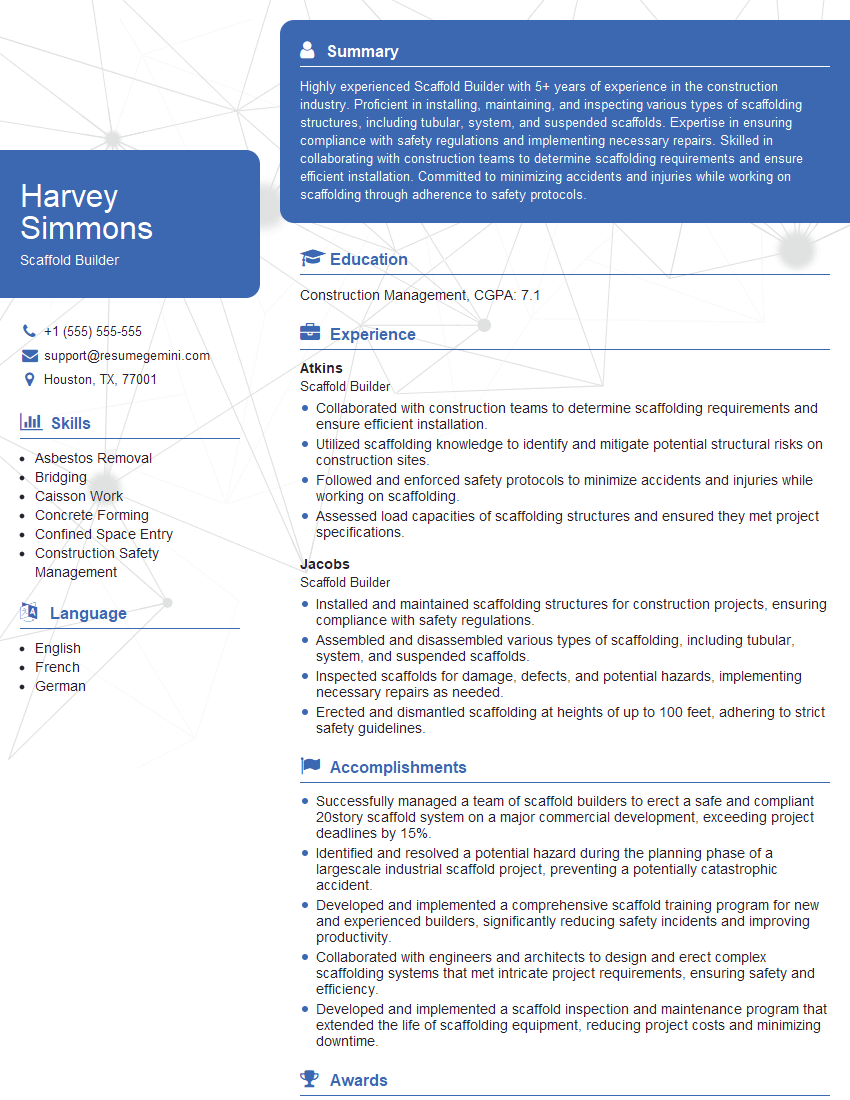
Mastering scaffold assembly and dismantling opens doors to rewarding careers in construction and related fields, offering opportunities for advancement and specialized roles. To maximize your job prospects, creating a strong, ATS-friendly resume is crucial. ResumeGemini is a trusted resource that can help you build a professional and impactful resume tailored to highlight your skills and experience. Examples of resumes tailored to Scaffold Assembly and Dismantling are available to help guide you through the process.
Explore more articles
Users Rating of Our Blogs
Share Your Experience
We value your feedback! Please rate our content and share your thoughts (optional).
What Readers Say About Our Blog
Amazing blog
Interesting Article, I liked the depth of knowledge you’ve shared.
Helpful, thanks for sharing.