Are you ready to stand out in your next interview? Understanding and preparing for Theatre Sound Design interview questions is a game-changer. In this blog, we’ve compiled key questions and expert advice to help you showcase your skills with confidence and precision. Let’s get started on your journey to acing the interview.
Questions Asked in Theatre Sound Design Interview
Q 1. Describe your experience with different microphone types and their applications in theatre.
Microphone selection is crucial in theatre sound design. The choice depends heavily on the source, desired sound quality, and the environment. I’ve extensive experience using various types, including:
- Condenser Microphones: These are highly sensitive and capture a wide frequency range, making them ideal for capturing subtle nuances in dialogue or delicate musical instruments. I often use them for close miking actors on stage, particularly for sensitive scenes requiring crystal-clear speech. Specific examples include the Neumann KM 184 for its detailed high-frequency response and the Schoeps CMC6 for its exceptional clarity and transient response.
- Dynamic Microphones: These are robust and handle high sound pressure levels well, perfect for loud instruments or vocalists. I use Shure SM57s for close miking of snare drums and guitars, and Shure SM58s for vocalists, due to their feedback resistance and durability, especially beneficial in live environments.
- Boundary Microphones: These are low-profile mics ideal for table use or discreet placement in set pieces. They’re fantastic for picking up ambient sound or group dialogue in a natural manner. I frequently employ these for conferences or meetings scenes.
- Shotgun Microphones: Known for their directional sensitivity, these excel at isolating sound sources from a distance, helpful for capturing sound effects offstage or in a specific area of the stage without picking up extraneous noise.
The placement and type of microphone greatly affect the final mix. For instance, using a condenser close to a vocal source will capture detailed breath sounds; whereas a distant dynamic mic might prioritize capturing the overall power of a song.
Q 2. Explain your process for designing sound effects for a specific scene.
Designing sound effects starts with a deep understanding of the scene. I first analyze the script, identifying key moments that could be enhanced or clarified by sound. Let’s say we have a scene depicting a violent storm. My process would be:
- Sound Library Search: I begin by searching my extensive sound effect library (both commercial and personal collections) for suitable elements like thunder, wind, rain. I prefer naturalistic recordings for authenticity, but sometimes need to layer or manipulate sounds for the desired effect.
- Sound Creation/Manipulation: If necessary, I use digital audio workstations (DAWs) to create or modify sounds. For the storm, this might involve synthesizing specific wind gusts or creating realistic rain sounds by manipulating recordings of water.
- Layering & Mixing: I carefully layer the found and created sounds, adjusting levels and equalization (EQ) to create a balanced soundscape. The mix should avoid sonic muddiness. The rain, wind, and thunder are meticulously layered to build the storm’s intensity.
- Spatialization & Ambiance: I would use panning and reverb effects to simulate the storm’s location and distance relative to the characters. Reverb should reflect the scene’s environment (a small room versus an open field).
- Testing & Refinement: Finally, I test the effect in the theatre space. The acoustics of the venue significantly influence the final sound, thus adjustments are often needed to optimize levels and balance.
The goal is not to just add sounds but to sculpt a soundscape that complements the visuals, enhancing the emotional impact of the scene without overpowering the actors’ voices.
Q 3. How do you balance the needs of dialogue clarity with the impact of the sound design?
Balancing dialogue clarity with impactful sound design is a constant juggling act. It’s the cornerstone of successful theatre sound. My approach involves:
- Prioritizing Dialogue: Dialogue always takes precedence. I use techniques like EQ to carve out a frequency range for the dialogue, minimizing conflict with other sound elements. This often involves boosting speech intelligibility frequencies, while attenuating frequencies that muddy the dialogue or interfere with vocals.
- Strategic Sound Placement: I’m careful about where and when I place sound effects. Avoid placing loud sounds directly behind the actors as this frequently masks the dialogue. Instead I use sound to support the mood without disturbing clarity.
- Dynamic Mixing: The mixer’s skill in dynamically adjusting levels is key. During quieter scenes, the sound effects are subtly placed, whereas they are more impactful during moments that don’t require heightened dialogue clarity.
- Use of Music Underscoring: Music can both complement dialogue and create atmosphere, however it must be used tastefully. Music should generally be lower in volume compared to dialogue, acting as a support rather than a competitor.
- Careful Reverb and Delay application: While reverb adds ambiance, excessive reverb can obscure speech. I carefully use these tools to sculpt the space without making dialogue hard to understand. The amount of reverb used should carefully reflect the size and acoustics of the space.
Imagine a tense courtroom scene; the background hum of the crowd needs to be present but shouldn’t drown out the lawyer’s crucial arguments. Mastering this balance is critical for immersive and engaging theatre.
Q 4. What software and hardware are you proficient in using for theatre sound design?
My workflow relies on a combination of powerful software and reliable hardware. I’m proficient in:
- Software: I use QLab extensively for show control and playback, Ableton Live for sound design and music composition and editing, and Adobe Audition for detailed audio editing and processing. I’m also familiar with other DAWs like Pro Tools and Logic Pro X.
- Hardware: I’m comfortable with a range of hardware including digital mixing consoles (Yamaha, Soundcraft), high-quality audio interfaces (Focusrite, RME), and various microphones (as discussed previously).
The specific tools utilized depend on the production’s scale and budget. A smaller show might only require a laptop with QLab, while a large production could involve a larger console and a sophisticated network setup.
Q 5. Describe your experience with digital audio workstations (DAWs).
Digital Audio Workstations (DAWs) are the backbone of my sound design workflow. They are sophisticated software applications that allow me to record, edit, mix, and process audio. My experience with DAWs is extensive, covering various aspects such as:
- Recording and Editing: I use DAWs to record sound effects, music, and voiceovers, and then to meticulously edit the audio, ensuring clarity and seamless integration into the production.
- Sound Design: DAWs provide a vast array of tools to manipulate and create sounds. I use plugins for reverb, delay, EQ, compression, and various synthesis tools to craft unique soundscapes, tailored to the specific needs of the show.
- Mixing and Mastering: DAWs are essential for balancing and mixing the various audio elements, creating a cohesive and immersive soundscape. Mastering involves final adjustments to ensure consistency and optimal playback quality across various sound systems.
- Automation: I utilize automation features to dynamically adjust levels, effects, and panning, creating a responsive soundscape that evolves along with the action on stage.
My expertise extends across various DAWs. Each DAW offers unique features and strengths. I select the DAW that best suits the specific demands of each project. For instance, Ableton’s intuitive workflow is ideal for sound design, while Pro Tools is industry-standard for audio post-production.
Q 6. How do you handle unforeseen technical difficulties during a performance?
Unforeseen technical issues are inevitable in live performance. My strategy focuses on preparedness and swift problem-solving:
- Redundancy: I always maintain backups of all audio files and ensure multiple playback systems are available. If one fails, there’s an immediate alternative.
- Troubleshooting Skills: I possess a deep understanding of both hardware and software, allowing me to diagnose and fix problems quickly. I’m also skilled at quickly identifying the source of a problem under pressure. A common occurrence is a microphone cutting out: this could be due to a cable issue, a faulty microphone, or even a blown fuse in the sound system.
- Communication: Clear communication with the stage manager and other technicians is crucial. A prompt alert of a problem allows the team to address it collaboratively before it impacts the performance.
- Contingency Plans: For each show, I develop a set of contingency plans for common issues, such as a sudden power outage or equipment failure. These plans outline alternate solutions and prioritize the least disruptive course of action.
- Quick Decision Making: In a live setting, speed is vital. I’m capable of making quick, informed decisions to minimize downtime and preserve the flow of the performance.
For example, if a microphone malfunctions during a crucial scene, I might quickly switch to a backup microphone or even adjust the sound system mix to rely on other available microphones, prioritizing vocal clarity and minimizing any disruption to the audience.
Q 7. What is your process for integrating pre-recorded sound effects and music into a live performance?
Integrating pre-recorded elements into a live performance requires careful planning and execution. My process is as follows:
- Audio Quality Control: I always start by ensuring the pre-recorded sound effects and music are of high quality, free of clicks, pops, or other artifacts. I often do some additional mastering to ensure consistency with the live audio.
- Synchronization: Precise synchronization is crucial. I use precise timecode (often SMPTE) to align the pre-recorded tracks with the live performance. This guarantees that sounds effects occur at the right moment, in sync with the actors’ actions.
- Playback System: I employ a reliable playback system, usually QLab, to manage and trigger the pre-recorded audio cues. QLab allows for precise timing and cue management, crucial for a seamless experience.
- Level Matching: Balancing levels between the pre-recorded and live elements requires careful attention. Pre-recorded elements must complement and enhance the live audio, not dominate it. I pay close attention to volume peaks and ensure a smooth integration.
- Testing and Rehearsal: Thorough testing is essential. I dedicate ample time to rehearse the show with pre-recorded elements, ironing out any timing or level issues. This minimizes the likelihood of issues during the actual performance.
For example, in a scene involving a train arriving, I will carefully align the sound of the approaching train to match the visual cues, ensuring the sound effect peaks as the train appears, thus creating a perfectly synchronized theatrical experience.
Q 8. How do you work with other departments, such as lighting and stage management?
Collaboration is paramount in theatre. Sound design doesn’t exist in a vacuum; it’s intricately woven with lighting, stage management, and the director’s vision. With lighting, for instance, we coordinate cues to ensure the sonic landscape complements the visual one. A sudden blackout might be paired with a dramatic sound effect or a shift in music, creating a unified emotional impact. With stage management, communication is key. I provide them with a detailed cue sheet, specifying timings and triggers for sound effects and music. We’ll often have regular meetings to troubleshoot potential issues and ensure seamless execution during rehearsals and performances. Open communication and a shared understanding of the overall artistic goals are essential for a successful production. For example, on a recent production of ‘Hamlet,’ the lighting designer and I worked closely to create a specific atmosphere for the graveyard scene. The flickering candles were accompanied by subtle, unsettling sounds – a low, sustained drone and distant wind – to enhance the sense of unease and foreboding.
Q 9. Explain your understanding of acoustic principles and their application in theatre spaces.
Understanding acoustic principles is fundamental to effective sound design. Theatre spaces often present unique acoustic challenges – reverberation (echo), reflections, and dead spots. My approach involves analyzing the venue’s acoustics. This might involve using sound-level meters to measure reverberation time and identify areas with poor sound distribution. We then use this information to strategically position speakers and microphones to optimize sound clarity and evenness throughout the audience. For example, using delay speakers can help create a more natural and evenly dispersed soundscape, particularly in large auditoriums. We might also use sound-absorbing materials to mitigate unwanted reflections in areas that need it, or use reflective surfaces strategically to project sound in specific directions. In essence, it’s about managing and shaping the sound environment to enhance the audience experience and make sure everyone can clearly hear what they need to.
Q 10. Describe your experience with sound system setup and optimization.
My experience with sound system setup and optimization is extensive. It starts with assessing the venue’s existing infrastructure – the number and type of speakers, microphones, mixers, and processing units. I then design a system that meets the production’s needs, considering factors like audience size, the type of performance, and the specific sound design requirements. This involves choosing the right microphones for different instruments and vocalists, configuring the mixing console to manage signal flow and levels, and using digital signal processing (DSP) to shape the sound and address any acoustic issues. Optimization involves fine-tuning the system using advanced tools like room acoustic modelling software and sophisticated signal analyzers. A crucial aspect is testing and refinement during rehearsals, making adjustments as needed to ensure consistent sound quality across all seating areas. For example, on a recent musical, we used a line array system for main speaker coverage and strategically placed delay speakers to ensure even coverage in the furthest reaches of the theatre while strategically using subwoofers to add controlled low-frequency enhancement, particularly for the musical numbers.
Q 11. How do you create an immersive soundscape for a production?
Creating an immersive soundscape involves leveraging multiple techniques to surround the audience with sound, making them feel like they are part of the story. This starts with careful microphone placement to capture the nuances of live performances and then strategically using surround sound techniques to place sounds in specific areas. Using multiple speakers and carefully crafted sound effects that move around the space can create a very realistic or stylized soundscape. Adding environmental sounds – wind, rain, distant traffic – can add depth and realism to the setting. Spatial audio techniques, such as binaural recording and ambisonics, can further enhance immersion by creating a more realistic and three-dimensional sound field. For a recent production of ‘A Midsummer Night’s Dream,’ we used a combination of immersive sound design techniques to create a fantastical forest setting. Sound effects like rustling leaves and owl calls were strategically placed around the theatre to create the illusion that the audience was within the forest itself.
Q 12. What is your experience with spatial audio techniques?
My experience with spatial audio techniques is substantial. I’m proficient in using various methods to create three-dimensional sound experiences, including binaural recording (using dummy-head microphones to simulate human hearing), ambisonics (surround sound encoding method) and object-based audio. These techniques enable precise placement of sounds in space, leading to a more engaging and immersive experience for the audience. For instance, I’ve used binaural recordings of ambient sounds to create realistic and detailed soundscapes for outdoor scenes and ambisonics to create a fully enveloping soundscape for a piece using VR technology. The choice of method depends on the specific requirements of the production and the available technology, along with the venue’s capabilities and infrastructure.
Q 13. How do you manage sound levels and avoid feedback issues?
Managing sound levels and avoiding feedback is a critical aspect of live sound. Feedback, that high-pitched squeal, occurs when sound from speakers is picked up by microphones and amplified, creating a loop. My approach involves careful microphone placement and gain staging. This means setting appropriate input levels for each microphone, minimizing unnecessary gain to reduce the likelihood of feedback. EQ (equalization) plays a vital role. By cutting frequencies prone to feedback, the risk of such issues is significantly reduced. Feedback suppressors are also effective tools. These devices actively monitor for feedback and automatically reduce the offending frequencies. Additionally, regular sound checks and communication with performers are crucial to ensure all sound levels are appropriately managed throughout the performance. For example, during a recent musical performance, we implemented a ‘gain-before-feedback’ workflow, ensuring that enough sound is captured without pushing the microphone levels to their max so as to avoid the likelihood of feedback. With this, we also minimized the need for EQ adjustments.
Q 14. Describe your workflow for creating and implementing a sound cue sheet.
My workflow for creating and implementing a sound cue sheet is structured and meticulous. It typically begins with close collaboration with the director to understand their vision and the specific sound requirements for each scene. I then create a detailed cue sheet in a spreadsheet or dedicated sound design software. This sheet lists each cue, its timing, description, source (e.g., sound effect, music track), and any specific instructions for implementation. The sheet is regularly updated throughout the rehearsal process. The cues are then organized and prepared for playback using a digital audio workstation (DAW) and a sound console. Prior to performances, I work closely with the stage manager to ensure that all sound cues are accurately timed and triggered appropriately. We do comprehensive sound checks before each performance, and I continuously monitor the sound mix during the show to address any issues in real-time. This structured approach ensures that the sound design contributes effectively to the performance’s success. Clear naming conventions, timestamping and version control are also very important aspects of my workflow.
Q 15. Explain your experience with wireless microphone systems.
My experience with wireless microphone systems is extensive, encompassing various technologies from analog UHF to digital 2.4GHz systems. I’m proficient in selecting the appropriate system based on factors like range, frequency interference, audio quality requirements, and budget. For instance, in a recent outdoor Shakespeare production, we used a digital 2.4GHz system to mitigate interference from other wireless devices. The digital system provided superior sound quality and robustness despite challenging environmental conditions. I also have experience with bodypack transmitters, lavalier microphones, and headset microphones, ensuring optimal placement for different performance styles and actor preferences. Proper antenna placement and frequency coordination are crucial, and I meticulously plan these aspects to ensure seamless operation and avoid dropouts. Regular maintenance and battery checks are essential to prevent unexpected technical difficulties during performances.
Career Expert Tips:
- Ace those interviews! Prepare effectively by reviewing the Top 50 Most Common Interview Questions on ResumeGemini.
- Navigate your job search with confidence! Explore a wide range of Career Tips on ResumeGemini. Learn about common challenges and recommendations to overcome them.
- Craft the perfect resume! Master the Art of Resume Writing with ResumeGemini’s guide. Showcase your unique qualifications and achievements effectively.
- Don’t miss out on holiday savings! Build your dream resume with ResumeGemini’s ATS optimized templates.
Q 16. How do you troubleshoot and resolve common sound issues?
Troubleshooting sound issues requires a systematic approach. My process typically starts with isolating the problem. Is it a microphone issue, a mixer problem, an amplifier issue, or something within the speaker system? I use a combination of listening carefully, observing the equipment (looking for visual cues like flashing lights indicating problems), and using test signals. For example, if the dialogue is unclear, I’d first check the microphone levels, ensuring they are not too low (resulting in quiet, muddy audio) or too high (resulting in distortion). Then I’d check the EQ (equalization) settings to ensure appropriate frequencies are being boosted or cut to enhance clarity. If the issue is with a particular frequency, I might use a spectrum analyzer to pinpoint the problem frequency and adjust accordingly. I also frequently utilize a ‘signal flow chart’ to mentally track the audio from the source to the speaker, making it easier to identify where the problem lies. I always have a backup plan for crucial elements and a well-stocked toolkit of commonly used replacement parts.
Q 17. How do you adapt your sound design to different performance venues?
Adapting sound design to different venues is a crucial skill. Each venue has unique acoustic properties – its size, shape, materials, and ambient noise levels all impact the sound. Before designing, I always conduct a site survey, measuring the reverberation time, identifying potential problem areas, and assessing the existing sound reinforcement system. This informs my choice of microphones, speaker placement, and EQ settings. For instance, a large, reverberant cathedral requires a different approach compared to a small, intimate black-box theatre. In the cathedral, I might use directional microphones to minimize unwanted ambient noise and employ delay systems to time-align the sound for different audience positions. In the black box, more intimate miking techniques would be sufficient with the focus on clarity and minimal effects.
Q 18. What are some of the challenges of designing sound for a specific play or musical?
Designing sound for a play or musical presents unique challenges. In a play, the primary focus is usually on clear and natural-sounding dialogue. Achieving this can be difficult with busy stage action or background noise. I might use techniques like microphone placement close to the actor, employing noise reduction software, and using carefully chosen ambiance to create the desired atmosphere without masking the dialogue. In musicals, the challenges are different, balancing vocal clarity with the orchestral score and sound effects. I frequently need to manage multiple layers of audio, carefully adjusting levels and effects to create a cohesive and dramatic soundscape. Furthermore, the director’s vision significantly influences the sound design, and successful collaboration is paramount to achieving that vision.
Q 19. Describe your experience with sound reinforcement techniques.
My experience with sound reinforcement techniques is extensive. I am proficient in using various types of speakers, including point-source, line-array, and subwoofer systems. Understanding the polar patterns of speakers is critical for even coverage throughout the audience area. I often use speaker modeling software to predict sound levels and coverage before the actual show, minimizing the need for major adjustments during the technical rehearsals. I have experience with digital signal processing (DSP) to shape and control the sound, applying equalization (EQ), compression, limiting, and delay to optimize clarity and evenness. For example, delay systems are crucial in larger spaces to compensate for the time it takes for the sound to reach different parts of the audience, preventing echo or muddiness.
Q 20. How do you ensure sound quality across different audience seating areas?
Ensuring consistent sound quality across the audience seating areas requires careful planning and execution. I use acoustical modelling software to predict how the sound will behave in the venue and optimize speaker placement accordingly. This process considers the venue’s dimensions, reflective surfaces, and potential problem areas. Precise level matching and time alignment across different speakers are also crucial. I utilize test tones and a sound level meter to ensure even sound pressure levels across all seating positions. Precise placement and angling of speakers are key and often involve iterative adjustments during the sound check to achieve the most balanced and even sound across the seating areas.
Q 21. What strategies do you use to maintain clear dialogue in a large theatre?
Maintaining clear dialogue in a large theatre requires a multi-faceted approach. Firstly, high-quality microphones with appropriate polar patterns (like cardioid or supercardioid to minimize background noise) are essential. Secondly, strategic microphone placement close to the actors, yet avoiding interference with stage action, improves dialogue intelligibility. Thirdly, appropriate use of equalization (EQ) and dynamics processing (compression and limiting) is crucial. Boosting the frequencies around 1-4kHz can enhance clarity without sacrificing naturalness. Finally, in very large spaces, a properly designed delay system can further improve clarity by compensating for the time it takes for the sound to travel to different parts of the audience. The placement of the delay speakers is paramount to successfully implementing the delay system.
Q 22. Describe your experience with using EQ, compression, and other audio processing tools.
EQ, compression, and other audio processing tools are fundamental to sculpting the sound in theatre. Think of them as a sculptor’s tools, allowing me to shape the audio to fit the dramatic needs of the production.
EQ (Equalization) allows me to adjust the balance of frequencies. For instance, I might boost the high frequencies to make a character’s voice sound clearer and crisper, or cut the low frequencies to reduce muddiness in a crowded scene. A common scenario is boosting the high-mid frequencies for vocal clarity in a large space.
Compression controls the dynamic range of a sound, making loud parts quieter and quiet parts louder. This is crucial for maintaining consistent volume levels, preventing jarring peaks, and ensuring dialogue intelligibility, particularly important during intense scenes or with instruments like drums. Imagine a scene with a sudden gunshot – compression would help prevent it from blowing out the speakers and ensure that other sounds maintain balance.
Beyond EQ and compression, I regularly employ other tools such as reverb to create a sense of space and ambience (a large cathedral would have a longer, more spacious reverb than a small room), delay to add depth and texture (perhaps to create an echo effect in a cave scene), and gating to remove unwanted noise or ambience (such as audience chatter between lines). I’m proficient in using digital audio workstations (DAWs) like Pro Tools, Ableton Live, and Reaper to implement these techniques and create engaging soundscapes.
Q 23. How do you create a believable soundscape for a period piece?
Creating a believable soundscape for a period piece demands meticulous research and attention to detail. It’s not just about finding the ‘right’ sound effects; it’s about understanding the acoustic environment of the time period. For instance, creating a soundscape for a Shakespearean play requires consideration of the open-air theatres of that era and the limited sound amplification available. The soundscape needs to be more ‘naturalistic’. I would research period-appropriate instruments, sounds of the streets (horse-drawn carriages, etc.), and household noises to establish authenticity.
I would utilize a combination of recordings of historical instruments, carefully processed Foley (sound effects created live in a recording studio, often using everyday objects to replicate the necessary sound), and environmental recordings to build the soundscape. I might also employ certain sound design techniques, like adding subtle background noise levels to reflect the ambience of that time period without overpowering the dialogue. Authenticity is key – a jarring anachronistic sound could pull the audience out of the experience.
Q 24. How do you design sound effects for different genres, like comedy or tragedy?
The sound design approach varies drastically between comedy and tragedy. Comedy relies on heightened sounds, often used for comedic effect.
For comedy, I might employ exaggerated sound effects, perhaps using cartoonish sound effects to underscore slapstick humour or using ironic musical cues for added punch. Timing is critical; the comedic impact often hinges on the precise placement of a sound effect. For example, a perfectly timed ‘boing’ sound during a physical comedy sequence creates a huge impact.
In contrast, tragedy demands a more subtle and nuanced approach. Sound effects in tragedy might be used to underscore the emotional weight of a scene, relying on less exaggerated and more realistic sounds. A slow, mournful cello could emphasize loss and sorrow, for instance. The soundscape will often support the visual elements subtly, highlighting emotion rather than providing a comedic punchline.
The use of silence is also powerful, particularly in tragic scenes. A pregnant pause underscored only by subtle ambient sound can be extremely effective in highlighting the emotional gravity of a moment.
Q 25. How do you create a sound design that complements the visual aspects of a production?
Sound design should enhance and complement the visual aspects of a production, not compete with them. It’s about creating a unified artistic experience. I engage closely with the director and visual designers throughout the process. This collaboration helps ensure that the sound design directly complements, and doesn’t overshadow or conflict with the scenic and costume design.
For example, if a scene takes place in a bustling marketplace, the sound design should reflect that – a cacophony of sounds – but it should still maintain clarity for the main dialogue. In contrast, a quiet, intimate scene would demand a more subdued and atmospheric soundscape that supports the reflective mood. The aim is synergy: the sound and visuals work together seamlessly to tell a story.
Q 26. How do you balance the artistic vision of the director with the technical limitations of the venue?
Balancing artistic vision with technical limitations is a constant challenge. It requires open communication, creative problem-solving, and a willingness to compromise. I begin by understanding the director’s artistic vision completely. Then I assess the venue’s technical capabilities—sound system, speaker placement, acoustics, etc.
If the director envisions a massive, immersive soundscape, but the venue’s sound system lacks the capacity to handle it, I need to find creative solutions. This might involve modifying the design, using different sound processing techniques, focusing sound reinforcement in specific areas, or perhaps suggesting adjustments to the staging to better suit the venue’s limitations. The key is to find a balance that keeps the director’s vision as intact as possible without compromising the technical quality of the performance.
Q 27. Explain your process for creating a sound design budget and schedule.
Creating a sound design budget and schedule is crucial for managing resources and meeting deadlines. The process begins with a detailed analysis of the script and the director’s vision. I then create a comprehensive list of all sound elements needed: music, sound effects, microphones, and equipment rentals.
The budget includes costs for: equipment rental or purchase, sound engineers’ fees, software licenses, royalty payments for pre-existing music, and potentially voice actors (especially for Foley or other specific needs). I create a detailed schedule factoring in time for research, sound recording, editing, mixing, and integration with the rest of the production’s sound system and cues. The schedule also accounts for potential delays and troubleshooting. Regular meetings with the production team help in tracking progress and making any necessary adjustments.
Q 28. What are your salary expectations for this position?
My salary expectations are commensurate with my experience and expertise in theatre sound design, and are in line with industry standards for similarly qualified professionals in this region. I am open to discussing a competitive compensation package that reflects the scope and complexity of this project.
Key Topics to Learn for Theatre Sound Design Interview
- Acoustic Principles: Understanding reverberation, absorption, and sound reflection in theatrical spaces. Practical application: Designing sound reinforcement systems to optimize clarity and minimize unwanted noise.
- Sound Reinforcement Systems: Microphone techniques, mixer operation, loudspeaker placement and equalization. Practical application: Troubleshooting a live performance sound system experiencing feedback issues.
- Digital Audio Workstations (DAWs): Proficiency in software like Pro Tools, Ableton Live, or Reaper for sound editing, mixing, and effects processing. Practical application: Creating and implementing a soundscape for a specific scene, considering mood, atmosphere, and plot points.
- Sound Design Software & Tools: Familiarity with QLab, other sound playback software, and related technologies. Practical application: Programming and operating a complex sound cue during a live theatre performance.
- Music for Theatre: Understanding the role of music in storytelling, including underscoring, source music, and sound effects integration. Practical application: Selecting and preparing appropriate musical cues to enhance a dramatic scene.
- Spatial Audio & Surround Sound: Designing immersive soundscapes using multi-channel audio techniques. Practical application: Creating a soundscape that effectively uses the different channels in a surround sound system to enhance audience immersion.
- Collaboration & Communication: Effective communication with directors, actors, and other technical crew members. Practical application: Effectively conveying technical requirements and creative vision to the production team.
- Problem-Solving & Troubleshooting: Diagnosing and resolving technical issues that may arise during rehearsals or performances. Practical application: Quickly identifying and addressing a problem with a microphone or speaker system during a live show.
Next Steps
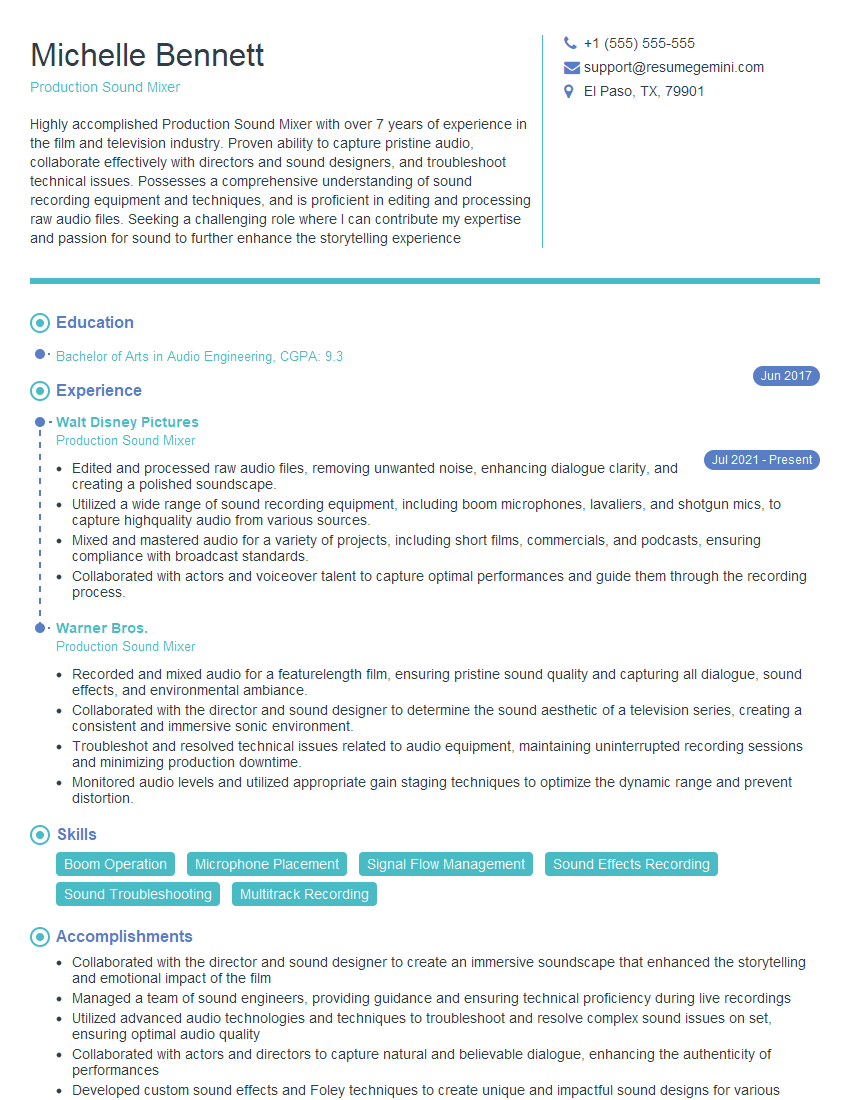
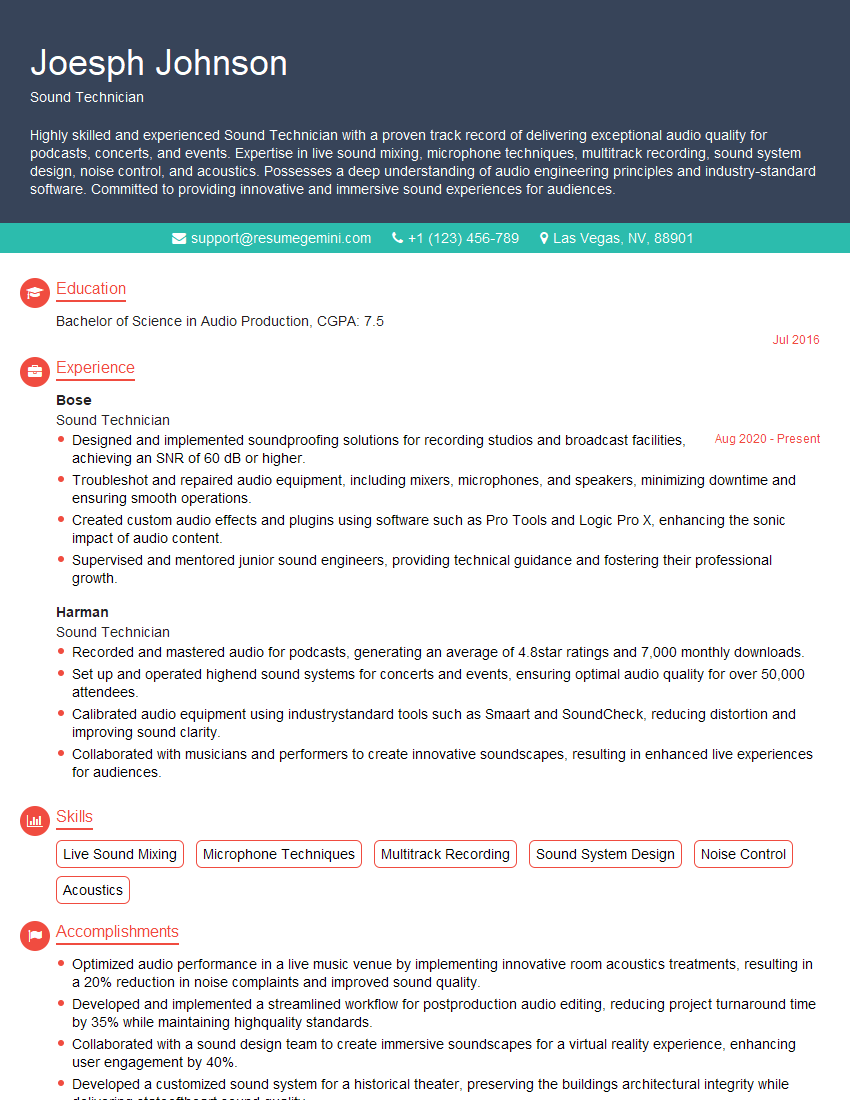
Mastering Theatre Sound Design opens doors to exciting and fulfilling careers in theatre, film, and beyond. To maximize your job prospects, it’s crucial to create a resume that effectively showcases your skills and experience. An ATS-friendly resume is key for getting your application noticed. ResumeGemini is a trusted resource for building professional resumes that stand out. They provide examples of resumes tailored to Theatre Sound Design to help you create a compelling application. Invest the time in crafting a strong resume – it’s your first impression on potential employers.
Explore more articles
Users Rating of Our Blogs
Share Your Experience
We value your feedback! Please rate our content and share your thoughts (optional).
What Readers Say About Our Blog
Amazing blog
Interesting Article, I liked the depth of knowledge you’ve shared.
Helpful, thanks for sharing.