The thought of an interview can be nerve-wracking, but the right preparation can make all the difference. Explore this comprehensive guide to Fabric Design Knowledge interview questions and gain the confidence you need to showcase your abilities and secure the role.
Questions Asked in Fabric Design Knowledge Interview
Q 1. Explain the difference between woven and knit fabrics.
Woven and knit fabrics are fundamentally different in their construction methods, leading to distinct properties. Woven fabrics are created by interlacing two sets of yarns at right angles – the warp (lengthwise) and weft (crosswise). Think of it like weaving a rug. This interlacing creates a strong, stable structure. Knit fabrics, on the other hand, are made by looping yarns together in a series of interconnected rows. Imagine knitting a sweater. This process produces a more flexible and often drapier fabric.
- Woven Fabrics: Typically stronger, more durable, less stretchy, and often have a more formal appearance. Examples include denim, linen, twill, and gabardine.
- Knit Fabrics: Generally softer, more stretchy, more comfortable, and often have a casual appearance. Examples include jersey, rib knit, interlock, and fleece.
The choice between woven and knit depends heavily on the intended garment or application. A woven fabric might be ideal for tailored trousers, while a knit fabric would be better suited for a t-shirt.
Q 2. Describe the various types of fabric finishes and their applications.
Fabric finishes are treatments applied to fabrics to enhance their properties, appearance, or performance. They can significantly alter a fabric’s feel, drape, and durability. There’s a wide variety:
- Calendering: Pressing the fabric to create a smooth surface or a specific texture. This is common in creating crisp fabrics like cotton poplin.
- Mercerization: Treating cotton with alkali to increase luster, strength, and dye affinity. This produces a much brighter and stronger cotton fabric.
- Water Repellency: Applying a coating to make the fabric resistant to water, such as those used for outdoor clothing.
- Flame Retardancy: Treating the fabric with chemicals to reduce its flammability, often required for safety wear.
- Softening: Using enzymes or chemicals to improve the fabric’s softness and handle, resulting in a more comfortable feel against the skin.
- Dyeing & Printing: Adding color to the fabric, which is a huge aspect of design and can range from simple solid dyes to complex prints.
The application of a finish depends entirely on the end-use of the fabric. For instance, a flame-retardant finish is crucial for children’s sleepwear, while water repellency is essential for outerwear.
Q 3. What are the key considerations when selecting a fabric for a specific garment or application?
Selecting the right fabric is crucial for garment success. Key considerations include:
- End Use: What will the garment be used for? This dictates the needed durability, comfort, and performance properties.
- Fabric Properties: Consider drape, weight, texture, stretch, breathability, and washability. A lightweight, breathable fabric is suitable for a summer dress, while a heavier, more durable fabric is better for a winter coat.
- Cost: Fabric costs vary significantly based on material, construction, and finishes. Budget needs to be considered.
- Aesthetics: The fabric’s look and feel must align with the design’s aesthetic. The color, pattern, and texture all contribute to the overall visual impact.
- Sustainability: Increasingly important is the environmental impact of the fabric production, including materials used and manufacturing processes.
For example, designing a performance athletic wear would require a fabric with moisture-wicking and quick-drying properties, whereas a formal evening gown might call for a luxurious, flowing fabric like silk.
Q 4. Discuss your experience with different printing techniques used on fabrics.
My experience encompasses a wide range of fabric printing techniques. I’ve worked extensively with:
- Screen Printing: A versatile technique ideal for bold designs and high-volume production. It involves pushing ink through a screen onto the fabric. This method is cost effective for large runs.
- Digital Printing: Offers unparalleled design flexibility and allows for intricate details and photographic quality prints. Ideal for smaller runs and custom designs, though it can be more expensive per unit for smaller orders.
- Rotary Screen Printing: High speed and efficient method perfect for large scale production of repetitive patterns. It utilizes cylindrical screens for faster printing.
- Heat Transfer Printing: A relatively simple process where pre-printed designs are transferred onto fabric using heat and pressure. Often used for smaller orders or specialized designs.
The choice of printing technique depends on factors such as design complexity, production volume, budget, and desired quality. I am adept at selecting the most appropriate method for a given project and can manage all aspects of the printing process, from design preparation to quality control.
Q 5. How familiar are you with CAD software for fabric design?
I am highly proficient in using CAD software for fabric design. My experience includes extensive use of industry-standard programs such as Adobe Illustrator, Photoshop, and specialized textile design software like [mention specific software if applicable, e.g., Lectra Modaris]. I leverage these tools to create repeat patterns, manipulate textures, simulate fabric drape, and generate technical drawings for production. I’m comfortable creating and editing complex designs, working with color palettes, and ensuring designs are technically feasible for manufacturing. My skills enable me to efficiently and effectively translate design concepts into production-ready files.
Q 6. Explain the process of developing a new fabric design from concept to production.
Developing a new fabric design is a multi-stage process:
- Concept Development: This begins with market research, trend analysis, and brainstorming. We identify target markets, analyze existing designs, and define the desired aesthetic and functionality of the fabric.
- Design Creation: Using CAD software, we develop the initial design, exploring different color palettes, patterns, and textures. This often involves numerous iterations and revisions.
- Technical Design: We translate the design into technical specifications for the mill, including yarn type, weave structure (for woven fabrics), knit structure (for knit fabrics), and finish requirements. This stage ensures the design is manufacturable.
- Sampling & Prototyping: We work with a mill to produce samples of the fabric based on the technical specifications. This allows for evaluation of color accuracy, texture, drape, and overall quality.
- Testing & Refinement: The samples undergo rigorous testing to ensure they meet quality standards, considering factors such as durability, colorfastness, and shrinkage. We might make further adjustments based on the test results.
- Production: Once the design and manufacturing process are finalized, full-scale production can begin.
Throughout this process, close collaboration with various stakeholders – designers, manufacturers, and quality control teams – is essential to ensuring successful product development.
Q 7. How do you stay updated on current trends in fabric design and technology?
Staying updated on current trends and technology is crucial in this dynamic field. I actively utilize several methods:
- Industry Publications: I regularly read trade magazines and online publications dedicated to textile design and technology, such as [mention specific publications].
- Trade Shows and Conferences: Attending industry events like Première Vision and Heimtextil allows me to network with peers, see the latest innovations, and gather inspiration.
- Online Resources: I follow key influencers, designers, and brands on social media and utilize online platforms to track emerging trends.
- Workshops and Training: I participate in workshops and training sessions to enhance my skills in CAD software and new production techniques.
- Networking: Maintaining professional relationships with designers, manufacturers, and other industry experts provides valuable insights and fosters innovation.
By combining these methods, I stay at the forefront of industry advancements and ensure my work incorporates the latest innovations and trends.
Q 8. Describe your experience with color theory and its application in fabric design.
Color theory is the backbone of effective fabric design. It’s about understanding how colors interact – their relationships in terms of hue, saturation, and value – to create visually appealing and impactful designs. My experience encompasses a wide range of applications, from selecting palettes that evoke specific moods (e.g., calming blues for bedding, vibrant reds for activewear) to understanding color harmony (analogous, complementary, triadic) and contrast to create visual interest. For instance, I once designed a collection of scarves using analogous colors – shades of green, blue, and teal – to create a sense of tranquility, while another project utilized complementary colors like orange and blue to achieve a bold and energetic effect.
I use tools like Adobe Color to experiment with different palettes and visualize their impact. Beyond simply choosing pretty colors, I consider the target audience, the intended use of the fabric, and the overall brand aesthetic. A children’s clothing line would require a different color palette than a high-end evening wear collection. Understanding color psychology – how colors evoke emotions and associations – is also crucial.
Q 9. What are some sustainable fabric options and their impact on the environment?
Sustainability is paramount in modern fabric design. Several eco-friendly options are gaining traction. Organic cotton, for example, is grown without harmful pesticides and fertilizers, reducing its environmental impact compared to conventional cotton. Hemp is another strong contender; it’s incredibly durable, requires minimal water, and doesn’t need pesticides. Tencel (Lyocell) is a rayon fabric made from sustainably harvested wood pulp using a closed-loop production process, minimizing water and chemical waste. Recycled fabrics, made from pre-consumer or post-consumer textile waste, represent a significant step towards circularity in the fashion industry.
The impact on the environment is substantial. Sustainable fabrics reduce water consumption, pesticide use, and greenhouse gas emissions associated with conventional textile production. Choosing these options actively supports environmentally responsible practices and helps mitigate the negative environmental consequences of the fashion industry.
Q 10. How do you handle design feedback and incorporate it into your work?
Handling design feedback is a critical skill. I approach it as a collaborative process, viewing feedback as an opportunity for improvement rather than criticism. My approach involves active listening, clarifying any uncertainties, and asking clarifying questions to ensure I fully understand the feedback’s intent. I then carefully evaluate the suggestions, considering their feasibility within the project’s constraints (budget, timeline, technical limitations).
I incorporate feedback iteratively, often presenting revised designs to ensure alignment with the client’s vision. For example, if feedback indicates a need for more vibrant colors, I might adjust the color palette and present multiple options for consideration. Documentation is key; I maintain detailed records of all feedback and the subsequent design revisions, which helps track progress and ensure transparency.
Q 11. Explain your understanding of different fabric weights and their suitability for various uses.
Fabric weight, measured in grams per square meter (GSM), significantly influences a fabric’s drape, suitability, and application. Lightweight fabrics (e.g., chiffon, voile) with GSM under 100 are ideal for garments like summer dresses and blouses, offering breathability and a flowing drape. Medium-weight fabrics (e.g., poplin, cotton twill), ranging from 100 to 200 GSM, are versatile and suitable for shirts, skirts, and trousers. Heavyweight fabrics (e.g., denim, canvas), exceeding 200 GSM, are durable and used for outerwear, upholstery, and workwear.
Understanding fabric weight is crucial for selecting the right fabric for a specific purpose. For instance, a lightweight fabric wouldn’t be suitable for a durable pair of jeans, while a heavyweight fabric would be too stiff for a flowing summer dress. I consider the weight alongside other properties like fiber content, weave structure, and intended use to achieve optimal results.
Q 12. How do you manage your time effectively when working on multiple design projects?
Managing multiple design projects effectively requires a structured approach. I employ project management techniques, prioritizing tasks based on deadlines and urgency. I create detailed project timelines, breaking down each project into smaller, manageable tasks. This allows for better tracking of progress and identification of potential bottlenecks. I also utilize digital tools like project management software (e.g., Asana, Trello) to maintain organized records and facilitate communication with clients and collaborators.
Timeboxing is another useful technique. I allocate specific time blocks for each project, ensuring focused work sessions. Regular reviews of my schedule and prioritization of tasks are crucial for avoiding burnout and maintaining a productive workflow. Delegation, where feasible, also helps distribute workload and optimize time management.
Q 13. Describe your experience with textile testing and quality control.
Textile testing and quality control are essential aspects of fabric design. My experience includes working with various testing methods, ensuring that the final product meets the required standards of quality and performance. This involves assessing factors like colorfastness (resistance to fading), abrasion resistance (durability), shrinkage (changes in dimensions after washing), and tensile strength (resistance to tearing). We use standardized testing procedures and equipment, following industry best practices.
Quality control is an ongoing process, beginning with the selection of raw materials and continuing through each stage of production. Regular inspections and testing at various stages help identify and address any potential issues early on, preventing costly rework or product recalls. Maintaining detailed records of all testing results is crucial for tracking quality and improving processes over time.
Q 14. What are your preferred design tools and software?
My preferred design tools and software include Adobe Photoshop for image manipulation and detailed design work, Adobe Illustrator for vector graphics and pattern creation, and Adobe InDesign for creating presentations and technical documents. For 3D visualization, I utilize CLO3D to create realistic garment simulations, allowing clients to see how a design will look in 3D before production. I’m also proficient in using various CAD (Computer-Aided Design) software for more technical aspects of design and pattern making, depending on the specific needs of the project.
Beyond software, I find that sketching and hand-rendering are still essential components of my design process. These techniques allow for quick ideation and exploration of design concepts before moving to digital tools.
Q 15. How do you handle pressure and deadlines in a fast-paced design environment?
In a fast-paced design environment, effective time management and prioritization are crucial. I approach pressure and deadlines with a structured, proactive approach. I begin by breaking down large projects into smaller, manageable tasks with clearly defined timelines. This allows me to track progress, identify potential bottlenecks early on, and adjust my schedule as needed. I utilize project management tools to maintain organization and visibility. For example, I might use a Kanban board to visualize task flow and identify potential roadblocks. Furthermore, I prioritize tasks based on urgency and importance, focusing on the most critical elements first. Open communication with my team and clients is key; I proactively update them on my progress and any potential challenges to ensure we’re all aligned. This collaborative approach prevents surprises and allows for timely adjustments. Finally, I’ve learned to delegate effectively when possible, ensuring that tasks are assigned to the most appropriate team members, maximizing efficiency.
Career Expert Tips:
- Ace those interviews! Prepare effectively by reviewing the Top 50 Most Common Interview Questions on ResumeGemini.
- Navigate your job search with confidence! Explore a wide range of Career Tips on ResumeGemini. Learn about common challenges and recommendations to overcome them.
- Craft the perfect resume! Master the Art of Resume Writing with ResumeGemini’s guide. Showcase your unique qualifications and achievements effectively.
- Don’t miss out on holiday savings! Build your dream resume with ResumeGemini’s ATS optimized templates.
Q 16. Explain your experience with different fiber types (e.g., cotton, silk, polyester).
My experience encompasses a wide range of fiber types, each with unique properties impacting design choices. Cotton, for example, is a versatile natural fiber known for its breathability and absorbency, making it ideal for summer clothing. However, its tendency to wrinkle needs to be considered. Silk, another natural fiber, boasts luxurious drape and sheen, perfect for high-end garments, but it is delicate and requires careful handling in design and production. Polyester, a synthetic fiber, offers durability, wrinkle resistance, and cost-effectiveness, making it a popular choice for many applications. However, it lacks the breathability and luxurious feel of natural fibers. My understanding extends beyond just the basic properties; I consider how different fiber blends affect the final fabric’s performance – for instance, a cotton-polyester blend can offer the breathability of cotton with enhanced wrinkle resistance from the polyester. This knowledge allows me to select the appropriate fibers for specific design goals, considering factors like end-use, budget, and desired aesthetic.
Q 17. How familiar are you with fabric sourcing and supply chain management?
Fabric sourcing and supply chain management are integral to successful fabric design. I have experience researching and selecting suppliers, negotiating contracts, and overseeing the entire process from raw material selection to finished fabric delivery. This includes understanding the ethical and environmental implications of sourcing, prioritizing sustainable practices where possible. I’m familiar with various sourcing strategies, including direct sourcing from mills, using agents or intermediaries, and exploring different geographical locations for optimal cost and quality. I’m adept at managing relationships with suppliers, ensuring timely delivery, and addressing quality control issues proactively. I use technology to streamline the process, leveraging platforms for communication and order tracking. My experience includes managing inventory, forecasting demand, and mitigating supply chain disruptions – a crucial skill, particularly in the current global market. For example, I’ve successfully navigated delays by identifying alternative suppliers and proactively communicating with clients about potential adjustments to project timelines.
Q 18. Describe your experience with creating fabric patterns and repeats.
Creating fabric patterns and repeats requires a blend of artistic vision and technical skill. I’m proficient in using both traditional methods like hand-drawing and painting, and digital tools such as Adobe Illustrator and Photoshop. My process typically begins with sketching initial ideas, exploring different motifs and color palettes. Once I have a promising design, I meticulously refine it, ensuring that the repeat seamlessly connects and maintains visual consistency. I understand various repeat types, including half-drop, quarter-drop, and full-drop repeats, and select the most appropriate one based on the design’s complexity and the final application. For example, a large, bold floral print might benefit from a half-drop repeat to maximize visual impact, while a smaller, more intricate pattern may be better suited for a full-drop repeat. I also consider the technical aspects, such as the size of the repeat and its impact on printing efficiency. I often create several variations, presenting options to clients and collaborating on selecting the most suitable one.
Q 19. How do you ensure your designs are both aesthetically pleasing and commercially viable?
Balancing aesthetic appeal with commercial viability is a core principle of my design process. I achieve this by thoroughly researching market trends, understanding target demographics, and analyzing competitor products. While creative freedom is important, I always consider the practical aspects of production and pricing. For instance, an aesthetically stunning design with intricate details might be impractical to produce at a commercially viable cost. Therefore, I often explore simplified versions or alternative techniques to retain the design’s essence while optimizing production. I collaborate closely with production teams to assess feasibility and identify potential challenges early on. Data analysis plays a crucial role; studying sales figures and consumer feedback helps refine designs and ensure they align with market demand. This iterative process, combining creative vision with market analysis, enables me to create designs that are both visually captivating and commercially successful.
Q 20. Explain your understanding of fabric drape and its importance in garment design.
Fabric drape refers to the way a fabric hangs and folds under its own weight. It’s a crucial consideration in garment design because it significantly impacts the garment’s overall silhouette and how it fits the body. A fabric with good drape will flow gracefully, creating a flattering shape, while a stiff fabric might create a boxy or rigid look. Understanding drape involves considering factors such as fiber type, weave structure, and fabric weight. For example, silk, known for its luxurious drape, will create a much different silhouette than a stiff cotton canvas. I consider drape throughout the design process, from selecting appropriate fabrics to creating patterns that complement the fabric’s natural movement. I often conduct drape tests with different fabrics to visualize how they’ll behave in a garment, informing my pattern creation and design choices. This ensures that the final garment achieves the desired aesthetic and fit, enhancing its overall appeal.
Q 21. What is your experience working with different textile structures (e.g., plain weave, twill, satin)?
My experience encompasses a wide range of textile structures. Plain weave, the most basic structure, creates a simple, balanced fabric suitable for various applications. Twill weave, characterized by its diagonal lines, provides durability and strength, often used in denim and other workwear fabrics. Satin weave, with its smooth, lustrous surface, is known for its elegant drape and is commonly used in high-end apparel. Beyond these, I’m familiar with more complex structures such as jacquard weaves, which allow for intricate patterns, and double cloth, offering warmth and insulation. Understanding these different structures enables me to select the appropriate fabric for specific design goals. For example, a lightweight, breathable plain weave might be suitable for a summer dress, whereas a durable twill weave would be ideal for a pair of trousers. This knowledge is crucial for achieving the desired aesthetic and performance characteristics in the final garment. The choice of textile structure directly impacts drape, texture, and even the durability of the finished product.
Q 22. How would you approach designing a fabric for a specific target market?
Designing fabric for a specific target market begins with thorough market research. Understanding the demographics, lifestyle, purchasing habits, and aesthetic preferences of the target audience is crucial. For example, designing for teenagers might involve vibrant colors, bold patterns, and trendy themes, while a design for the luxury market might prioritize sophisticated textures, muted tones, and high-quality materials.
I’d then create a mood board to visually represent the desired aesthetic, incorporating color palettes, textures, and potential design motifs. This serves as a guide throughout the design process. Next, I’d consider the practical aspects: the fabric’s intended use (clothing, upholstery, etc.), the desired drape and hand-feel, and the necessary durability and care instructions. Finally, I’d develop several design options, considering different pattern scales, color variations, and texture combinations, presenting these options for client feedback and refinement.
For instance, if designing for a sustainable clothing brand targeting environmentally conscious millennials, I would prioritize using organic cotton or recycled materials, incorporate earthy tones and minimalist designs, and possibly use eco-friendly printing methods.
Q 23. Describe your problem-solving skills in relation to fabric design challenges.
Problem-solving in fabric design often involves navigating constraints like budget limitations, production capabilities, and client expectations. My approach is systematic: I start by clearly defining the problem, gathering relevant information, and brainstorming potential solutions. This often involves experimenting with different materials, techniques, and design elements.
For example, if a client requests a luxurious silk-like feel but has a limited budget, I might explore alternative materials like Tencel or modal, which offer a similar drape and softness at a lower cost. Or, if a design is too intricate for efficient screen printing, I might adapt it for digital printing, optimizing the design for the chosen technique. I regularly use CAD software to simulate different design variations and test their feasibility before proceeding to sampling.
Critical evaluation is a core part of my problem-solving. I regularly review my work, seeking feedback from colleagues and using industry best practices to refine my designs and improve efficiency.
Q 24. How do you incorporate client feedback and specifications into your designs?
Client feedback is paramount. I actively solicit feedback at various stages of the design process, from initial concept sketches to final sample approvals. This involves not only verbal communication but also visual presentations and detailed specification documents outlining fabric composition, weight, width, and other relevant attributes.
I utilize collaborative tools like shared online design platforms to ensure transparency and facilitate easy communication. I take detailed notes and carefully consider every comment, making revisions based on client preferences while adhering to design principles and technical feasibility.
For example, if a client suggests a color change, I’ll explore various options within the chosen color family, ensuring the new color complements the overall design and aligns with the brand’s aesthetic. If a client requests a change in texture, I’ll explore appropriate fabric types to achieve the desired effect, considering factors such as drape, breathability, and production costs.
Q 25. Discuss your knowledge of fabric costing and budgeting.
Understanding fabric costing is essential for successful design. I’m familiar with all aspects of the production process, from raw material sourcing to finishing and packaging. My knowledge encompasses material costs, labor costs (including design, sampling, and manufacturing), and overhead expenses like machinery usage and facility costs.
I create detailed cost breakdowns for each design, considering factors such as fabric type, print method, embellishments, and quantity. This involves using industry-standard costing methods and software to estimate the final product cost, ensuring that the design aligns with the client’s budget. This also involves exploring ways to optimize cost without compromising quality, such as considering alternative materials or streamlining production processes.
For example, I might propose substituting a more expensive silk with a silk-blend if the budget is constrained, or suggest reducing the number of colors in a print design to reduce production costs. This requires a thorough understanding of both design and the production realities.
Q 26. What are the key considerations when designing for different printing methods?
Different printing methods have unique capabilities and limitations that greatly impact design considerations. Screen printing, for example, excels with bold, vibrant colors and large, simple designs but can be costly for intricate patterns or large-scale production. Digital printing offers greater flexibility with intricate details and allows for variable color changes within the same run. However, it may not achieve the same vibrancy or texture as screen printing, depending on the fabric and ink used.
For screen printing, I would simplify designs, reducing the number of colors and focusing on clean lines and bold shapes. For digital printing, I can incorporate more intricate details, gradients, and photorealistic images, while considering the resolution capabilities of the specific printer and the potential for color variations between runs. Rotary printing offers a high-volume, cost-effective solution, but requires repeating patterns.
The fabric itself also influences printing choices. Some fabrics are more suitable for certain methods than others. For example, natural fibers may react differently to inks compared to synthetics, impacting color fastness and overall appearance.
Q 27. Explain your experience with digital printing techniques and software.
I have extensive experience with digital printing techniques and software, including Adobe Photoshop, Illustrator, and specialized textile design software. I’m proficient in creating high-resolution artwork for digital printing, understanding color profiles (CMYK, RGB), and optimizing designs for various printing resolutions. I understand the importance of color management to ensure accurate color reproduction across different devices and processes.
My experience includes working with various digital printing methods, including inkjet printing, reactive printing, and sublimation, and I understand the technical requirements and limitations of each. I also have experience in preparing designs for different file formats, such as TIFF, PDF, and EPS, ensuring that files are optimized for seamless printing. I have worked with several digital printing houses, enabling me to understand production constraints and create designs that can be realistically produced.
Q 28. How do you maintain design integrity while adapting designs for different production methods?
Maintaining design integrity while adapting for different production methods requires a deep understanding of both design and production processes. The key is to identify core design elements—the essence of the design—that must be preserved regardless of the production method.
For example, if a design features a specific color palette or a particular pattern rhythm, these elements should remain consistent. However, I may need to simplify complex details or adjust the scale of the design to make it feasible for a less versatile printing technique. Vector-based design files help maintain design integrity across different scales and resolutions.
Careful consideration of the material is also important. The same design might need slight adjustments based on the drape, texture, and weight of the fabric. The process involves continuous testing and refinement to ensure the final product closely reflects the initial design vision while meeting production constraints and maintaining high quality. It’s a balancing act that comes with experience and a meticulous approach.
Key Topics to Learn for Fabric Design Knowledge Interview
- Fiber Properties & Classification: Understanding natural (cotton, silk, wool, linen) and synthetic (polyester, nylon, rayon) fibers; their properties (strength, drape, absorbency, etc.) and suitability for different applications.
- Fabric Construction & Weaves: Knowledge of different weave structures (plain, twill, satin, jacquard) and their impact on fabric hand, drape, and durability. Practical application: analyzing fabric swatches to identify weave types and predict their performance.
- Print & Dyeing Techniques: Familiarity with various printing methods (screen printing, digital printing, rotary printing) and dyeing processes (reactive, acid, disperse). Understanding the impact of each technique on colorfastness and fabric hand.
- Fabric Finishes & Treatments: Knowledge of different finishes (water repellent, wrinkle resistant, flame retardant) and their effects on fabric performance and aesthetics. Problem-solving: identifying appropriate finishes for specific garment applications.
- Color Theory & Application: Understanding color palettes, color mixing, and the psychology of color in design. Practical application: creating harmonious color combinations for fabric designs.
- Sustainability & Ethical Sourcing: Awareness of eco-friendly fabrics, sustainable dyeing practices, and ethical sourcing of materials. This demonstrates commitment to responsible design.
- Design Software & Technology: Proficiency in relevant design software (Adobe Illustrator, Photoshop, CAD software) and understanding of digital printing technologies.
- Trend Forecasting & Analysis: Ability to identify current and emerging trends in fabric design and their influence on market demand.
Next Steps
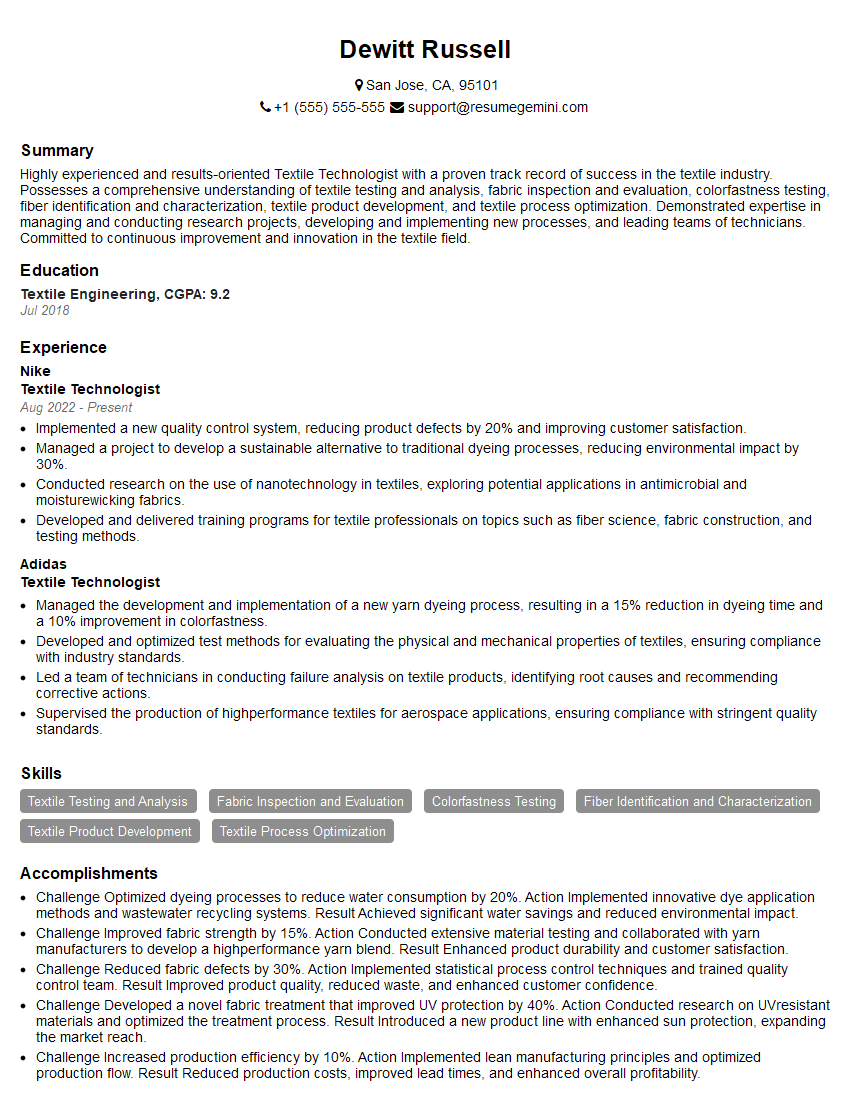
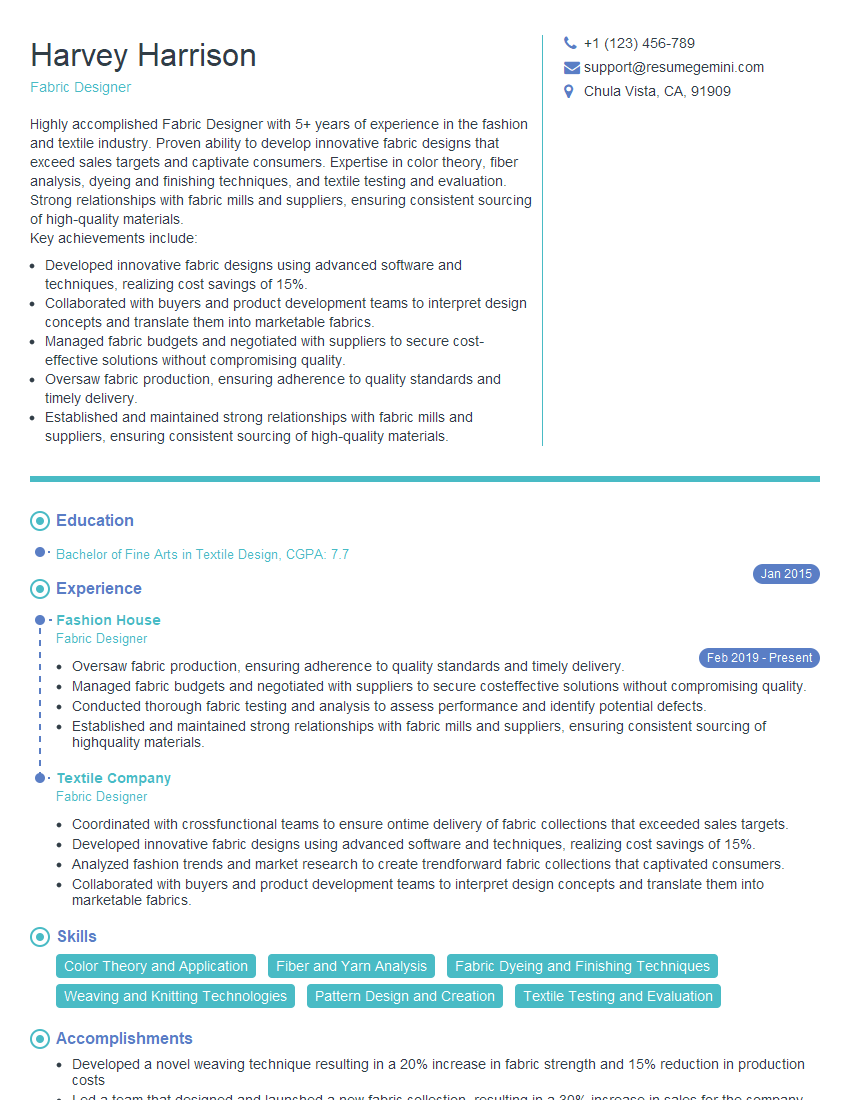
Mastering fabric design knowledge is crucial for career advancement in the textile industry, opening doors to exciting opportunities in design, production, and quality control. To significantly increase your job prospects, crafting an ATS-friendly resume is paramount. ResumeGemini is a trusted resource to help you build a professional and impactful resume that showcases your skills effectively. Examples of resumes tailored to Fabric Design Knowledge are available to help guide you. Invest the time to create a strong resume; it’s your first impression on potential employers.
Explore more articles
Users Rating of Our Blogs
Share Your Experience
We value your feedback! Please rate our content and share your thoughts (optional).
What Readers Say About Our Blog
Amazing blog
Interesting Article, I liked the depth of knowledge you’ve shared.
Helpful, thanks for sharing.