Cracking a skill-specific interview, like one for Algorithmic Trading, requires understanding the nuances of the role. In this blog, we present the questions you’re most likely to encounter, along with insights into how to answer them effectively. Let’s ensure you’re ready to make a strong impression.
Questions Asked in Algorithmic Trading Interview
Q 1. Explain the difference between market making and arbitrage.
Market making and arbitrage are both profitable strategies in algorithmic trading, but they differ significantly in their approach. Market making involves providing liquidity to the market by quoting both bid and ask prices for a given asset. Market makers profit from the bid-ask spread – the difference between the buying and selling price. They aim to profit from the volume of trades, even if individual trades yield small profits. Think of them as the ‘dealers’ of the financial market, always ready to buy or sell.
Arbitrage, on the other hand, exploits temporary price discrepancies between two or more markets. Arbitrageurs identify situations where an asset is priced differently on different exchanges or in different derivative markets. They simultaneously buy low and sell high to profit from the price difference, ideally without taking on significant risk. Arbitrage opportunities are often short-lived, requiring fast execution and sophisticated algorithms. Imagine finding a $100 bill selling for $90 – the arbitrage opportunity is to buy the bill at $90 and immediately sell it for $100.
In essence, market making is about consistent, small profits from many trades, while arbitrage is about capturing larger, but rarer, profits from price discrepancies.
Q 2. Describe your experience with backtesting trading strategies.
Backtesting is crucial in algorithmic trading. My experience involves developing and rigorously testing numerous strategies using historical market data. I typically utilize Python libraries like pandas for data manipulation and analysis, and backtrader or zipline for backtesting frameworks.
A typical process for me begins with clearly defining the trading strategy, including entry and exit rules, risk management parameters, and position sizing. I then gather and meticulously clean the historical data, handling issues such as missing values, outliers, and data inconsistencies. The backtesting process involves simulating trades based on the historical data and evaluating the strategy’s performance across various metrics, like Sharpe Ratio, maximum drawdown, and Sortino Ratio.
Crucially, I pay attention to potential biases in the backtesting process, like survivorship bias (only including currently existing assets) and look-ahead bias (using future information to make past decisions). To mitigate these biases, I utilize robust data sources, employ robust statistical methods and, most importantly, perform ‘out-of-sample’ testing – applying the tested strategy to unseen data to gauge its real-world potential. I often use Monte Carlo simulations to quantify the strategy’s potential risks under various market conditions.
Q 3. What are the common challenges in high-frequency trading?
High-frequency trading (HFT) presents unique challenges:
- Latency: Minimizing the time it takes to receive, process, and act on market data is paramount. Even microseconds can make a significant difference in profitability.
- Network Connectivity and Reliability: Stable, low-latency connections to exchanges are critical. Network outages or interruptions can lead to substantial losses.
- Hardware and Software Infrastructure: Specialized, high-performance hardware and custom-built, highly optimized software are needed to handle the enormous data volumes and execution speeds involved.
- Regulatory Compliance: HFT strategies are subject to stringent regulations, requiring careful monitoring and reporting to prevent market manipulation or unfair advantages.
- Market Microstructure: Understanding and adapting to market nuances like order book dynamics, price formation, and the impact of other HFT algorithms is crucial.
- Competition: The HFT landscape is highly competitive, with many sophisticated firms vying for the same opportunities.
Overcoming these challenges requires a combination of cutting-edge technology, deep market understanding, and robust risk management practices.
Q 4. Explain the concept of slippage and how to mitigate it.
Slippage is the difference between the expected price of a trade and the actual execution price. It occurs because the best available price may not always be attainable, especially during periods of high volatility or low liquidity. For example, if you place an order to buy 1000 shares at $10, but the market only has 500 shares available at that price, you might end up buying the remaining 500 shares at $10.05, resulting in slippage of $0.05 per share.
Slippage can significantly impact profitability, especially for large orders or during volatile market conditions. To mitigate slippage:
- Break down large orders: Instead of placing one large order, divide it into smaller orders executed over time to minimize market impact.
- Use limit orders: Limit orders specify a maximum (buy) or minimum (sell) price, reducing the risk of executing at an unfavorable price.
- Employ hidden orders (iceberg orders): Only a portion of the order is visible to the market, reducing the risk of adverse price movements due to large order visibility.
- Optimize order routing: Route orders to the exchange offering the best price and liquidity at the moment of execution. This often involves algorithmic order routing and smart order management systems.
Q 5. Discuss various order types used in algorithmic trading.
Algorithmic trading utilizes a variety of order types to achieve specific goals. Some common ones include:
- Market Order: Executes immediately at the best available price. Simple but exposes you to slippage.
- Limit Order: Executes only at or better than a specified price. Reduces slippage risk but might not execute if the price is not reached.
- Stop Order: Executes when the price reaches a specified trigger price. Often used to limit losses or protect profits.
- Stop-Limit Order: A combination of stop and limit orders. Executes when the price reaches the stop price, but only at or better than the limit price.
- Iceberg Order (Hidden Order): Only a portion of the order is visible to the market, concealing the total volume. Useful to reduce market impact.
- Trailing Stop Order: Automatically adjusts the stop price as the asset price moves favorably, locking in profits while minimizing losses.
- Fill-or-Kill (FOK): The entire order must be filled immediately, otherwise it is cancelled.
The choice of order type depends heavily on the specific trading strategy, risk tolerance, and market conditions.
Q 6. How do you handle data cleaning and preprocessing for algorithmic trading?
Data cleaning and preprocessing are crucial steps in algorithmic trading. Poor data quality can lead to inaccurate backtesting results and flawed trading strategies. My process usually involves these steps:
- Data Acquisition: Gathering data from reliable sources, such as exchanges or financial data providers, ensuring data integrity and consistency.
- Data Cleaning: Identifying and handling missing values (imputation or removal), outliers (clipping or winsorization), and inconsistencies in the data.
- Data Transformation: Converting data into a suitable format for analysis, potentially including normalization, standardization, or log transformations to address skewness or heteroscedasticity.
- Feature Engineering: Creating new features from existing ones. This could involve calculating technical indicators (e.g., moving averages, RSI), creating lagged variables, or incorporating macroeconomic factors.
- Data Validation: Verifying the accuracy and reliability of the cleaned and transformed data using various checks and tests.
I often use Python libraries such as pandas and scikit-learn for these tasks. It is crucial to document all cleaning and preprocessing steps to ensure reproducibility and transparency.
Q 7. What are some common performance metrics used to evaluate trading algorithms?
Several key performance metrics are used to evaluate trading algorithms:
- Sharpe Ratio: Measures risk-adjusted return. A higher Sharpe ratio indicates better performance for the risk taken.
- Sortino Ratio: Similar to Sharpe Ratio, but only considers downside risk (negative returns).
- Maximum Drawdown: The largest percentage drop from a peak to a trough in the portfolio value. Indicates the worst-case scenario loss.
- Calmar Ratio: The annualized return divided by the maximum drawdown. A higher ratio suggests better risk-adjusted performance.
- Win Rate: The percentage of trades that resulted in profits.
- Average Trade Profit/Loss: The average profit or loss per trade.
- Information Ratio: Measures the excess return of a strategy relative to a benchmark, divided by the tracking error.
The choice of metrics depends on the specific investment objective and risk tolerance. A comprehensive evaluation considers multiple metrics to obtain a holistic view of the algorithm’s performance.
Q 8. Explain your understanding of different risk management techniques in algorithmic trading.
Risk management in algorithmic trading is paramount. It’s not just about making money; it’s about preserving capital. My approach is multifaceted, combining several key techniques.
Position Sizing: This is fundamental. I use techniques like the Kelly Criterion or fixed fractional position sizing to determine the appropriate amount to invest in each trade, based on my risk tolerance and the expected return/risk ratio. For example, if my strategy suggests a 10% potential profit with a 5% risk, I wouldn’t invest my entire portfolio. Instead, a fixed fractional approach might dictate investing only a small percentage, say 2%, limiting potential losses to a manageable level.
Stop-Loss Orders: These are crucial for automatically exiting a trade when it reaches a predefined loss level. It prevents large, unexpected losses that can wipe out your account. I always implement stop-loss orders tailored to the specific characteristics of the asset and trading strategy.
Take-Profit Orders: While stop-losses protect against losses, take-profit orders secure profits once a certain target is reached. This helps lock in gains and prevents the reversal of winning trades.
Backtesting and Simulation: Before deploying any algorithm live, extensive backtesting is necessary, simulating its performance across various market conditions. Stress testing with historical data, including periods of high volatility, helps identify weaknesses and potential risks.
Real-Time Monitoring and Alert Systems: I build systems that constantly monitor the algorithm’s performance and generate alerts if deviations from expected behavior or risk thresholds occur. This allows for quick intervention if necessary.
Diversification: I diversify across different asset classes, trading strategies, and even brokers to reduce overall portfolio risk. No single strategy is foolproof, so diversification is essential to weather market downturns.
In essence, risk management isn’t a single technique, but a robust framework of interconnected measures designed to protect capital and ensure the long-term viability of the trading strategy.
Q 9. Describe your experience with different programming languages used in algorithmic trading (e.g., Python, C++, Java).
My experience spans several languages commonly used in algorithmic trading. Each offers unique advantages depending on the specific needs of the project.
Python: Python is my go-to language for its extensive libraries (NumPy, Pandas, Scikit-learn) suited for data analysis, statistical modeling, and backtesting. Its readability and ease of use make prototyping and rapid development highly efficient. I’ve used it extensively for developing machine learning models for predicting price movements and building backtesting frameworks.
C++: When speed and low latency are paramount, I choose C++. Its compiled nature allows for faster execution speeds, critical for high-frequency trading (HFT). I’ve used it for building high-performance trading engines requiring extremely fast order placement and execution.
Java: Java’s robustness and platform independence make it ideal for large-scale, distributed systems. I’ve utilized Java for building robust and scalable trading systems that handle enormous data volumes and complex order routing logic.
My choice of language depends on the specific trade-off between development speed, performance requirements, and maintainability. A project might use Python for initial prototyping and backtesting, then migrate critical components to C++ for production deployment.
Q 10. How do you optimize trading algorithms for speed and efficiency?
Optimizing trading algorithms for speed and efficiency involves a multi-pronged approach targeting both code and infrastructure.
Algorithmic Optimization: This focuses on improving the algorithm’s core logic. Techniques include using efficient data structures (e.g., using NumPy arrays in Python instead of lists for numerical computations), optimizing loops and conditional statements, and using vectorized operations wherever possible. For example, using vectorized operations in NumPy can significantly speed up calculations compared to iterative approaches.
import numpy as np #Example of vectorized operation in NumPy a = np.array([1, 2, 3]) b = np.array([4, 5, 6]) c = a + b #Vector addition print(c)Code Profiling and Bottleneck Identification: Tools like cProfile (Python) or gprof (C++) help pinpoint performance bottlenecks. This allows me to focus optimization efforts on the most time-consuming parts of the code.
Hardware Acceleration: Using GPUs or specialized hardware designed for numerical computation (e.g., FPGAs) can drastically improve processing speeds for computationally intensive algorithms.
Database Optimization: Efficient database design and query optimization are crucial if the algorithm deals with large datasets. Indexing and choosing the appropriate database technology are vital for fast data retrieval.
Parallel Processing: Breaking down tasks into smaller, independent units that can be processed concurrently using multithreading or multiprocessing techniques significantly boosts performance.
Network Optimization: For HFT, minimizing network latency is critical. This involves using low-latency network connections, optimized network protocols, and co-locating servers near exchanges.
Optimization is an iterative process; I continuously monitor performance, identify bottlenecks, and refine the algorithm and infrastructure for optimal efficiency.
Q 11. What are some common techniques for dealing with market microstructure noise?
Market microstructure noise refers to the random fluctuations in prices that aren’t driven by fundamental factors. Dealing with it effectively is essential for accurate signal detection and reliable trading.
Data Filtering: Applying filters like moving averages or other smoothing techniques can reduce the impact of high-frequency noise. However, choosing the right filter parameters is crucial to avoid over-smoothing, potentially losing valuable information.
Tick Aggregation: Instead of using every single price tick, I might aggregate data over a longer time interval (e.g., 5-minute, 15-minute bars) to reduce the noise. This approach sacrifices some granularity but improves signal-to-noise ratio.
Robust Statistical Methods: Employing robust statistical methods less sensitive to outliers, such as median filters or robust regression, improves the accuracy of signal extraction from noisy data.
Machine Learning Techniques: Advanced machine learning models, like recurrent neural networks (RNNs) or long short-term memory (LSTM) networks, are capable of learning complex patterns in noisy time series data and can be trained to filter out noise more effectively than traditional methods. However, such models require significant training data and careful tuning.
Realized Volatility Estimation: Estimating realized volatility using high-frequency data allows for a more accurate representation of price fluctuations and reduces the impact of microstructure noise on volatility-based trading strategies.
The optimal approach often involves a combination of these techniques. The best method depends on the specific characteristics of the market, the asset being traded, and the trading strategy.
Q 12. Explain your understanding of different statistical methods used in algorithmic trading.
Statistical methods form the backbone of algorithmic trading. They’re used for everything from data analysis and strategy development to risk management and performance evaluation.
Time Series Analysis: Techniques like ARIMA, GARCH, and exponential smoothing are used to model and forecast asset prices. This helps predict future price movements and inform trading decisions. For instance, GARCH models help quantify volatility clustering, which is the tendency of high volatility periods to be followed by other high volatility periods.
Regression Analysis: Linear and non-linear regression models are employed to identify relationships between various market variables and asset prices. This is useful for building predictive models and understanding market dynamics. For example, a linear regression could assess the relationship between a stock’s price and its trading volume.
Hypothesis Testing: Statistical tests like t-tests or chi-squared tests are used to evaluate the statistical significance of trading signals and strategies. This ensures that observed results aren’t simply due to random chance.
Monte Carlo Simulations: These simulations use random sampling to model the probability distribution of future outcomes, enabling risk assessment and evaluating the potential performance of trading strategies under various scenarios. This is crucial for stress-testing and understanding the potential impact of unexpected events.
Principal Component Analysis (PCA): PCA is used for dimensionality reduction in high-dimensional datasets. This technique helps to identify the most important factors driving market movements and simplify complex models.
My proficiency in these methods ensures rigorous analysis, precise forecasting, and effective risk management.
Q 13. How do you validate and verify your trading strategies?
Validating and verifying trading strategies are critical steps before live deployment. It involves a rigorous process to ensure accuracy and reliability.
Backtesting: This involves testing the strategy on historical market data. I use robust backtesting frameworks that incorporate realistic transaction costs, slippage, and market impact. Moreover, I ensure the backtesting data is of high quality and accounts for data biases.
Walk-Forward Analysis: This technique divides the historical data into in-sample and out-of-sample periods. The strategy is optimized on the in-sample data, then tested on the out-of-sample data to assess its performance on unseen data. This helps prevent overfitting, a common issue in algorithmic trading.
Monte Carlo Simulation: This further validates the robustness of the strategy by simulating its performance under different market conditions and risk scenarios.
Paper Trading: Before deploying any algorithm live with real capital, I always test it in a paper trading environment. This allows me to observe its performance in a real-market setting without risking actual capital.
Live Monitoring and Evaluation: Even after deployment, I constantly monitor the algorithm’s performance and compare it against benchmarks. Regular evaluation allows for timely adjustments and improvements.
The goal is to build confidence in the strategy’s ability to perform consistently across different market conditions and avoid surprises once deployed in a live trading environment. Thorough validation and verification significantly mitigate risks and enhance the likelihood of success.
Q 14. Describe your experience with different trading platforms and APIs.
My experience encompasses various trading platforms and APIs, each with its strengths and weaknesses.
Interactive Brokers (IBKR): IBKR’s API provides access to a wide range of markets and instruments, making it suitable for diverse trading strategies. Its robust infrastructure and low latency are beneficial for high-frequency trading. I’ve used their API extensively for building and deploying various algorithmic trading strategies.
Alpaca Trade API: Alpaca provides a user-friendly API, making it suitable for beginners and rapid prototyping. Its commission-free trading and simulated trading environment makes it ideal for educational purposes and initial algorithm testing.
NinjaTrader: NinjaTrader offers a powerful and flexible platform with its own API, enabling customized indicators, strategies, and backtesting capabilities. It’s a good option for both discretionary and algorithmic traders.
TradingView: TradingView combines a charting platform with an API, useful for strategy development and data retrieval. While not directly a trading platform, its API can supplement trading strategies based on technical indicators or sentiment analysis.
My familiarity with these and other APIs allows me to select the most appropriate platform based on the specific requirements of the trading strategy. This includes factors like market access, latency requirements, cost, and ease of integration.
Q 15. How do you handle unexpected events or market shocks in your algorithms?
Handling unexpected market events, or ‘black swan’ events, is crucial in algorithmic trading. Robust algorithms must incorporate mechanisms to detect anomalies and react appropriately. This involves a multi-pronged approach:
- Real-time Monitoring and Alerting: My algorithms constantly monitor key market indicators (volatility, liquidity, price movements) and trigger alerts if deviations exceed predefined thresholds. For instance, a sudden, sharp drop in liquidity might trigger a halt to trading until conditions stabilize.
- Circuit Breakers and Stop-Loss Orders: These act as safety nets. Circuit breakers pause trading temporarily if certain conditions are met (e.g., a significant price drop within a short period). Stop-loss orders automatically sell assets when they reach a predetermined price, limiting potential losses.
- Adaptive Risk Management: Instead of static risk parameters, I implement dynamic risk management. This means adjusting position sizing, order frequency, or even halting trading completely based on real-time market conditions. For example, during periods of high volatility, the algorithm reduces position sizes to mitigate potential losses.
- Stress Testing and Backtesting with Simulated Shocks: Before deploying an algorithm, it’s crucial to stress test it with historical data incorporating significant market shocks. This allows me to identify weaknesses and refine the algorithm’s response mechanisms.
- Fallback Strategies: Having a backup plan is essential. If the primary trading strategy fails due to unforeseen circumstances, the algorithm should gracefully transition to a pre-defined fallback strategy (e.g., a less aggressive, more conservative approach).
Imagine a flash crash: a sudden, dramatic drop in prices. An algorithm without these safeguards might incur massive losses. By using these techniques, the algorithm could either reduce its exposure or completely exit the market, minimizing losses.
Career Expert Tips:
- Ace those interviews! Prepare effectively by reviewing the Top 50 Most Common Interview Questions on ResumeGemini.
- Navigate your job search with confidence! Explore a wide range of Career Tips on ResumeGemini. Learn about common challenges and recommendations to overcome them.
- Craft the perfect resume! Master the Art of Resume Writing with ResumeGemini’s guide. Showcase your unique qualifications and achievements effectively.
- Don’t miss out on holiday savings! Build your dream resume with ResumeGemini’s ATS optimized templates.
Q 16. Explain the concept of overfitting in algorithmic trading and how to avoid it.
Overfitting occurs when an algorithm learns the training data too well, including its noise and outliers, resulting in poor performance on unseen data (i.e., the actual market). It’s like memorizing the answers to a test instead of understanding the underlying concepts – you’ll do well on that specific test but fail on a similar one.
Here’s how to avoid it:
- Sufficient Data: Use a large and diverse dataset representative of various market conditions. A small dataset is more prone to overfitting.
- Cross-Validation: Divide the dataset into multiple subsets (e.g., training, validation, testing). Train the model on the training set, tune parameters using the validation set, and evaluate its performance on the unseen test set. This helps to detect and mitigate overfitting.
- Regularization Techniques: Methods like L1 and L2 regularization add penalties to the model’s complexity, discouraging it from fitting the noise in the data. This helps to keep the model simpler and generalize better.
- Feature Selection and Engineering: Choose relevant features and avoid including irrelevant or redundant ones. Improper feature engineering can lead to overfitting.
- Ensemble Methods: Combine multiple models (e.g., bagging, boosting) to reduce the impact of individual model overfitting.
- Keep it Simple: Start with simpler models and only increase complexity when necessary. Often, a simpler model with fewer parameters generalizes better.
For example, if a model perfectly predicts past prices but fails to predict future prices, it’s likely overfit. Cross-validation and regularization help prevent this by focusing on the model’s ability to generalize to new, unseen data.
Q 17. What is your experience with different machine learning techniques used in algorithmic trading (e.g., reinforcement learning, neural networks)?
I have extensive experience with various machine learning techniques in algorithmic trading. My expertise includes:
- Neural Networks: I’ve used recurrent neural networks (RNNs), particularly LSTMs, for time series forecasting (predicting future price movements based on historical data). Convolutional neural networks (CNNs) are also useful for identifying patterns in market data.
- Reinforcement Learning (RL): RL algorithms, particularly Deep Q-Networks (DQNs), are powerful for developing trading agents that learn optimal trading strategies through trial and error. I have used RL to optimize trading parameters like position sizing and order execution timing.
- Support Vector Machines (SVMs): SVMs are effective for classification tasks, such as identifying market regimes or predicting whether a price will go up or down.
- Random Forests and Gradient Boosting Machines (GBMs): These ensemble methods are robust and generally perform well for prediction tasks in trading, combining the strengths of multiple decision trees.
For instance, I’ve developed a DQN agent that learned to outperform a simple moving average strategy in simulated trading environments. I also used LSTMs to predict short-term price movements with a higher degree of accuracy than traditional technical indicators. The choice of technique depends heavily on the specific trading strategy and available data.
Q 18. Describe your experience with different database technologies used in algorithmic trading.
Efficient data management is crucial in algorithmic trading. I have experience with several database technologies:
- Relational Databases (SQL): PostgreSQL and MySQL are used for storing historical market data, trading logs, and other structured information. SQL’s querying capabilities are essential for data analysis and backtesting.
- NoSQL Databases: MongoDB and Cassandra are useful for handling large volumes of unstructured or semi-structured data, such as tick-level market data or social media sentiment analysis. Their scalability makes them ideal for high-frequency trading.
- Time Series Databases: InfluxDB and TimescaleDB are optimized for handling time-stamped data, which is essential for financial data. They provide efficient querying and aggregation capabilities for time series analysis.
- In-Memory Databases: Redis is used for caching frequently accessed data to significantly improve the speed of the trading algorithms. This is particularly crucial in high-frequency trading applications.
The choice of database depends on the specific needs of the trading strategy. For example, high-frequency trading might benefit from an in-memory database for low latency, while backtesting might use a relational database for its analytical capabilities.
Q 19. Explain your understanding of different order book dynamics.
Understanding order book dynamics is paramount for successful algorithmic trading. The order book is a constantly changing record of buy and sell orders, revealing market depth, liquidity, and price pressure. Key aspects include:
- Liquidity: The ease with which an asset can be bought or sold without significantly impacting its price. A deep order book (many orders at various price levels) indicates high liquidity, while a shallow order book suggests low liquidity.
- Bid-Ask Spread: The difference between the highest buy order (bid) and the lowest sell order (ask). A narrow spread indicates high liquidity and low price volatility.
- Order Flow: The pattern of orders entering and leaving the order book. Analyzing order flow helps to anticipate price movements and identify potential market manipulations.
- Market Depth: The total number of shares available to buy or sell at various price levels. A deep market indicates a strong ability to absorb large trades without causing significant price movements.
- Order Book Imbalances: Disproportionate volume of buy or sell orders can indicate potential price direction. For instance, a large influx of buy orders might push the price upward.
Imagine trying to buy a large quantity of stock. A deep order book with many sell orders at similar prices will ensure a smooth execution without significantly impacting the price. In contrast, a shallow order book might lead to large price slippage (buying at a higher price than anticipated).
Q 20. How do you evaluate the profitability and risk of a trading strategy?
Evaluating the profitability and risk of a trading strategy is crucial before deployment. I use a variety of metrics:
- Sharpe Ratio: Measures the risk-adjusted return. A higher Sharpe ratio indicates better performance relative to the risk taken.
- Sortino Ratio: Similar to the Sharpe ratio but only considers downside risk (losses). This is more appropriate for strategies with asymmetric return distributions.
- Maximum Drawdown: The largest peak-to-trough decline during a specific period. It indicates the maximum loss that could be experienced.
- Calmar Ratio: The annualized rate of return divided by the maximum drawdown. Higher values suggest better risk-adjusted performance.
- Win Rate and Average Win/Loss Ratio: The percentage of winning trades and the average ratio of winning trades’ profits to losing trades’ losses. This gives an idea of the strategy’s consistency.
- Backtesting Results: Simulate the strategy’s performance on historical data. This helps identify potential weaknesses and assess its profitability under various market conditions.
I always emphasize robust backtesting with out-of-sample data to ensure that the observed profitability is not just due to overfitting. The choice of metrics depends on the investment objective and risk tolerance.
Q 21. Describe your experience with developing and implementing trading signals.
Developing and implementing trading signals is a core part of algorithmic trading. My experience encompasses:
- Technical Indicators: Using well-established technical indicators (e.g., moving averages, RSI, MACD) as input signals to determine entry and exit points.
- Fundamental Analysis: Integrating fundamental data (e.g., earnings reports, financial ratios) to identify undervalued or overvalued assets.
- Sentiment Analysis: Analyzing news articles, social media posts, and other text data to gauge market sentiment and anticipate price movements.
- Machine Learning Models: Using machine learning algorithms to generate trading signals based on complex patterns and relationships in market data.
- Order Routing and Execution: Ensuring that signals are translated into executable orders and routed efficiently through exchanges to minimize slippage and other costs.
For example, I’ve developed a signal generation system that combines technical indicators with a neural network to predict price reversals. The system generates buy signals when the network predicts an upward price movement and sell signals when a downward movement is anticipated. Careful signal validation is crucial to avoid generating false signals and incurring unnecessary costs. The best signals balance accuracy, timeliness, and potential profit against risk.
Q 22. Explain your understanding of different market regimes and their impact on algorithmic trading.
Market regimes refer to the different states or characteristics of the market, broadly categorized by volatility, trend strength, and liquidity. Understanding these regimes is crucial for algorithmic trading because different strategies perform better under different conditions. For example, a high-frequency trading (HFT) algorithm relying on small price discrepancies might thrive in a highly liquid, low-volatility regime (think a quiet day on a major exchange), but fail miserably during a flash crash where volatility spikes and liquidity dries up.
We can identify several key regimes:
- Trending Market: A market displaying a sustained upward or downward movement. Trend-following algorithms, which aim to capitalize on the continuation of trends, are best suited here.
- Range-Bound Market: A market where prices oscillate within a defined range. Mean-reversion strategies, which bet on prices reverting to their average, are preferred in this regime.
- High Volatility Regime: Characterized by large price swings and increased uncertainty. Robust risk management is paramount, and strategies might involve hedging or reducing exposure.
- Low Volatility Regime: Prices move slowly and predictably. This can be opportune for arbitrage or statistical arbitrage strategies.
My approach involves using regime-detection algorithms, often based on statistical measures like volatility clustering or Markov regime-switching models. These models dynamically identify the current market regime and adjust the trading strategy accordingly. This adaptive approach maximizes profitability and minimizes risk by aligning the algorithm with the prevailing market conditions.
Q 23. How do you ensure the stability and robustness of your trading algorithms?
Ensuring stability and robustness in algorithmic trading requires a multi-faceted approach encompassing rigorous testing, robust error handling, and continuous monitoring. Think of it like building a bridge – you need strong foundations and redundancy to withstand various stresses.
- Backtesting and Simulation: Extensive backtesting on historical data is essential. This helps to assess the strategy’s performance under various market conditions and identify potential weaknesses. We would simulate different scenarios including extreme events like flash crashes to stress-test the algorithm.
- Forward Testing: After thorough backtesting, we use forward testing on real-time data, but with limited capital initially to gauge performance in a live environment. This allows for validation of the backtesting results.
- Error Handling and Exception Management: Comprehensive error handling and exception management is critical. The algorithm should gracefully handle unexpected situations, such as network outages or data errors, without triggering catastrophic failures. This is often implemented using try-except blocks in the code.
- Risk Management: Implementing robust risk management techniques, including position sizing, stop-loss orders, and volatility scaling, is key. We’d also use metrics such as Value at Risk (VaR) and Expected Shortfall (ES) to help understand and quantify potential losses.
- Monitoring and Alerting: Continuous monitoring of the algorithm’s performance and key metrics is crucial. Setting up alerts for unusual behavior, significant deviations from expectations, or critical errors is vital to ensure quick intervention if needed.
For example, a crucial part of our testing involves simulating various network latency scenarios and ensuring the algorithm continues to function optimally even with delays.
Q 24. What are some ethical considerations in algorithmic trading?
Ethical considerations in algorithmic trading are paramount. The power of these automated systems demands a strong ethical framework to prevent market manipulation, unfair advantages, and other detrimental practices. It’s about responsible innovation and ensuring fairness within the market ecosystem.
- Market Manipulation: Algorithmic trading must be designed to avoid any form of market manipulation, such as spoofing (placing orders with the intent to cancel them before execution to mislead other traders) or wash trading (creating artificial volume to influence the price). Strict adherence to regulatory guidelines and ethical trading practices are crucial.
- Fairness and Transparency: Algorithms should not provide an unfair advantage to certain market participants. This requires transparency in the design and operation of the algorithm, to ensure that everyone has a fair chance in the market.
- Data Privacy and Security: Algorithmic trading often involves handling vast amounts of sensitive data. Robust security measures must be in place to protect this data from unauthorized access and misuse, complying with regulations like GDPR.
- Algorithmic Bias: Algorithms can inherit biases present in the data they are trained on, potentially leading to discriminatory outcomes. Care must be taken to ensure fairness and avoid biases in the design and development of trading algorithms.
In my work, I actively contribute to the ongoing discussion around these ethical considerations, participating in industry forums and contributing to the development of best practices.
Q 25. Describe your experience with regulatory compliance in algorithmic trading.
Regulatory compliance is non-negotiable in algorithmic trading. It’s a highly regulated field, and non-compliance can lead to significant penalties. My experience involves ensuring adherence to regulations such as those set by the Securities and Exchange Commission (SEC) in the US, and equivalent bodies in other jurisdictions.
- Know Your Customer (KYC) and Anti-Money Laundering (AML) Compliance: Rigorous KYC and AML checks are essential to prevent the use of algorithmic trading for illicit activities.
- Best Execution Obligations: Algorithms must be designed to achieve best execution for clients, prioritizing the best possible price and execution speed.
- Order Routing and Transparency: Clear and auditable records of order routing and execution are required, demonstrating adherence to regulations regarding order handling and transparency.
- Algorithmic Testing and Validation: Thorough testing and validation of algorithms are required to demonstrate their stability and reliability.
- Regular Audits: Independent audits are frequently required to ensure ongoing compliance with regulations.
I’ve worked directly with compliance teams to ensure that all aspects of our algorithmic trading operations meet the stringent regulatory requirements. We maintain detailed documentation of our algorithms, testing procedures, and trading activities, readily accessible for audits.
Q 26. Explain your understanding of different types of market data and their uses.
Market data is the lifeblood of algorithmic trading. Different types of data serve various purposes, enabling informed decision-making and efficient execution.
- Tick Data: This is the most granular level of market data, recording every single trade and quote. It’s valuable for high-frequency trading strategies that rely on detecting very small price movements.
- Bar Data: This aggregates tick data into bars (e.g., 1-minute, 5-minute, or daily bars). It’s less detailed than tick data but easier to manage and analyze for many strategies.
- Level II Market Data: This provides a view of the order book, showing the best bid and ask prices and the associated volumes at each price level. It’s crucial for understanding market depth and liquidity.
- Fundamental Data: This includes financial statements, earnings reports, and news articles, useful for longer-term investment strategies and valuation modeling.
- Alternative Data: This encompasses a broad range of non-traditional data sources, including social media sentiment, satellite imagery, and web scraping data. It can offer unique insights and predictive power.
The choice of market data depends heavily on the specific trading strategy. For example, a long-term value investor may primarily use fundamental data, whereas an HFT firm will rely heavily on tick and Level II market data. Understanding the strengths and limitations of each type is key to building effective algorithms.
Q 27. How do you choose the appropriate parameters for your trading algorithms?
Choosing appropriate parameters for trading algorithms is a critical aspect that requires a blend of theoretical understanding, empirical analysis, and practical judgment. Think of it as fine-tuning a musical instrument – each adjustment affects the overall sound.
- Backtesting and Optimization: We systematically explore the parameter space through backtesting, evaluating the algorithm’s performance across different parameter combinations. Techniques like grid search or genetic algorithms are commonly employed.
- Walk-Forward Analysis: To avoid overfitting to historical data, we utilize walk-forward analysis, where we split the historical data into multiple periods and optimize parameters on one period, before testing on a subsequent, out-of-sample period. This helps in ensuring that the parameters generalize well to future market conditions.
- Statistical Significance Testing: We assess the statistical significance of any improvements identified through backtesting. We should avoid parameters that improve performance purely by chance.
- Regular Review and Adjustment: Market conditions change constantly. Therefore, regular review and adjustment of parameters are essential to maintain optimal performance. We continuously monitor the algorithm’s performance and make adjustments as needed.
- Consideration of Transaction Costs and Slippage: Parameter optimization should account for realistic transaction costs and slippage to ensure that the identified optimal parameters lead to actual profitable trading.
A common example is adjusting stop-loss levels – initially, backtesting might suggest a tight stop-loss, but considering slippage in a live market might necessitate a wider range to mitigate false triggers.
Q 28. What are some common pitfalls to avoid when developing and implementing algorithmic trading strategies?
Developing and implementing algorithmic trading strategies presents several potential pitfalls. Avoiding these pitfalls is essential for creating successful and sustainable trading systems.
- Overfitting: This occurs when an algorithm performs well on historical data but poorly on new, unseen data. Robust testing methodologies, such as walk-forward analysis, are essential to mitigate this risk.
- Data Mining Bias: Finding patterns in historical data that appear statistically significant but are purely coincidental. Rigorous statistical testing and out-of-sample validation are vital to avoid this trap.
- Lack of Robust Risk Management: Underestimating market risk and lacking comprehensive risk management measures can lead to significant losses. This includes implementing appropriate stop-loss orders, position sizing, and stress testing under various market conditions.
- Ignoring Transaction Costs and Slippage: Failing to account for transaction costs and slippage can significantly impact profitability. These should be explicitly incorporated into backtesting and strategy evaluation.
- Poor Code Quality and Bugs: Errors in the algorithm’s code can lead to unexpected behavior and losses. Thorough code review, testing, and debugging are crucial to ensure accuracy and stability.
- Ignoring Market Regime Changes: A strategy optimized for one market regime might perform poorly in another. Building adaptive strategies that respond to changing market conditions is essential.
In my experience, one of the most common mistakes is underestimating the impact of transaction costs, especially in high-frequency trading. A strategy that looks profitable on paper might be entirely unprofitable when real-world costs are factored in.
Key Topics to Learn for Algorithmic Trading Interview
- Market Microstructure: Understanding order books, limit order books, market impact, and trading venues is crucial for designing effective algorithms.
- Backtesting and Simulation: Learn how to design robust backtesting frameworks to evaluate algorithm performance and manage risk effectively. Consider different statistical methods for evaluating performance and identifying overfitting.
- Algorithmic Design Patterns: Explore common algorithmic strategies like mean reversion, arbitrage, and trend following. Understand their strengths, weaknesses, and appropriate market conditions.
- Data Structures and Algorithms: Master fundamental data structures (e.g., heaps, trees, graphs) and algorithms (e.g., sorting, searching) for efficient data processing and algorithm execution. Consider the computational complexity of your chosen algorithms.
- Programming Languages and Libraries: Demonstrate proficiency in languages like Python or C++ and relevant libraries such as Pandas, NumPy, and other quantitative finance tools.
- Risk Management: Understand various risk management techniques, including position sizing, stop-loss orders, and Value at Risk (VaR) calculations, to protect capital and mitigate losses.
- High-Frequency Trading (HFT) Concepts (if applicable): If targeting HFT roles, delve into topics like latency arbitrage, co-location, and network optimization.
- Order Routing and Execution: Gain a thorough understanding of how orders are routed to exchanges and executed, including considerations of slippage and latency.
- Quantitative Finance Theory: A solid grasp of concepts such as stochastic calculus, time series analysis, and statistical modeling is beneficial.
Next Steps
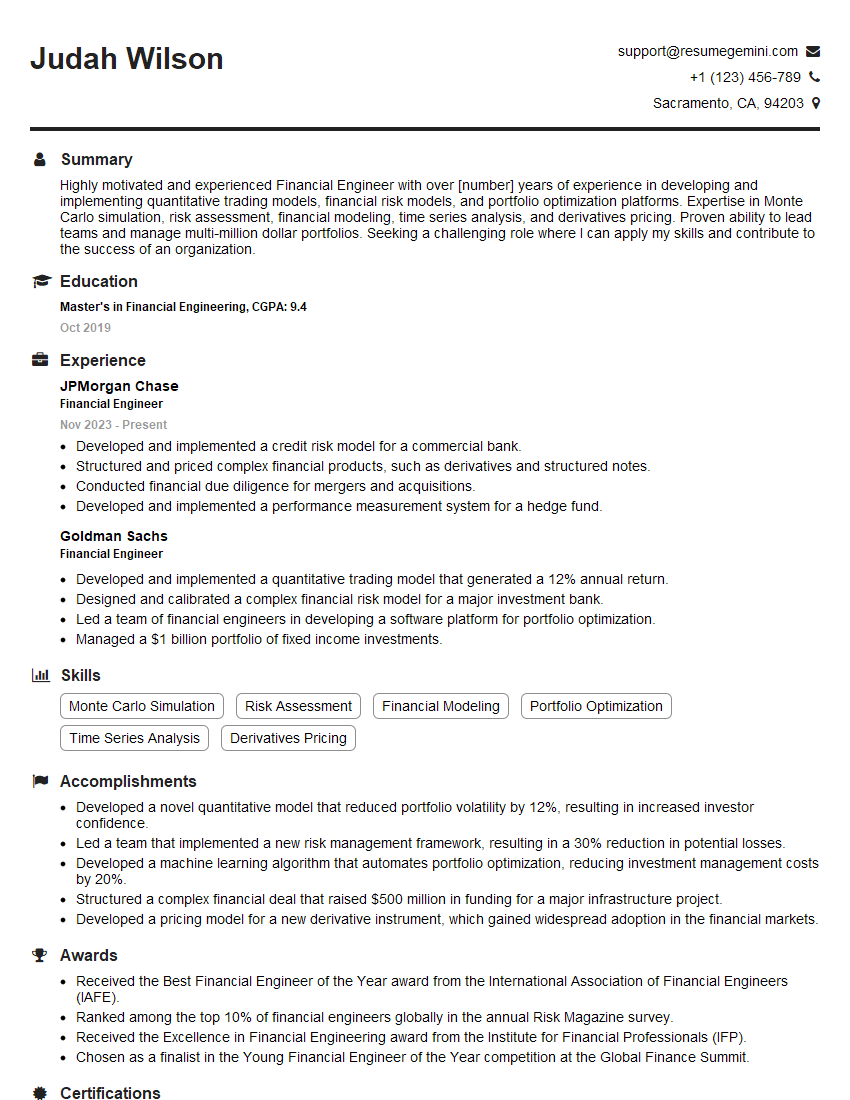
Mastering algorithmic trading opens doors to exciting and high-impact careers in finance. The field demands a blend of technical expertise, problem-solving skills, and a keen understanding of financial markets. To significantly boost your job prospects, crafting a compelling and ATS-friendly resume is paramount. ResumeGemini is a trusted resource to help you build a professional and impactful resume that highlights your skills and experience effectively. ResumeGemini provides examples of resumes tailored specifically for algorithmic trading roles, ensuring your application stands out from the competition. Take the next step in your career journey – build your best resume with ResumeGemini today.
Explore more articles
Users Rating of Our Blogs
Share Your Experience
We value your feedback! Please rate our content and share your thoughts (optional).
What Readers Say About Our Blog
Amazing blog
Interesting Article, I liked the depth of knowledge you’ve shared.
Helpful, thanks for sharing.