The thought of an interview can be nerve-wracking, but the right preparation can make all the difference. Explore this comprehensive guide to Fade In Software interview questions and gain the confidence you need to showcase your abilities and secure the role.
Questions Asked in Fade In Software Interview
Q 1. Explain the difference between a scene heading and a slugline in Fade In.
In Fade In, both scene headings and sluglines describe the location and time of a scene, but they differ in their formatting and purpose. Think of the slugline as a concise summary, while the scene heading provides more detail.
A slugline is a short, single-line description, typically INT. or EXT., followed by the location and time of day (e.g., INT. COFFEE SHOP - DAY). It’s designed for quick reference and navigation within the script.
A scene heading, on the other hand, can be more descriptive. While it still starts with INT. or EXT., it can provide more specific location details. For example, instead of INT. COFFEE SHOP - DAY, you might use INT. NOISY COFFEE SHOP - DAY or even INT. NOISY COFFEE SHOP, MANHATTAN - DAY. This gives the reader a richer understanding of the setting.
The key difference lies in conciseness versus descriptive detail. Sluglines are for quick identification; scene headings offer a more cinematic portrayal of the scene’s setting.
Q 2. How do you create and manage revisions in Fade In?
Fade In excels at revision management. Its core strength lies in its versioning system, allowing you to track every change you make. Think of it like Google Docs for screenwriters.
To create a revision, simply save your script. Fade In automatically creates a new version with a timestamp. You can then revert to any previous version by selecting it from the ‘Revision History’. This is invaluable for collaboration, as you can easily compare different drafts and see exactly what has been changed.
Further, you can add notes to specific revisions, outlining the changes made, such as ‘Added character interaction scene’ or ‘Revised ending’. This makes collaboration smoother and more transparent.
This process helps prevent accidental data loss and allows for easy collaboration by tracking all changes and allowing easy reversion to prior drafts.
Q 3. Describe your process for formatting a screenplay according to industry standards in Fade In.
Formatting a screenplay to industry standards in Fade In is straightforward thanks to its built-in formatting features. Fade In automatically adheres to standard screenplay formatting rules, handling page breaks, margins, and font sizes without manual intervention.
My process involves focusing on content first. I write the script, and then let Fade In’s automatic formatting do its job. Once finished, a simple review confirms everything is correctly formatted: 12-point Courier font, 1.5-inch left margin, 1-inch top, bottom, and right margins, etc.
However, the software’s true power is in its flexibility. While it automatically formats, it also provides customisation options for those who need to adapt to specific production preferences. It’s best to use the default settings unless a production house specifically requests something different.
Q 4. How do you use Fade In’s outlining features to structure your script?
Fade In’s outlining features are crucial for structuring a script. Think of it as creating a roadmap before embarking on a long journey.
I typically start by creating a detailed outline using Fade In’s built-in outlining tools. This involves breaking the story down into acts, sequences, scenes, and even individual beats. This allows for a clear hierarchical view of the story’s progression.
Each outline element can contain notes, descriptions, and even draft dialogue, making it a dynamic workspace. This pre-writing process is critical for building a solid foundation, ensuring logical flow and preventing plot holes before writing the actual script.
Once the outline is complete, I can easily drag and drop elements to rearrange the structure and refine the narrative flow. This iterative outlining process allows for flexible story development.
Q 5. Explain how to use Fade In’s report generation features.
Fade In’s report generation is a powerful tool, especially for collaborating with others. Imagine having a clear overview of your script’s key elements without manually combing through it. It’s like getting a concise summary tailored to your needs.
The reports can include a scene breakdown, character list, scene durations (for estimated shooting times), script length in pages, and many more. This information is invaluable for budgeting, scheduling, and pitching your script to potential producers.
To generate a report, simply navigate to the ‘Reports’ menu. Select the desired type of report, and Fade In will create a neatly formatted document showing you the desired information in a user-friendly report.
Q 6. How do you handle multiple characters and their dialogue in Fade In?
Managing multiple characters and their dialogue in Fade In is highly efficient. The software automatically formats dialogue blocks and character names, ensuring readability and adherence to industry standards.
Each character name is entered before their dialogue, with parenthetical remarks allowed below to provide additional information regarding their action or emotion (e.g., JOHN (Smiling)). This aids clarity for anyone reading the script, particularly during the production stage.
The software’s colour-coding and character list feature helps keep track of every character, avoiding confusion and ensuring consistency in character names and their appearances throughout the script. It’s like having a built-in character tracker and formatter.
Q 7. Describe your method for using Fade In’s search and find features.
Fade In’s search and find features are indispensable for navigating and editing large scripts. Imagine searching for a specific line of dialogue or scene description within a lengthy screenplay—it would be extremely time-consuming without this tool. It’s like having a powerful spotlight for your script.
To search, simply use the keyboard shortcut (typically Ctrl+F or Cmd+F), or find the search function in the Edit Menu. Enter the text you’re looking for, and Fade In will highlight all instances in the script. You can also utilize advanced search options, such as using regular expressions, to refine your search for more accurate results.
This search functionality is integral for streamlining edits, ensuring consistency in character names, and quickly finding specific elements within a complex script. You can effortlessly find specific scenes, lines, or character names, dramatically improving efficiency.
Q 8. How do you import and export scripts in different formats using Fade In?
Importing and exporting scripts in different formats in Fade In is crucial for collaboration and compatibility. Fade In supports various formats, including its native .fdx, Final Draft’s .fdx, and plain text .txt.
To import: You simply go to File > Open and select your script file. Fade In will attempt to interpret the formatting based on the file extension. Sometimes manual cleanup might be needed, especially when importing from less compatible formats like .txt.
To export: Navigate to File > Save As. You’ll see a dropdown menu with various options. Choose the desired format (e.g., .fdx for Fade In, .txt for a plain text version, or a different Final Draft version if needed). Exporting to .txt offers maximum compatibility but might lose some specific formatting.
Example: I once received a script in a very old Final Draft format. While importing it directly caused some formatting issues, exporting it to .txt, then importing it back into Fade In after a quick clean-up, solved the problem beautifully.
Q 9. How do you utilize Fade In’s notes and comments feature for collaboration?
Fade In’s notes and comments are invaluable for collaborative screenwriting. Think of it as a virtual brainstorming session embedded within your script. You can add comments to specific scenes, characters, or even individual lines of dialogue. This is ideal for feedback sessions, where multiple writers or collaborators can provide suggestions without altering the main script text itself.
How to utilize it: Right-click on the element you wish to comment on. Choose ‘Add Note.’ A separate note window will appear for input. You can even assign the note to a specific user if you’re using Fade In’s collaborative features. The notes are color-coded by user and can be easily reviewed.
Example: In a recent project, my collaborator and I used notes extensively. I’d add comments suggesting dialogue refinements, while she would add notes suggesting plot adjustments. This kept our feedback organized and separate from the main script, allowing us to easily review and implement changes.
Q 10. Explain your process for creating and using templates in Fade In.
Templates are a powerful way to standardize formatting and streamline your workflow in Fade In. Think of them as pre-designed blueprints for your scripts. You can create templates with your preferred font, margins, spacing, and even include custom header and footer information.
Creating a template: After configuring your script to your ideal settings (font, margins, etc.), go to File > Save As Template. Give it a descriptive name (like ‘MyStandardTemplate’).
Using a template: When creating a new script, instead of starting from scratch, select File > New From Template, and choose your saved template. Your new script will instantly inherit all of your preferred settings.
Example: I’ve created a template with my preferred Courier font, consistent margins, and a customized header area which automatically includes my contact information. This ensures that all my scripts have a professional and consistent look.
Q 11. How do you manage scene numbers and page numbers in Fade In?
Managing scene numbers and page numbers effectively is essential for script organization and readability. Fade In automatically handles much of this. Scene numbers are updated automatically as you add or delete scenes. Page numbers adjust dynamically with changes in formatting or text length.
Manual Control: While largely automatic, you can always manually adjust scene numbers by clicking on the scene heading and modifying the number directly. You can also change page numbering style through Format > Page Numbering and selecting options such as Arabic, Roman numerals, etc.
Example: If you need to insert a new scene in the middle of your script, Fade In automatically renumbers the subsequent scenes. This ensures that your script maintains proper organization and avoids numbering errors.
Q 12. Describe your experience with Fade In’s character and location tracking features.
Fade In’s character and location tracking features are excellent tools for keeping your script organized, particularly in complex projects. This helps identify inconsistencies and maintain a consistent world.
Character Tracking: The character list provides a comprehensive view of all the characters and their scenes. You can access it using the Character List feature. This overview reveals which characters are in which scenes, helping avoid accidental inconsistencies or omissions.
Location Tracking: Similarly, the location tracking feature provides an overview of all locations used, with scene breakdowns per location. This feature prevents confusion and helps visualize the scope of your story’s setting.
Example: In a recent project with many characters and locations, the character and location reports helped me ensure consistency and identify potential plot holes. The ability to see all appearances of a specific character saved significant editing time.
Q 13. How do you handle complex formatting requirements within Fade In?
Handling complex formatting in Fade In often involves a combination of using styles, manual formatting, and the software’s built-in tools. While most formatting is automatic, you might need more control for specific elements.
Styles: Use paragraph styles (Format > Styles) for consistent heading, scene heading, dialogue, action line, etc., formatting. This ensures a professional, consistent look across your entire script. Customizing styles once affects all instances automatically.
Manual Formatting: For unique or complex formatting needs, you can use the formatting toolbar (fonts, size, bold, italic, etc.) for manual formatting. But remember, over-reliance on manual formatting can be cumbersome for later edits.
Example: For a particularly stylized script, I used paragraph styles to create unique visual elements for different parts of the narrative, while still maintaining consistent formatting for standard elements like dialogue.
Q 14. How do you use Fade In’s script breakdown features?
Fade In’s script breakdown features are invaluable for production. They create reports that help in scheduling, budgeting, and crew allocation. These reports detail scene information such as location, characters present, props, special effects, etc.
How to use them: Navigate to the Reports menu. Various reports can be generated: shooting schedules, daily call sheets, scene breakdowns. You can customize the level of detail provided in these reports.
Example: Before production, I generated a detailed scene breakdown including location, characters, props, and special effects for each scene. This report allowed the production team to estimate the shooting schedule and budget more accurately.
Q 15. Describe your workflow for using Fade In in a collaborative writing environment.
My collaborative workflow in Fade In centers around utilizing its robust revision tracking and cloud syncing capabilities. We typically designate one person as the primary writer, responsible for inputting the initial draft and managing the main script file. Other collaborators then use the ‘Compare’ function to review changes, add comments, and suggest revisions. This creates a clear history of all alterations.
We leverage Fade In’s ability to create and manage multiple script versions. One writer might work on a specific scene or act, saving it as a separate version. Then, we use the ‘Merge’ function to consolidate changes, allowing for a streamlined review process. Regular cloud syncing (if using a service like Dropbox or Google Drive) ensures everyone has the latest version. Clear communication through tools outside of Fade In (like Slack or email) is also key to coordinating revisions.
For example, one collaborator might focus solely on dialogue, another on action descriptions, and a third on character development. They can each work on their specific aspect simultaneously, and then merge their changes into a unified version using Fade In’s compare and merge functionality.
Career Expert Tips:
- Ace those interviews! Prepare effectively by reviewing the Top 50 Most Common Interview Questions on ResumeGemini.
- Navigate your job search with confidence! Explore a wide range of Career Tips on ResumeGemini. Learn about common challenges and recommendations to overcome them.
- Craft the perfect resume! Master the Art of Resume Writing with ResumeGemini’s guide. Showcase your unique qualifications and achievements effectively.
- Don’t miss out on holiday savings! Build your dream resume with ResumeGemini’s ATS optimized templates.
Q 16. How do you troubleshoot common issues encountered while using Fade In?
Troubleshooting in Fade In usually involves a combination of checking the software’s help files, consulting online forums, and systematically examining the script itself. Common issues include formatting problems, corrupted files, and unexpected behavior. For formatting problems, I’d first ensure I’m using the correct script template and following Fade In’s style guidelines. If a file becomes corrupted, I would check the autosave files (if enabled) for a recoverable version. If the problem persists, I might try creating a new script and importing the content.
Unexpected behavior often stems from plugins or outdated software. Disabling plugins or updating to the latest version of Fade In can help resolve unexpected issues. If the problem is complex, contacting Fade In’s customer support is an excellent option. Before contacting support, always try to thoroughly document the issue (including screenshots or even a short video recording) to expedite problem resolution.
Q 17. How familiar are you with Fade In’s keyboard shortcuts?
I’m very familiar with Fade In’s keyboard shortcuts. They’re crucial for efficient scriptwriting. For example, I use Cmd+Shift+N (Mac) or Ctrl+Shift+N (Windows) constantly to create new scenes. Similarly, Cmd+Enter (Mac) or Ctrl+Enter (Windows) inserts a page break. These shortcuts, along with the many others for actions like inserting characters, saving, navigating scenes, and managing elements, significantly boost productivity, and are essential for rapidly moving through the writing and editing process. I have built them into my muscle memory.
My familiarity extends beyond just knowing the shortcuts. I understand the logic behind them and can quickly adapt to slight variations depending on the operating system. This allows me to work effortlessly across different computers without needing to relearn commands. The ability to use these shortcuts seamlessly helps me maintain a constant flow of creativity without interruptions, allowing me to focus on the script itself.
Q 18. Describe your experience using Fade In’s scene-splitting and merging functions.
Fade In’s scene-splitting and merging functionalities are invaluable for refining a script’s structure. Scene-splitting allows me to break down lengthy scenes into more manageable chunks. This can improve readability and clarity, making it easier to identify pacing issues or areas needing revision. The process is straightforward; I simply place the cursor at the desired split point and use the ‘Split Scene’ command, either from the menu or via keyboard shortcut (though there isn’t a dedicated shortcut).
Merging scenes allows me to combine smaller scenes into a larger, more cohesive unit, often used when adjusting the pacing or narrative flow. It’s just as simple as selecting the scenes to merge and using the appropriate command. These functions are particularly useful during revisions when a significant restructure is necessary. For example, during a script rewrite, I might split a long exposition scene to spread the information out, or merge two shorter scenes to create a more impactful moment. I have used this extensively to enhance the flow and narrative impact of scripts.
Q 19. How do you use Fade In’s revision tracking to manage changes across multiple drafts?
Fade In’s revision tracking is a godsend for managing changes across multiple drafts. It lets me compare different versions of the script, highlighting additions, deletions, and modifications. This is particularly helpful when collaborating with others, as it provides a clear visual record of every change. I use the ‘Compare’ function to see the differences between versions and the detailed revision history panel to trace changes back to specific users (if using collaborative features). This facilitates discussion and agreement on revisions.
For instance, if a collaborator suggests a significant change to a character’s arc, I can easily track that change across several versions, and assess its impact on the overall script. This is especially vital when working with multiple drafts over a longer period, helping maintain clarity and accountability for changes across multiple revisions and iterations.
Q 20. Explain how you would use Fade In to prepare a script for production.
Preparing a script for production in Fade In involves several key steps. First, I ensure the script is formatted correctly according to industry standards. This includes using proper scene headings, character names, action lines, dialogue, and parentheticals. I would then use Fade In’s outlining capabilities to structure the narrative effectively. Next, I’d perform a thorough review for any errors in formatting, continuity, or narrative flow.
Creating a shooting script is also crucial. This involves adding elements specific to production needs, such as shot descriptions and technical details. I utilize Fade In’s features to generate reports, such as scene breakdowns, which list all scenes with their locations, characters, and props. This helps with planning and scheduling during production. Finally, I’d create a clean, final version free from unnecessary annotations or notes, ready for distribution to the production team.
Q 21. How do you use Fade In to create different versions of a script for various audiences?
Creating different script versions for different audiences in Fade In is largely about leveraging the versioning features. For example, I might create a version for a potential investor that focuses on the high-concept pitch, highlighting key plot points and the overall commercial viability. A version for a director would contain more detailed action descriptions and notes on visual style. Finally, a version for actors would contain only dialogue, character names and minimal action directions focusing on subtext and character relationships.
Each version is saved as a distinct file, with clearly descriptive file names. This allows easy access and ensures that each audience receives a tailored version of the script, meeting their specific requirements. The script’s core elements remain consistent across versions, while the additional elements adapt to the audience’s needs, maintaining clarity and purpose.
Q 22. How would you use Fade In’s indexing features?
Fade In’s indexing features are invaluable for quickly navigating large scripts. They allow you to create a searchable index of characters, locations, or any other element you define. Think of it like a detailed table of contents, but much more powerful.
To create an index, you’d typically start by identifying key elements in your script that need indexing. For example, each time a character named ‘John Smith’ appears, you might tag that instance. Fade In lets you do this manually by highlighting and applying a tag or by using its powerful find and replace features with tagging options. After tagging, Fade In can automatically generate an index listing every scene where ‘John Smith’ is present along with the page number. This saves considerable time during revisions or when you need to quickly check scene continuity or character arcs.
For instance, imagine you are working on a large period drama with dozens of characters. Creating an index of the characters and their appearances in the script becomes crucial for maintaining consistency and avoiding errors. You can then easily jump to specific scenes featuring a particular character, making revisions and edits incredibly efficient.
Q 23. Describe your process for exporting a script as a PDF from Fade In.
Exporting a script as a PDF in Fade In is straightforward. First, you ensure your script is formatted to your liking, including headers, footers, and page breaks. Once you’re ready, you simply go to the ‘File’ menu, then select ‘Print’. Instead of sending it to a physical printer, you choose a PDF printer option (like Adobe Acrobat or a similar program installed on your system). This creates a clean, printable version that preserves your formatting.
Fade In also offers various PDF export options, allowing you to control things like margins, font sizes, and the inclusion of page numbers. Taking the time to customize these settings results in a professional-looking final product, ideal for sharing with producers, directors, or actors. For example, for a submission to a studio, I’d always opt for smaller margins and a professional font like Courier.
Q 24. How do you utilize Fade In’s timeline features?
Fade In’s timeline feature is a powerful tool for visualizing your script’s pacing and structure, especially useful for long-form projects. The timeline displays your scenes as blocks laid out in chronological order, offering a visual representation of the length of each scene and the overall story arc. This is unlike the linear, page-by-page view. It helps see the big picture.
You can adjust the length of each scene block directly on the timeline, effectively simulating changes to the pacing. This is fantastic for identifying potential pacing issues – scenes that might be too long or short in relation to others. It’s a great way to discover whether the climax is appropriately placed and if there’s sufficient build-up to that climax.
For example, when working on a feature film, I use the timeline to evaluate the balance between exposition, conflict, and resolution. If a section of the timeline feels overly dense with short scenes, I might consider combining some scenes or re-evaluating the pace of the narrative.
Q 25. Explain Fade In’s scene numbering and page numbering options.
Fade In offers granular control over both scene numbering and page numbering. Scene numbering is automatic by default, usually starting with ‘Scene 1’, ‘Scene 2’, and so on. However, you can customize this to start with different numbers or use a completely different naming convention (e.g., adding prefixes like ‘INT.’ or ‘EXT.’).
Page numbering is equally flexible. You can add page numbers to the header or footer, choose different numbering styles (Arabic, Roman numerals, etc.), and even choose to omit page numbers from certain pages, like title pages or scene headings. These settings are typically found in the ‘Format’ menu under ‘Page Setup’.
The settings give great flexibility. For instance, a screenplay might use a standard scene numbering scheme for the main script, but you can choose a different numbering format for a separate appendix that contains background material. In general, keeping things simple and clear is best practice.
Q 26. How do you handle script revisions and collaboration using Fade In’s version control?
Fade In doesn’t have built-in version control in the same way as dedicated software like Git. However, its ‘Save As’ functionality, combined with a consistent file-naming system, acts as a de-facto version control system. The most common method I employ is appending revision numbers to my filenames (e.g., ‘myscript_v1.fdx’, ‘myscript_v2.fdx’). This allows me to keep track of each revision and revert to earlier versions if necessary. This helps me track changes over time.
For collaboration, cloud storage solutions like Dropbox or Google Drive provide excellent external version control. Multiple writers can access and modify the script on the cloud, and the services often maintain revision history. However, it is crucial to have a clear communication plan to avoid conflicts or overwriting each other’s work. Using comments within the Fade In software itself can greatly facilitate collaborative editing.
Q 27. What are your preferred Fade In settings for optimal workflow?
My preferred Fade In settings focus on clarity, efficiency, and consistency. I always use Courier New font (the industry standard) at a 12-point size. I maintain consistent margins and indentation to ensure readability. My page setup includes headers containing the script title, scene number, and page number. Footers display the revision date and author’s name. I also utilize the ‘Outline’ feature extensively to manage and organize my script’s structure. This helps me grasp the story’s arc quickly and make significant structural adjustments without getting lost in the details. These preferences are saved as my default settings to ensure consistency across projects.
Q 28. How would you troubleshoot a formatting error within a Fade In script?
Troubleshooting formatting errors in Fade In often involves a systematic approach. First, I would carefully examine the problematic area for inconsistencies in indentation, spacing, or formatting codes. Fade In usually provides visual cues to highlight potential errors, such as inconsistent spacing after scene headings. Using Fade In’s ‘Find and Replace’ function to check for unwanted extra spaces or carriage returns can prove useful. Often, a simple ‘save’ or a ‘re-save’ can resolve minor glitches.
If the error persists, checking the script’s formatting settings (margins, tabs, fonts, etc.) is the next step. In extreme cases, a complete reformatting – often done by carefully copying all the text from the problematic file into a new Fade In file – can resolve more complex formatting issues. Finally, consulting Fade In’s extensive help documentation or online support forums can assist in diagnosing and fixing more complex formatting problems.
Key Topics to Learn for Fade In Software Interview
- Project Setup and Management: Understanding how to create, manage, and navigate projects within Fade In, including importing and exporting various file types.
- Scene Organization and Script Formatting: Mastering scene headings, slug lines, action lines, dialogue, and character names; applying proper formatting for readability and professional presentation.
- Revision Tracking and Collaboration: Utilizing Fade In’s revision tracking tools for collaborative scriptwriting, understanding version control and merging changes effectively.
- Report Generation and Output Options: Familiarizing yourself with generating various reports (e.g., scene breakdowns, character lists) and exporting scripts in different formats (PDF, Final Draft, etc.).
- Templates and Customization: Exploring and adapting pre-built templates and customizing settings to optimize workflow and personal preferences.
- Advanced Features: Investigating more advanced features such as indexing, outlining, and using the outlining tools for complex screenplays.
- Troubleshooting and Problem-Solving: Developing the ability to identify and resolve common issues encountered while using Fade In Software.
- Best Practices: Understanding industry best practices for script formatting and organization within the Fade In environment.
Next Steps
Mastering Fade In Software demonstrates a commitment to professional screenwriting and filmmaking practices, significantly enhancing your candidacy. A strong understanding of this industry-standard software will set you apart from other candidates. To further boost your job prospects, creating an ATS-friendly resume is crucial. ResumeGemini can help you build a professional and effective resume tailored to the specific requirements of the job market, including positions utilizing Fade In Software. Examples of resumes optimized for Fade In Software roles are available below.

Production Coordinator Resume Sample

Multimedia Specialist Resume Sample

Media Producer Resume Sample
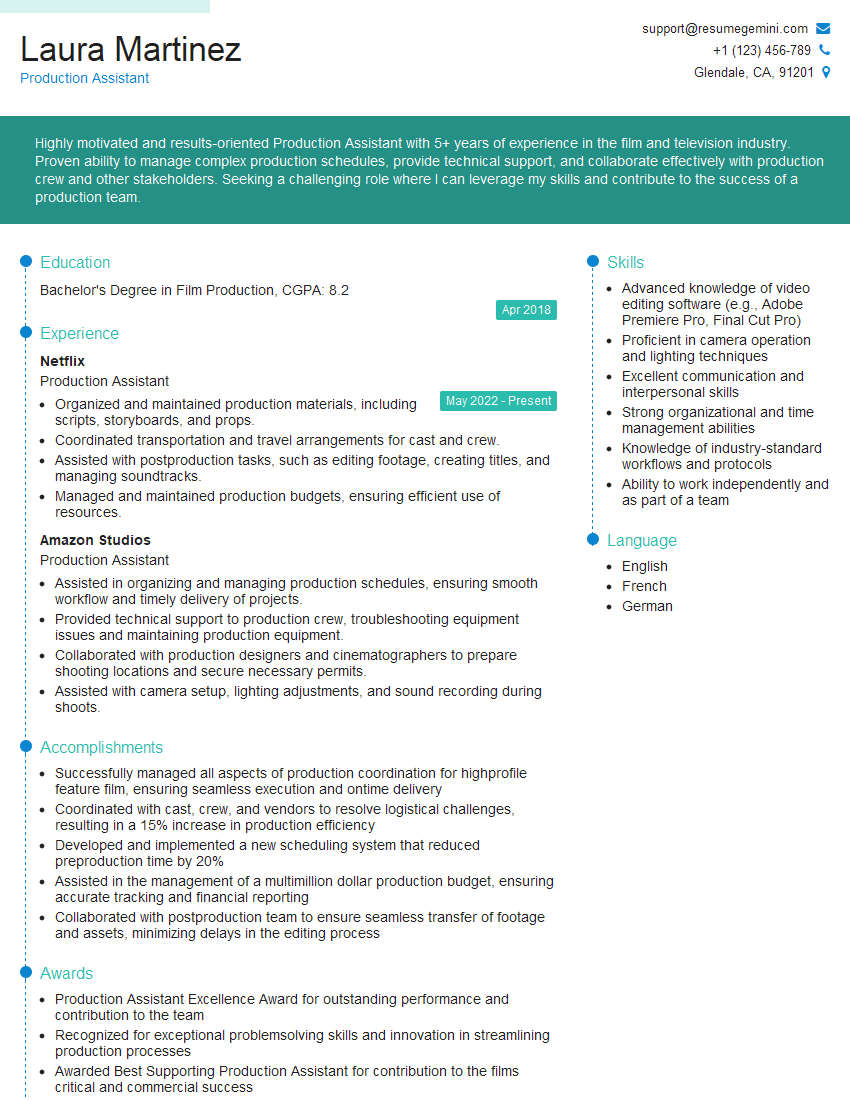
Production Assistant Resume Sample
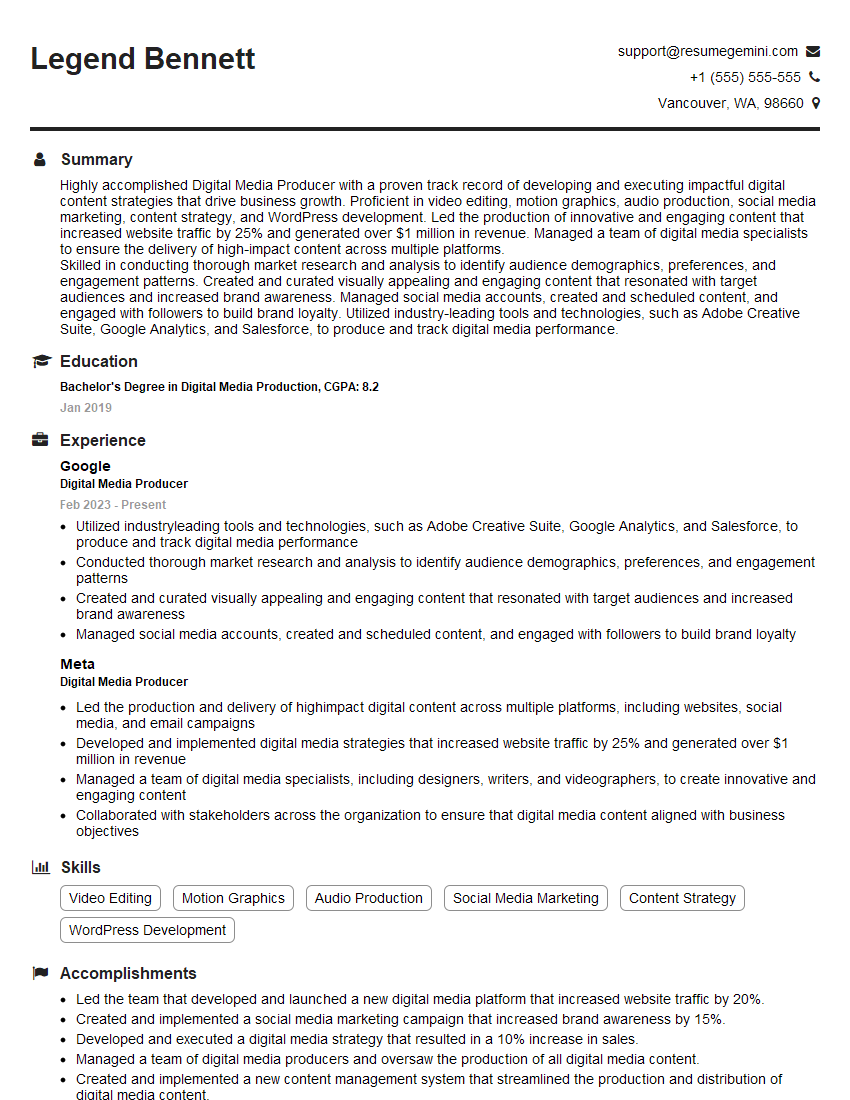
Digital Media Producer Resume Sample
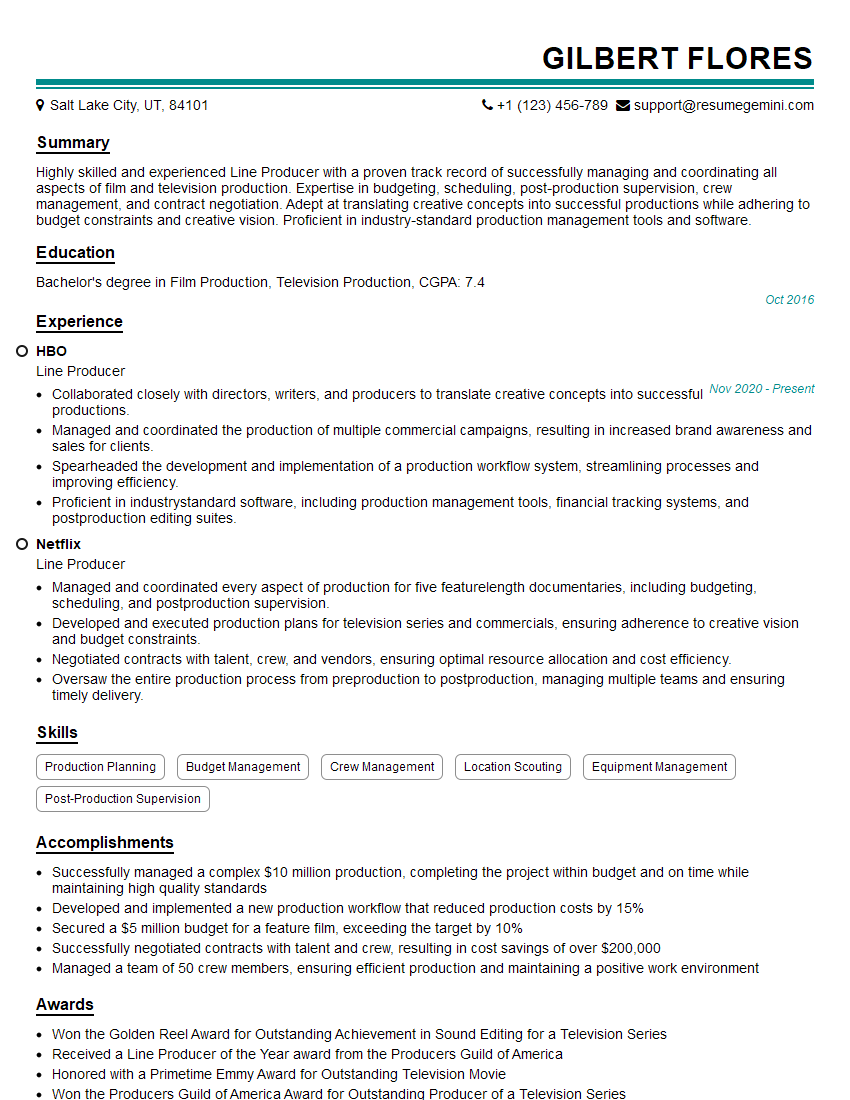
Line Producer Resume Sample
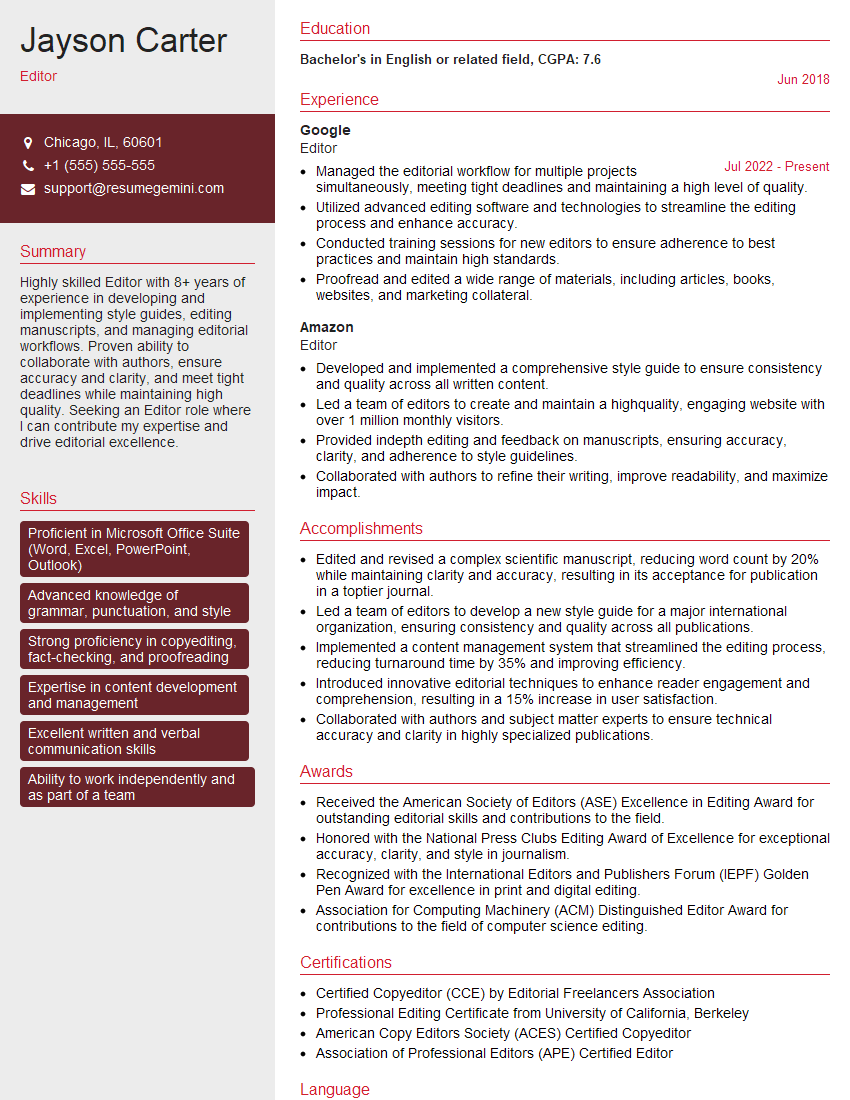
Editor Resume Sample
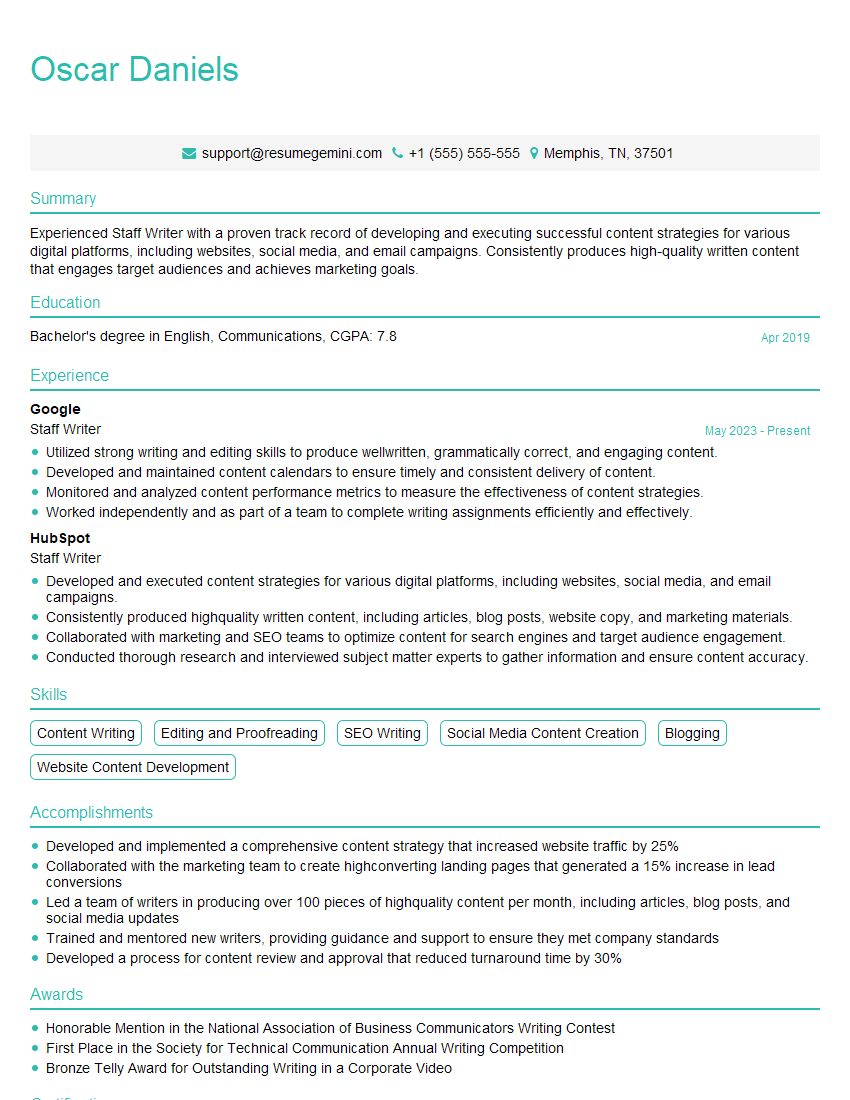
Staff Writer Resume Sample
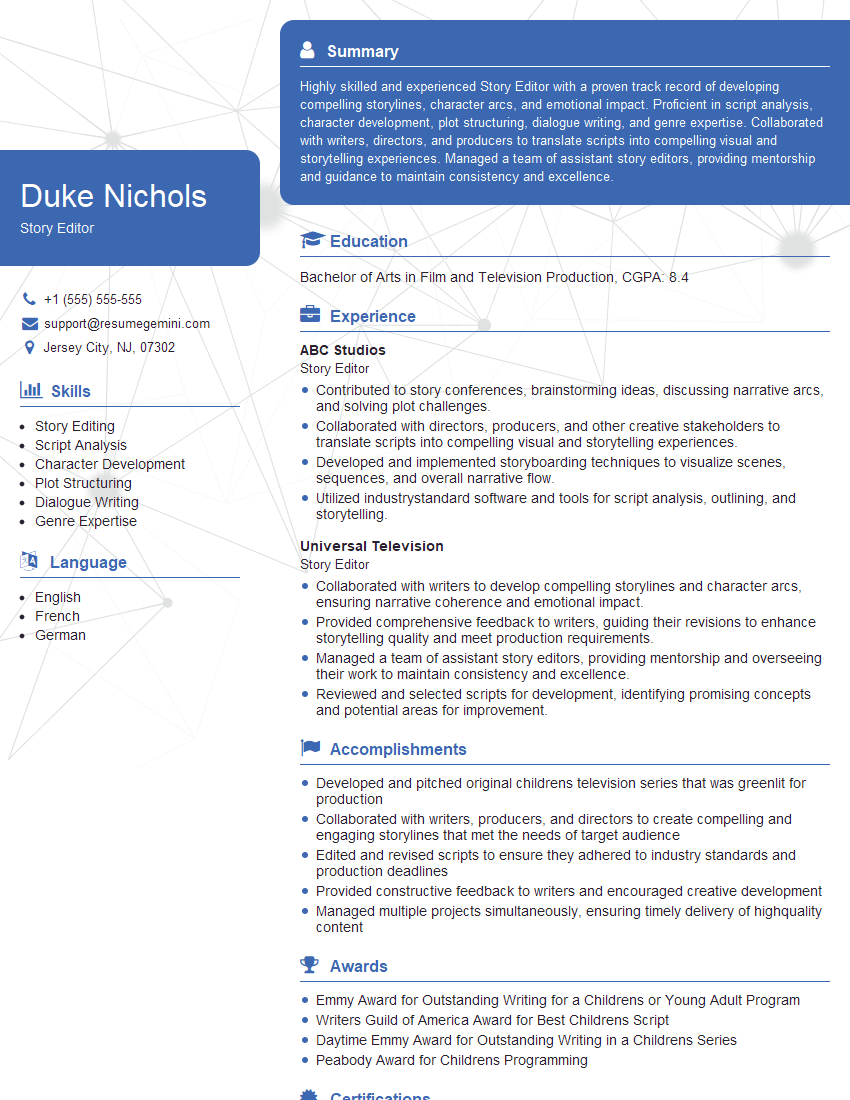
Story Editor Resume Sample

Freelance Writer Resume Sample
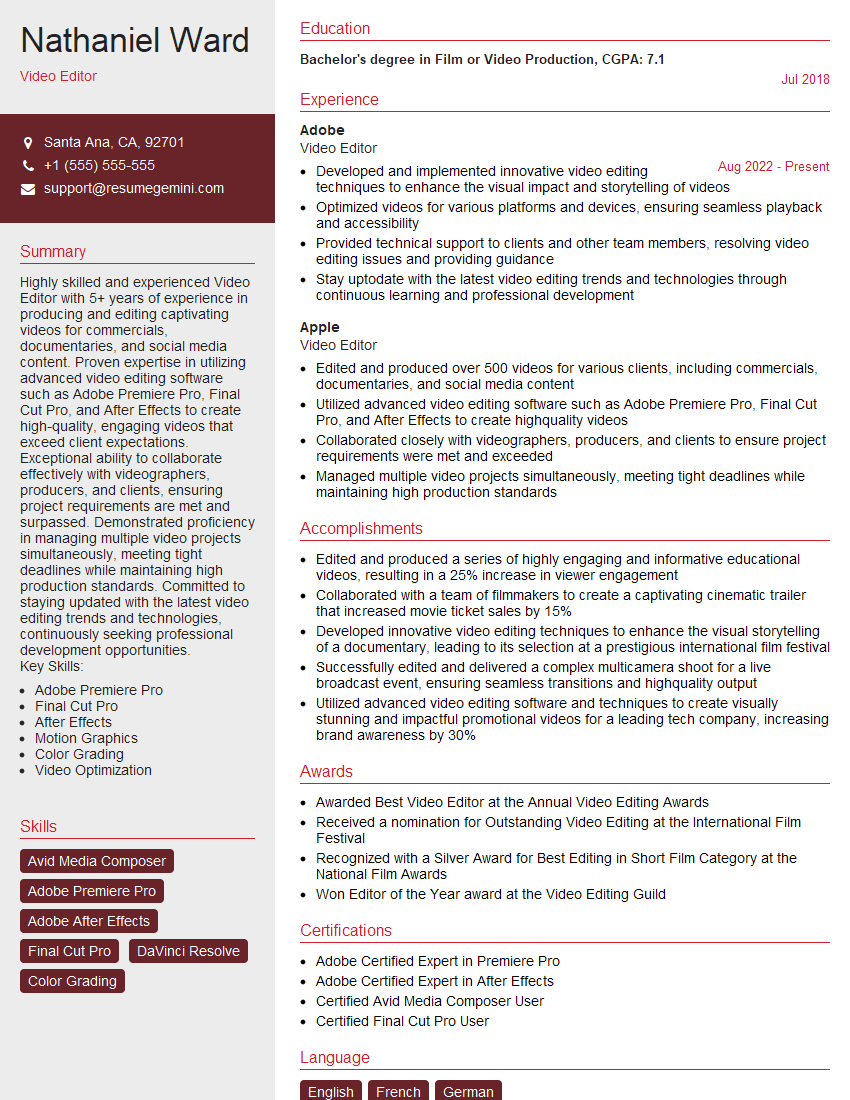
Video Editor Resume Sample
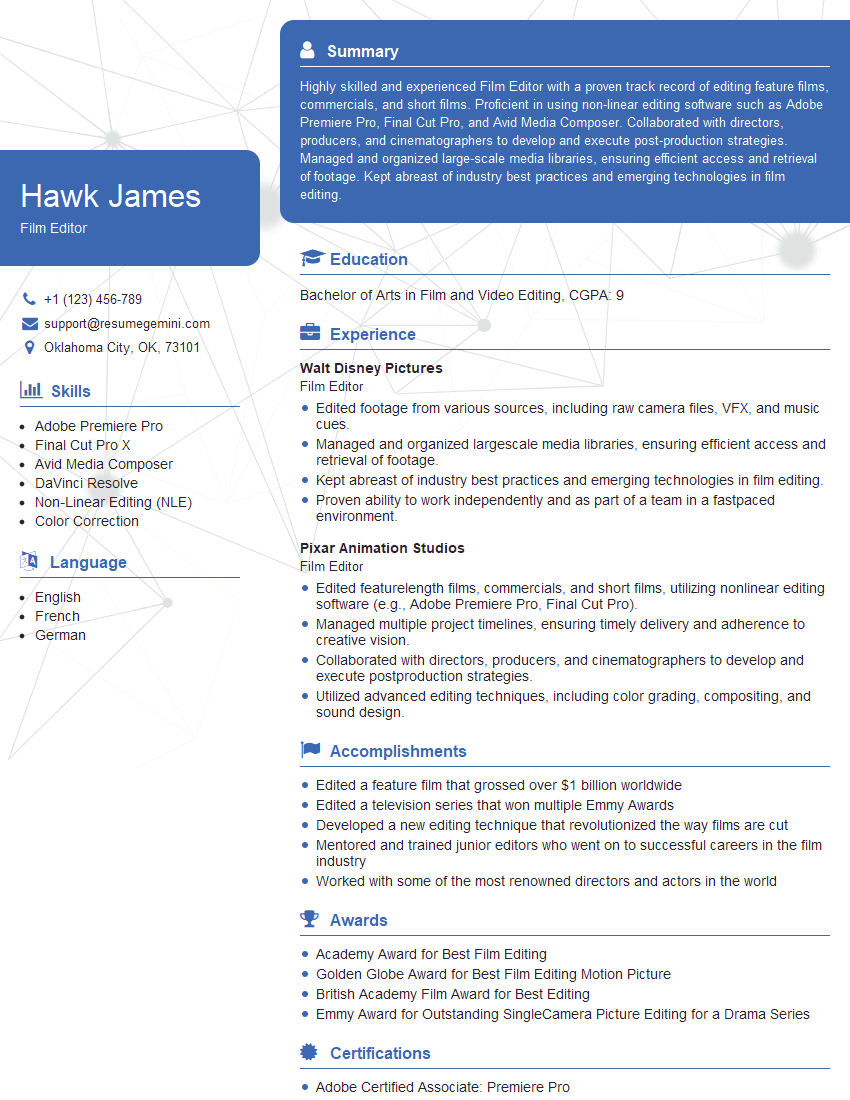
Film Editor Resume Sample
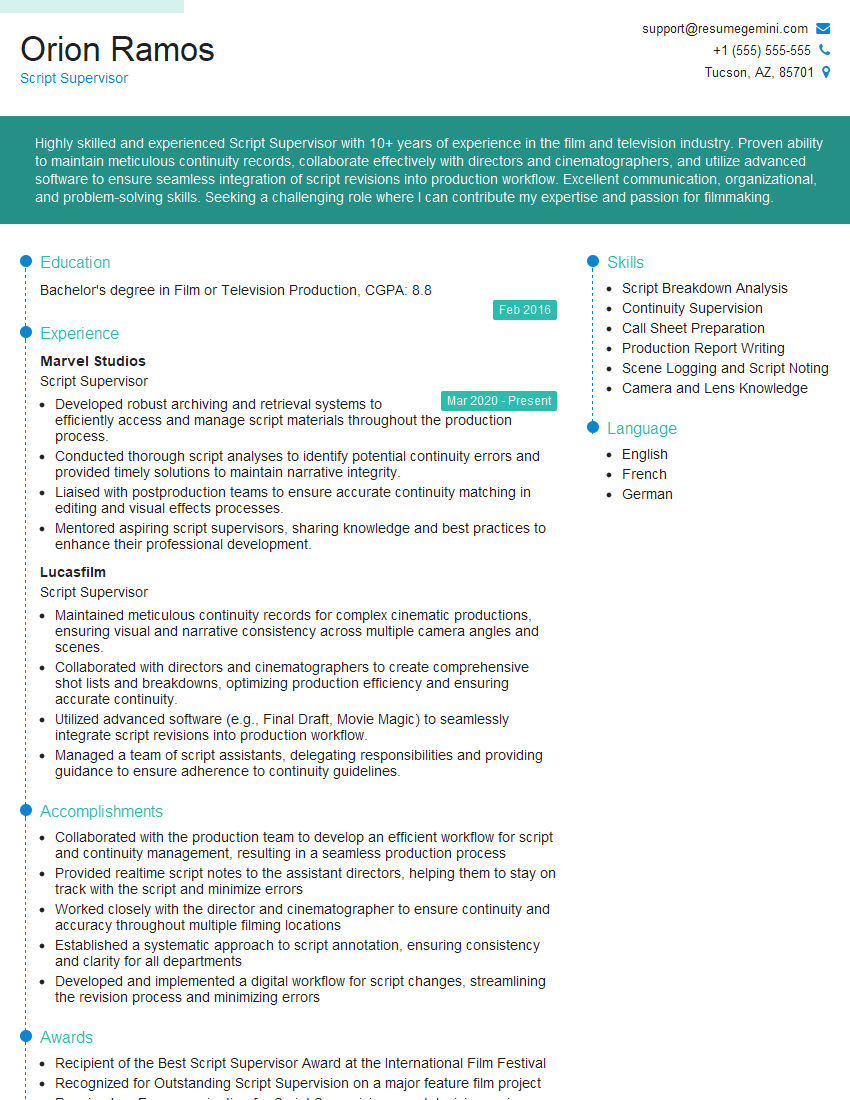
Script Supervisor Resume Sample
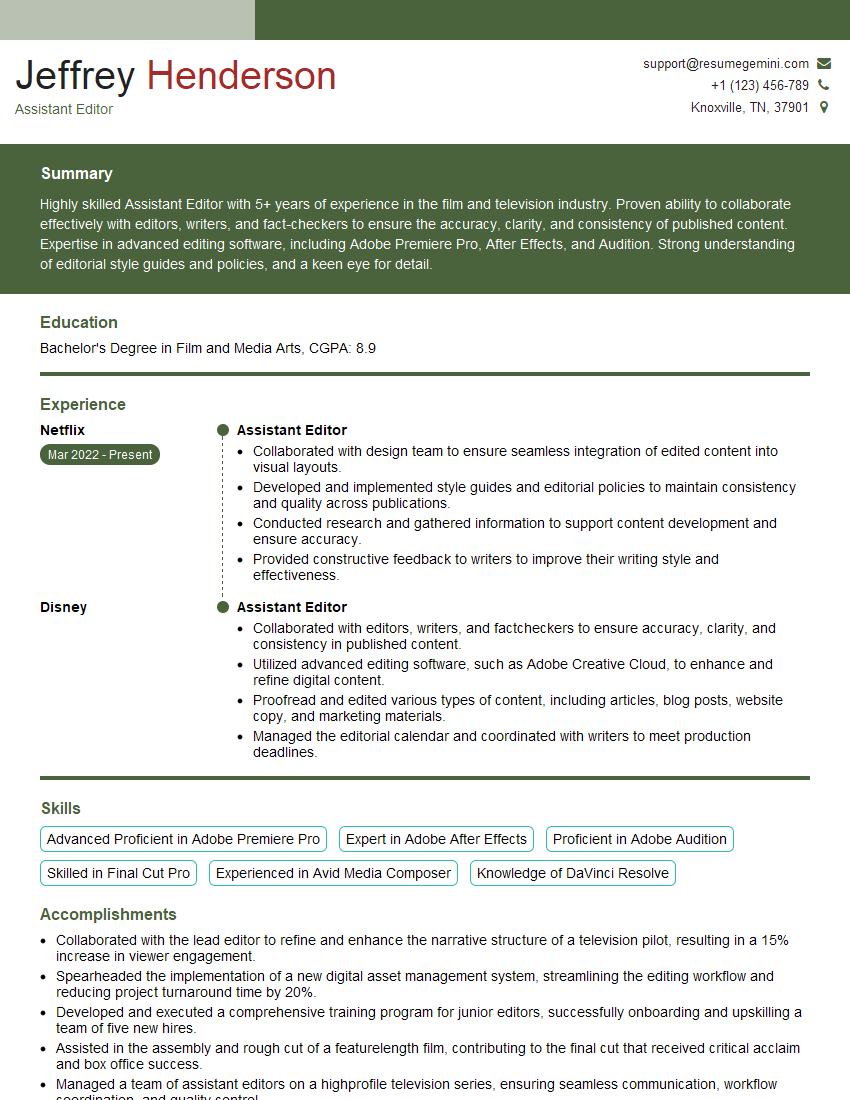
Assistant Editor Resume Sample

Content Creator Resume Sample
Explore more articles
Users Rating of Our Blogs
Share Your Experience
We value your feedback! Please rate our content and share your thoughts (optional).
What Readers Say About Our Blog
Amazing blog
Interesting Article, I liked the depth of knowledge you’ve shared.
Helpful, thanks for sharing.