Interviews are opportunities to demonstrate your expertise, and this guide is here to help you shine. Explore the essential Bidding and Estimating interview questions that employers frequently ask, paired with strategies for crafting responses that set you apart from the competition.
Questions Asked in Bidding and Estimating Interview
Q 1. Explain the difference between a bid and an estimate.
While both bids and estimates involve determining the cost of a project, they serve different purposes and have distinct characteristics. An estimate is a preliminary assessment of the likely cost, often created early in the project lifecycle. It’s a best guess based on available information, and it may lack precise details. Think of it as a ballpark figure, useful for initial planning and budget discussions. A bid, on the other hand, is a formal, documented offer to complete a project for a specific price. It’s a legally binding commitment once accepted, requiring meticulous detail and accuracy. Bids are typically submitted in response to a request for proposal (RFP) and are used in competitive bidding processes.
Example: Let’s say you’re planning a kitchen renovation. An initial estimate might be $20,000-$30,000 based on the general scope. After detailed plans and material selections are finalized, a contractor would provide a formal bid of $27,500, outlining every task and associated cost. This bid is the fixed price you’ll likely pay if you choose that contractor.
Q 2. Describe your experience with different estimating methodologies (e.g., top-down, bottom-up).
I’m experienced with both top-down and bottom-up estimating methodologies, and I select the most appropriate method based on the project’s complexity, available information, and timeline constraints. Top-down estimating uses historical data and similar projects to provide a quick, high-level cost estimate. It’s useful for early-stage planning or when detailed information isn’t readily available. For example, estimating the cost of building a similar sized facility based on previous projects cost figures. Bottom-up estimating, on the other hand, is a more detailed and precise approach where the total cost is determined by summing the costs of individual work items, materials, labor, and other resources. This methodology is suitable for projects requiring greater accuracy and more transparency in the cost breakdown. It’s like building with LEGOs – each piece is accounted for to build a complete picture of the final cost.
I’ve also successfully used a combination of both approaches. For instance, I might use top-down to get a preliminary estimate and then refine it with bottom-up techniques as the project progresses and more information becomes available.
Q 3. How do you handle unforeseen costs or changes during a project?
Unforeseen costs are an inevitable part of any project. My approach involves proactive risk management and a formal change management process. First, I clearly define the scope of work in the initial bid or estimate, using detailed specifications and drawings. This minimizes ambiguities that can lead to disputes. Should changes be required, I follow a rigorous process of documenting the request, evaluating its impact on the project schedule and budget, and preparing a revised estimate detailing the additional costs. This revised estimate is then reviewed and approved by the client before proceeding with the changes. This transparency and agreement are crucial for maintaining a positive working relationship and avoiding conflicts.
For minor, unforeseen issues, a contingency buffer is often built into the initial estimate (typically 5-10%, depending on project complexity). This allows for absorption of small, unexpected expenses without requiring extensive change orders. Open communication with the client is vital throughout the process, ensuring that they are informed and agree on the approach taken for resolving issues.
Q 4. What software are you proficient in for bidding and estimating?
I’m proficient in several industry-standard bidding and estimating software packages. My experience includes using PlanSwift for takeoff and estimating, Procore for project management and collaboration, and Microsoft Excel for detailed cost breakdowns and analysis. I’m also familiar with Timberline and other specialized construction software and comfortable learning new systems as needed.
Q 5. Explain your process for reviewing and analyzing blueprints and specifications.
My blueprint and specification review process is methodical and thorough. I start with a comprehensive overview to grasp the project’s scope and complexity. Next, I meticulously review the drawings, noting all quantities of materials needed. This often involves using digital takeoff software like PlanSwift to measure and quantify items accurately. Simultaneously, I carefully study the specifications, ensuring I understand the required quality of materials, workmanship standards, and any special requirements. I cross-reference the drawings and specifications to identify potential discrepancies or conflicts, and I often create a detailed checklist to track the review progress. Any questions or ambiguities are clarified with the client or architect before proceeding to the estimating phase.
Q 6. How do you identify and mitigate risks in your estimates?
Risk identification and mitigation are integrated throughout my estimating process. I use a combination of techniques, including brainstorming sessions, checklists, and historical data analysis. Potential risks are categorized – for example, material price fluctuations, labor shortages, weather delays, and regulatory changes. For each identified risk, I develop mitigation strategies. This may involve securing materials in advance, securing multiple bids for subcontractors, including contingency allowances in the estimate, and establishing clear communication channels to manage unforeseen challenges. I document these risks and mitigation plans in a separate risk register, providing a clear record of potential problems and the plan to address them. This proactive approach helps to ensure that my estimates are realistic and minimizes the likelihood of cost overruns or project delays.
Q 7. Describe your experience with creating detailed cost breakdowns.
Creating detailed cost breakdowns is a critical part of my process. I typically break down costs into several key categories: Labor (including labor hours, rates, and any associated fringe benefits); Materials (specifying each material, its quantity, and unit cost); Equipment (rental costs or ownership costs for necessary equipment); Subcontractors (detailed costs for all subcontracted work); Overhead (including general and administrative expenses, permits, and insurance); and Profit (a reasonable profit margin for the work). I use spreadsheets to meticulously track these costs and ensure that all items are clearly accounted for. This detailed breakdown facilitates transparency and allows for easy review and analysis, making it simpler to identify areas for potential savings or to justify costs to the client.
Q 8. How do you account for contingency in your estimates?
Contingency in estimating accounts for the inherent uncertainties in a project. It’s essentially a buffer built into the estimate to cover unforeseen costs or delays. Think of it as an insurance policy for your project. I typically incorporate contingency in two ways:
- Percentage-based contingency: I apply a percentage to various cost categories (e.g., 5% for labor, 10% for materials) based on the project’s complexity and historical data. For example, a complex renovation might warrant a higher contingency than a straightforward construction project.
- Lump-sum contingency: For specific, high-risk items, I allocate a fixed sum as contingency. This is useful for items with significant price volatility or a high probability of unforeseen complications. For example, a contingency might be added for potential underground utility conflicts during excavation.
The overall contingency percentage is carefully considered and justified in my estimate documentation. It’s crucial to be transparent about contingency allocation, explaining to the client the risks being mitigated.
Q 9. How do you manage and track changes to project scope and cost?
Managing scope and cost changes requires a robust change management system. It starts with clearly defined scope in the initial contract, including a detailed scope statement and drawings. Then:
- Formal Change Requests: All changes, no matter how small, are documented via formal change requests. This ensures traceability and avoids misunderstandings. The request details the change, its impact on cost and schedule, and proposed solutions.
- Change Review Board: A change review board (CRB) evaluates the requests. The CRB comprises stakeholders who can assess the impact and approve or reject changes. This process prevents scope creep and unauthorized alterations.
- Version Control: I use software that tracks revisions to drawings, specifications, and the cost estimate. This allows me to readily identify the impact of changes and maintain an accurate record.
- Cost Tracking Software: Real-time cost tracking software helps monitor budget expenditure against the approved estimate, highlighting any deviations promptly.
For example, if a client wants to upgrade flooring mid-project, a change request is submitted, reviewed by the CRB, and incorporated into the project budget and schedule. The client then receives a revised estimate and updated project timeline.
Q 10. Explain your process for preparing a detailed bid proposal.
Preparing a detailed bid proposal involves a systematic approach. I start with a thorough understanding of the project requirements, including the bid documents, plans, and specifications. My process generally includes these steps:
- Detailed Quantity Takeoff: Accurate quantification of materials and labor hours is critical. I meticulously review the plans to determine the quantities needed for each item.
- Unit Cost Estimation: I assign unit costs to each item based on market prices, material costs, labor rates, and historical data. This involves considering factors like inflation and potential material price fluctuations.
- Cost Breakdown Structure (CBS): I organize the estimate using a hierarchical CBS, clearly showing the breakdown of costs by category (e.g., labor, materials, equipment, subcontractor costs). This provides a clear, transparent view of the overall cost.
- Contingency and Profit: Contingency is added as described previously. A reasonable profit margin is also included to ensure profitability.
- Proposal Writing: I prepare a professional proposal summarizing the project scope, methodology, cost breakdown, and schedule. I also highlight our company’s qualifications and experience relevant to the project.
- Review and Submission: Thorough review by senior team members is vital before submission to ensure completeness, accuracy, and adherence to the client’s requirements.
Using this structured approach minimizes errors and provides a competitive and compelling bid.
Q 11. How do you ensure accuracy in your estimates?
Accuracy in estimating is paramount. I ensure accuracy through several methods:
- Detailed Plans Review: I carefully review all plans, specifications, and other relevant documents to identify all aspects of the work.
- Accurate Quantity Takeoff: Using sophisticated software and double-checking calculations, I minimize errors in quantifying materials and labor.
- Realistic Unit Costs: I regularly update my unit cost database based on current market prices and industry trends. I also leverage historical data from similar projects.
- Peer Review: Before finalizing the estimate, it is reviewed by experienced colleagues to identify potential omissions or errors. A fresh perspective often catches mistakes.
- Software Utilization: Using estimating software helps in automating calculations, reducing errors, and ensuring consistency.
Regularly updating my knowledge of building codes and best practices, along with staying informed about industry changes, ensures that my estimates reflect current standards and market realities. The goal is always to create an estimate that’s not just accurate but also defendable and transparent.
Q 12. How do you handle conflicting information from different sources?
Conflicting information requires careful evaluation. I approach this by:
- Source Verification: I assess the credibility and reliability of each source. This involves identifying the source’s expertise and potential biases.
- Data Reconciliation: I compare data points from different sources, looking for patterns and discrepancies. I might need to seek clarification from the original source of information if discrepancies are identified.
- Independent Verification: If conflicts persist, I may seek independent verification from another reliable source or conduct my own assessment using established methods.
- Documentation: I meticulously document the conflicting information, my analysis, and the resolution chosen. This provides an audit trail if questions arise later.
For example, if one subcontractor quotes a significantly different price than others for the same task, I would investigate the reasons behind the difference before selecting a subcontractor. This might involve checking the subcontractor’s qualifications and understanding their methods to ensure they are meeting the project requirements.
Q 13. How familiar are you with different types of contracts (e.g., lump sum, cost-plus)?
I’m very familiar with various contract types, including:
- Lump Sum: A fixed price contract where the total cost is agreed upon upfront. This provides certainty for the client but requires accurate upfront estimating. Risks are typically borne by the contractor.
- Cost-Plus: The contractor is reimbursed for actual costs incurred, plus a predetermined fee or markup. This offers flexibility for changes but requires careful cost tracking and transparent reporting. Risk is shared between the client and contractor.
- Unit Price: The contractor is paid a set price per unit of work (e.g., per square foot of flooring, per linear foot of trench). This suits projects with uncertain quantities but well-defined unit work items.
- Time and Materials (T&M): The client pays for the contractor’s time and materials used at an agreed-upon hourly rate and material cost. This is often used for smaller projects or those with highly uncertain scopes, but it requires detailed time tracking.
Each contract type has its own advantages and disadvantages. The choice depends on the project’s complexity, risk tolerance of all parties, and the need for flexibility.
Q 14. How do you negotiate favorable terms with subcontractors?
Negotiating favorable terms with subcontractors involves a combination of preparation, strategy, and relationship building:
- Detailed Scope Definition: Providing clear and concise scope descriptions minimizes ambiguity and disputes.
- Competitive Bidding: Obtaining multiple bids allows comparison and negotiation. I generally request at least three bids for significant subcontractor packages.
- Value Engineering: Exploring alternative methods or materials with subcontractors can sometimes lead to cost savings without compromising quality.
- Payment Terms: Negotiating favorable payment schedules ensures cash flow is managed effectively. This might involve progressive payments tied to milestones.
- Risk Allocation: Clearly defining responsibilities and risk allocation within the subcontract agreements reduces potential disputes.
- Strong Relationships: Maintaining positive relationships with subcontractors can lead to better terms and smoother collaboration in the long run.
For example, I might negotiate a lower price by offering a subcontractor a larger volume of work, or by guaranteeing payment within a specific timeframe. This demonstrates understanding of the subcontractor’s business needs, creating a foundation for mutual benefit.
Q 15. Describe your experience with value engineering.
Value engineering is a systematic method to improve the value of goods or services by identifying and eliminating unnecessary costs without sacrificing quality or functionality. It’s essentially finding smarter, more efficient ways to achieve the same outcome. My experience involves leading value engineering workshops, analyzing project specifications, identifying cost-saving opportunities in materials, processes, and design, and presenting recommendations to clients. For instance, on a recent project involving the construction of a large warehouse, we identified a less expensive, equally durable roofing material that resulted in a 15% reduction in material costs without compromising the building’s structural integrity or lifespan. We also explored alternative construction techniques to shorten the project timeline and reduce labor costs. This involved detailed analysis of material specifications, subcontractor pricing, and potential schedule impacts, ultimately leading to significant cost savings while maintaining quality and delivery timelines.
Career Expert Tips:
- Ace those interviews! Prepare effectively by reviewing the Top 50 Most Common Interview Questions on ResumeGemini.
- Navigate your job search with confidence! Explore a wide range of Career Tips on ResumeGemini. Learn about common challenges and recommendations to overcome them.
- Craft the perfect resume! Master the Art of Resume Writing with ResumeGemini’s guide. Showcase your unique qualifications and achievements effectively.
- Don’t miss out on holiday savings! Build your dream resume with ResumeGemini’s ATS optimized templates.
Q 16. How do you prioritize tasks during the bidding and estimating process?
Prioritizing tasks in bidding and estimating requires a structured approach. I typically employ a weighted prioritization matrix based on factors like urgency, impact on the bid’s success, and resource requirements. Tasks directly impacting the accuracy and completeness of the cost estimate, such as quantity takeoff and material pricing, receive top priority. These are critical for a competitive and realistic bid. Next, I prioritize tasks that are crucial for meeting deadlines, like subcontractor outreach and document preparation. Finally, tasks with lower impact and more flexibility are scheduled towards the end. Think of it like building a house: you need a solid foundation (accurate cost estimate) before adding the walls (subcontractor negotiations) and the finishing touches (document preparation). A project management software helps to visualize and track this progression, ensuring nothing falls through the cracks.
Q 17. How do you deal with tight deadlines?
Dealing with tight deadlines requires a proactive and organized approach. My strategy involves creating a detailed project schedule with clear milestones and deadlines, leveraging project management tools to track progress, and communicating transparently with the team and client about potential challenges. This means I often employ techniques like parallel processing – working on multiple aspects of the bid simultaneously. For example, while one team member researches material pricing, another can focus on subcontractor outreach. It also involves identifying potential bottlenecks early on and finding solutions, such as bringing in additional resources if needed. Crucially, I also maintain clear, open communication, informing all stakeholders immediately of any delays or unexpected issues, enabling collaborative problem solving and mitigating risks.
Q 18. What is your approach to managing a large volume of bids?
Managing a large volume of bids demands a systematic process and efficient tools. I use a combination of project management software and customizable spreadsheets to track bids, deadlines, and relevant documents. This centralized system allows for easy access to all bid-related information and helps avoid duplication of effort. I also standardize my approach to bidding, using templates and checklists to ensure consistency and avoid overlooking critical details. This standardized process dramatically improves efficiency and reduces the risk of errors in each individual bid. Furthermore, I prioritize bids based on strategic importance, profitability potential, and client relationship value. This ensures I allocate my resources to bids that offer the greatest return on investment, while still maintaining a timely response to all incoming bids.
Q 19. How do you ensure compliance with relevant regulations and standards?
Compliance is paramount. I ensure adherence to all relevant regulations and standards through a multi-pronged approach. Firstly, I maintain a thorough understanding of all applicable laws, building codes, and industry best practices. Secondly, I incorporate compliance checklists into my bidding process to verify that all necessary permits and approvals are obtained. Thirdly, I collaborate closely with legal and compliance professionals to address any ambiguities or potential issues. Finally, I ensure that all team members receive regular training on relevant regulations to keep their knowledge current. For example, when bidding on government contracts, we meticulously review the Request for Proposal (RFP) documents to ensure full compliance with all specifications and guidelines. Non-compliance can lead to bid rejection, fines, or even legal action, so meticulous attention to this detail is crucial.
Q 20. Describe a time you had to make a difficult decision regarding a bid.
In one instance, we faced a bid where the initial estimate significantly underestimated the project’s complexity. Our team had identified a potential cost-saving strategy, but this involved a slight deviation from standard procedure. The decision was difficult because deviating from standard procedure carried risks, yet sticking to the original, overly-optimistic estimate risked significant financial losses. After careful analysis, risk assessment, and consultation with the team and client, we opted for the cost-saving strategy, coupled with contingency planning to mitigate potential risks. This involved transparent communication with the client and securing their approval for the altered approach. While this solution increased the bid slightly, it proved to be the far more prudent decision. The project was ultimately completed successfully and profitably, validating our approach.
Q 21. How do you communicate effectively with clients and team members?
Effective communication is crucial. With clients, I prioritize active listening and clear, concise updates throughout the bidding process. I use a variety of communication methods tailored to client preferences, including regular meetings, email updates, and formal presentations. With team members, I foster open dialogue, encourage feedback, and provide regular training to keep their skills sharp. I use project management software to facilitate collaboration, sharing documents and updates efficiently. Clear, consistent communication prevents misunderstandings and ensures everyone is aligned, ultimately leading to better collaboration and more successful bids. This includes being responsive, providing clear and accurate information, and actively seeking feedback.
Q 22. How do you stay up-to-date on industry trends and best practices?
Staying current in the dynamic field of bidding and estimating requires a multi-faceted approach. It’s not enough to rely solely on past experience; continuous learning is crucial.
Industry Publications and Journals: I regularly subscribe to and read publications like Engineering News-Record and other specialized journals relevant to my area of expertise (e.g., residential construction, commercial building, etc.). These provide insights into market trends, new technologies, and best practices.
Professional Organizations: Active membership in organizations like the Associated Builders and Contractors (ABC) or similar groups offers access to networking opportunities, conferences, webinars, and training programs that keep me abreast of the latest advancements and regulations.
Online Resources and Courses: I leverage online platforms like LinkedIn Learning, Coursera, and industry-specific websites for continuing education. These offer courses on topics ranging from advanced estimating techniques to software proficiency.
Networking and Collaboration: I actively participate in industry events and maintain professional relationships with colleagues, subcontractors, and suppliers. Sharing experiences and insights with others is invaluable in identifying emerging trends and best practices.
For example, recently I attended a webinar on the application of Building Information Modeling (BIM) in cost estimating, which significantly enhanced my understanding of how this technology can improve accuracy and efficiency.
Q 23. What are some common pitfalls to avoid in bidding and estimating?
Several common pitfalls can significantly impact the accuracy and profitability of bids and estimates. Avoiding these requires careful planning and attention to detail.
Incomplete Scope Definition: Failing to thoroughly understand and document the project scope is a major error. Unforeseen elements can lead to cost overruns and missed deadlines. Always ensure a clear and comprehensive scope of work is agreed upon before starting the estimating process.
Inaccurate Quantity Takeoffs: Inaccurate measurements and material calculations directly translate to flawed estimates. Employing precise measurement techniques and utilizing digital takeoff software is critical.
Ignoring Contingencies: Unexpected issues are inevitable. Not including a contingency buffer in the estimate leaves the project vulnerable to cost overruns and potential losses. A realistic contingency should be included to account for unknown variables.
Underestimating Labor Costs: Labor costs are a significant portion of project expenses. Underestimating these costs due to insufficient experience or inadequate labor market research can severely impact profitability.
Ignoring Permits and Fees: Overlooking necessary permits, inspections, and associated fees can lead to significant delays and unexpected expenses. Thorough research is crucial in this area.
For instance, I once worked on a project where the initial estimate lacked a sufficient contingency for unforeseen site conditions. The discovery of unexpected underground utilities resulted in significant cost overruns and delays, highlighting the importance of thorough site investigation and robust contingency planning.
Q 24. How do you use historical data to improve the accuracy of your estimates?
Historical data is a cornerstone of accurate estimating. By analyzing past projects, I can identify trends, refine cost models, and improve the accuracy of future estimates. This involves more than just looking at the final costs; a comprehensive analysis is necessary.
Data Collection and Organization: I maintain a detailed database of past projects, including all relevant costs broken down by categories (labor, materials, equipment, subcontractors, etc.). This data is organized in a way that allows for easy retrieval and analysis.
Trend Analysis: I use statistical methods to identify trends in material costs, labor rates, and other variables over time. This helps me predict future costs with greater accuracy.
Cost Modeling: I develop cost models that incorporate historical data to predict costs for similar projects. These models are refined and updated regularly as new data becomes available.
Performance Analysis: I analyze past project performance to identify areas where costs were higher or lower than expected. This helps me refine my estimating techniques and improve accuracy.
For example, I noticed a consistent upward trend in the cost of specific materials over the past few years. By incorporating this trend into my cost models, I am able to provide more realistic estimates for future projects.
Q 25. Describe your experience with different types of projects (e.g., residential, commercial, industrial).
My experience encompasses a diverse range of projects across various sectors, providing a well-rounded understanding of the unique challenges and best practices in each.
Residential: I’ve worked extensively on residential projects, ranging from single-family homes to multi-unit dwellings. This includes experience with custom homes, renovations, and new construction, requiring expertise in understanding material specifications, labor requirements, and local building codes.
Commercial: My commercial project experience includes office buildings, retail spaces, and light industrial facilities. This involves a more complex estimating process, often requiring the coordination of multiple subcontractors and specialized equipment.
Industrial: I’ve been involved in industrial projects, such as warehouse construction and manufacturing facilities. This requires knowledge of specialized equipment, safety regulations, and potentially more complex logistical considerations.
This broad experience allows me to adapt my estimating techniques to different project types and effectively manage the specific challenges associated with each sector.
Q 26. How do you handle discrepancies between your estimate and actual costs?
Discrepancies between estimates and actual costs are inevitable. However, a proactive approach to analyzing these differences is critical for improving future estimates and project control.
Variance Analysis: I conduct a thorough variance analysis to pinpoint the causes of discrepancies. This involves comparing the original estimate to the actual costs, identifying areas of overestimation or underestimation.
Root Cause Investigation: Once variances are identified, I investigate the root causes. This may involve reviewing the original scope of work, examining changes orders, assessing material price fluctuations, or investigating potential inefficiencies in the construction process.
Documentation and Reporting: All findings from the variance analysis and root cause investigation are carefully documented and reported. This information is invaluable for improving future estimates and informing project management decisions.
Process Improvement: Based on the analysis, I identify areas for process improvement in my estimating techniques. This could include refining quantity takeoff methods, improving cost modeling, or enhancing communication with subcontractors.
For example, in a recent project, a significant cost overrun was attributed to unforeseen site conditions. By documenting this, we incorporated a larger contingency for future projects with similar potential challenges, preventing similar overruns.
Q 27. How do you use technology to improve efficiency in bidding and estimating?
Technology plays a vital role in enhancing efficiency and accuracy in bidding and estimating. I utilize a variety of software and tools to streamline the process and improve outcomes.
Estimating Software: I use specialized estimating software to manage data, create cost models, and generate detailed estimates. This software often integrates with other project management tools.
Digital Takeoff Software: I utilize digital takeoff software to efficiently and accurately measure quantities from blueprints and other project documents, minimizing manual errors.
Cloud-Based Platforms: Cloud-based platforms facilitate collaboration and data sharing among team members and subcontractors, streamlining communication and improving efficiency.
Data Analytics Tools: I leverage data analytics tools to analyze historical data, identify trends, and improve the accuracy of cost models.
For example, the use of digital takeoff software has reduced the time required for quantity takeoffs by approximately 40%, allowing me to dedicate more time to analyzing cost data and refining estimates.
Q 28. Describe your experience with project risk management.
Project risk management is an integral part of the bidding and estimating process. Identifying and mitigating potential risks is crucial for ensuring project success and profitability.
Risk Identification: I begin by identifying potential risks through thorough project planning and site analysis. This includes considering factors such as weather conditions, material availability, regulatory changes, and potential subcontractor issues.
Risk Assessment: Each identified risk is assessed based on its likelihood and potential impact on the project. This allows me to prioritize risks and focus on those posing the greatest threat.
Risk Mitigation Strategies: I develop mitigation strategies to address identified risks. This may involve developing contingency plans, securing alternative suppliers, or building buffers into the schedule and budget.
Risk Monitoring and Control: Throughout the project, I continuously monitor risks and adjust mitigation strategies as needed. This requires regular communication with the project team and stakeholders.
For instance, on a recent project, we identified a risk related to potential material price increases. To mitigate this risk, we secured a contract with a supplier that guaranteed a fixed price for a specified period, protecting the project from unexpected cost increases.
Key Topics to Learn for Your Bidding and Estimating Interview
- Cost Estimating Techniques: Understand various methods like parametric estimating, bottom-up estimating, and analogous estimating. Practice applying these methods to different project scenarios.
- Risk Assessment and Mitigation: Learn to identify potential risks in a project’s bid and develop strategies to mitigate those risks, impacting your overall estimate’s accuracy.
- Profit Margin Analysis: Master the calculation and justification of profit margins, considering factors like overhead costs, labor rates, and market competition.
- Proposal Writing and Presentation: Practice structuring compelling proposals that clearly communicate your cost estimates and project approach. Develop strong presentation skills to effectively convey your findings.
- Software Proficiency: Demonstrate familiarity with relevant bidding and estimating software (mention specific software if applicable to the target roles). Highlight your skills in data analysis and report generation using these tools.
- Contract Law and Negotiation: Understand the basics of contract law as it relates to bidding and negotiating favorable terms with clients.
- Understanding Project Scope and Requirements: Practice accurately interpreting project specifications and clarifying ambiguities to avoid costly misunderstandings.
- Material Take-off and Quantity Surveying: Develop skills in accurately estimating material quantities needed for a project. This is crucial for accurate cost estimation.
- Data Analysis and Interpretation: Show your ability to analyze historical data, trends, and market conditions to inform your estimations.
Next Steps
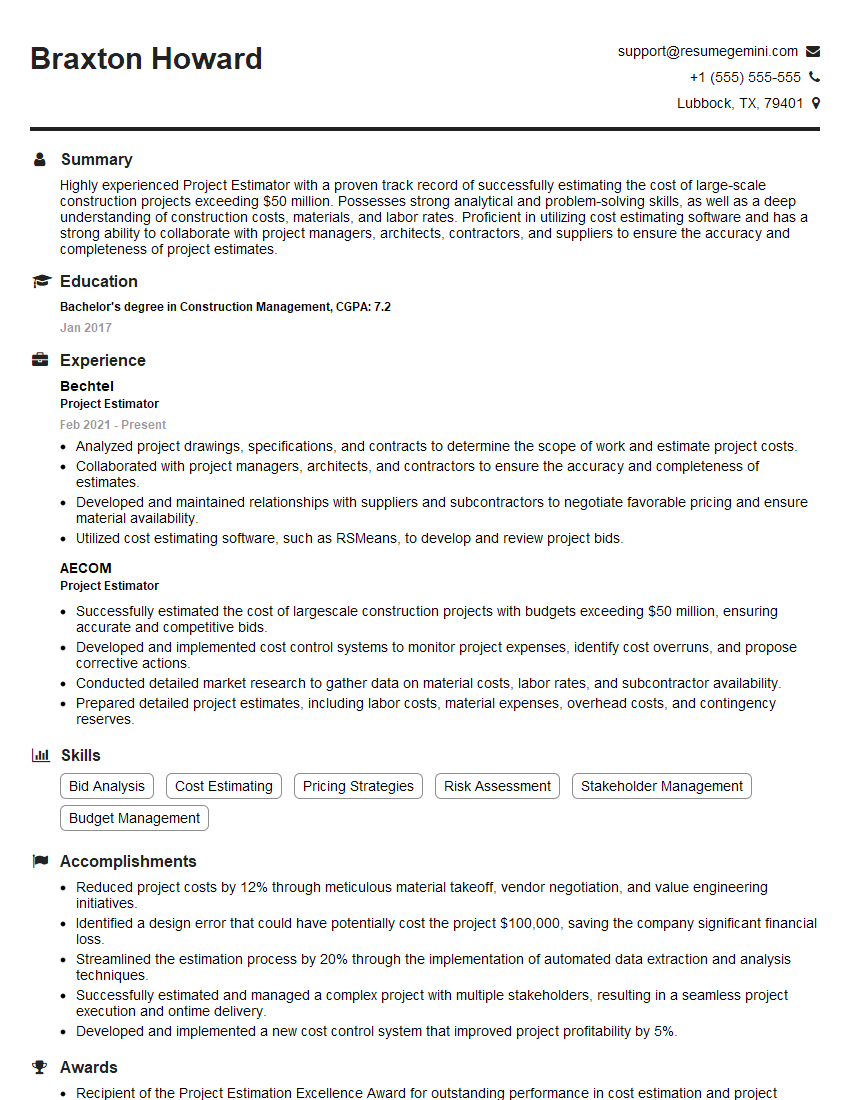
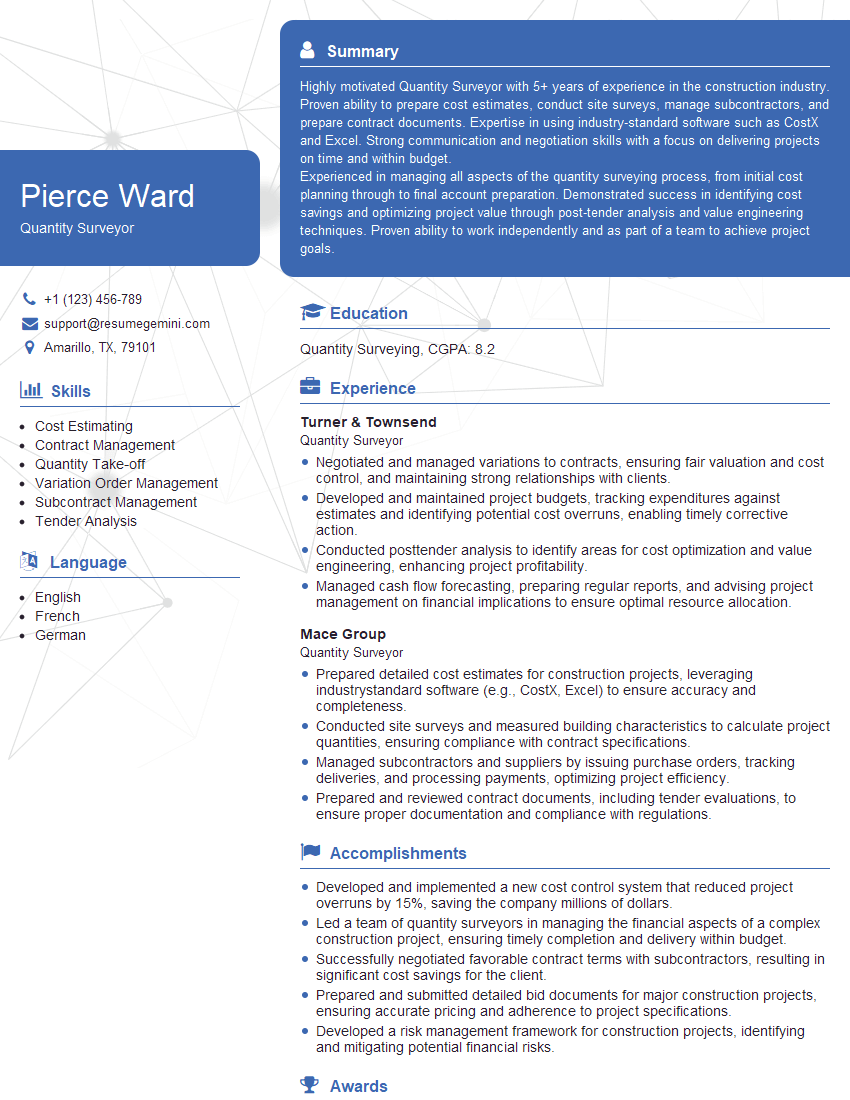
Mastering bidding and estimating is crucial for career advancement in the construction, engineering, and project management fields. It demonstrates a valuable skillset in strategic planning, financial acumen, and risk management. To significantly boost your job prospects, focus on creating an ATS-friendly resume that highlights your achievements and quantifiable results. ResumeGemini is a trusted resource to help you build a professional and impactful resume. We provide examples of resumes tailored specifically to Bidding and Estimating roles to guide you. Make your skills shine and land your dream job!

Explore more articles
Users Rating of Our Blogs
Share Your Experience
We value your feedback! Please rate our content and share your thoughts (optional).
What Readers Say About Our Blog
Amazing blog
Interesting Article, I liked the depth of knowledge you’ve shared.
Helpful, thanks for sharing.