Interviews are opportunities to demonstrate your expertise, and this guide is here to help you shine. Explore the essential Concert Touring Sound Engineering interview questions that employers frequently ask, paired with strategies for crafting responses that set you apart from the competition.
Questions Asked in Concert Touring Sound Engineering Interview
Q 1. Describe your experience with different digital audio consoles (e.g., DiGiCo, Avid Venue, Yamaha CL series).
I’ve had extensive experience with various digital audio consoles, each offering a unique workflow and feature set. The DiGiCo SD series, for example, is renowned for its powerful processing capabilities and intuitive control surface, making it ideal for complex shows with many inputs and outputs. I appreciate its flexible routing and the ability to create and recall snapshots quickly, crucial for efficient sound checks and seamless transitions between songs. Avid Venue consoles, particularly the Profile, excel in their robust processing and integration with other Avid products. The extensive automation capabilities are invaluable for intricate shows requiring precise control over levels and effects. Finally, the Yamaha CL series provides a user-friendly interface perfect for smaller to mid-sized shows. Its ease of use, coupled with its solid performance, makes it a reliable workhorse. Each console has its strengths; my choice depends heavily on the scale and specific requirements of the production.
Q 2. Explain your process for setting up and tuning a PA system for a large outdoor concert.
Setting up a PA for a large outdoor concert is a meticulous process. It starts with a site survey, assessing the venue’s acoustics, audience capacity, and potential challenges like wind or ambient noise. Next, I determine the optimal speaker placement based on coverage patterns, aiming for even sound distribution across the entire audience. This involves careful calculation of distances and angles, often utilizing specialized software for precise modeling. System design includes choosing the appropriate speakers, based on factors like frequency response and power handling. Once the system is physically set up, we begin the alignment and tuning process. This involves using test tones and acoustic measurement tools to ensure phase coherence, flat frequency response, and consistent sound across all listening positions. We use delay lines to compensate for distances between speakers, ensuring all sound arrives at the audience simultaneously. Finally, detailed sound checks with the artists are critical to tailor the mix to the specific performance and the venue’s unique characteristics. Imagine a huge festival: getting the sound right for a stadium is different than a smaller, more intimate outdoor space.
Q 3. How do you handle feedback issues during a live performance?
Feedback is the bane of live sound, but thankfully, there are several strategies for handling it. The first line of defense is proper microphone technique. This includes keeping microphones away from speakers, using directional microphones to minimize pickup of unwanted sounds, and employing appropriate gain staging. If feedback persists, I’ll use equalization (EQ) to notch out the offending frequencies, carefully sculpting the sound without compromising clarity. Gate reduction can also eliminate feedback issues by quickly reducing the microphone’s gain when not receiving a signal. In extreme cases, a feedback suppressor, a specialized piece of equipment, can automatically identify and eliminate feedback frequencies. It’s all about finding the balance: reducing feedback without affecting the sound quality the artist desires.
Q 4. What are your preferred methods for microphone selection and placement for various instruments and vocalists?
Microphone selection and placement are crucial for capturing the best possible sound. For vocals, I often prefer condenser microphones known for their clarity and sensitivity, like a Neumann U 87 or a Shure KSM9. The placement depends on the singer’s style, aiming for optimal proximity without causing proximity effect (excessive bass boost). For acoustic guitars, I might use a small-diaphragm condenser or a dynamic microphone like a Shure SM57, depending on the desired tone. For electric guitars, a Shure SM57 is a classic choice, often positioned close to the amp’s speaker cone. Drums require a comprehensive microphone setup tailored to the kit’s specific configuration. Kick drums might use a combination of dynamic mics (e.g., AKG D112) and condenser mics, while snare drums often get an SM57 and possibly an overhead condenser for ambiance. Each instrument presents unique challenges, and my approach always aims to capture its nuances while ensuring a balanced, well-defined mix.
Q 5. Describe your experience with digital signal processing (DSP) and its applications in live sound.
Digital signal processing (DSP) has revolutionized live sound. It allows for precise control over equalization, compression, delay, reverb, and other effects. Using DSP, we can fine-tune the sound of individual instruments or vocalists, shaping their tonal characteristics to fit the overall mix. This includes creating custom EQ curves, adjusting dynamic range, and adding effects such as delay or reverb with surgical precision. A great example is using a multiband compressor to control dynamics separately across different frequency ranges. This enables a more nuanced control of the sound, compared to traditional single-band compressors. Moreover, DSP within digital consoles makes it possible to achieve a much greater level of system control and flexibility compared to analog systems.
Q 6. How do you manage audio delays and ensure proper time alignment in a multi-speaker system?
Managing audio delays in a multi-speaker system is essential for a cohesive sound experience. Delay is introduced to compensate for the time it takes for sound to travel from each speaker to the audience. If not properly aligned, listeners will perceive a sound delay, making it sound out of sync and disrupting the overall listening experience. Specialized signal delay devices or software within the digital console allow us to precisely adjust the delay time for each speaker, ensuring that all signals arrive at the listener simultaneously. This process often involves meticulous measurements and calculations, sometimes employing acoustic modeling software to visualize the sound field. Proper delay alignment is a key factor in maintaining a solid and consistent listening experience.
Q 7. What are your troubleshooting strategies for common audio problems (e.g., hum, buzz, distortion)?
Troubleshooting audio problems requires a systematic approach. A hum or buzz often points to ground loops or interference. I’d start by checking all ground connections and ensuring that equipment is properly grounded to avoid ground loops. Using balanced cables helps to minimize hum and buzz significantly. If the problem persists, I’d isolate the affected equipment by disconnecting components one at a time to identify the source of the problem. Distortion usually indicates signal overload. This could be due to excessive gain, clipping in the audio signal path, or a faulty component. I would carefully check gain staging levels throughout the system, reducing the overall gain, and then examine the signal path for signs of saturation or clipping in the analog or digital domains. A methodical, step-by-step approach is key to quickly diagnosing and solving any audio problem. It’s like a detective investigation – finding the culprit can be surprisingly methodical.
Q 8. Explain your understanding of different loudspeaker configurations and their acoustic properties.
Loudspeaker configurations are crucial for achieving optimal sound coverage and quality in a concert setting. Different setups cater to varying venue sizes and audience distributions. Common configurations include:
- Point Source: A single loudspeaker or cluster aiming sound directly at the audience. Think of a small club setup with a single speaker stack. Simple, but limited in coverage and frequency response at larger distances.
- Line Arrays: Multiple speakers arranged vertically in a line, creating a more consistent sound field over a longer distance. These are frequently used in larger venues like arenas and stadiums for even sound distribution.
- Distributed Systems: Many smaller speakers strategically placed throughout a venue, providing uniform sound coverage. This approach is particularly effective in large, complex spaces like stadiums or outdoor amphitheaters, minimizing sound inconsistencies.
Acoustic properties vary greatly depending on the configuration. Line arrays, for example, offer better control over vertical dispersion compared to point source systems. Distributed systems can provide consistent levels across the entire audience area, but careful system design and tuning are critical to prevent phase cancellations or comb filtering (destructive interference of sound waves).
Choosing the right configuration depends heavily on factors such as venue size, audience capacity, the type of music being performed, and the budget. A small intimate gig might utilize point source systems, while a large stadium tour will rely on complex line array and distributed systems that incorporate delays and equalization to compensate for sound travel time and venue acoustics.
Q 9. How do you work effectively with other members of the sound crew (e.g., stagehands, lighting technicians)?
Effective teamwork is paramount in live sound. My approach emphasizes clear communication, mutual respect, and proactive collaboration. I regularly attend pre-production meetings with lighting technicians, stagehands, and other crew members to discuss setup plans, potential conflicts (e.g., cable routing), and safety protocols. Open lines of communication during the show are equally important. We use a combination of headsets and hand signals to ensure seamless transitions and address any issues promptly. For instance, if a stagehand needs to access a cable behind a speaker, a quick headset message prevents accidental disconnections or damage. I view the entire crew as a team, each member bringing unique expertise that contributes to a successful performance.
Q 10. Describe your experience with RF wireless microphone systems and their frequency coordination.
RF wireless microphone systems are integral to modern concert sound, but require careful frequency coordination to prevent interference. My experience includes using spectrum analyzers and coordination software to identify available frequencies and assign channels to avoid conflicts. Factors to consider include the number of microphones, the frequency range of each microphone, nearby transmitters (other wireless mics, in-ear monitors, etc.), and potential interference from cell towers or other RF sources. We typically create a frequency plan before a tour begins, considering the specific geographic locations and the potential for interference in each venue. During the show, we monitor RF levels to identify and address any issues quickly, sometimes involving manual channel adjustments or switching to backup frequencies. A recent tour required us to coordinate 12 wireless mics and 4 in-ear monitors across several venues – each required a unique and carefully planned frequency plan to ensure reliable operation.
Q 11. How do you create and maintain a comprehensive audio inventory for a concert tour?
Maintaining a detailed audio inventory is crucial for efficient touring. Our system uses a combination of physical labels, digital spreadsheets, and dedicated software to track every piece of equipment. Each item is assigned a unique identification number, allowing for precise tracking of location and condition. The spreadsheet details serial numbers, specifications, and maintenance history, while the software offers real-time inventory tracking for multiple tours. We also include a section for damage reports or needed repairs. Before and after each show, a thorough check ensures all equipment is accounted for. This detailed system allows us to identify gear that needs servicing or replacement and to quickly locate equipment when needed. This streamlined process saves valuable time and reduces the risk of equipment loss or malfunction during the tour.
Q 12. Explain your approach to monitoring and adjusting sound levels during a performance.
Monitoring and adjusting sound levels during a performance is an ongoing process that requires constant attention. I use a combination of digital mixing consoles and metering tools to ensure appropriate gain staging and optimize the overall sound for the audience and performers. This involves monitoring levels for individual instruments, vocals, and the overall mix, adjusting levels based on the dynamics of the performance and the artist’s requirements. Communication with the front of house engineer and the performers is critical. Often, performers will have specific requests regarding their monitor mixes. For instance, a drummer might request a slightly louder kick drum in their monitors. We use a combination of communication systems including hand signals and headset communication to ensure these needs are met.
Q 13. What are your strategies for optimizing sound quality for different venues (e.g., arenas, stadiums, theaters)?
Optimizing sound quality for different venues requires a flexible approach. The acoustics of each space significantly affect sound propagation and require specific tuning strategies. For example, a large arena may suffer from excessive reverberation (echoes) requiring the use of delays, EQ, and potentially sound absorption to mitigate this. A smaller theater, on the other hand, might need less processing. Prior to the show, I typically conduct sound checks to assess the venue’s acoustics and adjust the PA system accordingly. This includes using EQ to compensate for frequency imbalances and employing delay settings to align sound from different speakers, ensuring that the entire audience receives a clear and consistent sound experience. The goal is always to achieve a balance between clarity, power, and natural sound, customized to each unique venue.
Q 14. How do you handle unexpected equipment failures during a live performance?
Equipment failure is an unavoidable reality in live performance, and having a plan is critical. We employ a layered approach to redundancy: backup microphones, redundant mixer channels, and backup amplifiers ensure that critical elements are protected against single points of failure. In case of failure, we have a pre-determined workflow. This includes isolating the problem, using backup equipment to replace the failed component, and minimizing disruption to the performance. For instance, a quick swap of a faulty microphone would be handled smoothly due to pre-planning. Effective communication is key—keeping the artist and the crew informed about the situation and the plan to resolve it helps maintain composure and minimizes audience disruption. Post-show, a thorough analysis is conducted to identify the cause of the failure and prevent similar issues from occurring in the future. This might involve maintenance checks or upgrading equipment to more reliable components.
Q 15. Describe your experience with different types of audio signal processing equipment (e.g., compressors, gates, EQs).
My experience with audio signal processing is extensive, encompassing years of hands-on work with compressors, gates, equalizers (EQs), and other crucial tools. Think of these as the ‘makeup’ for your audio signal, shaping it to sound its best.
Compressors reduce the dynamic range of a signal, making loud parts quieter and quiet parts louder. This is invaluable for controlling unruly vocals or taming overly aggressive instruments, resulting in a more consistent and punchy sound. For example, I might use a compressor on a lead vocal to prevent it from clipping (distorting) during powerful phrases while maintaining clarity in quieter parts.
Gates are like volume control switches that only open when a certain sound level is reached. This is vital for eliminating unwanted noise, such as microphone hiss or stage rumble. Imagine a drummer’s cymbal mic picking up the low-frequency thump of the bass drum – a gate silences the mic between cymbal strikes, keeping the mix clean.
EQs allow precise adjustment of specific frequencies within a signal. This is crucial for shaping the tone and clarity of instruments and vocals. For instance, a muddy bass guitar might benefit from cutting some low-mid frequencies while boosting the higher frequencies for definition. Conversely, a thin-sounding acoustic guitar might need a boost in the low-mid range to add warmth.
Beyond these fundamentals, I’m also proficient with other processing tools like delays, reverbs, and multi-effects units which are used to create specific effects and ambience. The effective use of these tools depends heavily on the context of the specific artist and venue.
Career Expert Tips:
- Ace those interviews! Prepare effectively by reviewing the Top 50 Most Common Interview Questions on ResumeGemini.
- Navigate your job search with confidence! Explore a wide range of Career Tips on ResumeGemini. Learn about common challenges and recommendations to overcome them.
- Craft the perfect resume! Master the Art of Resume Writing with ResumeGemini’s guide. Showcase your unique qualifications and achievements effectively.
- Don’t miss out on holiday savings! Build your dream resume with ResumeGemini’s ATS optimized templates.
Q 16. How do you ensure the safety and security of audio equipment during transportation and setup?
Ensuring the safety and security of audio equipment is paramount. It’s not just about protecting expensive gear; it’s about guaranteeing a smooth, uninterrupted show. My approach involves a multi-layered strategy.
- Proper Packing and Transportation: I use high-quality road cases, custom-fitted to protect equipment from shocks and vibrations during transport. We always use appropriate vehicle and secure the equipment for transit.
- Inventory Management: A detailed inventory list, including serial numbers and photos, is crucial. This simplifies tracking and insurance claims in case of damage or loss.
- On-Site Security: At the venue, I prioritize secure storage and setup areas, minimizing the risk of theft or accidental damage. This frequently means coordinating with the venue’s security personnel.
- Preventive Maintenance: Regular checks and preventative maintenance minimize the chances of equipment failure during a show. This includes careful cable management and regular cleaning of equipment.
- Insurance: Comprehensive insurance coverage is essential to protect against unforeseen circumstances.
Q 17. What are your methods for creating effective monitor mixes for musicians?
Creating effective monitor mixes is about providing musicians with the tools they need to perform their best. It’s a collaborative process, and I always begin by talking to each musician about their specific needs and preferences.
Understanding the Musician’s Perspective: I ask about their preferred listening levels, the instruments they need to hear clearly, and any potential problems they’ve encountered in past shows. This involves a lot of listening and understanding of the dynamics and style of their playing.
Balancing the Mix: I aim for a balanced mix that is neither too loud nor too quiet. This requires careful adjustment of individual channels, ensuring each instrument is audible without masking other sounds. This might entail careful EQ adjustments, balancing levels across the frequency spectrum and using effects judiciously.
Frequency Management: I use EQ and routing to avoid frequency clashes that can lead to muddiness or feedback. For instance, a bass guitar’s low frequencies could conflict with a kick drum’s if not carefully managed.
Iteration and Adjustment: The monitor mix is rarely perfect on the first try. I work closely with musicians throughout the soundcheck, making adjustments based on their feedback and observations.
Q 18. Describe your understanding of audio signal flow and its importance in live sound reinforcement.
Understanding audio signal flow is fundamental to live sound reinforcement. Think of it as the road map of your audio system. A clear grasp of signal flow allows for efficient troubleshooting and optimal sound quality.
The signal typically starts at the source (microphone, instrument), travels through preamps and processors (EQ, compressors), then into a mixing console. From the console, the signal is sent to amplifiers and finally to the loudspeakers. The signal path is important to optimize signal to noise ratio and clarity.
Importance in Live Sound: Understanding this allows for quick identification of problems. For example, if a vocalist’s microphone is cutting out, tracing the signal path from the microphone to the speakers helps pinpoint the source of the issue quickly – a faulty cable, a malfunctioning preamp, or a blown speaker.
Example: Consider a typical signal path for a vocalist: Microphone → Mic Preamp → Compressor → EQ → Mixing Console → Output to amplifiers → Speakers
Without a thorough understanding of this flow, troubleshooting can become a time-consuming and frustrating experience. It’s also important to note that the signal flow can vary considerably according to the specific configuration and complexity of the system.
Q 19. How do you collaborate with artists and other sound professionals to meet their specific audio needs?
Collaboration is crucial in live sound. I value open communication and actively seek input from artists and other sound professionals.
Artist Interaction: I start by having a conversation with the artist or their sound engineer, understanding their musical vision and any specific preferences regarding sound. This might involve discussing past shows, listening to recordings, or even attending rehearsals.
Teamwork with Sound Professionals: I work closely with other sound engineers, stage managers, and lighting technicians to coordinate various aspects of the show. This includes ensuring proper signal routing, monitoring levels, and preventing signal interference. Effective communication avoids conflicting signal paths and assures an efficient workflow.
Adaptability: Being flexible and adaptable is key. Unforeseen challenges often arise in live sound (equipment failure, unexpected feedback), and a successful sound engineer knows how to solve problems collaboratively, adapting to changing circumstances efficiently.
Q 20. Explain your experience with digital audio workstations (DAWs) and their role in live sound production.
While DAWs (Digital Audio Workstations) are primarily associated with studio recording, they have a growing role in live sound production. I use them for several purposes.
- Pre-show Preparation: I use DAWs to create virtual sound checks, allowing for pre-emptive problem-solving and fine-tuning of mixes before the actual show.
- Effects Processing: Some effects, particularly complex ones, can be better handled within a DAW. This allows for precise control and easier recall.
- Virtual Soundcheck: I often use a DAW to create a virtual soundcheck before the actual event. This allows me to pre-program sound levels and effects and check for potential issues before a live audience is present.
- Playback: DAWs are used to playback backing tracks, samples, or pre-recorded elements that are integrated into the live performance.
However, it’s crucial to remember that DAWs are not a replacement for a solid understanding of live sound mixing. Their role is to enhance, not replace, the core skills of a live sound engineer.
Q 21. Describe your understanding of different loudspeaker array designs and their applications.
Loudspeaker array design is critical for achieving even sound coverage across a venue. There are several types of designs, each with specific applications.
- Line Arrays: These are vertical arrays of speakers designed to provide long-throw, even coverage over large distances. They are widely used in large concerts and stadiums.
- Point Source Systems: These use individual speakers, often clustered together, to cover smaller areas. They are suitable for smaller venues or for creating localized effects.
- Curved Arrays: These arrays are designed to focus sound towards the audience, reducing sound spill and improving sound quality in areas that might otherwise be difficult to cover.
- Distributed Systems: These use multiple small speakers positioned throughout the venue, offering uniform sound distribution with minimal sound reflection and minimal variations in level across large seating areas.
Application Considerations: The choice of array design depends on several factors, including the size and shape of the venue, the audience capacity, and the desired sound characteristics. For example, a large outdoor concert would benefit from a line array system, while a small club might use a point source system or a distributed system.
Advanced modeling software is often used to predict sound coverage and optimize array configurations, helping ensure uniform sound levels across the listening area.
Q 22. How do you manage and troubleshoot issues related to ground loops and audio interference?
Ground loops are a common nemesis in audio engineering, caused by multiple paths to ground creating a voltage difference that manifests as a hum or buzz. Audio interference can stem from various sources like radio frequencies (RF) or electromagnetic interference (EMI) from lighting or power equipment. Managing these issues requires a systematic approach.
- Ground Loop Isolation: The first line of defense is using ground loop isolators, which break the ground connection to prevent circulating currents. These are like one-way valves for electricity, only letting audio signals through.
- Balanced Cables and Connections: Always prioritize balanced cables (XLR) over unbalanced (1/4 inch TS) for their superior noise rejection. Ensure all connections are tight and free of corrosion.
- Careful Cable Routing: Keep audio cables away from power cables and other potential sources of interference. Think of it like separating rival fans at a concert—avoid any close proximity that might cause a clash.
- RF Filtering: Use RF filters to attenuate radio frequencies. These are like specialized gatekeepers, allowing only the desired audio frequencies to pass.
- Troubleshooting: If a hum persists, systematically disconnect equipment one by one to identify the source. Use a multimeter to check for voltage differences between ground points.
For example, on a recent tour, we traced a persistent hum to a faulty power conditioner. Replacing it immediately solved the issue. Knowing where to start—systematically eliminating possibilities—is key.
Q 23. Explain your experience with acoustic treatment and its impact on live sound quality.
Acoustic treatment is crucial for achieving optimal sound quality in live venues. It’s about managing sound reflections, controlling reverberation, and minimizing unwanted noise. My experience spans working in various venues, from small clubs with minimal treatment to large arenas demanding sophisticated solutions.
- Absorption: Absorbent materials like acoustic panels, bass traps, and curtains reduce reflections and reverberation. This prevents muddiness and makes vocals clearer.
- Diffusion: Diffusers scatter sound energy, creating a more even and natural sound field. Think of it as distributing the sound waves evenly, instead of letting them bounce back in one concentrated spot.
- Isolation: Sound isolation techniques like using heavy curtains or sound-proof doors are especially important in venues with noisy surroundings.
In a recent arena show, we utilized strategically placed bass traps to tame low-frequency build-up, significantly improving the clarity of the low end. The difference was night and day: the bass was tight, not muddy. The proper application of acoustic treatment transforms a harsh, undefined space into a controlled and pleasant environment.
Q 24. How do you use frequency analysis tools to optimize sound quality and identify problematic frequencies?
Real-time analyzers (RTAs) and spectrum analyzers are indispensable tools for optimizing sound quality. They visually display frequency content, allowing us to pinpoint problematic frequencies like feedback points or muddiness.
- Identifying Feedback Frequencies: An RTA helps locate frequencies causing feedback by showing a sharp peak. We can then use EQ to notch out those specific frequencies, preventing squealing.
- EQ Optimization: RTAs help us tailor the EQ to achieve a balanced sound. We can adjust frequencies to compensate for room acoustics, or to highlight certain instruments in the mix. This creates a clearer and more defined sound.
- Identifying Problematic Frequencies: A spectrum analyzer can reveal unwanted frequencies caused by things such as excessive low-end muddiness or harsh highs from certain instruments. By identifying these, we can use EQ to correct them.
For example, during a sound check, the RTA revealed a prominent feedback peak at 2kHz. By carefully applying a narrow notch filter at that frequency, we eliminated the feedback without significantly affecting the overall sound.
Q 25. What are your preferred methods for pre-production planning and communication with clients and the production team?
Thorough pre-production planning is crucial for a successful tour. My approach involves detailed communication, meticulous documentation, and proactive problem-solving.
- Pre-Production Meeting: I always initiate detailed meetings with clients and the production team. We review rider specifications, discuss technical requirements (power, stage size, rigging points, etc.), and coordinate system design.
- System Design & Documentation: Based on the meetings, I create a comprehensive system design document, including equipment lists, cable plans, signal flow diagrams, and setup instructions. It serves as a blueprint for the entire audio team.
- Communication Protocols: I establish clear communication channels using email, shared online documents, and regular update calls. This ensures everyone is aligned and informed of any changes.
For instance, before a recent festival appearance, our pre-production document included detailed stage plots, which minimized confusion during setup. The collaborative planning ensured a smooth and successful concert.
Q 26. Describe your experience with different types of microphones and their suitability for various applications.
Microphone selection is critical for capturing the nuances of various instruments and vocals. My experience encompasses working with a wide range of microphones, each suited for specific applications.
- Dynamic Microphones: These are robust and handle high sound pressure levels, ideal for loud instruments like drums and guitar amps. Shure SM57 and SM58 are industry standards.
- Condenser Microphones: More sensitive, they capture detail and are suited for vocals, acoustic instruments, and overhead drum mics. Neumann U87 and AKG C414 are examples of high-end choices.
- Ribbon Microphones: Known for their smooth, warm sound, these are often used for recording guitars, brass, and other instruments requiring a delicate sonic capture.
In one instance, we used a ribbon microphone to record a singer’s voice, resulting in an unbelievably smooth, warm sound that perfectly suited their vocal style. Selecting the right microphone can make a world of difference.
Q 27. How do you maintain accurate documentation of all audio system components and configurations?
Maintaining accurate documentation is paramount for efficient troubleshooting and future reference. My methods include using a combination of physical and digital documentation.
- Equipment Inventory: A detailed inventory of all audio equipment, including serial numbers, model numbers, and any special configurations.
- System Diagrams: Clear and labeled diagrams showing the signal flow, cable routing, and equipment placement.
- Digital Database: A digital database containing all the above information, easily accessible by the entire sound team.
- Post-Show Reports: After every concert, I create a report summarizing the event’s technical details, any issues encountered, and solutions implemented. This helps improve future productions.
Using this method ensures that we have a precise record of what equipment was used and how it was configured, proving incredibly valuable for troubleshooting and planning future events.
Q 28. What are your strategies for managing and prioritizing tasks under pressure during a live concert?
Live concerts are high-pressure environments. Effective task management and prioritization are crucial for navigating unforeseen challenges.
- Prioritization: I focus on critical tasks first, addressing immediate problems like feedback or equipment failure before tackling less urgent issues.
- Delegation: I effectively delegate tasks to the sound crew based on their skills and experience. Clear communication and instructions are essential here.
- Anticipation: I anticipate potential problems and prepare contingency plans. This proactive approach minimizes downtime during a show.
- Problem-Solving: Under pressure, I remain calm and analytical, systematically troubleshooting issues rather than panicking. Experience teaches you to assess the situation quickly and find the most efficient solution.
During one concert, a crucial mixing console channel suddenly failed. By quickly assessing the situation and delegating a replacement, the show continued without a significant interruption. Staying calm under pressure and having a plan are key to success.
Key Topics to Learn for Concert Touring Sound Engineering Interview
- System Design & Setup: Understanding the architecture of a large-scale touring sound system, including PA systems, monitors, stage wedges, and their interconnectivity. Practical application: Troubleshooting a system failure mid-show, identifying the source of feedback, and implementing quick fixes.
- Signal Flow & Processing: Mastering the flow of audio signals from input to output, including the use of mixers, equalizers, compressors, gates, and effects processors. Practical application: Designing a sound reinforcement system for a specific venue and artist’s needs, optimizing signal clarity and gain staging.
- Microphone Techniques & Placement: Deep understanding of microphone types, polar patterns, and their applications in various live sound scenarios. Practical application: Choosing and positioning microphones for optimal sound capture of different instruments and vocalists, minimizing bleed and maximizing sound quality.
- Digital Audio Workstations (DAWs) & Plugins: Familiarity with commonly used DAWs and their application in live sound reinforcement, including effects processing, routing, and monitoring. Practical application: Creating and managing virtual sound checks, utilizing plugins for specialized effects and signal processing.
- Acoustic Principles & Room Treatment: Understanding basic acoustics, sound reflections, and absorption. Practical application: Assessing the acoustic characteristics of a venue and suggesting strategies for sound optimization, minimizing unwanted reverberation.
- Troubleshooting & Problem Solving: Developing effective strategies for identifying and resolving technical issues rapidly and efficiently in high-pressure environments. Practical application: Diagnosing and rectifying equipment malfunctions, dealing with feedback, and ensuring a seamless performance.
- Health & Safety Regulations: Knowledge of relevant health and safety regulations related to sound engineering, including noise exposure limits and safe working practices. Practical application: Implementing safety procedures and risk assessments to protect the performers, crew, and audience from noise-induced hearing loss.
- Teamwork & Communication: Understanding the importance of effective communication and collaboration within a large touring crew. Practical application: Effectively communicating with artists, crew members, and venue technicians to ensure a smooth and efficient workflow.
Next Steps
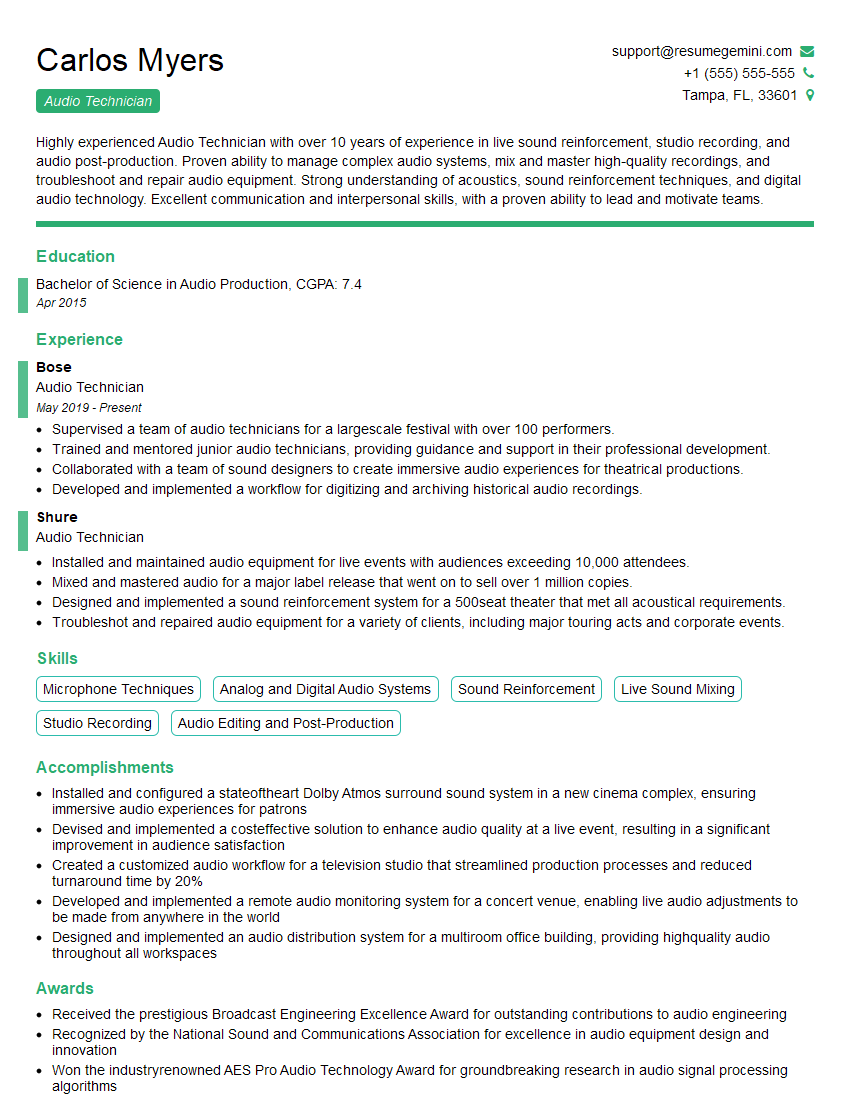
Mastering Concert Touring Sound Engineering opens doors to exciting and rewarding career opportunities, offering travel, creative challenges, and high earning potential. An ATS-friendly resume is crucial for increasing your job prospects. To significantly enhance your resume and increase your chances of landing your dream job, leverage the power of ResumeGemini. ResumeGemini offers a streamlined and user-friendly experience for building professional resumes, and provides examples of resumes tailored specifically for Concert Touring Sound Engineering roles. Invest the time to craft a compelling resume—it’s your first impression!
Explore more articles
Users Rating of Our Blogs
Share Your Experience
We value your feedback! Please rate our content and share your thoughts (optional).
What Readers Say About Our Blog
Amazing blog
Interesting Article, I liked the depth of knowledge you’ve shared.
Helpful, thanks for sharing.