Feeling uncertain about what to expect in your upcoming interview? We’ve got you covered! This blog highlights the most important Experience in working with Tascam DA-88 and other multitrack recorders interview questions and provides actionable advice to help you stand out as the ideal candidate. Let’s pave the way for your success.
Questions Asked in Experience in working with Tascam DA-88 and other multitrack recorders Interview
Q 1. Describe your experience with the Tascam DA-88’s transport controls.
The Tascam DA-88’s transport controls, while seemingly simple, are incredibly precise and crucial for successful recording. The large, robust buttons for Play, Stop, Record, Rewind, and Fast Forward provided tactile feedback, essential for the sometimes frantic pace of a recording session. The shuttle jog wheel allowed for precise positioning within the recording, invaluable for editing and punch-ins. I particularly appreciated the feel of the buttons – they gave you confidence in their responsiveness, a crucial aspect when working under pressure. The display clearly showed the current time, position, and status of the machine, eliminating guesswork. I remember countless sessions where the smooth, reliable operation of these controls made all the difference.
For example, during a live recording of a string quartet, precise control over the shuttle was vital for finding the exact moment to execute a punch-in. The responsiveness of the transport controls allowed me to seamlessly integrate the correction without any audible glitches. The solid mechanical design meant that the controls held up remarkably well, even after years of daily use in various recording environments.
Q 2. Explain the process of setting up a multitrack recording session on a Tascam DA-88.
Setting up a multitrack recording session on a Tascam DA-88 involved a systematic approach to ensure a smooth workflow. First, I’d ensure the machine was properly powered up and the DAT tapes were correctly inserted and formatted (if necessary). Then, I’d carefully configure the input levels for each track, using the VU meters as a guide to prevent clipping. This involved connecting the various microphones and instruments to the respective inputs, considering impedance matching and signal routing. The DA-88’s flexible routing allowed for great creativity in signal flow. I would often employ outboard gear like compressors and equalizers, which required careful patching to and from the DA-88’s inputs and outputs.
Next, I’d create a detailed track sheet outlining which instrument or microphone was assigned to each track. This was critical for organization and efficiency, especially for larger projects. Once all the levels were set and the signal routing was confirmed, I’d do a quick soundcheck, verifying the levels and confirming that everything was recorded correctly to the machine. Finally, before hitting record, I would always ensure I had enough tape for the entire session! I’d often add extra time to account for mistakes or unexpected developments. This preparation was key to avoiding potential issues during the actual recording process.
Q 3. How do you manage track levels and prevent clipping on the DA-88?
Managing track levels and preventing clipping on the DA-88 was a constant balancing act. I relied heavily on the VU meters, aiming for a peak level around 0 VU, while keeping an eye on the LEDs indicating potential clipping. The key was to anticipate peaks and adjust the input gain accordingly. This often involved a combination of setting the input gain on the recorder and using preamps and compressors on individual instruments or microphones.
For example, when recording vocals, I might start with a lower input gain on the microphone preamp, gradually increasing it during the performance to capture dynamic range, always carefully watching the VU meters. If a particular passage sounded like it might clip, I would use a compressor to smooth out the dynamics, preventing the signal from exceeding the 0 VU mark. The use of headroom was also a very important aspect. Leaving ample headroom before the 0 VU mark is key to prevent distortion and maintain good sound quality during mixing.
Q 4. What are the different types of timecode used with the Tascam DA-88 and how do they work?
The Tascam DA-88 supported both LTC (Linear Timecode) and MTC (MIDI Timecode). LTC is an analog timecode signal, typically recorded on a dedicated track, providing a continuous time reference. MTC, on the other hand, is a digital signal transmitted via MIDI. LTC was often preferred for its robustness against signal degradation, particularly when synchronizing with video cameras during film scoring, or even working with other DAT machines. MTC, however, provided a flexible option for synchronization with MIDI devices and digital audio workstations (DAWs).
I remember one project where we were synchronizing the DA-88 with a video camera for a music video. We used LTC to ensure perfect synchronization of the audio with the video footage. The accuracy of LTC was paramount for seamless editing. We dedicated a separate track on the DA-88 to record the LTC, providing an accurate time reference for both our audio and our video team.
Q 5. How do you sync a Tascam DA-88 with other recording devices?
Synchronizing a Tascam DA-88 with other recording devices typically involved using either LTC or MTC. For devices that supported LTC, the process was straightforward: a dedicated LTC generator would send the timecode signal to both the DA-88 and the other device. This ensured that both machines recorded concurrently with a common time reference. For synchronizing with devices that used MTC, the process involved configuring the MIDI connections and ensuring that both devices were correctly set to receive and transmit the timecode. The process was usually much simpler than the analog counterpart but still required thorough preparation and attention to detail.
In practice, I’ve used various methods. For example, to sync a DA-88 with a digital mixer, we’d use an external timecode generator, which would send LTC to both the mixer and DA-88. This method provided very reliable and precise synchronization, which was crucial in post-production for maintaining proper timing between multiple sources.
Q 6. Explain your experience with different types of analog audio formats, e.g. DAT.
My experience with analog audio formats, particularly DAT (Digital Audio Tape), was extensive. DAT offered a significant improvement over analog tape formats, providing higher fidelity and greater dynamic range. However, DAT also introduced its own challenges. The tape itself was sensitive to temperature and humidity, and the format was highly susceptible to dropouts and errors if the machine wasn’t properly maintained. Proper tape handling was vital. I often used special tape cleaners and ensured I always handled the tapes carefully, avoiding excessive winding or rewinding to prevent mechanical stress on the tape media.
Working with DAT involved a careful consideration of tape formulation. Different tapes had different performance characteristics. Knowing which tape best suited a particular project was crucial to achieving optimal audio quality and longevity. Despite the technical challenges DAT presented, it was a superior format compared to analog magnetic tape, offering superior storage capacity and signal clarity.
Q 7. Describe your troubleshooting experience with the Tascam DA-88.
Troubleshooting the Tascam DA-88 often involved systematic investigation of various aspects of the system. Common issues included head alignment issues, resulting in poor audio quality or dropouts. I’d often check head alignment using test tones and specialized equipment, ensuring optimal signal transfer. Other problems included issues with the transport mechanism, often manifesting as erratic playback or recording behavior. These issues could sometimes be resolved by simple maintenance, like cleaning the heads or lubricating the moving parts. Other times the problems were related to tape quality or improper handling. The internal electronics also had their quirks; identifying component failures often required the use of specialist tools and techniques.
One memorable instance involved a strange intermittent dropout problem that plagued a vital session. After systematically checking all inputs and outputs, tape quality and transport, I eventually discovered a loose internal connection. After resoldering the connection, the problem was immediately resolved, emphasizing the importance of understanding how the machine worked at a lower level to find these kinds of obscure issues.
Q 8. How do you perform a proper tape head cleaning and maintenance on a Tascam DA-88?
Proper tape head cleaning is crucial for maintaining the audio quality and longevity of your Tascam DA-88. Think of the tape heads as the ‘eyes’ of your recorder – they need to be pristine to capture a clean signal. Neglecting this can lead to hiss, dropouts, and even damage to your tapes.
Step-by-step cleaning process:
- Power Down: Always turn off the DA-88 before performing any maintenance.
- Head Cleaning Solution: Use a high-quality isopropyl alcohol-based head cleaning solution specifically designed for magnetic tape heads. Avoid harsh chemicals.
- Cleaning Sticks/Swabs: Use specialized cleaning sticks or swabs, never cotton swabs. These are designed to avoid scratching the delicate heads.
- Cleaning Process: Gently and slowly swipe the heads several times from left to right and back again, using a fresh swab for each pass. Be sure to clean both the record and playback heads. Don’t apply excessive pressure.
- Dry Swab: After cleaning with the alcohol solution, use a dry cleaning swab to remove any remaining residue.
- Frequency: Clean the heads before each important recording session and regularly in between, depending on your usage. This prevents build-up of oxide from the tapes.
Beyond Head Cleaning: Regular maintenance also includes checking the pinch roller for wear and cleaning it with a suitable solution (check your manual for specifics). The capstan should also be kept clean to maintain proper tape transport.
Q 9. What is the difference between pre- and post-fader sends on a multitrack recorder?
Pre- and post-fader sends on a multitrack recorder determine when a signal is sent to an external device, like an effects processor or a monitor mix. Imagine you’re a sound engineer controlling a band’s instruments. Each instrument has its own level (fader).
- Pre-fader send: The signal is sent before the fader controls the volume. So even if you reduce an instrument’s level on the main mix, the signal sent to the effect remains unchanged. Useful for effects like reverb or delay, where you want consistent effect levels regardless of the instrument’s main mix level.
- Post-fader send: The signal is sent after the fader controls the volume. If you lower the instrument’s fader, the signal sent to the effect also reduces proportionally. Helpful for aux sends that directly influence the monitoring mix for performers.
Example: If you have a vocalist with a reverb effect on a pre-fader send, adjusting the vocalist’s fader on the main mix won’t affect the reverb level. But if it’s on a post-fader send, lowering the vocal fader will also lower the reverb level in the final mix.
Q 10. Explain your understanding of different microphone techniques for recording vocals and instruments.
Microphone techniques are vital for capturing the best possible sound. It’s like choosing the right lens for a photograph – different techniques are needed for different sounds and situations.
Vocal Recording:
- Distance: Closer miking (e.g., 6-12 inches) provides a more intimate and present sound, while further miking (e.g., 18-24 inches) creates a more natural and spacious sound, often reducing plosives (hard ‘p’ and ‘b’ sounds).
- Off-Axis: Experimenting with off-axis positioning can subtly alter the tone and character of the vocal recording, reducing harshness or creating a different tonal balance.
- Microphone Choice: Condenser mics are generally preferred for vocals due to their sensitivity and clarity, while dynamic mics are more durable and better suited for louder sources.
Instrument Recording:
- Acoustic Guitar: Common techniques involve using a condenser mic pointed at the soundhole for a warm sound or using multiple mics for a stereo image.
- Electric Guitar: Amplification techniques can vary wildly from close-miking the speaker cone to using a room microphone for a spacious sound.
- Drums: Often requires a multi-microphone setup with dedicated mics for each drum component, with different techniques used for snare, kick, toms, and cymbals.
Experimentation is key. The best technique depends entirely on the source, the desired sound, and the acoustics of the recording environment. Listening critically and experimenting with different approaches is the key to success.
Q 11. How do you identify and correct common audio problems such as noise, hum, and distortion?
Identifying and correcting audio problems is a crucial part of recording. Think of it as being a detective, tracking down the source of the issue.
Noise:
- Source Identification: Noise can come from many sources – faulty cables, dirty preamps, interference from other equipment. Check all connections thoroughly.
- Solutions: Use noise gates to eliminate background sounds. Consider using balanced cables to reduce interference. If the noise is inherent in the equipment, it may need repair or replacement.
Hum:
- Source Identification: Ground loops are a common cause of hum. These occur when there’s a difference in ground potential between two pieces of equipment.
- Solutions: Use a ground lift adapter on one piece of equipment to break the loop. Ensure all equipment is properly grounded. Check for faulty wiring.
Distortion:
- Source Identification: Distortion is caused by signal overload – the signal is too strong for the equipment to handle properly.
- Solutions: Reduce the gain on your preamp. Make sure your input levels are appropriately set. Check for clipping indicators on your recorder.
Systematic Approach: Work through each potential source systematically – this approach will allow you to quickly identify the problem and implement a solution.
Q 12. What is your preferred method for backing up and archiving multitrack recordings?
Backing up and archiving multitrack recordings is essential. Digital degradation, hard drive failure, and even accidental deletion can lead to irretrievable loss of work, so a robust backup strategy is critical. For the Tascam DA-88, the process is somewhat different from modern DAWs.
My Preferred Method:
- DA-88 to Digital: The first step is to transfer your DA-88 tapes to a digital format. I’d use a high-quality AD converter for accurate conversion. Then, you have a master digital copy.
- Multiple Copies: Create multiple digital copies of your project – not just one. At least two physical storage copies (e.g., hard drives or SSDs). Ideally, use a cloud-based backup solution as well for added redundancy.
- Metadata: Always carefully document your recordings. Include project details, date, client, and other relevant information in well-organized folder structures.
- Storage Media: Use archival-grade media for your backups. This increases the longevity and reduces the risk of data loss over time.
- File Formats: Use lossless audio formats like WAV or AIFF for your backups to preserve the highest fidelity.
Regular backups are key: I routinely back up my projects after each session. This minimizes potential data loss from accidents or malfunctions.
Q 13. What are the limitations of the Tascam DA-88 compared to modern digital audio workstations?
The Tascam DA-88, while a classic, has limitations compared to modern DAWs (Digital Audio Workstations).
DA-88 Limitations:
- Limited Tracks: Typically only offers 8 tracks, a constraint when compared to the hundreds or thousands available in modern DAWs.
- No Editing Capabilities: Editing is very limited and mainly involves punch-in/punch-out. Modern DAWs offer extensive editing capabilities like non-destructive editing, time stretching, and pitch correction.
- No Plug-ins: The DA-88 doesn’t have the ability to use virtual instruments or effects plugins, greatly limiting processing and creative options.
- Tape Degradation: Tape-based systems are prone to physical wear and degradation. Digital systems, however, offer more stability and longevity.
- Workflow: Workflow can be less efficient than a DAW’s drag-and-drop, non-linear nature.
DAWs Advantages: Modern DAWs offer a much more flexible, efficient, and powerful workflow, supporting far more tracks, advanced editing features, and a wide array of virtual instruments and effects.
Q 14. Describe your experience with using various types of microphones, preamps, and equalizers.
My experience spans a wide range of microphones, preamps, and equalizers.
Microphones:
- Neumann U 87: A classic large-diaphragm condenser mic. Exceptional for vocals and other instruments requiring detail and clarity.
- Shure SM57: A workhorse dynamic mic, known for its durability and ability to handle high sound pressure levels. Ideal for snare drums, guitar amps, and vocals in live situations.
- Royer R-121: A ribbon microphone known for its smooth and warm sound, very popular for capturing instruments with a rich tonal character, such as guitars and horns.
Preamps:
- Neve 1073: Renowned for its warm and rich sound, a very popular choice, often sought after for its rich harmonic content.
- API 512c: Known for its clean and transparent sound, great for capturing a source accurately without coloring it too much.
Equalizers:
- Pultec EQP-1A: A classic passive equalizer prized for its warmth and ability to subtly shape the tone. Very musically enhancing without being drastic.
- API 550A: A versatile and transparent equalizer, capable of precise adjustments.
The choice of microphone, preamp, and equalizer is highly context-dependent and depends heavily on the source being recorded, and the desired tonal character.
Q 15. How do you ensure the proper gain staging during recording on a multitrack recorder?
Gain staging is crucial for achieving a clean, dynamic, and distortion-free recording. It’s all about setting the input levels of your signals so that they’re appropriately loud, but not so loud as to clip (distort) the signal. On a Tascam DA-88, or any multitrack recorder, you want to aim for a healthy signal level, leaving plenty of headroom. Imagine a car engine – you don’t want to constantly redline it; you want to operate in the optimal range for performance and longevity.
How to do it:
- Start with a low input level: Begin with the input gain on your recorder relatively low.
- Send a test signal: Play a section of your source material (instrument or microphone) with typical dynamics.
- Monitor the meters: Carefully watch your recorder’s meters. You’re aiming for peaks to hit around -18dBFS (for digital) or just below 0VU (for analog sections of hybrid recorders like the DA-88), leaving headroom for transients and avoiding clipping.
- Adjust gain: Gradually increase the gain until you reach this ideal level.
- Listen critically: Pay close attention for any distortion or unwanted noise. If you hear clipping, reduce the gain immediately.
- Repeat for each track: Each input source will likely require different gain settings.
For example, a quiet acoustic guitar will need a higher gain setting than a loud electric bass.
Career Expert Tips:
- Ace those interviews! Prepare effectively by reviewing the Top 50 Most Common Interview Questions on ResumeGemini.
- Navigate your job search with confidence! Explore a wide range of Career Tips on ResumeGemini. Learn about common challenges and recommendations to overcome them.
- Craft the perfect resume! Master the Art of Resume Writing with ResumeGemini’s guide. Showcase your unique qualifications and achievements effectively.
- Don’t miss out on holiday savings! Build your dream resume with ResumeGemini’s ATS optimized templates.
Q 16. Explain your understanding of signal flow in a professional recording studio.
Signal flow in a professional studio is the path an audio signal takes from its source to the final recording. It’s a carefully managed process that involves various pieces of equipment and signal processing. Think of it as a river flowing from its source to the ocean, with various dams, channels, and filters influencing its course.
Typical Signal Flow (simplified):
- Source: Instrument (e.g., guitar, vocals), microphone.
- Preamplification (if needed): Microphones often require preamps to boost their weak signal.
- Signal Processing (optional): This could include EQ, compression, gates, reverb, delay, etc. These are applied to shape and enhance the sound.
- Analog-to-Digital Conversion (ADC): If recording to a digital recorder (like the DA-88), an audio interface converts the analog signal to digital data.
- Multitrack Recorder (DA-88, etc.): The digital signal is recorded onto individual tracks.
- Mixing Console (or DAW): The individual tracks are mixed together.
- Digital-to-Analog Conversion (DAC): For monitoring or final output to a physical medium, this reverses the ADC process.
- Output: Speakers, headphones, master recorder.
Understanding the signal flow is critical for troubleshooting and making informed decisions about signal processing. A poorly routed signal can lead to unwanted noise, phase issues, or a weak final mix.
Q 17. How do you troubleshoot issues with timecode synchronization in a multitrack recording environment?
Timecode synchronization ensures that all your recording devices and equipment are working in perfect unison, aligning audio and video recordings. On a DA-88, timecode is usually used to jam-sync with external video cameras, other multitrack devices, or to maintain a consistent timestamp across a session. Troubleshooting timecode issues can be tricky, but a systematic approach is key.
Troubleshooting Steps:
- Check cables: Ensure all timecode cables are securely connected, and the correct type of cable (typically BNC) is used.
- Verify timecode source: Is your timecode generator functioning correctly? Test it by connecting it to a known working device.
- Confirm timecode settings: Check the frame rate and timecode format settings on all devices to ensure they match (e.g., 24fps, 25fps, drop frame, non-drop frame).
- Examine timecode signal strength: Use a timecode reader or analyzer to evaluate the quality of the timecode signal.
- Isolate the problem: If you have multiple devices synced via timecode, try disconnecting them one by one to isolate the problematic device.
- Reset devices: Try power cycling your devices (turning them off and on). In rare cases a factory reset (if possible) might resolve the problem.
- Consult the manuals: The manuals for your DA-88 and other connected devices can be very helpful in providing specific troubleshooting guidance.
If a problem persists, consider having a professional service technician examine your equipment.
Q 18. What are some best practices for managing audio files and projects?
Managing audio files and projects efficiently is crucial for preventing chaos and ensuring easy retrieval of your work. Think of a librarian maintaining a well-organized library—that’s the same kind of careful methodology that’s needed.
Best Practices:
- Consistent File Naming: Use a clear and consistent naming convention for your files (e.g., ‘Project Name_Track Number_Take Number.wav’).
- Organized Folder Structure: Create a logical folder structure for your projects (e.g., Project Folder/Audio Files/Session Data/etc.).
- Regular Backups: Back up your projects regularly to multiple locations (cloud storage, external hard drives). Consider making copies to different mediums (such as cloud, and an external drive).
- Metadata Tagging: Utilize metadata (artist, album, genre, date recorded) to make file searching easier.
- Version Control: Keep track of different versions of your files (e.g., ‘v1,’ ‘v2’) to preserve earlier iterations.
- Session Data: Document important session details (gain settings, EQ curves, etc.) in a text file or session notes.
- Utilize a Digital Audio Workstation (DAW): DAWs such as Pro Tools, Logic Pro, Cubase, offer project management features for organization and version control.
By implementing these practices, you’ll ensure easier project retrieval, streamlined workflows, and safeguard your valuable work.
Q 19. How familiar are you with different types of analog and digital audio interfaces?
My experience with audio interfaces spans both analog and digital domains. Analog interfaces are largely simpler devices, essentially acting as a connection between analog equipment and a computer or recorder. Digital interfaces provide more advanced features like MIDI connectivity, routing flexibility, and improved signal quality.
Examples:
- Analog Interfaces: Older, simpler interfaces provided basic signal conversion. Think of the iconic 8-channel API lunchbox interfaces. They simply connected and passed signal on.
- Digital Interfaces: Modern interfaces like those from Universal Audio, Focusrite, RME offer a broader range of functionalities – many providing features such as high-resolution AD/DA conversion (with sampling rates up to 192kHz), and low latency (minimal delay), along with digital signal processing capabilities. Some include integrated preamplification.
The choice of interface depends on the specific recording project’s demands and budget.
Q 20. How would you handle a situation where a track is inadvertently erased on a DA-88?
Accidentally erasing a track on a DA-88 is a nightmare scenario, as the machine lacks native undo functionality. Prevention is better than cure, so always back up your work regularly and do not solely rely on any single recording medium.
If an accidental erase occurs:
- Don’t panic: Immediately stop any further recording or operations.
- Check backups: Check any existing backups to see if the data still exists.
- Consult the DA-88 manual: Some advanced recovery techniques, depending on the exact DA-88 model and error conditions, may be described in the device’s manual.
- Professional data recovery: If you don’t have backups, and the manual offers no assistance, data recovery services specializing in magnetic media may be able to recover some or all of the lost data. Success is not guaranteed, and the cost can be substantial.
This emphasizes the critical importance of frequent backups and careful attention to workflow when working with any analog or older digital equipment lacking sophisticated undo/redo capabilities. It’s a harsh lesson, but one worth learning.
Q 21. Explain your experience with different compression techniques and their uses in audio recording.
Compression is a signal processing technique used to reduce the dynamic range (difference between the loudest and quietest parts) of an audio signal. It’s a fundamental tool in both analog and digital recording. It can make quieter parts louder, louder parts quieter, and improve overall clarity and punch.
Different Compression Techniques:
- Ratio: This determines how much compression is applied. A higher ratio (e.g., 4:1) reduces the dynamic range more than a lower ratio (e.g., 2:1).
- Threshold: This determines the level at which compression starts to be applied.
- Attack Time: This controls how quickly the compressor reacts to a signal exceeding the threshold. A fast attack will quickly compress loud transients, whereas a slow attack is less noticeable at the start of a signal.
- Release Time: This controls how quickly the compressor returns to its normal state after the signal falls below the threshold. Too fast a release can cause pumping; too slow can make the signal sound sluggish.
Uses in Audio Recording:
- Vocal Compression: Often used to even out vocal dynamics and make vocals sit better in a mix.
- Drum Compression: Used to glue the drum tracks together and give the drums a more powerful sound.
- Bass Compression: Controls the low-frequency energy and prevents bass from overpowering the mix.
- Master Bus Compression: Used on the final mix bus to control overall dynamics and create a more polished sound.
Choosing the right compression settings depends heavily on the source material and artistic intent. It’s a skill developed over time and through experimentation.
Q 22. What is your understanding of the limitations of dynamic range on the Tascam DA-88?
The Tascam DA-88, while revolutionary for its time, had limitations in its dynamic range compared to modern recorders. Dynamic range refers to the difference between the quietest and loudest sounds a device can record without distortion. The DA-88 typically offered around 80dB of dynamic range. This means that the quietest sounds were only 80 decibels quieter than the loudest sounds it could capture before clipping (distortion). Compared to today’s digital recorders with 120dB or more, this is a significant difference. Think of it like this: a higher dynamic range is like having a wider range of colors in a painting – you can capture more subtle nuances and detail. A lower dynamic range, like the DA-88’s, is like painting with a limited palette; you’ll lose some of the finer details in both the quiet and loud passages of the recording. This was particularly noticeable when recording very quiet acoustic instruments alongside louder ones; the quiet instruments might get lost in the mix or suffer from increased noise.
Q 23. How familiar are you with digital audio editing software?
I’m extremely familiar with digital audio editing software. My experience spans decades and includes proficiency in a wide range of DAWs (Digital Audio Workstations), from industry standards like Pro Tools, Logic Pro X, and Ableton Live, to others such as Cubase and Studio One. I’ve used these programs for everything from basic editing and mixing to complex restoration and mastering tasks. My familiarity extends beyond just the user interface; I understand the underlying signal processing principles and workflow optimizations that are crucial for efficient and high-quality audio production.
Q 24. Describe your experience with different types of audio editing and mixing software.
My experience with audio editing and mixing software is extensive and varied. I’ve used linear editing systems (like those found in older versions of Pro Tools) and non-linear systems (like Logic or Ableton). I’m proficient in tasks such as: editing and trimming audio, applying time stretching and pitch correction, utilizing various effects (EQ, compression, reverb, delay), automating parameters, mixing multiple tracks, and mastering final mixes. For example, I once used Pro Tools’ Elastic Audio to fix timing issues in a live recording of a jazz band where the drummer’s tempo fluctuated slightly throughout the performance. Another time, I used the noise reduction capabilities of iZotope RX to salvage a recording that was plagued with background hum. Each DAW has its strengths and weaknesses, and I adapt my workflow accordingly to optimize the process and achieve the best possible sound quality.
Q 25. Explain your understanding of signal-to-noise ratio and its importance in audio recording.
Signal-to-noise ratio (SNR) is a critical concept in audio recording. It represents the ratio of the desired audio signal’s power to the unwanted noise power. It’s expressed in decibels (dB). A higher SNR indicates a cleaner, less noisy recording. For example, an SNR of 90dB means the signal is 90dB louder than the noise floor. In practice, a high SNR is vital because noise can mask the subtle details of the music, making it sound dull and muddy. It’s especially important in recording quiet instruments like acoustic guitars or classical vocals. A low SNR, on the other hand, results in a recording that is less dynamic and less pleasing to the ear. The limitations in dynamic range of the Tascam DA-88 directly impacted its SNR. To achieve a higher SNR, we often employed techniques such as proper microphone placement, pre-amp selection, and careful monitoring of levels during recording.
Q 26. What is your experience with audio restoration and noise reduction techniques?
My experience with audio restoration and noise reduction is significant. I’ve used various software plugins and techniques to address a wide range of audio problems. These include dealing with clicks, pops, hum, hiss, tape degradation, and even addressing issues related to unwanted background sounds in older recordings. I am proficient in using both spectral editing tools (like those found in iZotope RX) to surgically remove specific frequencies of noise and time-based techniques to identify and correct clicks and pops. For instance, I once successfully restored an old reel-to-reel recording of a rare folk musician’s performance that suffered from significant tape hiss and dropouts. This required a combination of careful spectral editing, noise reduction plugins, and intelligent gain staging to bring the performance back to life. Proper restoration also depends on understanding the limitations of different methods and ensuring that the process doesn’t negatively impact the original audio’s integrity.
Q 27. How would you approach the task of transferring audio from a Tascam DA-88 to a modern DAW?
Transferring audio from a Tascam DA-88 to a modern DAW is a straightforward but crucial process. First, you need an appropriate interface to connect the DA-88’s analog outputs to the DAW’s analog inputs. A high-quality audio interface with good converters is essential to minimize the introduction of additional noise during the transfer. Then, you would select a suitable sample rate and bit depth in your DAW which should ideally match (or be higher than) what was used on the DA-88, typically 44.1kHz and 16-bit. Next, you’d play back each track from the DA-88, recording them individually into separate tracks in the DAW. This is crucial for maintaining control over each audio source during the subsequent editing and mixing phases. Accurate level monitoring is critical to avoid clipping during transfer. Once all tracks are transferred, the DAW provides a flexible environment for editing, mixing, and mastering the audio to modern standards.
Q 28. What are some common issues you have encountered while working with multitrack recorders?
Throughout my experience with multitrack recorders, several common issues have surfaced. One common issue is head alignment in older recorders like the DA-88. Incorrect alignment could lead to timing problems and signal dropout. Another issue involves the fragility of the physical media. For example, the DA-88 uses DAT tapes which can be susceptible to damage, leading to data loss. Also, it’s essential to be mindful of tape speed and other settings for correct playback. In the digital realm, issues with data corruption or file format compatibility can present challenges when transferring files to modern systems. Addressing these issues requires meticulous handling of the hardware, proper maintenance, and careful adherence to established workflows. This experience has taught me the importance of backup procedures and regular testing to prevent data loss and ensure the integrity of recordings.
Key Topics to Learn for Experience in working with Tascam DA-88 and other multitrack recorders Interview
- DA-88 Specifics: Understanding the DA-88’s workflow, including track configuration, input/output routing, and its limitations compared to modern recorders.
- Multitrack Recording Principles: Mastering concepts like track layering, gain staging, microphone placement, and signal flow in a multitrack environment.
- Digital Audio Fundamentals: A solid grasp of sampling rates, bit depth, and their impact on audio quality and file sizes. Understanding different audio file formats (WAV, AIFF).
- Practical Applications: Describe scenarios where you’ve used multitrack recorders for various projects, detailing your approach to pre-production, recording, mixing, and mastering.
- Troubleshooting: Discuss common issues encountered during recording (e.g., noise, clipping, sync problems) and your methods for resolving them.
- Other Multitrack Recorders: Highlight your experience with other models (e.g., Fostex, Alesis), comparing and contrasting their functionalities and workflows with the Tascam DA-88.
- DAW Integration: Explain how you’ve integrated recordings from multitrack recorders into Digital Audio Workstations (DAWs) for further editing and mixing.
- Audio Post-Production: Discuss your experience with basic audio editing techniques such as noise reduction, compression, equalization, and reverb as applied to multitrack recordings.
Next Steps
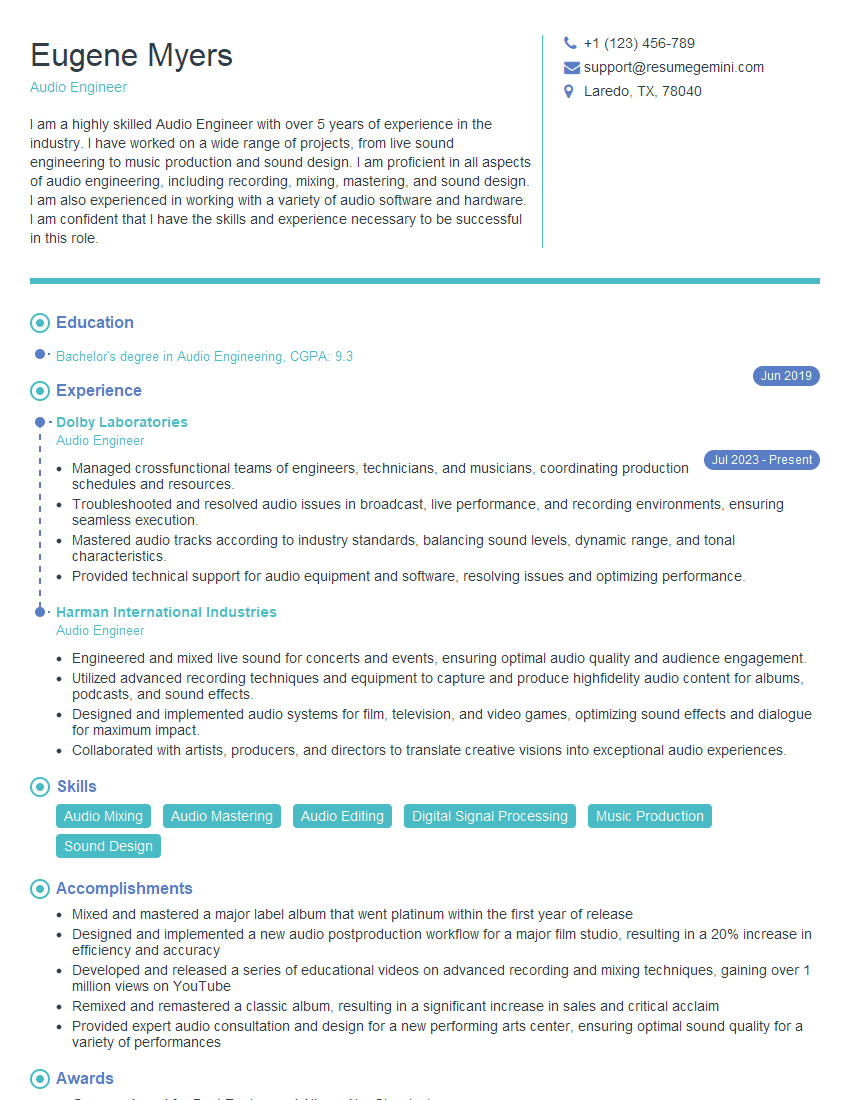
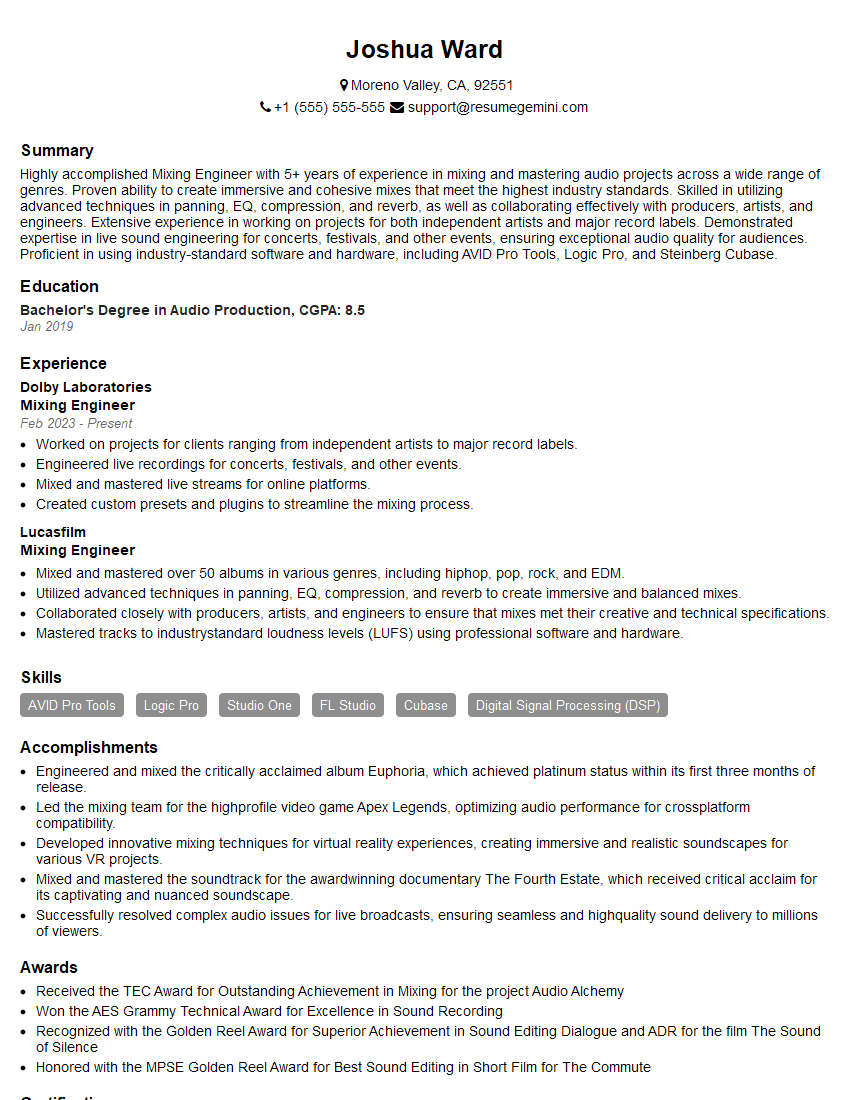
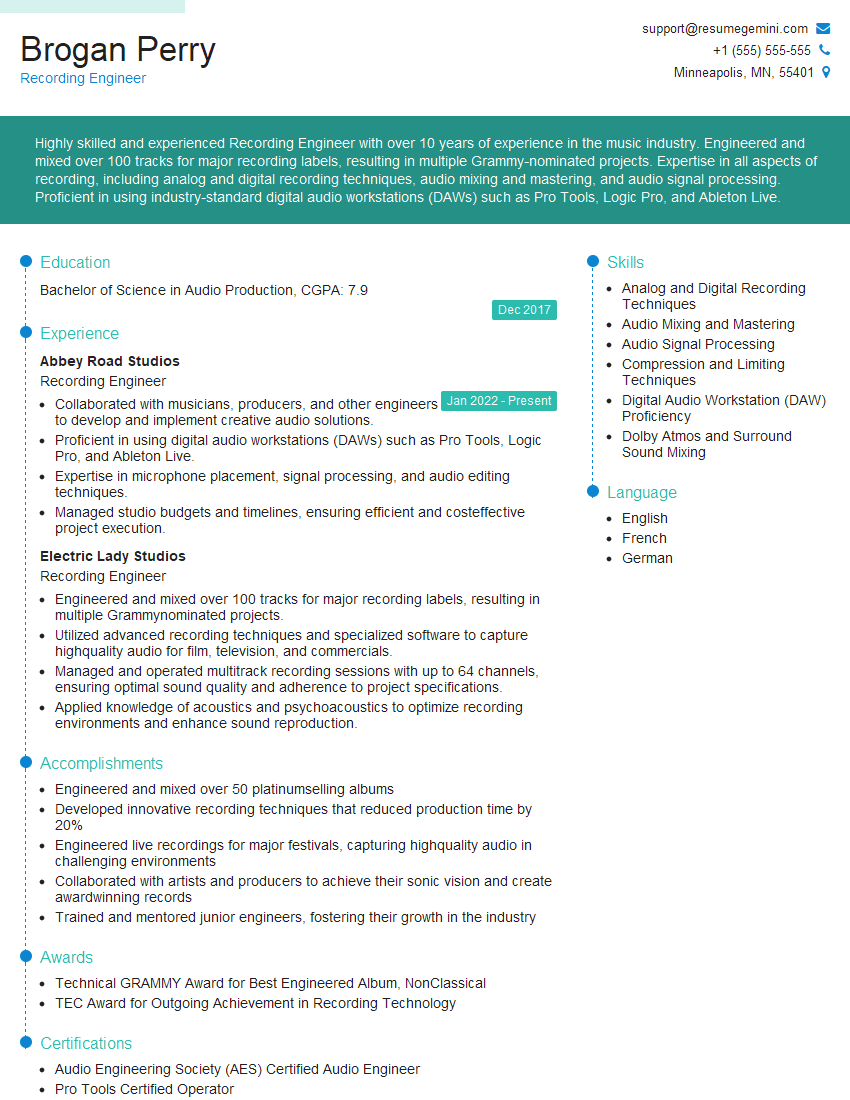
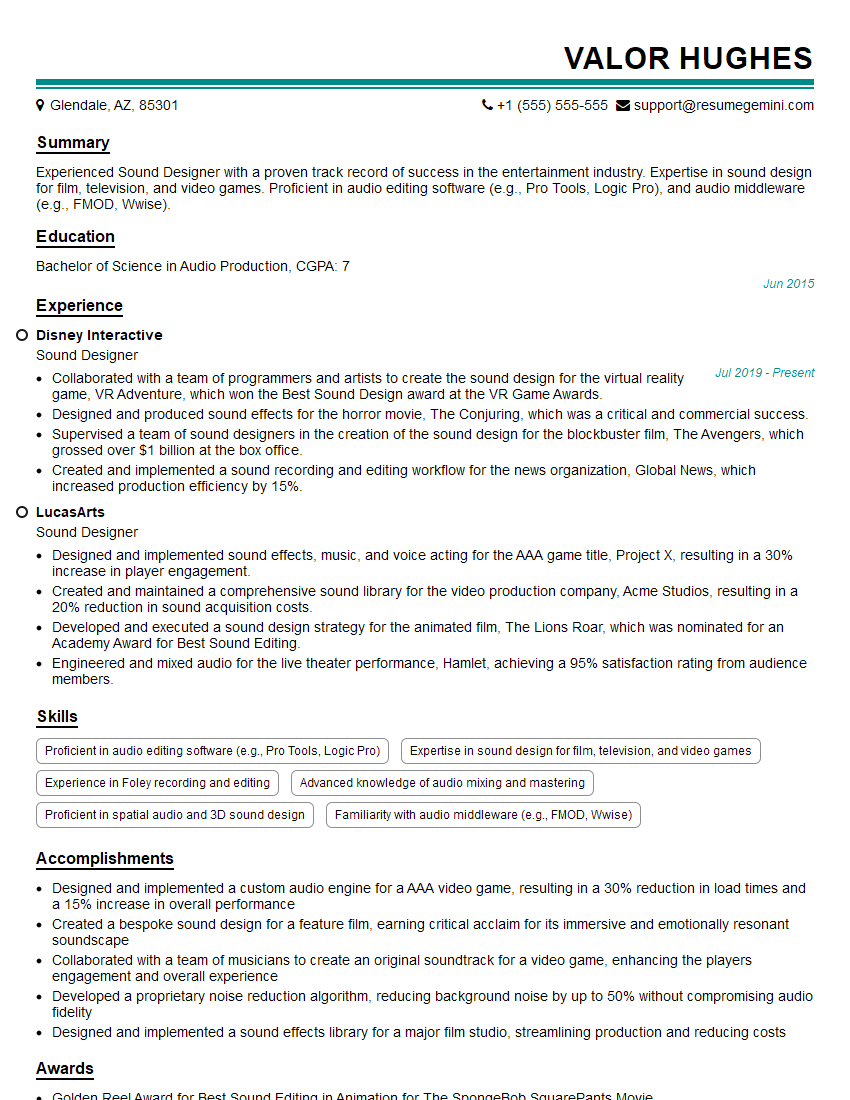
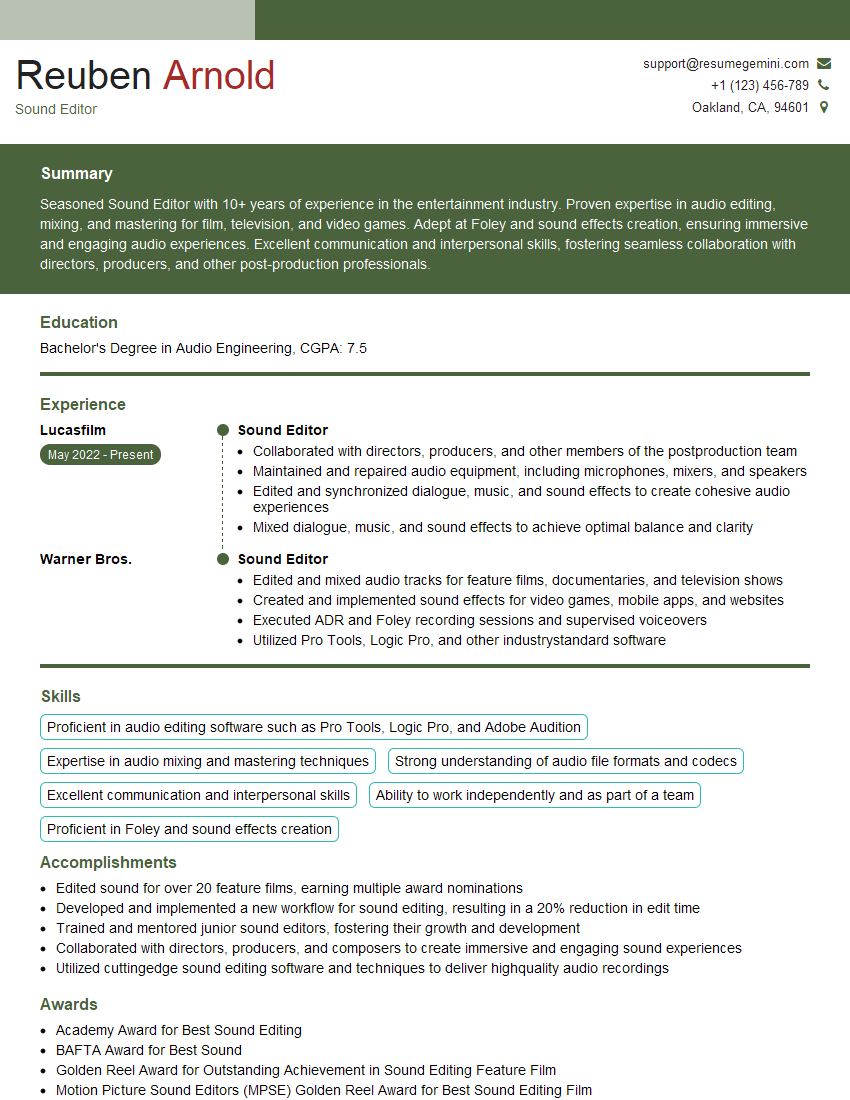
Mastering the intricacies of working with the Tascam DA-88 and other multitrack recorders is crucial for advancing your career in audio engineering, music production, or related fields. Demonstrating this expertise effectively requires a strong resume that highlights your skills and accomplishments. Creating an ATS-friendly resume is essential for getting your application noticed by recruiters. To help you build a compelling and effective resume, we recommend using ResumeGemini, a trusted resource for crafting professional resumes. Examples of resumes tailored to highlight experience with the Tascam DA-88 and other multitrack recorders are available to help guide you.
Explore more articles
Users Rating of Our Blogs
Share Your Experience
We value your feedback! Please rate our content and share your thoughts (optional).
What Readers Say About Our Blog
Amazing blog
Interesting Article, I liked the depth of knowledge you’ve shared.
Helpful, thanks for sharing.