Interviews are opportunities to demonstrate your expertise, and this guide is here to help you shine. Explore the essential Geospatial Software Development interview questions that employers frequently ask, paired with strategies for crafting responses that set you apart from the competition.
Questions Asked in Geospatial Software Development Interview
Q 1. Explain the difference between vector and raster data models.
Vector and raster are two fundamental data models used in Geographic Information Systems (GIS). Think of it like this: raster data is like a photograph – a grid of pixels, each representing a value (e.g., temperature, elevation). Vector data is like a drawing – made up of points, lines, and polygons, each with defined coordinates and attributes.
Raster Data: Represents spatial data as a grid of cells or pixels. Each cell holds a value representing a particular attribute, like elevation or land cover. Common examples include satellite imagery, aerial photographs, and digital elevation models (DEMs). Raster data is great for representing continuous phenomena.
Vector Data: Represents spatial data as points, lines, and polygons. Points represent locations (e.g., a well), lines represent linear features (e.g., a road), and polygons represent areas (e.g., a building). Each feature has attributes associated with it, such as name, ID, or length. Vector data is suitable for discrete features and allows precise representation of boundaries.
The choice between raster and vector depends on the application. If you need precise boundaries, vector is usually better. If you need to analyze continuous surfaces or have a large amount of image data, raster is often the preferred choice. For example, a map showing individual buildings would use vector data, while a land use map derived from satellite imagery would be represented using raster data.
Q 2. Describe different coordinate reference systems (CRS) and their importance.
A Coordinate Reference System (CRS) is a system used to define the location of geographic features on the Earth’s surface. It’s essentially a set of rules that tells us how to translate latitude and longitude coordinates (which are spherical) into a flat, 2D map. Different CRSs exist because the Earth is a sphere, and representing it on a flat surface introduces distortions.
Geographic Coordinate Systems (GCS): Use latitude and longitude to define locations on a sphere, typically using the WGS84 datum (a standard reference ellipsoid that closely approximates the Earth’s shape). These are location-based.
Projected Coordinate Systems (PCS): Transform geographic coordinates into a flat, planar surface using mathematical projections. These projections introduce distortions (area, shape, distance, or direction), and different projections minimize different types of distortion. Common projections include UTM (Universal Transverse Mercator), Albers Equal-Area, and Mercator. These are distance-based.
The importance of CRS lies in the accuracy and consistency of spatial analysis. If your data uses different CRSs, you can’t perform meaningful spatial operations (e.g., overlaying two maps). Always ensure your data uses a consistent CRS that is appropriate for your project area and analysis needs.
Q 3. What are the common file formats used in geospatial data?
Geospatial data comes in a variety of file formats, each with its own strengths and weaknesses. Here are some of the most common:
Shapefile (.shp): A popular vector format storing point, line, and polygon data along with attribute information in related files (.shx, .dbf, .prj). Although widely used, it’s not a single file but a collection.
GeoJSON (.geojson): A text-based vector format that uses JSON to represent geographic features and their attributes. It’s lightweight, easily readable, and widely supported by GIS software and web mapping applications.
GeoPackage (.gpkg): A single-file format supporting both raster and vector data, attribute tables, and metadata. It is becoming increasingly popular due to its efficiency and portability.
TIFF (.tif): A widely used raster format supporting various compression methods and georeferencing information. Common for storing satellite images and aerial photographs.
GeoTIFF (.tif): Extends TIFF to include georeferencing tags, enabling the file to contain information about its spatial location and projection.
KML/KMZ (.kml, .kmz): Keyhole Markup Language, used for displaying geographic data in Google Earth and other applications. KMZ is a compressed version of KML.
Understanding these file formats and their capabilities is crucial for efficient data management and analysis.
Q 4. Explain the concept of geoprocessing and provide examples.
Geoprocessing refers to the manipulation and analysis of geospatial data using various tools and techniques. It’s essentially automating spatial operations using computer algorithms. Think of it as a set of instructions to perform operations on geographic data.
Example 1: Buffering: Creating a zone around a feature (e.g., a road or a point) with a specified distance. This is useful for analyzing proximity or accessibility. For example, creating a buffer zone around a school to identify houses within walking distance.
Example 2: Overlay: Combining multiple layers of spatial data to create a new layer that incorporates information from all input layers. For instance, overlaying a land use layer with a soil type layer to identify areas suitable for specific agricultural practices.
Example 3: Spatial Join: Joining attributes from one layer to another based on spatial relationships (e.g., proximity, intersection). For example, associating census data to polygons representing neighborhoods.
Geoprocessing is fundamental in GIS, enabling automated map creation, spatial analysis, and data management. It accelerates workflows and allows for complex spatial analyses that would be impossible manually.
Q 5. How do you handle spatial data projections and transformations?
Spatial data projections and transformations are crucial for ensuring accurate spatial analysis and visualization. They involve converting data from one coordinate reference system (CRS) to another. This is necessary because different projections minimize different types of distortion, and data from various sources might use different CRSs.
Handling Projections: This typically involves using GIS software or libraries to define the source and target CRSs and then applying a transformation. Most GIS software (like ArcGIS, QGIS) handles this automatically, allowing you to reproject layers on-the-fly. Libraries like GDAL/OGR (in Python) provide functionalities for programmatic transformation.
Example (Python with GDAL):
import gdal
gdal.Warp(...) #Uses various parameters to specify input/output CRS and resampling method.
Choosing the right projection: The selection of the target CRS depends heavily on the intended analysis. For local analysis, a projected CRS minimizing distortion within the study area is appropriate. For global analysis, a geographic CRS like WGS84 might be preferable, though accepting the inherent spherical distortions.
Ignoring projection differences leads to inaccurate measurements, erroneous overlays, and incorrect analyses. Proper projection handling is paramount for reliable geospatial applications.
Q 6. Describe your experience with PostGIS or other spatial databases.
I have extensive experience working with PostGIS, the spatial extension for PostgreSQL. I’ve used it in numerous projects to store, manage, and query geospatial data. I find it especially valuable for its ability to handle large datasets efficiently. I’ve leveraged PostGIS for tasks like:
Storing and managing vector data: Creating and managing spatial tables, storing point, line, and polygon geometries, indexing for efficient spatial queries.
Performing spatial analysis: Utilizing PostGIS functions for operations such as buffering, intersection, overlay, distance calculations, and proximity analysis directly within the database, enabling faster processing of large datasets compared to client-side operations.
Developing geospatial web applications: Integrating PostGIS with web frameworks (like Django or Node.js) to build interactive maps and location-based services. Using PostGIS to handle spatial queries and return relevant data to the application.
PostGIS’s open-source nature, robustness, and SQL integration make it a powerful tool for various geospatial applications. I have experience optimizing spatial queries for improved performance and implementing appropriate indexing strategies to enhance query speeds.
Q 7. What are your preferred programming languages for geospatial development?
My preferred programming languages for geospatial development are Python and JavaScript. Python offers a rich ecosystem of libraries like GDAL/OGR, Shapely, GeoPandas, and Rasterio, providing comprehensive tools for data manipulation, analysis, and visualization. It’s excellent for backend processing and complex spatial analyses.
JavaScript, particularly with libraries like Leaflet and Mapbox GL JS, is ideal for front-end development of interactive web maps and location-based applications. It allows the creation of visually appealing and user-friendly web interfaces for interacting with geospatial data. Node.js expands JavaScript capabilities for server-side processing, complementing the front-end.
I also have experience with other languages like R, which is strong in spatial statistics, but Python and Javascript offer a good balance of power, community support and versatility for many geospatial tasks.
Q 8. Explain your understanding of spatial indexing and its benefits.
Spatial indexing is a crucial technique in geospatial databases that allows for efficient searching and retrieval of spatial data. Imagine trying to find a specific house in a city without a street address or map – it would be incredibly difficult! Spatial indexing provides a similar function for computers, allowing them to quickly locate features based on their location.
Instead of linearly searching through every single data point, spatial indexes organize data spatially, creating structures that dramatically reduce search time. Common spatial indexing methods include R-trees, Quadtrees, and Grid indexes. Each method organizes the data in a hierarchical structure, dividing space into smaller regions to facilitate faster searches.
Benefits:
- Faster Query Performance: Significantly reduces the time taken to find features within a specific area or radius.
- Improved Database Efficiency: Reduces the amount of data that needs to be processed for each query.
- Scalability: Enables the management and efficient querying of massive geospatial datasets, handling millions or even billions of features.
Example: In a system tracking forest fires, a spatial index allows firefighters to rapidly identify all active fires within a specific radius, assisting in resource allocation and emergency response.
Q 9. How do you ensure data quality and accuracy in geospatial projects?
Ensuring data quality and accuracy is paramount in geospatial projects. Inaccurate data can lead to flawed analyses, incorrect decisions, and ultimately, costly mistakes. My approach involves a multi-faceted strategy:
- Source Data Validation: I meticulously evaluate the reliability and accuracy of all source data. This includes assessing the metadata, understanding data collection methodologies, and checking for inconsistencies or errors.
- Data Cleaning and Preprocessing: This crucial step involves identifying and correcting errors, handling missing values, and transforming data into a consistent format. This might involve tasks like removing duplicates, resolving spatial inconsistencies, and standardizing attribute fields.
- Data Transformation and Projection: Ensuring all data uses the correct coordinate reference system (CRS) and is appropriately projected is fundamental to maintain accuracy and enable seamless integration.
- Quality Control Checks: Throughout the process, I employ various checks, such as visual inspection using GIS software, spatial consistency checks, and validation against known ground truth data.
- Metadata Management: Rigorous metadata documentation is essential for transparency and reproducibility, tracking data sources, transformations, and quality control measures.
Real-World Example: During a project mapping agricultural lands, I discovered inconsistencies in the polygon boundaries of some farms. By cross-referencing with high-resolution imagery and field surveys, I was able to correct these inaccuracies, ensuring the resulting land-use maps were reliable and could be used for accurate yield estimations.
Q 10. What are some common challenges in working with large geospatial datasets?
Working with large geospatial datasets presents unique challenges. The sheer volume of data can overwhelm standard processing techniques and storage capabilities. Key challenges include:
- Data Storage and Management: Storing and managing terabytes or even petabytes of spatial data requires specialized databases and infrastructure, often utilizing cloud-based solutions or distributed file systems.
- Processing Time: Many spatial operations, such as overlay analysis or spatial joins, can become computationally intensive with massive datasets, requiring optimization techniques and potentially parallel processing.
- Data Visualization: Displaying and interacting with large datasets efficiently can be a challenge. Techniques such as data aggregation, simplification, and dynamic visualization are essential.
- Data Consistency and Integrity: Maintaining data consistency and integrity across large datasets is crucial and often requires the implementation of rigorous data quality control measures and validation protocols.
- Bandwidth and Network Limitations: Transferring, sharing, and accessing large datasets can be hampered by network bandwidth limitations and require efficient data transfer mechanisms.
Mitigation Strategies: Addressing these challenges involves utilizing parallel processing, employing efficient data structures like spatial indexes, leveraging cloud computing resources, and implementing optimized data processing algorithms.
Q 11. Describe your experience with GIS software (e.g., ArcGIS, QGIS).
I have extensive experience with both ArcGIS and QGIS, utilizing them for a variety of geospatial tasks. ArcGIS, a proprietary software, offers a comprehensive suite of tools and a robust platform for complex geospatial analyses and data management. I’ve used it extensively for tasks like creating and editing geodatabases, performing spatial analyses (e.g., overlay, proximity analysis), and creating maps for diverse applications, from urban planning to environmental monitoring.
QGIS, an open-source alternative, has proven to be a valuable tool for its flexibility, cost-effectiveness, and large community support. I’ve leveraged QGIS for tasks requiring rapid prototyping, geoprocessing scripts, and integration with open-source libraries. A recent project utilized QGIS to process and analyze satellite imagery for deforestation monitoring, benefitting from its extensibility and plugin ecosystem.
My skills encompass both platforms, allowing me to choose the best tool based on project requirements, budget constraints, and the need for specific functionalities.
Q 12. How do you approach the design and development of a geospatial application?
Designing and developing a geospatial application requires a structured approach. My process typically follows these steps:
- Requirements Gathering: Clearly define the application’s purpose, target users, required functionalities, and data sources.
- Database Design: Choose an appropriate geospatial database (e.g., PostGIS, Oracle Spatial) and design the schema to efficiently store and manage the spatial data.
- Application Architecture: Select a suitable technology stack (e.g., Python with libraries like GeoPandas, JavaScript libraries like Leaflet or OpenLayers) to build the application’s front-end and back-end components.
- User Interface (UI) Design: Create an intuitive and user-friendly interface for data visualization, interaction, and analysis.
- Development and Testing: Implement the application features, thoroughly test them, and address any bugs or issues.
- Deployment and Maintenance: Deploy the application to a suitable environment and implement strategies for ongoing maintenance and updates.
Example: In a recent project, we developed a web application for visualizing real-time traffic data using Leaflet for the map display, Python with Flask for the backend, and PostGIS for storing the spatial data. This involved careful consideration of data streaming, user authentication, and performance optimization.
Q 13. Explain your knowledge of spatial analysis techniques.
Spatial analysis involves applying statistical and analytical techniques to geospatial data to extract meaningful insights. It goes beyond simply visualizing data; it involves understanding spatial relationships, patterns, and processes. Think of it as asking ‘what’ and ‘why’ questions about the location and distribution of features.
This includes various techniques such as proximity analysis (determining distances between features), overlay analysis (combining multiple layers of spatial data), interpolation (estimating values at unsampled locations), spatial autocorrelation (measuring the degree of similarity between nearby locations), and network analysis (analyzing movement and connectivity across a network). A key aspect is understanding the spatial context of the data, and choosing appropriate techniques based on the research question.
Q 14. What are some common spatial analysis methods you’ve used?
I have extensive experience applying a range of spatial analysis methods in various projects. Some common ones include:
- Overlay Analysis: Frequently used to determine areas of overlap between different layers, such as identifying areas where land use conflicts with environmentally sensitive zones.
- Proximity Analysis: Used to determine distances between points, lines, or polygons; for example, finding the closest hospitals to residential areas.
- Interpolation: Estimating rainfall amounts at unsampled locations based on observations from weather stations using methods such as kriging or inverse distance weighting.
- Buffering: Creating zones around features; for example, creating a 500-meter buffer around rivers to delineate a flood-prone area.
- Spatial Autocorrelation: Analyzing spatial patterns to determine if nearby locations show similar characteristics; for example, assessing the spatial clustering of disease occurrences.
Example: In a study of urban sprawl, I used overlay analysis to combine land-use data with road network data to analyze the relationship between urban development patterns and transportation infrastructure.
Q 15. Describe your experience with remote sensing data processing.
Remote sensing data processing involves extracting meaningful information from imagery captured by satellites or aircraft. This involves a multi-stage process, from pre-processing to analysis and interpretation. My experience encompasses working with various sensor data types, including Landsat, Sentinel, and aerial photography.
Pre-processing steps I routinely handle include atmospheric correction (removing atmospheric distortions), geometric correction (aligning images to a geographic coordinate system), and orthorectification (removing geometric distortions caused by terrain and sensor perspective). For example, I’ve used ENVI and Erdas Imagine to perform atmospheric corrections on Landsat 8 imagery to accurately assess vegetation health in a large agricultural region.
Post-processing involves tasks like image classification (categorizing pixels into land cover types like forests, urban areas, and water bodies) and change detection (identifying differences between images acquired at different times). I’ve used machine learning techniques like Support Vector Machines (SVMs) and Random Forests in QGIS to classify land cover from satellite imagery, achieving over 90% accuracy in a recent project. I’m also proficient in using spectral indices, like NDVI (Normalized Difference Vegetation Index), to quantify vegetation health.
Career Expert Tips:
- Ace those interviews! Prepare effectively by reviewing the Top 50 Most Common Interview Questions on ResumeGemini.
- Navigate your job search with confidence! Explore a wide range of Career Tips on ResumeGemini. Learn about common challenges and recommendations to overcome them.
- Craft the perfect resume! Master the Art of Resume Writing with ResumeGemini’s guide. Showcase your unique qualifications and achievements effectively.
- Don’t miss out on holiday savings! Build your dream resume with ResumeGemini’s ATS optimized templates.
Q 16. How familiar are you with different map projections?
Map projections are essential for representing the three-dimensional Earth on a two-dimensional map. Understanding their properties is crucial for accurate spatial analysis. My familiarity extends to various projections, including projected coordinate systems (like UTM and State Plane) and geographic coordinate systems (like latitude and longitude).
I understand the implications of different projections on distance, area, shape, and direction. For instance, the Mercator projection accurately preserves shape and direction but distorts area significantly at higher latitudes. Conversely, equal-area projections, like Albers Equal-Area Conic, accurately represent area but distort shape. Choosing the appropriate projection depends heavily on the specific application. A project requiring accurate area calculations for land surveying would benefit from an equal-area projection, while a navigation application might prefer a conformal projection like Mercator. I often use tools like GDAL and PROJ to manage and transform data between different projections.
Q 17. What is your experience with geospatial APIs (e.g., Google Maps API)?
I have extensive experience using various geospatial APIs, most notably the Google Maps Platform. My work with the Google Maps API encompasses leveraging its functionalities for map visualization, geocoding (converting addresses to coordinates), reverse geocoding (converting coordinates to addresses), and route optimization. I have developed web applications that integrate Google Maps for location-based services, displaying custom map layers alongside Google’s base maps.
For example, in a recent project, I used the Google Maps Directions API to calculate optimal routes for delivery vehicles, considering real-time traffic conditions. This involved handling API requests, processing JSON responses, and integrating the results into a user-friendly interface. Beyond Google Maps, I’m also familiar with other APIs such as Mapbox, and understand the principles of interacting with RESTful APIs to retrieve and manipulate geospatial data.
Q 18. How do you handle spatial data visualization and cartography?
Spatial data visualization and cartography are integral to effectively communicating geospatial information. My approach involves selecting appropriate map types, symbolization, and labeling techniques to create clear and informative maps.
I am proficient in using GIS software such as ArcGIS Pro and QGIS to create various map products, including choropleth maps (representing data using color variations), dot density maps (showing density using dots), and isopleth maps (representing continuous data using lines of equal value). I understand the importance of map design principles, such as visual hierarchy, color palettes, and typography, to ensure effective communication. For example, in a project analyzing population density, I used a graduated color scheme in QGIS to effectively communicate variations in population across different regions, ensuring that the map was both visually appealing and easy to interpret.
I also have experience creating interactive maps using JavaScript libraries such as Leaflet and OpenLayers, enabling dynamic exploration and data analysis. This allows users to zoom, pan, and interact with the map data, creating a more engaging experience.
Q 19. Explain your understanding of spatial statistics.
Spatial statistics involves the application of statistical methods to analyze spatial data. My understanding encompasses various techniques, including spatial autocorrelation, spatial regression, and geostatistics.
Spatial autocorrelation measures the degree to which nearby locations exhibit similar values. This is crucial for understanding spatial patterns and dependencies. I frequently use Moran’s I index to assess spatial autocorrelation. For example, in a study of disease outbreaks, I used Moran’s I to determine if the spread of the disease was clustered or randomly distributed.
Spatial regression accounts for spatial autocorrelation in data when performing statistical modeling. Ignoring spatial autocorrelation can lead to biased results. I’ve used Geographically Weighted Regression (GWR) to model the relationship between crime rates and socioeconomic factors, considering spatial variations in the relationship. Geostatistics, involving techniques such as kriging, are essential for interpolating values at unsampled locations. I have used kriging to estimate air pollution levels across a region based on measurements at a limited number of monitoring stations.
Q 20. Describe your experience with version control systems in geospatial development.
Version control systems, primarily Git, are fundamental to collaborative geospatial development. I have extensive experience using Git for managing code, data, and project documentation. My workflow involves regular commits, branching for feature development, and pull requests for code reviews. This ensures efficient collaboration and prevents conflicts.
I’m familiar with using Git platforms like GitHub and GitLab, and understand the importance of clear commit messages, meaningful branch names, and robust testing strategies. In a team environment, I’ve utilized Git’s branching capabilities to work on distinct features concurrently without interfering with each other’s progress. For instance, one branch might contain changes to a data processing script, while another branch focuses on improving the user interface of a web mapping application. This organized approach allows for clean integration of individual contributions into the main project.
Q 21. How do you ensure data security and privacy in geospatial applications?
Data security and privacy are paramount in geospatial applications. My approach involves implementing various measures to protect sensitive data throughout its lifecycle, from acquisition to storage and dissemination.
This includes encrypting data both in transit and at rest, using strong passwords and access control mechanisms to restrict access to authorized personnel. I adhere to relevant privacy regulations, such as GDPR, ensuring user consent is obtained for collecting and processing personal location data. When dealing with sensitive data, I employ anonymization or generalization techniques to protect individual privacy while preserving the utility of the data for analysis.
For example, in a project involving location data of individuals, I replaced precise coordinates with less accurate approximations, ensuring sufficient protection of individual privacy while maintaining aggregate level analysis. Furthermore, secure coding practices are essential to prevent vulnerabilities that could compromise data integrity. Regular security audits and penetration testing are vital in identifying and addressing potential risks.
Q 22. What are some common geospatial data interoperability challenges?
Geospatial data interoperability challenges arise from the diverse formats, standards, and projections used to represent geographic information. Think of it like trying to fit different puzzle pieces together – if they’re not compatible, the complete picture is impossible to create.
- Different Data Formats: Shapefiles, GeoJSON, GeoTIFF, databases like PostGIS – each has its own structure and metadata. Converting between them can be complex and lossy, potentially altering data integrity.
- Coordinate Reference Systems (CRS): Data might be projected using different coordinate systems (e.g., WGS 84, UTM). Incorrectly transforming between these systems leads to inaccurate spatial relationships and overlay errors. Imagine trying to merge a map of Europe drawn on a flat surface with another drawn on a globe – things won’t line up correctly!
- Metadata inconsistencies: Incomplete or inconsistent metadata (information about the data’s origin, accuracy, and projection) makes it difficult to understand and use the data effectively. It’s like having a treasure map without a legend – you might find some treasure, but you’ll miss a lot.
- Schema differences: Even if data is in the same format (like GeoJSON), the attributes and their data types may differ between datasets, creating challenges when integrating or analyzing them.
Addressing these challenges often involves using format conversion tools, coordinate transformation libraries, and careful metadata management practices. A robust understanding of spatial data standards (OGC standards, for example) is critical for effective interoperability.
Q 23. Explain your experience with cloud-based geospatial platforms (e.g., AWS, Azure).
I have extensive experience leveraging cloud-based geospatial platforms, primarily AWS and Azure. My work has involved designing, deploying, and managing geospatial applications and data pipelines within these environments.
- AWS: I’ve utilized services like Amazon S3 for storing large geospatial datasets, Amazon EC2 for running geoprocessing workflows and web services, and Amazon RDS (PostgreSQL) for managing spatial databases. I’ve also worked with Amazon Elastic MapReduce (EMR) for processing massive datasets using tools like Hadoop and Spark.
- Azure: On Azure, I’ve utilized Azure Blob Storage for data storage, Azure Virtual Machines for deploying applications, and Azure SQL Database (with spatial extensions) for data management. I have also experience with Azure Data Lake Storage Gen2 for storing and processing big data for geospatial applications.
In both environments, I’ve focused on implementing scalable and cost-effective solutions, ensuring data security and high availability. My experience includes building serverless functions for processing real-time geospatial data and using cloud-native tools for monitoring and managing geospatial workloads.
For example, I once designed a system on AWS to process satellite imagery for deforestation monitoring. This involved using S3 for storage, Lambda for individual image processing tasks and a step-function to orchestrate the tasks. The final output was stored in a PostGIS database running on RDS. This demonstrated a strong understanding of serverless architecture and managing large-scale geospatial data in the cloud.
Q 24. How do you stay up-to-date with the latest advancements in geospatial technology?
Staying current in the rapidly evolving field of geospatial technology is crucial. I employ a multifaceted approach:
- Conferences and Workshops: Attending conferences like Esri DevSummit, FOSS4G, and GeoDev provides exposure to the latest technologies and networking opportunities.
- Online Courses and Tutorials: Platforms like Coursera, edX, and Udemy offer excellent resources for learning new skills and deepening existing knowledge.
- Professional Publications and Journals: I regularly read journals like the International Journal of Geographic Information Science and Geoinformatica to stay informed about research and advancements.
- Open-Source Contributions: Contributing to open-source geospatial projects like GDAL/OGR or PostGIS allows hands-on experience with cutting-edge technologies and interaction with a community of experts.
- Industry Blogs and Newsletters: Many companies and organizations in the geospatial industry publish blogs and newsletters that provide updates on new products, technologies and trends.
This combination allows me to maintain a strong understanding of best practices, emerging technologies, and the overall direction of the field.
Q 25. Describe a challenging geospatial problem you solved and your approach.
A particularly challenging project involved developing a real-time flood prediction system for a coastal city. The challenge was integrating diverse data sources – weather forecasts, hydrological models, elevation data, and real-time sensor readings – in a way that provided accurate and timely flood alerts.
My approach involved:
- Data Integration: I used a combination of Python libraries (like GDAL, GeoPandas, and rasterio) to ingest and preprocess the various data sources, handling different formats and projections.
- Model Development: I implemented a hydrological model using Python and several open-source libraries, integrating real-time data streams using message queues (e.g., Kafka). I utilized machine learning techniques to improve the model’s accuracy over time.
- Visualization and Alert System: I created a web application using JavaScript libraries (like Leaflet or OpenLayers) to visualize the predicted flood areas and generate alerts based on predefined thresholds. The alerts were delivered through SMS and email notifications.
This project required expertise in data integration, hydrological modeling, real-time data processing, and web application development. The success of the system hinged on accurate data handling, robust model performance, and efficient alert dissemination. The system went on to help the city improve its flood response capabilities significantly.
Q 26. What are your strengths and weaknesses as a geospatial software developer?
My strengths lie in my strong problem-solving abilities, my proficiency in multiple programming languages (Python, JavaScript, SQL), and my deep understanding of geospatial data structures and algorithms. I’m also a highly effective team player and possess excellent communication skills.
My main weakness is sometimes getting too deeply into the technical details, which occasionally requires reminding myself to step back and consider the broader application context and user needs. I am actively working on improving this by practicing better time management and using more agile methodologies in my development process.
Q 27. What are your salary expectations?
My salary expectations are in the range of [Insert Salary Range] annually, commensurate with my experience and the responsibilities of the role. I am open to discussing this further based on the specifics of the position and the company’s compensation structure.
Q 28. Do you have any questions for me?
Yes, I have a few questions. I’d like to know more about the specific technologies and tools used by the team. I’m also keen to understand the company’s culture and opportunities for professional development and growth within the organization.
Key Topics to Learn for Geospatial Software Development Interview
- Geographic Data Formats and Standards: Understanding formats like Shapefiles, GeoJSON, GeoTIFF, and their respective strengths and weaknesses is crucial. Practical application includes data import/export and format conversion in your projects.
- Spatial Databases and Query Languages: Mastering PostGIS (PostgreSQL extension) or other spatial databases and their query languages (SQL with spatial functions) is essential for efficient data management and analysis. This includes understanding spatial indexing and optimization techniques.
- Coordinate Reference Systems (CRS) and Projections: A thorough understanding of different map projections, datums, and coordinate systems is vital for accurate geospatial calculations and data visualization. Practical application: handling data from diverse sources with varying CRS.
- Geoprocessing and Spatial Analysis Techniques: Familiarity with common geoprocessing tasks like buffering, overlay analysis, network analysis, and interpolation is key. Be prepared to discuss algorithms and their applications in solving real-world problems.
- Mapping Libraries and Frameworks: Proficiency in at least one mapping library (e.g., Leaflet, OpenLayers, Mapbox GL JS) is essential for creating interactive maps and web applications. Demonstrate understanding of map rendering, interaction, and performance optimization.
- API Integration and Web Services: Experience integrating with various geospatial APIs (e.g., Google Maps Platform, OpenStreetMap) is highly valuable. This includes understanding RESTful APIs, authentication, and data handling.
- Software Development Best Practices: Showcase your understanding of version control (Git), testing methodologies, and software design principles applicable to geospatial development. Be ready to discuss your approach to project management and collaboration.
Next Steps
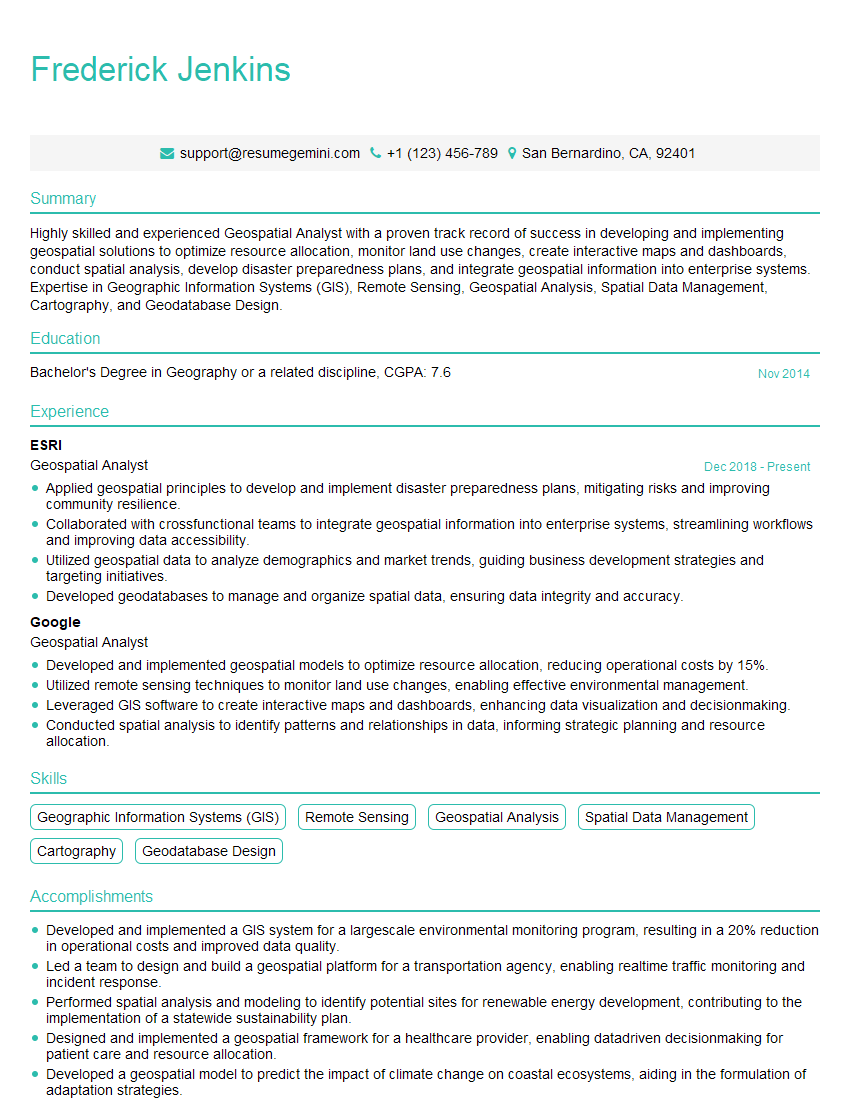
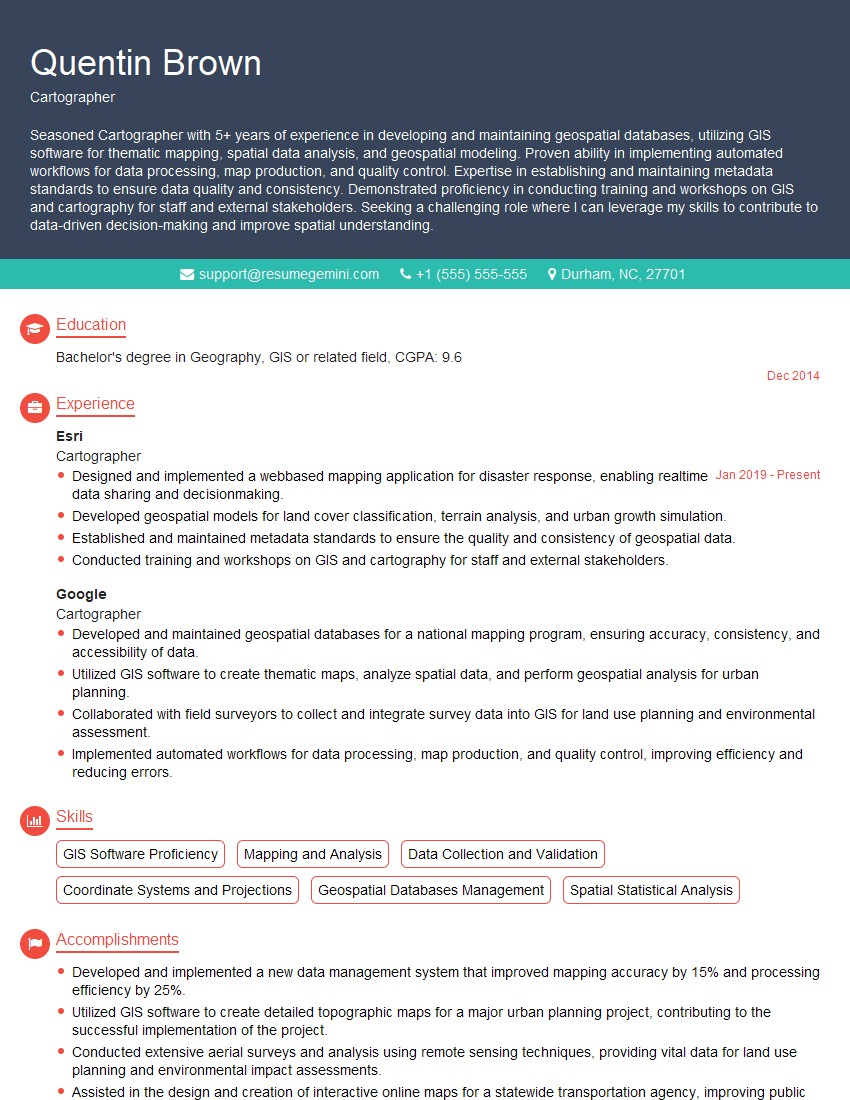
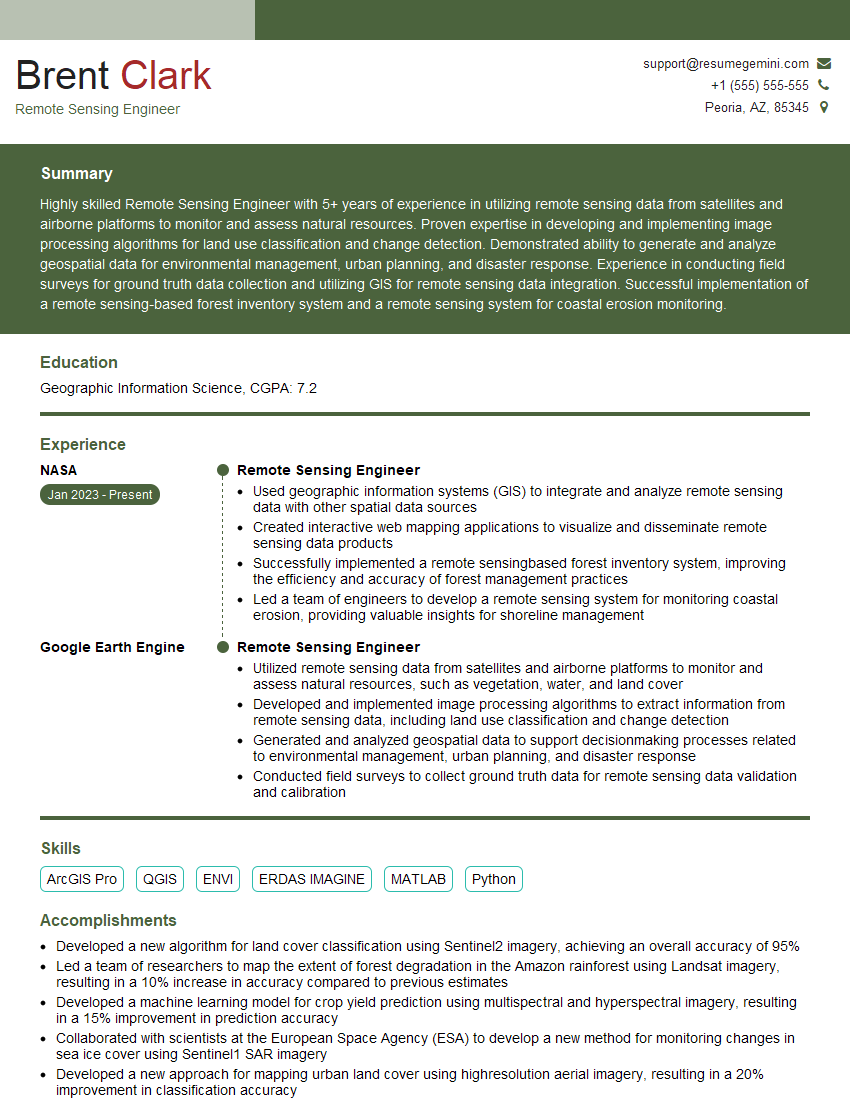
Mastering Geospatial Software Development opens doors to exciting and impactful careers in various fields, from environmental monitoring to urban planning and transportation. A strong grasp of these skills significantly enhances your job prospects and allows you to contribute meaningfully to innovative projects. To maximize your chances of landing your dream job, creating an ATS-friendly resume is crucial. This ensures your qualifications are effectively communicated to hiring managers. We highly recommend leveraging ResumeGemini to build a professional and impactful resume. ResumeGemini provides valuable tools and resources, including examples of resumes tailored to Geospatial Software Development, to help you present yourself effectively to potential employers. Invest in your future – invest in your resume.
Explore more articles
Users Rating of Our Blogs
Share Your Experience
We value your feedback! Please rate our content and share your thoughts (optional).
What Readers Say About Our Blog
Amazing blog
Interesting Article, I liked the depth of knowledge you’ve shared.
Helpful, thanks for sharing.