Are you ready to stand out in your next interview? Understanding and preparing for Gravity and Magnetic Data Processing interview questions is a game-changer. In this blog, we’ve compiled key questions and expert advice to help you showcase your skills with confidence and precision. Let’s get started on your journey to acing the interview.
Questions Asked in Gravity and Magnetic Data Processing Interview
Q 1. Explain the Bouguer correction in gravity data processing.
The Bouguer correction is a crucial step in gravity data processing that accounts for the gravitational attraction of the rock mass between the observation point and a reference datum, typically sea level. Imagine you’re measuring gravity on a mountain; the mountain itself will exert a gravitational pull, masking the signal from deeper structures we’re interested in. The Bouguer correction removes this effect, allowing us to see the variations caused by subsurface density contrasts.
The correction involves two components:
- Bouguer plate correction: This accounts for the gravitational attraction of the infinite horizontal slab of rock extending from the observation point down to the reference datum. It’s calculated using the density of the rock and the elevation of the observation point. The formula is relatively straightforward, but precise density estimation is crucial for accuracy.
- Terrain correction: This addresses the unevenness of the terrain. Surrounding hills and valleys will also exert gravitational pull, and their effects must be removed. This is more complex to calculate, often involving numerical integration techniques or terrain models. It’s computationally intensive but essential for accurate results, especially in rugged terrain.
For example, imagine conducting a gravity survey over an oil field. Without the Bouguer correction, the observed gravity anomalies would be significantly influenced by the elevation changes. The correction allows for a clearer picture of the density variations associated with subsurface structures such as oil reservoirs.
Q 2. Describe the process of removing regional trends from magnetic data.
Removing regional trends from magnetic data is vital for isolating local anomalies related to specific geological features. Regional trends often reflect large-scale geological structures or variations in the Earth’s main magnetic field. Several techniques exist for removing these trends, each with its strengths and weaknesses:
- Polynomial fitting: This involves fitting a polynomial surface to the data, representing the regional trend. The polynomial coefficients are determined using least-squares fitting. Subtracting this fitted surface from the original data reveals the residual anomalies. The order of the polynomial determines the complexity of the trend it can represent. A higher-order polynomial can fit more complex trends but risks fitting noise if not carefully chosen.
- Trend surface analysis: Similar to polynomial fitting, but this method typically uses gridded data and employs more sophisticated techniques to determine the regional trend. It’s particularly effective in visualizing and removing smoothly varying regional trends.
- Upward continuation: This is a mathematical technique that effectively ‘smooths’ the magnetic data by simulating the effect of observing the field from a higher altitude. Higher-frequency short-wavelength anomalies associated with local sources are attenuated more strongly than lower-frequency longer-wavelength regional trends. This method is less sensitive to noise but can also dampen the smaller, sometimes important, local anomalies.
The choice of technique depends on the characteristics of the data and the geological context. For instance, upward continuation might be preferable in areas with relatively simple regional trends, while polynomial fitting might be more suitable in areas with more complex patterns.
Q 3. What are the main differences between gravity and magnetic methods in geophysical exploration?
Gravity and magnetic methods are both passive geophysical techniques used to infer subsurface geological structures, but they measure different physical properties and therefore provide complementary information.
- Gravity measures density variations: Gravity surveys measure variations in the Earth’s gravitational field caused by differences in the density of subsurface rocks. Denser rocks produce stronger gravity anomalies. Gravity is sensitive to density contrasts between rocks of different compositions, such as ore bodies or sedimentary layers.
- Magnetic methods measure magnetization variations: Magnetic surveys measure variations in the Earth’s magnetic field caused by variations in the magnetization of subsurface rocks. Magnetized rocks produce magnetic anomalies. Magnetic susceptibility, the ease with which a material can be magnetized, is the key property. Magnetic methods are particularly effective at identifying magnetic minerals like magnetite, often associated with igneous rocks or some types of ore deposits.
In essence, gravity is sensitive to variations in bulk density, while magnetic methods are sensitive to the presence of magnetic minerals. A combination of both methods is often advantageous because they provide independent constraints on the subsurface structure and composition. For example, a gravity anomaly could reveal the presence of a dense body, while a magnetic anomaly might indicate its magnetic mineral content, helping in better identification of the geological feature.
Q 4. How do you identify and correct for instrumental drift in gravity or magnetic data?
Instrumental drift in gravity or magnetic data refers to gradual changes in the instrument’s readings over time, unrelated to actual changes in the geophysical field. This drift can be caused by several factors, such as temperature variations, electronic component aging, or even subtle shifts in the instrument’s orientation.
Identifying and correcting for instrumental drift is crucial for obtaining accurate results. Common techniques include:
- Base station measurements: A stationary instrument is placed at a known location to record continuous measurements. The data from the roving instrument can be corrected relative to the base station, removing any common drift experienced by both instruments.
- Regular calibration: Instruments should be regularly calibrated against known standards. This helps in identifying and quantifying any instrumental drift and allows for correction of the collected data.
- Statistical techniques: Time-series analysis can be used to identify and model the drift as a function of time. This drift model can then be subtracted from the data to correct for the drift.
- Data filtering: Some filtering techniques can help to mitigate the effects of drift by smoothing out short-term fluctuations, but it’s important to avoid over-filtering that removes real geophysical signals.
For example, during a long gravity survey, temperature changes might cause the instrument’s sensitivity to vary slightly over time. A base station helps to account for this variation and improves the accuracy of the survey results. The proper use of these techniques guarantees the high quality of the geophysical data.
Q 5. Explain the concept of magnetic susceptibility and its significance in geophysical interpretation.
Magnetic susceptibility (χ) is a dimensionless proportionality constant that indicates the degree to which a material can be magnetized in an external magnetic field. It represents the ratio of the induced magnetization (M) to the applied magnetic field intensity (H): M = χH.
High susceptibility means the material is easily magnetized, while low susceptibility implies it is difficult to magnetize. The significance of magnetic susceptibility in geophysical interpretation lies in its ability to help us identify and characterize different rock types and geological formations.
For instance, igneous rocks containing ferromagnetic minerals like magnetite often exhibit high susceptibility, resulting in strong magnetic anomalies. Conversely, sedimentary rocks typically have lower susceptibility. By analyzing the spatial distribution and magnitude of magnetic anomalies, geophysicists can infer the distribution and types of rocks in the subsurface. This is invaluable in various applications, such as mineral exploration (identifying ore bodies containing magnetite), mapping geological structures (fault zones or igneous intrusions), and studying tectonic processes.
Q 6. What are the common sources of noise in gravity and magnetic data?
Gravity and magnetic data are susceptible to various sources of noise that can obscure the subtle signals from subsurface structures. These noises can be categorized into:
- Instrumental noise: This arises from imperfections or limitations within the measuring instrument itself, including random electronic noise or slight variations in the instrument’s response. Regular instrument calibration helps to reduce this type of noise.
- Environmental noise: This encompasses external factors that affect the measurements, such as variations in temperature, atmospheric pressure, and the presence of nearby sources of magnetic or gravitational interference (e.g., traffic, electrical equipment). Careful survey design and data processing techniques help to minimize these effects.
- Cultural noise: This is due to human activities like nearby buildings, pipelines, or vehicles and can heavily impact the accuracy of the results. Careful survey planning and detailed mapping of potentially interfering structures are crucial.
- Geological noise: This includes near-surface variations in density and magnetization. This can mask deeper geological signals; careful data processing and interpretation are required to separate the near-surface noise from the signals of interest.
For example, a gravity survey near a large building might be affected by the building’s mass, creating a localized anomaly that needs to be carefully assessed or removed during processing. Similarly, magnetic surveys in urban areas can suffer from interference from power lines and other man-made structures, requiring careful consideration during data acquisition and analysis.
Q 7. Describe different types of filters used in gravity and magnetic data processing.
Various filters are used in gravity and magnetic data processing to enhance the signal-to-noise ratio and highlight features of interest. These filters operate in the frequency domain or spatial domain.
- Frequency domain filters: These filters operate by transforming the data into the frequency domain (using Fourier transforms), applying a filter function to attenuate or amplify specific frequency components, and then transforming the data back to the spatial domain. Examples include:
- Low-pass filters: These retain low-frequency components (representing larger-scale features) and remove high-frequency components (representing noise and small-scale features).
- High-pass filters: These retain high-frequency components (representing smaller-scale features) and remove low-frequency components (representing regional trends).
- Band-pass filters: These retain components within a specific frequency band.
- Spatial domain filters: These operate directly on the data in the spatial domain. Examples include:
- Moving average filters: These smooth the data by replacing each data point with the average of its neighboring points. They are simple to implement but can significantly smooth the data and suppress high-frequency anomalies.
- Median filters: Replace each data point by the median value of its neighbors. These are more robust to outliers compared to moving average filters.
The choice of filter depends on the specific characteristics of the data and the geological objectives. For example, a low-pass filter might be used to remove high-frequency noise before identifying major geological structures, while a high-pass filter might be used to enhance smaller anomalies potentially indicating localized ore deposits.
Q 8. How do you interpret gravity anomalies related to subsurface density variations?
Gravity anomalies, variations from the expected gravitational field, are directly related to subsurface density contrasts. Imagine a hidden, dense ore body buried underground. This body has a higher density than the surrounding rock. The increased mass causes a stronger gravitational pull above it, resulting in a positive gravity anomaly. Conversely, a less dense cavity or void will cause a weaker gravitational pull and a negative anomaly.
Interpreting these anomalies involves several steps: First, we acquire gravity data using a gravimeter. Then, we correct the data for various factors like latitude, elevation (Bouguer correction), terrain (terrain correction), and instrumental drift. Next, we apply processing techniques like filtering to enhance the signal. Finally, using geological knowledge and modelling software, we create 3D models to identify the location, size, and density of subsurface bodies that best explain the observed anomalies. For example, a circular positive anomaly might suggest a buried igneous intrusion, while a more elongated anomaly could indicate a geological fault.
Q 9. Explain the concept of potential field continuation and its applications.
Potential field continuation is a powerful technique used to transform gravity or magnetic data to a different observational surface. Imagine having a map of surface topography and wanting to know what the topography would look like at a higher elevation, like looking down from an airplane. Potential field continuation does something similar with gravity and magnetic data. Upward continuation moves data to a higher level; downward continuation to a lower level.
Applications include:
- Noise reduction: Upward continuation effectively dampens high-frequency noise originating from shallow sources, improving the signal-to-noise ratio for deeper targets.
- Depth estimation: The rate at which anomalies decay with upward continuation can provide an estimate of the depth to the source.
- Regional-residual separation: By separating regional and residual anomalies, we can better isolate features of interest.
In practice, this is accomplished using mathematical transformations – often involving Fourier transforms or other spectral methods – that are applied to the potential field data. The choice of method depends on the specific problem and data quality.
Q 10. How do you identify and interpret magnetic anomalies related to geological structures?
Magnetic anomalies arise from variations in the magnetization of subsurface rocks. Rocks containing magnetic minerals like magnetite will produce stronger magnetic fields. Interpreting these anomalies involves similar steps to gravity interpretation, but with an added complexity: magnetization is a vector quantity (it has both magnitude and direction).
Identifying anomalies involves removing diurnal variations (changes in the Earth’s magnetic field over time) and correcting for instrumental drift. Then, we can use analytic signal, Euler deconvolution, or source parameter imaging to better pinpoint the location and geometry of the magnetic sources. For example, a sharp, localized positive anomaly might indicate a near-surface, steeply dipping dike of highly magnetic rock. A more diffuse anomaly might reflect a larger, deeper body.
Geological context is crucial. A positive anomaly in a region known for mafic intrusions (e.g., basalt flows) is interpreted very differently than a similar anomaly in an area known for sedimentary rocks.
Q 11. What are the limitations of gravity and magnetic methods in geophysical exploration?
Gravity and magnetic methods, while powerful, have limitations. The most significant are:
- Ambiguity: Both methods are inherently ambiguous. Multiple subsurface density or magnetization distributions can produce similar observed anomalies. This requires integration with other geophysical or geological data for a robust interpretation.
- Limited resolution: The resolution of these methods is limited by the signal-to-noise ratio and the depth to the target. Deeply buried features are harder to resolve than shallow ones.
- Depth ambiguity: A shallow body with high susceptibility/density can produce a similar anomaly as a deeper body with lower susceptibility/density. This requires careful consideration of geological context and other geophysical data.
- Sensitivity to shallow features: These methods are very sensitive to near-surface geological variations (e.g. topography, changes in rock density close to the surface), which can mask deeper, more important targets.
Q 12. Explain the principles of upward and downward continuation.
Upward and downward continuation are mathematical techniques for transforming potential field data from one level to another. They are based on Poisson’s equation, which governs potential fields. Think of it like adjusting the focal length of a camera: upward continuation is like zooming out, while downward continuation is like zooming in.
Upward continuation reduces the influence of shallow sources by essentially “averaging” the field over a larger area. It is frequently used to smooth data and enhance the signal from deeper sources.
Downward continuation, conversely, tries to enhance the signal from shallow sources, but it’s a more unstable process, highly sensitive to noise. A small error in the input data can lead to significant amplification of noise in the downward continued data. It is generally used with caution and only with high-quality data.
Both are implemented using mathematical transforms, often in the frequency domain, using FFT algorithms.
Q 13. Describe the various data acquisition techniques used in gravity and magnetic surveys.
Gravity data acquisition involves precise measurement of the Earth’s gravitational acceleration using a gravimeter. There are two main types: absolute gravimeters (measure gravity directly) and relative gravimeters (measure differences in gravity between stations). Relative gravimeters are more commonly used for large-scale surveys due to their portability and ease of use. Data is typically collected at regularly spaced points along survey lines.
Magnetic surveys use magnetometers to measure the Earth’s magnetic field strength. Different types of magnetometers include proton precession magnetometers, fluxgate magnetometers, and optically pumped cesium magnetometers. As with gravity, data is acquired at regularly spaced points along survey lines or in grid patterns. The acquisition strategy (line spacing, station spacing) depends on the exploration target and the anticipated depth of the features.
Both methods often involve ground surveys, but airborne surveys are also possible (using airplanes or helicopters) for larger areas, and marine surveys for seabed mapping.
Q 14. What software packages are commonly used for gravity and magnetic data processing?
Numerous software packages are available for processing gravity and magnetic data. Some popular choices include:
- Geosoft Oasis Montaj: A comprehensive suite offering a wide range of processing tools, visualization capabilities, and modeling functionalities.
- Petrel (Schlumberger): Primarily known for seismic processing, Petrel also provides tools for gravity and magnetic interpretation and integration with other geophysical data.
- Kingdom (IHS Markit): Another integrated exploration software package incorporating various geophysical processing tools, including gravity and magnetic modules.
- Open-source options: Several open-source libraries and tools exist, such as GMT (Generic Mapping Tools), which are excellent for specific tasks and data visualization.
The choice of software depends on the project’s scope, budget, and the user’s familiarity with the specific platform. Many software packages also allow the scripting or development of custom processing workflows to address unique problems.
Q 15. How do you handle data gaps or missing data in gravity and magnetic surveys?
Missing data in gravity and magnetic surveys is a common problem, often due to logistical constraints or terrain inaccessibility. Handling these gaps requires a thoughtful approach to avoid introducing artifacts or bias into the interpretation. Several methods exist, each with its strengths and weaknesses:
Interpolation: This involves estimating the missing values based on the surrounding data points. Simple methods like linear or nearest-neighbor interpolation are quick but can be inaccurate, particularly for complex geological structures. More sophisticated techniques like kriging, which considers the spatial autocorrelation of the data, provide better results but require more computational power. The choice of method depends on the size and distribution of the gaps and the complexity of the underlying geology.
Data infilling with advanced methods: Techniques like inverse distance weighting (IDW), radial basis functions (RBFs), or even machine learning algorithms can be employed to infill the gaps. These methods can be more robust to noise and irregularities in data distribution, offering a more accurate representation of the subsurface.
Accepting the limitations: In some cases, the data gaps might be too extensive or irregularly distributed for reliable interpolation. In such scenarios, it’s crucial to acknowledge the limitations of the data and focus the interpretation on areas with complete coverage. Careful consideration of the area with missing data is key to ensure that any conclusions drawn are based on the trustworthy part of the survey.
For example, imagine a gravity survey where a river prevents access to a section of the survey area. Kriging could be used to estimate the gravity values in that gap, leveraging the spatial correlation between the data points on either side. However, it’s essential to validate the interpolated values by examining their consistency with the surrounding data and known geological features.
Career Expert Tips:
- Ace those interviews! Prepare effectively by reviewing the Top 50 Most Common Interview Questions on ResumeGemini.
- Navigate your job search with confidence! Explore a wide range of Career Tips on ResumeGemini. Learn about common challenges and recommendations to overcome them.
- Craft the perfect resume! Master the Art of Resume Writing with ResumeGemini’s guide. Showcase your unique qualifications and achievements effectively.
- Don’t miss out on holiday savings! Build your dream resume with ResumeGemini’s ATS optimized templates.
Q 16. Explain the concept of Euler deconvolution and its applications.
Euler deconvolution is a powerful technique used to estimate the depth and location of subsurface sources of potential fields (gravity and magnetic anomalies). It works by assuming a simplified model of the source, often a point mass or dipole, and solving a system of equations relating the observed anomaly to the source parameters. The ‘Euler equation’ itself is a mathematical expression representing the relationship between the potential field’s spatial derivatives and its source depth.
The process involves selecting a structural index (SI) that reflects the shape of the source (e.g., SI=0 for a point mass, SI=1 for a vertical dyke, etc.) and then searching for points in the data where the Euler equation is satisfied. These points represent potential locations of causative sources. Different SIs can highlight different geologic features. Software then finds the best fit (a solution that satisfies the Euler equation best). A collection of these solutions defines potential depths and locations of sources.
Applications of Euler deconvolution include:
- Estimating the depth of buried geologic structures, aiding in defining potential targets for mineral or hydrocarbon exploration.
- Mapping the spatial extent of ore bodies or other subsurface features based on the collected points.
- Improving the resolution and clarity of potential field maps by identifying and isolating individual sources.
For instance, in a mineral exploration context, Euler deconvolution can help pinpoint the depth and location of a potentially mineralized intrusion, guiding subsequent drilling programs. Remember, the results are dependent on the assumed source model and SI selection. Therefore, results should be examined critically in conjunction with other available geological and geophysical data.
Q 17. How do you perform a qualitative interpretation of gravity and magnetic data?
Qualitative interpretation of gravity and magnetic data involves visually analyzing the data maps and profiles to identify major trends, anomalies, and geological features. It’s the first step in understanding the subsurface, and it sets the stage for more quantitative analyses. This analysis is often done by experienced geophysicists who have an eye for subtle patterns and contextual knowledge of the region.
The process typically involves:
Visual inspection of maps: Identifying high and low gravity or magnetic values which correspond to areas of higher and lower density or magnetization, respectively. We look for patterns that suggest geologic structures like faults, folds, or intrusions.
Profile analysis: Examining profiles (cross-sections) of the data to better visualize the shapes and extents of anomalies. Profiles can reveal subtle features and provide an alternative perspective to the 2D map.
Regional-residual separation: Separating the regional background field from localized anomalies related to specific geological targets. This allows for better identification and isolation of specific geological features that might otherwise be masked by broader regional trends.
Comparing with geological maps and other data: Integrating potential field data with surface geology maps, well logs, or other geophysical data to validate interpretations and develop a holistic understanding of the area.
For example, a large, positive magnetic anomaly might indicate the presence of a mafic or ultramafic intrusion, while a negative gravity anomaly could suggest a less-dense sedimentary basin. These initial observations are crucial for hypothesis generation and formulating more focused quantitative interpretations.
Q 18. Describe the process of quantitative interpretation of gravity and magnetic anomalies.
Quantitative interpretation aims to extract precise numerical information about the subsurface from gravity and magnetic anomalies. This involves developing mathematical models to fit the observed data and infer physical properties (density, magnetization) and geometry of the subsurface features. It’s a more complex process that requires specialized software and a good understanding of forward and inverse modelling techniques.
The process generally involves these steps:
Forward modeling: Creating a theoretical model of the subsurface (e.g., a 3D geological model) based on preliminary interpretations, and then calculating the theoretical gravity or magnetic anomaly that such a model would produce. This is achieved by using software such as Oasis Montaj or Petrel that allows the user to define the geometry and physical properties of the source bodies.
Inverse modeling: Comparing the theoretical anomaly to the observed data and iteratively adjusting the model parameters (geometry, density, magnetization) to minimize the differences (fit the model to the observed data). This is an iterative process and relies on a number of techniques such as least-squares inversion, which aims to find the best-fit model using statistical approaches.
Model evaluation and uncertainty assessment: Evaluating the quality of the fit and assessing the uncertainties associated with the model parameters. Goodness-of-fit statistics such as RMS errors are important to understand the fidelity of the model to the observed data.
For instance, in hydrocarbon exploration, quantitative interpretation of gravity and magnetic data might be used to estimate the thickness and extent of a sedimentary basin or map the location of faults and other structural features that could impact reservoir properties.
Q 19. What are the applications of gravity and magnetic methods in mineral exploration?
Gravity and magnetic methods play a vital role in mineral exploration because they provide cost-effective, wide-area coverage surveys for identifying potential ore bodies. Different types of ore deposits have distinct density and magnetic properties, leading to characteristic gravity and magnetic anomalies.
Specific applications include:
Identifying mafic and ultramafic intrusions: These intrusions are often associated with nickel, copper, platinum group elements (PGEs), and chromite deposits. Their high magnetic susceptibility produces strong magnetic anomalies.
Mapping geological structures: Faults and folds can control the location of ore deposits. Gravity and magnetic data can help to map these structures, guiding exploration efforts towards more prospective areas.
Detecting buried ore bodies: Gravity and magnetic methods can detect density and magnetic contrasts associated with buried ore bodies, even beneath substantial overburden.
Regional exploration: They allow for efficient reconnaissance of large areas to identify prospective zones that warrant more detailed investigations.
For example, a strong positive magnetic anomaly might indicate a mafic or ultramafic intrusion, while a negative gravity anomaly could suggest the presence of a less-dense, potentially mineralized zone. This information would guide more detailed exploration and drilling activities.
Q 20. What are the applications of gravity and magnetic methods in hydrocarbon exploration?
In hydrocarbon exploration, gravity and magnetic surveys provide crucial information about the basin architecture and subsurface structures that control hydrocarbon accumulation. Although not directly detecting hydrocarbons themselves (as they are not significantly magnetic or dense), these methods are essential for contextualizing other geophysical and geological information.
Applications include:
Mapping basin boundaries: Gravity anomalies can delineate the edges of sedimentary basins, revealing their size and extent. This information is critical for understanding the potential volume of hydrocarbons that could be present.
Identifying faults and folds: These structural features can create traps for hydrocarbons. Gravity and magnetic data are instrumental in mapping fault systems and identifying structural features such as anticlines and synclines, potential hydrocarbon traps.
Imaging basement rocks: The depth to the basement rocks is important for understanding the thickness of the sedimentary column, which is crucial for assessing hydrocarbon potential. Magnetic data is especially useful for identifying the basement structure and depth.
Identifying salt domes: Salt domes are significant geological structures that can create hydrocarbon traps. Gravity and magnetic data are used to detect their presence and map their geometry.
For example, a regional gravity survey could help delineate the boundaries of a sedimentary basin, while a higher-resolution magnetic survey might reveal the presence of faults and folds within the basin, providing valuable information for hydrocarbon exploration.
Q 21. How do you integrate gravity and magnetic data with other geophysical data?
Integrating gravity and magnetic data with other geophysical data significantly enhances the understanding of the subsurface. This integration utilizes the complementary nature of different geophysical methods to create a more comprehensive and reliable geological model.
Common integration strategies include:
Joint inversion: Simultaneously inverting multiple datasets (e.g., gravity, magnetic, seismic) to obtain a more constrained and realistic model. This approach leverages the strengths of different datasets and reduces uncertainties associated with individual inversions.
Data fusion: Combining gravity and magnetic data with other geophysical datasets, such as seismic reflection or refraction, electromagnetic, or even well log data. This allows for improved resolution, reduction in ambiguities, and better definition of geologic features.
3D visualization: Visualizing the integrated datasets in 3D helps to develop a better understanding of the spatial relationships between different geological features. Software packages allow for the simultaneous visualization of multiple datasets, facilitating direct comparison and integrated interpretation.
Geostatistical analysis: Methods like kriging or cokriging can combine gravity and magnetic data with other datasets to improve spatial prediction and reduce uncertainty in areas with limited data.
For example, integrating gravity and magnetic data with seismic reflection data can help to define the geometry and properties of subsurface structures, improving the accuracy of hydrocarbon reservoir characterization. Likewise, integrating gravity and magnetic data with electromagnetic data can improve the identification of mineralization within the subsurface.
Q 22. Explain the concept of gravity and magnetic modeling.
Gravity and magnetic modeling is the process of creating three-dimensional representations of subsurface density and magnetic susceptibility variations, respectively, based on measured gravity and magnetic field data at the Earth’s surface. We use these models to interpret the geological structure, identify potential resources like ore bodies or hydrocarbons, and understand tectonic processes. Think of it like creating a detailed map of the underground based on subtle variations in gravitational pull and magnetic fields.
The process involves several steps: data acquisition, data processing (corrections, filtering), inversion (creating the 3D model from the data), and interpretation (analyzing the model to draw geological conclusions). Sophisticated software and algorithms are used to achieve this.
Q 23. Describe different types of gravity and magnetic models.
Gravity and magnetic models can be broadly categorized into:
- Forward models: These models start with a presumed subsurface structure (e.g., a sphere, a dike, or a more complex 3D model), and then calculate the theoretical gravity or magnetic anomaly that this structure would produce at the surface. This is useful to test different geological hypotheses.
- Inverse models: These models use the observed gravity or magnetic data to estimate the subsurface density or susceptibility distribution. Several inversion techniques exist, with different strengths and weaknesses. For instance, least-squares inversion is a common method, but it requires making assumptions about the model’s smoothness or complexity. Other more sophisticated methods like Bayesian inversion allow for incorporating prior geological knowledge.
- Parametric models: These models describe the subsurface structure using simple geometric shapes (e.g., spheres, cylinders, prisms) with a few parameters such as size, depth, and density/susceptibility contrast. They’re useful for initial interpretations or when computational resources are limited.
- Grid-based models: These models represent the subsurface density/susceptibility as a regular grid of values. They are very flexible and can represent complex structures, but require significantly more computational resources compared to parametric models.
Q 24. What are the challenges in interpreting gravity and magnetic data in complex geological settings?
Interpreting gravity and magnetic data in complex geological settings presents numerous challenges. The primary difficulty stems from the non-uniqueness problem – multiple subsurface density/susceptibility distributions can produce the same observed anomaly at the surface. This ambiguity makes it hard to arrive at a single, definitive geological interpretation.
- Depth ambiguity: A shallow, high-contrast body can produce a similar anomaly to a deeper, larger body. Resolving this requires additional data (e.g., well logs, seismic data) or using advanced inversion techniques.
- Lateral variations: Complex geology with varying rock types and structures can create overlapping anomalies that are difficult to separate.
- Remanent magnetization: In magnetic surveys, the magnetization of rocks can be influenced by past magnetic fields, leading to anomalies that are not solely dependent on the present-day susceptibility. This complicates the interpretation and requires careful consideration of the geological history.
- Noise and errors: Gravity and magnetic data are susceptible to various sources of noise (e.g., instrumental errors, terrain effects, cultural noise), and these errors can complicate the interpretation. Robust data processing techniques are essential.
Q 25. How do you assess the accuracy and reliability of gravity and magnetic data?
Assessing the accuracy and reliability of gravity and magnetic data involves several steps:
- Data quality control: Careful examination of the raw data for outliers, spikes, and systematic errors is crucial. This often involves visual inspection of data plots and statistical analysis.
- Error propagation: Understanding and quantifying the uncertainties associated with different processing steps is critical. This involves propagating errors from the raw data through the various corrections and inversions.
- Comparison with other datasets: Integrating gravity and magnetic data with other geophysical and geological data (e.g., seismic data, well logs, geological maps) helps to validate the results and improve confidence in the interpretations.
- Resolution analysis: Determining the spatial resolution of the data and the models is essential for understanding the limitations of the interpretations. Highly resolved models might be less reliable due to noise amplification.
- Model uncertainty assessment: Utilizing techniques like Monte Carlo simulations or Bayesian methods allows us to quantify the uncertainty in the model parameters and assess the robustness of the interpretations.
For instance, comparing a gravity model to seismic data helps validate the densities obtained. A good fit indicates higher reliability.
Q 26. How do you present and communicate geophysical results to a non-technical audience?
Communicating geophysical results to a non-technical audience requires a clear and concise approach, avoiding jargon. I use visual aids extensively – maps, cross-sections, and 3D visualizations are extremely effective. Instead of focusing on technical details, I concentrate on the key findings and their implications. For example, instead of saying “we detected a positive gravity anomaly,” I might say “our measurements suggest the presence of a dense rock body underground, possibly indicative of a mineral deposit”.
Analogies are useful too. Think of comparing gravity anomalies to how a heavy object under a mattress causes a dip. Simpler explanations and storytelling can greatly enhance understanding. I always prepare a presentation tailored to the audience’s background and level of understanding.
Q 27. Describe your experience with different gravity and magnetic data processing workflows.
My experience encompasses various gravity and magnetic data processing workflows, from basic corrections to advanced 3D inversions. I’m proficient in using industry-standard software such as Geosoft Oasis Montaj and Petrel. My workflow typically begins with data pre-processing, including instrument corrections, terrain corrections, latitude corrections (for gravity), and IGRF (International Geomagnetic Reference Field) removal for magnetic data. Then, I proceed to filtering (e.g., reduction to the pole, upward continuation for magnetic data; various filters for gravity data). This is followed by gridding and then either forward modeling or inversion to obtain a 3D model.
For example, in one project involving mineral exploration, we used a combination of gravity and magnetic data along with geological mapping to identify a promising exploration target. We used 3D inversion to build a model that constrained the location and depth of a suspected ore body.
Q 28. Explain a time you had to troubleshoot a problem during gravity or magnetic data processing.
During a project involving airborne magnetic data, we encountered significant noise related to diurnal variations in the Earth’s magnetic field. This wasn’t properly corrected in the initial processing. The resulting anomalies were distorted and unreliable. I identified the problem by analyzing the residual magnetic field after removing the IGRF. A pattern consistent with diurnal variations was visible.
To solve this, I implemented a more sophisticated diurnal correction using base station data. This involved carefully analyzing the base station records, interpolating the data to match the flight time, and then subtracting the variations from the airborne data. After implementing this correction, the quality of the magnetic data improved significantly, leading to a more reliable geological interpretation.
Key Topics to Learn for Gravity and Magnetic Data Processing Interview
- Data Acquisition and Preprocessing: Understanding instrument types, data formats, noise reduction techniques, and corrections (e.g., diurnal, latitude, terrain corrections).
- Gravity Data Processing: Familiarize yourself with Bouguer, Free-air, and isostatic anomaly calculations; interpreting gravity maps and profiles to identify subsurface structures (e.g., density contrasts).
- Magnetic Data Processing: Learn about reduction to the pole, analytic signal, and Euler deconvolution techniques; interpreting magnetic anomalies to delineate geological features (e.g., igneous intrusions, faults).
- Inversion Techniques: Grasp the fundamental concepts behind various inversion methods (e.g., least-squares, probabilistic) used to model subsurface properties from gravity and magnetic data.
- Geophysical Interpretation and Modeling: Develop your skills in integrating gravity and magnetic data with other geophysical and geological information for comprehensive subsurface imaging and interpretation.
- Software Proficiency: Demonstrate familiarity with commonly used software packages for gravity and magnetic data processing (mention specific software if applicable, keeping it general to avoid bias).
- Practical Applications: Be ready to discuss real-world applications of gravity and magnetic data processing in various fields, such as mineral exploration, petroleum exploration, groundwater studies, and environmental geophysics.
- Problem-Solving Approaches: Practice analyzing hypothetical geophysical datasets and formulating solutions to common challenges encountered during data processing and interpretation.
Next Steps
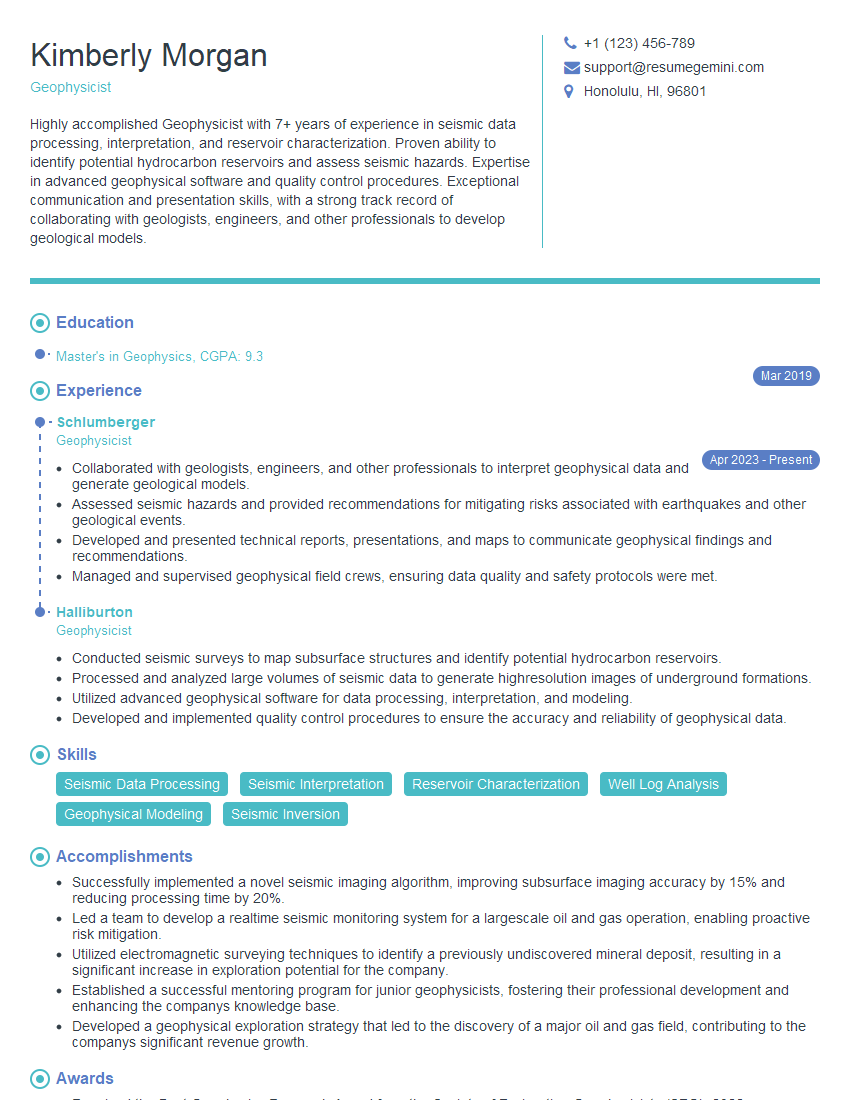
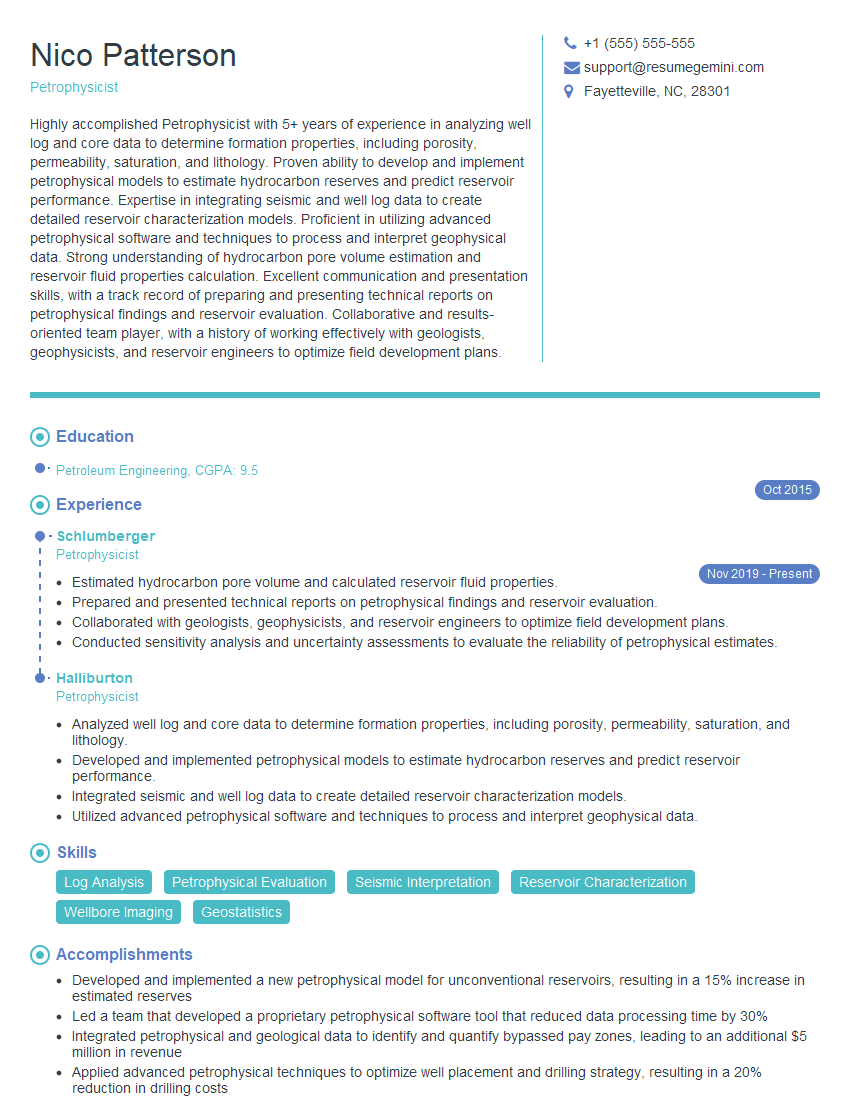
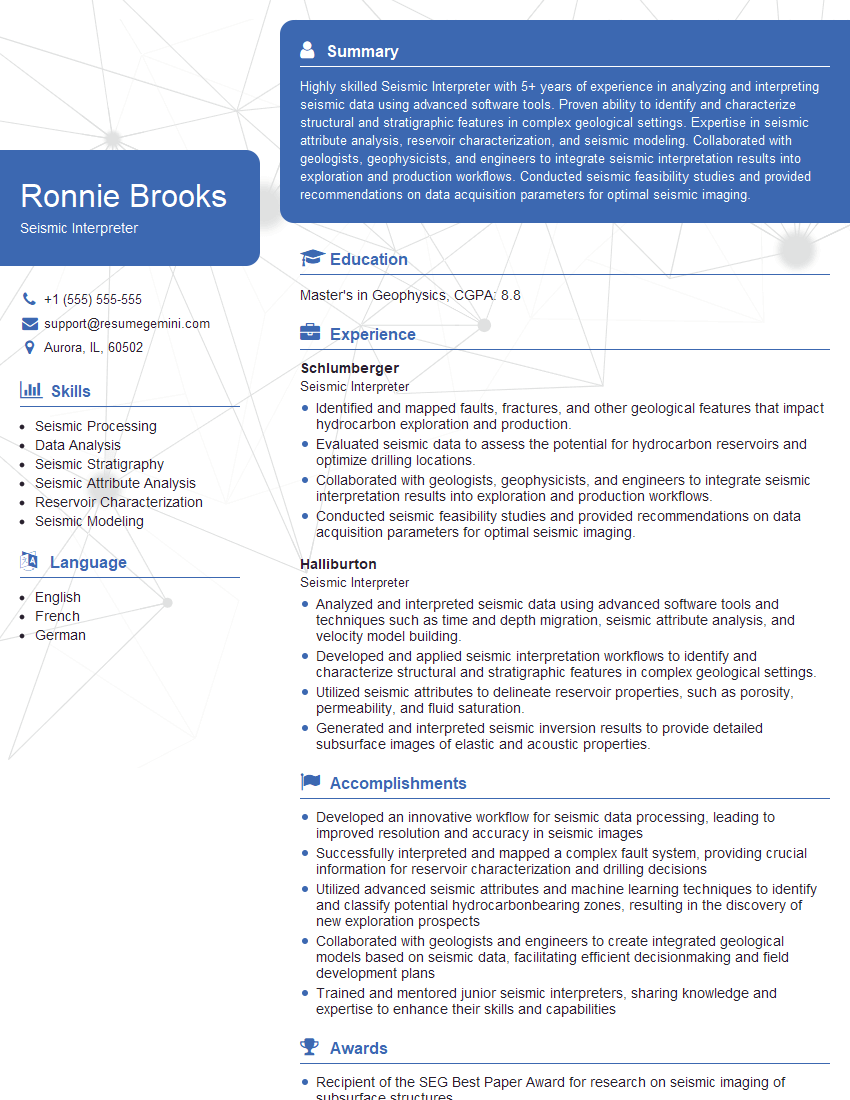
Mastering Gravity and Magnetic Data Processing opens doors to exciting career opportunities in the geoscience industry. A strong understanding of these techniques is highly valued by employers seeking skilled professionals. To significantly boost your job prospects, it’s crucial to present your skills effectively through a well-crafted, ATS-friendly resume. ResumeGemini is a trusted resource for building professional resumes tailored to your specific field. We provide examples of resumes specifically designed for candidates in Gravity and Magnetic Data Processing to help you showcase your expertise and land your dream job.


Explore more articles
Users Rating of Our Blogs
Share Your Experience
We value your feedback! Please rate our content and share your thoughts (optional).
What Readers Say About Our Blog
Amazing blog
Interesting Article, I liked the depth of knowledge you’ve shared.
Helpful, thanks for sharing.