Every successful interview starts with knowing what to expect. In this blog, we’ll take you through the top Language proficiency in multiple languages interview questions, breaking them down with expert tips to help you deliver impactful answers. Step into your next interview fully prepared and ready to succeed.
Questions Asked in Language proficiency in multiple languages Interview
Q 1. What languages are you proficient in, and what is your proficiency level in each (e.g., native, fluent, conversational)?
My native language is English. I am also fluent in Spanish and French, possessing near-native proficiency in both. My German is at a high-intermediate level, allowing for comfortable conversation and translation of non-technical texts. I also have conversational proficiency in Mandarin Chinese, sufficient for everyday interactions but not yet suitable for professional translation work.
- English: Native
- Spanish: Fluent
- French: Fluent
- German: High-Intermediate
- Mandarin Chinese: Conversational
Proficiency levels are assessed based on my ability to understand, speak, read, and write in each language, considering both grammatical accuracy and nuanced cultural understanding. For example, my fluency in Spanish allows me to comfortably navigate complex business negotiations, while my German proficiency is currently best suited to tasks like translating simpler marketing materials.
Q 2. Describe your experience with simultaneous interpretation vs. consecutive interpretation.
Simultaneous interpretation and consecutive interpretation are two distinct approaches to interpreting. Simultaneous interpretation involves translating the speaker’s words *in real-time*, with minimal delay. This requires exceptional listening skills, rapid cognitive processing, and a strong command of both languages. Consecutive interpretation, on the other hand, involves listening to a complete segment of speech (a sentence or paragraph) before translating it. This approach allows for greater accuracy and more careful consideration of nuanced meaning, but it naturally slows down the overall communication flow.
My experience encompasses both methodologies. I’ve worked extensively in consecutive interpretation for legal and business settings where accuracy is paramount. For example, I’ve interpreted legal contracts and business negotiations between Spanish and English speakers. My simultaneous interpretation experience is mainly focused on shorter presentations and conference calls where real-time translation is necessary. The skillset required for each is different – simultaneous interpretation demanding faster reflexes, while consecutive interpretation needs a sharper focus on linguistic precision.
Q 3. How do you handle translation ambiguities or inconsistencies in source texts?
Handling ambiguities and inconsistencies is a critical aspect of translation. My approach is multi-faceted:
- Careful analysis of context: I examine the surrounding text, paying close attention to the overall message and intended audience. This often helps clarify ambiguous phrases or sentences.
- Research and verification: When encountering inconsistencies or unfamiliar terms, I conduct thorough research using reliable sources like dictionaries, glossaries, and online corpora to ensure accuracy.
- Consultation with subject matter experts: In cases of significant ambiguity or specialized terminology, I consult with subject matter experts to gain a deeper understanding of the context and ensure the translation accurately reflects the source material.
- Note inclusion and client communication: If an ambiguity remains irresolvable, I clearly document it for the client along with my justification for my chosen translation, ensuring transparency.
For instance, if I encounter a phrase with multiple potential meanings, I investigate the surrounding sentences, paragraphs, and the overall document to determine the most appropriate interpretation before rendering the translation.
Q 4. Explain your approach to translating culturally specific terms or expressions.
Translating culturally specific terms or expressions requires sensitivity and cultural awareness. A direct, literal translation can often lead to misunderstandings or even appear nonsensical. My strategy involves:
- Identifying the cultural context: I meticulously analyze the cultural significance of the term or expression, considering the source culture’s norms, values, and history. This involves more than just dictionary definitions.
- Choosing the appropriate translation technique: I might use direct translation if the term has a direct equivalent in the target language, but more often, I opt for adaptation, functional equivalence, or even explanatory translation. Adaptation replaces the source language expression with one that is culturally appropriate and conveys the same meaning in the target language.
- Maintaining the intended impact: The goal is not just to convey the literal meaning but also to replicate the intended emotional and cultural impact of the original expression. For example, translating a humorous idiom requires understanding the humor and finding a similar humorous idiom in the target language.
For example, translating the Spanish expression “¡Ay, caramba!” directly would yield something awkward in English. A better translation would be “Oh, my goodness!” or “Gosh!” – preserving the informal, mildly exasperated tone. This is a classic example of adaptation.
Q 5. What translation tools or CAT tools are you familiar with?
I am proficient in several translation tools and Computer-Assisted Translation (CAT) tools. These tools significantly enhance efficiency and consistency in my workflow.
- CAT Tools: I have extensive experience with SDL Trados Studio, memoQ, and Across. These tools allow for efficient management of translation memories (TMs), terminology databases (TBs), and quality assurance checks.
- Machine Translation (MT) engines: I utilize Google Translate and DeepL as aids for research and pre-translation, but always treat the output as a starting point for careful revision and editing, ensuring the final translation is both accurate and natural-sounding.
- Dictionaries and Terminology Resources: I regularly consult specialized dictionaries, lexicons, and online terminology databases relevant to the subject matter at hand.
Using CAT tools is essential for large projects, enabling me to maintain consistency in terminology and style across all documents. For example, using a TM ensures consistent translation of repeated phrases, while a TB enforces correct use of technical terminology.
Q 6. How do you ensure accuracy and consistency in your translations?
Accuracy and consistency are cornerstones of my work. My approach involves a multi-stage process:
- Thorough source text analysis: I begin by carefully analyzing the source text to understand the context, purpose, and intended audience. This provides a solid foundation for accurate translation.
- Consistent terminology and style: Throughout the translation process, I maintain consistent use of terminology and style, using CAT tools to support this.
- Multiple revisions and quality assurance: I conduct multiple revisions to identify and correct errors in grammar, style, and meaning. This often includes self-review, followed by a colleague’s review for a second pair of eyes.
- Proofreading and editing: A final proofreading step is crucial to catch any remaining errors or inconsistencies before delivering the final translation.
For example, I always use a consistent terminology database for technical translations, ensuring that specialized terms are rendered the same way throughout the entire project. By following this rigorous process, I aim to deliver high-quality translations that meet the highest standards of accuracy and consistency.
Q 7. Describe your experience with different translation methodologies (e.g., direct, indirect, adaptation).
Different translation methodologies are employed depending on the source text and target audience. My experience spans several approaches:
- Direct translation: This method involves a word-for-word or phrase-for-phrase translation, suitable for texts with clear, literal equivalents in the target language. This is ideal for technical documents where precise wording is essential.
- Indirect translation: This is a more flexible approach, using paraphrasing and restructuring to achieve a natural and idiomatic rendering in the target language. This is beneficial when a direct translation sounds unnatural or awkward.
- Adaptation: This involves modifying the translation to suit the cultural context and preferences of the target audience. This technique is particularly crucial when dealing with culturally specific expressions or references.
Choosing the right methodology often depends on the text type and intended purpose. For instance, I might opt for direct translation for a technical manual, while choosing adaptation for a marketing brochure to tailor it to the target culture. Experience has taught me to be flexible in my approach and choose the most effective method for each translation task.
Q 8. How do you manage large-scale translation projects?
Managing large-scale translation projects requires a structured approach. Think of it like orchestrating a symphony – each instrument (translator, editor, proofreader) needs to play its part harmoniously to achieve a beautiful final product. My strategy involves several key steps:
Project Breakdown: First, I meticulously divide the project into manageable segments, often based on subject matter or linguistic complexity. This allows for parallel processing and efficient resource allocation.
Team Assembly: I carefully select translators specializing in the relevant subject matter and language pairs, ensuring they possess the necessary expertise and experience. This is crucial for maintaining consistency and accuracy.
Quality Assurance (QA): A robust QA process is essential. This typically involves multiple stages: initial translation, editing, proofreading, and potentially a final review by a subject matter expert. This layered approach significantly reduces errors.
Technology Utilization: I leverage Computer-Assisted Translation (CAT) tools like SDL Trados Studio or memoQ. These tools enable translation memory (TM) – storing previously translated segments – ensuring consistency across the project and improving efficiency.
Communication & Collaboration: Clear and consistent communication with the team and clients is paramount. Regular progress updates and feedback loops keep everyone informed and aligned, preventing misunderstandings and delays.
For example, when translating a large technical manual, I might divide it into chapters, assigning each to a specialized translator. Then, a dedicated editor reviews the entire translation for consistency and style, before a final proofread checks for minor errors.
Q 9. How do you prioritize tasks and manage your time effectively when working on multiple translation projects in different languages?
Juggling multiple translation projects in diverse languages demands exceptional organizational skills. I employ a combination of strategies to prioritize tasks and manage my time effectively. Think of it as a skilled chef managing multiple dishes simultaneously – each requiring specific attention and timing.
Prioritization Matrix: I use a prioritization matrix (e.g., Eisenhower Matrix – Urgent/Important) to categorize tasks based on urgency and importance. This ensures that critical tasks receive immediate attention.
Time Blocking: I allocate specific time blocks for each project, considering factors like deadline, complexity, and language. This focused approach minimizes context switching and maximizes productivity.
Project Management Software: I rely on project management tools like Asana or Trello to track progress, manage deadlines, and collaborate effectively with clients and team members. This provides a centralized overview of all ongoing projects.
Regular Review & Adjustment: I regularly review my schedule and adjust it as needed. This flexibility is crucial to accommodate unforeseen delays or changes in priorities. If a deadline is approaching, I might reallocate resources or request additional support.
For instance, if I have a high-priority urgent legal document translation and a less urgent marketing brochure, the legal document will occupy a larger portion of my time block.
Q 10. How do you handle tight deadlines and pressure?
Tight deadlines and pressure are inherent to translation work. My approach focuses on proactive planning and effective stress management. It’s like running a marathon – pacing oneself is essential.
Realistic Planning: I always factor in buffer time for unforeseen issues. Underestimating the time required is a common mistake that can lead to stress.
Delegation (when possible): If feasible, I delegate parts of the project to trusted colleagues or team members, ensuring seamless collaboration.
Break Down Tasks: I break down large tasks into smaller, more manageable steps. This makes the overall project less daunting and allows for better progress tracking.
Stress Management Techniques: I practice stress management techniques like taking short breaks, practicing mindfulness, and engaging in activities that help me relax and recharge.
For example, if faced with an extremely tight deadline, I will immediately communicate with the client to discuss the possibilities of adjusting the scope or extending the deadline while focusing on delivering the highest quality work within the available time.
Q 11. Describe your experience working with clients or stakeholders from different cultural backgrounds.
I’ve had the pleasure of collaborating with clients and stakeholders from diverse cultural backgrounds, enriching my understanding of global perspectives. It’s like a tapestry woven with many different threads.
Cultural Sensitivity Training: I’ve actively participated in cultural sensitivity training programs, which have sharpened my awareness of cultural nuances and communication styles.
Adaptability & Flexibility: I am adaptable to different communication styles and preferences. I understand that direct communication is valued in some cultures while indirect communication is preferred in others.
Open Communication: Maintaining open and respectful communication is key. I ensure that my interactions are sensitive and considerate, adapting to the specific cultural context.
Respectful Inquiry: When uncertain about cultural norms, I always ask clarifying questions to avoid misunderstandings or causing offense.
For instance, when working with a Japanese client, I understand the importance of formality and indirect communication. I prioritize meticulous attention to detail and strive to build trust through respectful interaction.
Q 12. Explain your understanding of linguistic nuances and their impact on translation.
Linguistic nuances are subtle yet powerful elements that significantly impact the effectiveness of a translation. They are like the spices in a dish – a small amount can enhance the flavor, but too much can ruin it. My understanding encompasses several key aspects:
Idioms & Expressions: Direct translation of idioms often results in nonsensical or unnatural language. I ensure that idioms and expressions are translated contextually, using equivalent expressions in the target language.
Register & Tone: Maintaining the appropriate register (formal vs. informal) and tone is vital. The translation should accurately reflect the style and tone of the source text.
Cultural Context: Language is deeply intertwined with culture. I consider the cultural context when translating to ensure that the message is culturally appropriate and avoids misinterpretations.
Grammar & Syntax: Each language has its own grammatical structure and syntax. I ensure that the target language translation adheres to the grammatical rules and stylistic conventions of the target language.
For example, the English idiom “to spill the beans” doesn’t have a direct equivalent in many languages. I would need to find a culturally appropriate equivalent expression to convey the same meaning effectively.
Q 13. How do you ensure the cultural appropriateness of your translations?
Cultural appropriateness in translation is paramount. It’s about ensuring that the translated text resonates with the target audience and avoids causing offense or misinterpretations. Think of it like adapting a play for a different culture – the storyline remains, but the context and delivery need adjustment.
Cultural Research: I conduct thorough research into the target culture, paying close attention to customs, values, and sensitivities. This provides a framework for culturally appropriate translation.
Local Expertise: I often consult with native speakers of the target language and culture for feedback and verification, especially when dealing with sensitive topics or cultural nuances.
Contextualization: I adapt the translation to the specific cultural context, considering factors such as humor, social norms, and religious beliefs.
Review by Native Speakers: A crucial step is reviewing the translation with native speakers of the target language and culture to ensure cultural appropriateness and identify potential issues.
For instance, when translating marketing materials, I’d ensure that imagery and wording align with the target culture’s preferences and avoid anything that might be considered offensive or inappropriate.
Q 14. How do you stay updated on changes in language and terminology?
The language landscape is constantly evolving. Staying updated is crucial for maintaining accuracy and relevance. Think of it as a gardener tending to their plants – constant care and attention are necessary for healthy growth.
Professional Development: I actively participate in professional development opportunities, attending conferences, workshops, and webinars to stay abreast of the latest linguistic developments and technological advancements.
Industry Publications: I regularly read industry publications and journals to stay informed about changes in terminology, language usage, and translation best practices.
Online Resources: I utilize reputable online resources such as language dictionaries, thesauruses, and style guides, as well as official language bodies’ websites to check for updated terminology and guidelines.
Networking: I engage in networking with fellow translators, linguists, and subject matter experts to share knowledge and learn from each other’s experiences.
For example, I regularly consult specialized terminology databases and industry-specific glossaries to ensure that technical translations remain accurate and up-to-date with current usage.
Q 15. What resources do you use to verify the accuracy of your translations?
Verifying the accuracy of my translations is paramount. My approach is multifaceted and relies on a combination of resources tailored to the specific project and language pair.
Bilingual Dictionaries and Glossaries: I utilize reputable dictionaries like Merriam-Webster, Oxford, and specialized glossaries for technical or industry-specific terminology to ensure precise word choice and nuanced meaning. For example, when translating legal documents, a specialized legal dictionary is crucial to avoid misinterpretations that could have serious consequences.
Corpus Analysis: I frequently consult corpora (large collections of text and speech) to check the naturalness and frequency of usage of specific phrases and expressions in the target language. This helps me avoid sounding unnatural or using obsolete terms.
Machine Translation Post-Editing: While I never rely solely on machine translation (MT), I occasionally use it as a preliminary step for large volumes of text. I then meticulously edit and refine the MT output, ensuring accuracy, fluency, and cultural appropriateness. Think of it as a starting point for a polishing process.
Style Guides and Translation Memories: For consistency, especially in projects with large volumes of text, I adhere to style guides provided by clients and leverage translation memories (databases of previously translated segments) to maintain uniformity in terminology and style.
Peer Review and Self-Review: I always incorporate a rigorous self-review process, revisiting my work after a period of time to catch errors I may have missed initially. For crucial projects, I seek feedback from other proficient translators in the relevant language pair, which is an invaluable form of quality control.
Career Expert Tips:
- Ace those interviews! Prepare effectively by reviewing the Top 50 Most Common Interview Questions on ResumeGemini.
- Navigate your job search with confidence! Explore a wide range of Career Tips on ResumeGemini. Learn about common challenges and recommendations to overcome them.
- Craft the perfect resume! Master the Art of Resume Writing with ResumeGemini’s guide. Showcase your unique qualifications and achievements effectively.
- Don’t miss out on holiday savings! Build your dream resume with ResumeGemini’s ATS optimized templates.
Q 16. Describe a challenging translation project you’ve completed and how you overcame the challenges.
One particularly challenging project involved translating a highly technical manual for a medical device from English into Japanese. The challenge stemmed from the intricate terminology, the necessity for perfect accuracy (a misinterpretation could have safety implications), and the significant cultural differences in technical writing style between the two languages.
To overcome these challenges, I adopted a phased approach:
Thorough Research: I spent considerable time researching the specific medical terminology involved, using specialized dictionaries, online resources, and even consulting with medical professionals to ensure precise understanding.
Contextualization: I meticulously analyzed each sentence and paragraph, paying close attention to the context to ensure the intended meaning was accurately conveyed in Japanese, which often requires different sentence structures.
Iterative Review: The translation process was iterative, involving several rounds of review and revision to refine both the accuracy and the flow of the translated text. I also incorporated feedback from a Japanese-speaking medical professional specializing in the relevant area.
Cultural Adaptation: I ensured that the style and tone of the manual adhered to Japanese cultural norms in technical writing, considering factors like formality and directness of communication.
The final product was a highly accurate and culturally appropriate translation that met the client’s stringent requirements and avoided potential misinterpretations.
Q 17. How do you handle feedback from clients or editors?
I value feedback as an integral part of the translation process and consider it crucial for continuous improvement. I approach feedback constructively and professionally, regardless of the source (client or editor).
Active Listening and Clarification: I carefully review the feedback and if anything is unclear, I engage in open communication to ensure I fully understand the concerns.
Justification and Analysis: If I disagree with a suggestion, I provide a thoughtful explanation and justification for my initial translation choice, outlining the linguistic or cultural reasons for my decision. This demonstrates my understanding of the nuances involved.
Implementation and Revision: I promptly implement the accepted feedback, revising and refining my work accordingly. This is a collaborative process, and the goal is to achieve the best possible outcome.
Documenting Changes: For larger projects, I keep meticulous records of all changes made, allowing for traceability and improved communication.
By actively engaging with feedback, I ensure the final product aligns with the client’s expectations and reflects the highest standards of quality.
Q 18. What are your strengths and weaknesses as a translator/interpreter?
My strengths lie in my meticulous attention to detail, my adaptability to diverse subject matter, and my ability to communicate effectively with clients. I’m proficient in multiple language pairs (please see resume for specifics) and I’m adept at navigating complex terminology and cultural nuances. I also pride myself on meeting deadlines consistently and efficiently.
My primary weakness is a tendency towards perfectionism, which can sometimes lead to spending excessive time on minor details. However, I’m actively working on managing this by implementing time management techniques and prioritizing tasks effectively. I’m also always eager to learn new skills and technologies to enhance my efficiency and expand my expertise.
Q 19. What are your salary expectations?
My salary expectations are commensurate with my experience, skills, and the demands of the role. I’m open to discussing this further based on the specifics of the position and your compensation structure. I have researched industry standards for translators with my level of experience and proficiency and believe my request is competitive and justified.
Q 20. What are your career goals?
My career goals include becoming a recognized expert in my field, specializing in [mention specific area of expertise, e.g., medical translation, financial translation]. I aim to continually expand my linguistic and technical skills, and eventually, I hope to mentor other translators, contributing to the growth of the translation profession.
Q 21. Describe your experience with quality assurance in translation.
Quality assurance (QA) is an integral part of my workflow. My QA process is systematic and involves several steps, beginning from the initial research phase and continuing throughout the entire translation process.
Pre-Translation QA: This stage involves analyzing the source text for inconsistencies, ambiguities, and potential challenges. I clarify any uncertainties with the client beforehand.
During Translation QA: This includes meticulous self-editing, cross-checking terminology using various resources, and ensuring stylistic consistency throughout the document.
Post-Translation QA: This involves a final review for any remaining errors, checking for accuracy, fluency, and consistency with the original text and style guide. This might also include running the translated text through a grammar and style checker to catch subtle errors.
Client Feedback Integration: Incorporating client feedback is an essential part of QA, ensuring the final product fully meets their expectations.
My commitment to QA extends beyond individual projects; I constantly update my knowledge of translation tools and technologies, and I seek feedback to refine my processes and achieve even higher levels of accuracy and quality.
Q 22. How familiar are you with different linguistic registers (formal, informal, technical)?
Linguistic registers refer to the level of formality in language. They significantly impact how we communicate in different contexts. Think of it like choosing the right outfit for an occasion: you wouldn’t wear a tuxedo to the beach, just as you wouldn’t use highly technical jargon when talking to a child.
- Formal register: Used in academic writing, official documents, or professional presentations. It emphasizes precision, objectivity, and avoids slang or contractions. Example:
"The aforementioned data indicates a statistically significant correlation." - Informal register: Used in casual conversations with friends and family, or informal emails. It’s characterized by colloquialisms, contractions, and a more relaxed tone. Example:
"Hey, did you see that crazy game last night?" - Technical register: Used in specialized fields like medicine, engineering, or law. It employs precise terminology and avoids ambiguity. Example:
"The algorithm utilizes a recursive function to optimize search parameters."
My experience encompasses fluent navigation across these registers, allowing me to tailor my communication to the specific audience and purpose.
Q 23. How do you maintain confidentiality when handling sensitive information?
Confidentiality is paramount. I treat all sensitive information with the utmost care, adhering to strict protocols. This includes:
- Secure storage: Using password-protected files and encrypted drives for storing sensitive data.
- Limited access: Restricting access to sensitive information to only authorized personnel.
- Data destruction: Properly destroying sensitive data when it’s no longer needed, ensuring its complete irretrievability.
- Compliance: Adhering to all relevant data privacy regulations and company policies.
For example, in a previous role, I handled confidential client data during translation projects. I always ensured data encryption, secure storage, and followed the client’s specific security guidelines, never sharing information beyond the designated team.
Q 24. How do you deal with unfamiliar terminology or jargon?
Encountering unfamiliar terminology is part of the job. My approach is systematic:
- Contextual understanding: I first try to understand the meaning from the surrounding text or context.
- Dictionary/thesaurus research: I use specialized dictionaries, thesauri, and online resources to look up the terms. I often find multiple dictionaries offer nuances in definitions, which helps in the most accurate choice for the situation.
- Subject matter expert consultation: If necessary, I consult with subject matter experts or colleagues to clarify ambiguous terms.
For instance, while translating a medical document, I recently encountered the term ‘idiopathic.’ By looking it up in a medical dictionary and reviewing the surrounding text, I understood its meaning accurately and chose the appropriate translation to avoid misinterpretations.
Q 25. Describe your experience using translation memory tools.
I have extensive experience with various translation memory tools, such as SDL Trados Studio, memoQ, and Across. These tools are invaluable for increasing efficiency and consistency.
Translation memory (TM) stores previously translated segments, allowing for quick retrieval of accurate translations of repeated phrases or sentences. This dramatically reduces translation time and ensures consistency in terminology across a project. For example, if a specific technical term appears multiple times, the TM automatically suggests the previously approved translation, saving time and eliminating potential inconsistencies.
I’m proficient in leveraging TM features like fuzzy matching (finding similar segments even if not identical), concordance searching (finding all instances of a specific term), and quality assurance checks. The use of these tools is integral to my workflow, ensuring quality and efficiency.
Q 26. How do you adapt your communication style to different audiences?
Adapting communication style is crucial for effective communication. I consider the audience’s background, level of expertise, and the communication purpose.
- Audience expertise: When addressing experts, I use precise technical language. When communicating with a general audience, I simplify complex concepts and use clear, concise language.
- Cultural sensitivity: I am mindful of cultural differences in communication styles, including directness, formality, and nonverbal cues.
- Communication channel: The style changes based on medium – a formal email versus a casual chat message requires different language.
For example, when presenting a technical report to engineers, my language is precise and uses industry jargon. However, when explaining the same findings to a non-technical audience, I use analogies and simpler language.
Q 27. How do you deal with errors or mistakes in your work?
Errors are inevitable, but my aim is to minimize them through thorough quality assurance. When an error is discovered:
- Acknowledge and correct: I promptly acknowledge the error and implement the necessary corrections.
- Analyze the cause: I carefully analyze the root cause of the error to prevent recurrence. Was it a misunderstanding of terminology, a careless mistake, or a system failure? This is crucial for continuous improvement.
- Implement preventative measures: Based on the analysis, I implement strategies to avoid similar errors in future work.
- Learn and improve: Each mistake is a learning opportunity. I review my process and seek feedback to enhance my skills and refine my workflow.
Transparency and accountability are key. I always inform the relevant stakeholders about any errors and the steps taken to rectify them. My focus is on learning from mistakes and delivering high-quality work.
Q 28. What are your preferred methods for improving your language skills?
I employ a multi-faceted approach to language skill improvement:
- Immersion: I regularly immerse myself in the target languages through reading, listening to music and podcasts, and watching films and television.
- Active practice: I actively practice speaking and writing in different contexts, such as engaging in conversations with native speakers, participating in online language exchange programs, and writing regularly.
- Formal study: I supplement my immersion and practice with formal study, such as taking language courses or working with tutors to address specific weaknesses.
- Feedback and revision: I actively seek feedback on my work from native speakers and other language professionals. Reviewing and revising my work is a continuous part of the learning process.
Continuous improvement is crucial, and I am committed to consistently refining my skills through a combination of these methods.
Key Topics to Learn for Language Proficiency in Multiple Languages Interview
- Understanding Proficiency Levels: Grasping the nuances of different proficiency scales (e.g., CEFR, ILR) and accurately self-assessing your abilities in each language.
- Communication Strategies: Developing effective communication techniques for various contexts (formal vs. informal, written vs. spoken), including adapting your style to different audiences and cultures.
- Cultural Sensitivity and Nuances: Demonstrating awareness of cultural differences in communication styles, idioms, and potential misunderstandings across languages. Prepare examples showcasing your understanding of these differences.
- Translation and Interpretation Skills (if applicable): If relevant to the role, be prepared to discuss your experience and skills in accurately translating and interpreting between languages, highlighting your attention to detail and accuracy.
- Practical Application of Language Skills: Prepare examples from your experience demonstrating how your multilingual skills have been utilized to solve problems, achieve goals, or contribute to team success. Quantify your achievements wherever possible.
- Handling Language-Related Challenges: Discuss strategies for overcoming communication barriers, managing misinterpretations, and adapting to unfamiliar linguistic environments. Show your problem-solving abilities in this area.
- Continuous Learning and Improvement: Highlight your commitment to ongoing language learning and development, including methods you use to maintain and improve your skills in each language.
Next Steps
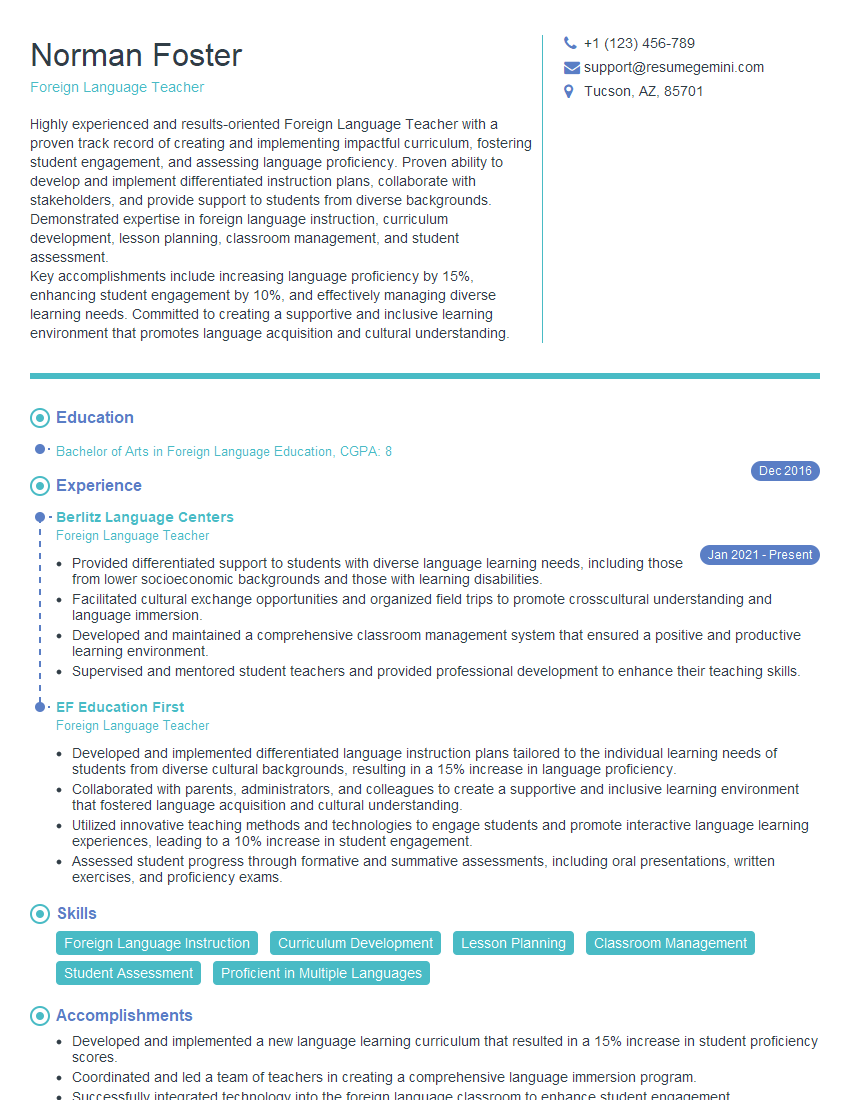
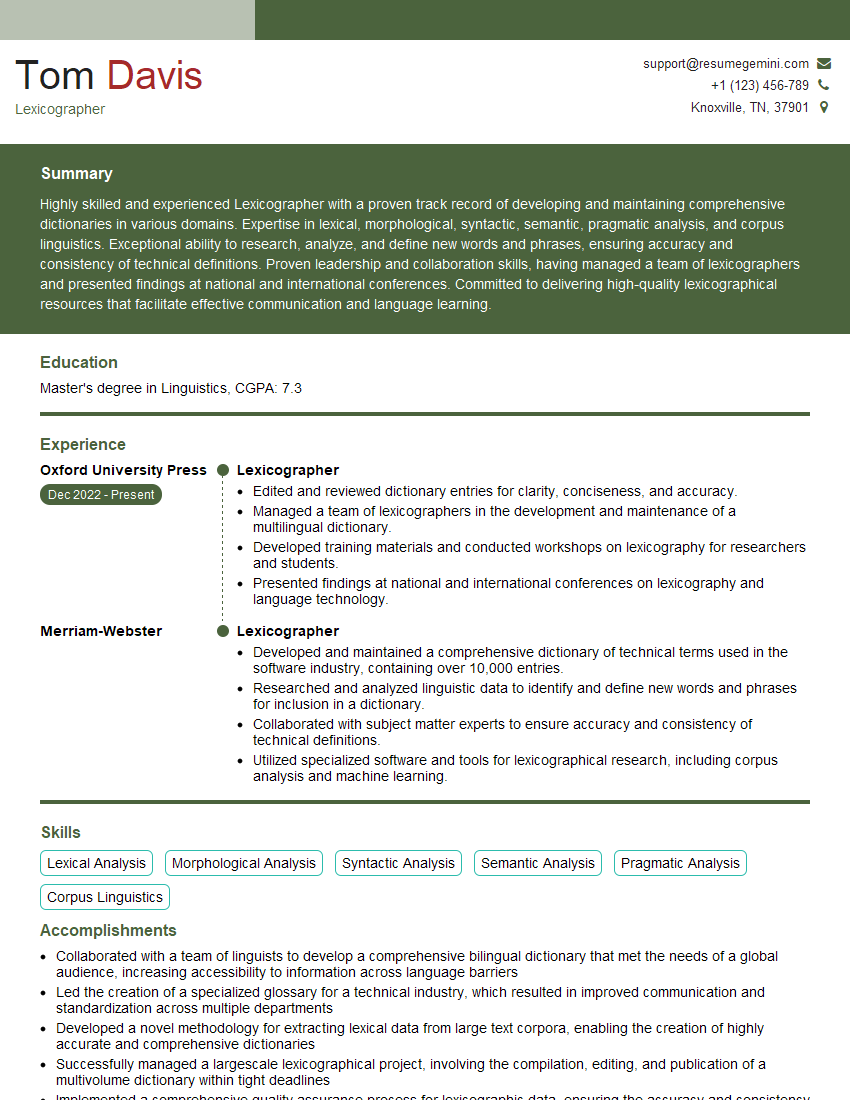
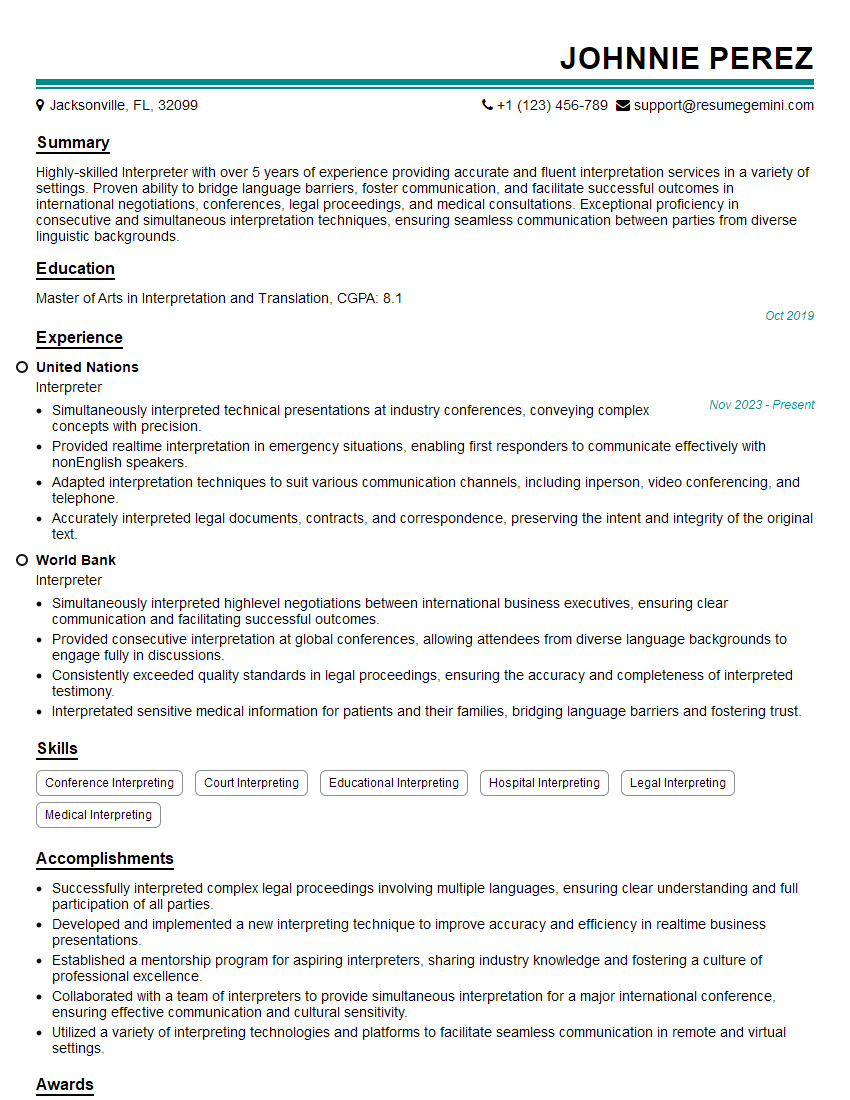
Mastering multiple languages significantly enhances your career prospects, opening doors to global opportunities and roles requiring intercultural communication. A strong, ATS-friendly resume is crucial for showcasing these skills effectively to potential employers. ResumeGemini is a trusted resource to help you craft a compelling and optimized resume that highlights your language proficiency and related experiences. We provide examples of resumes tailored to showcase expertise in multiple languages to help you get started. Invest time in crafting a professional resume that accurately reflects your abilities and career aspirations – it’s your first impression!
Explore more articles
Users Rating of Our Blogs
Share Your Experience
We value your feedback! Please rate our content and share your thoughts (optional).
What Readers Say About Our Blog
Amazing blog
Interesting Article, I liked the depth of knowledge you’ve shared.
Helpful, thanks for sharing.