Feeling uncertain about what to expect in your upcoming interview? We’ve got you covered! This blog highlights the most important Pantone Color Matching Expertise interview questions and provides actionable advice to help you stand out as the ideal candidate. Let’s pave the way for your success.
Questions Asked in Pantone Color Matching Expertise Interview
Q 1. Explain the difference between Pantone Matching System (PMS) and CMYK color models.
The Pantone Matching System (PMS) and CMYK are fundamentally different approaches to color reproduction. PMS is a spot color system, meaning each Pantone color is a premixed ink with a specific formula and unique Pantone number (e.g., Pantone 18-1664 TPX). This ensures consistent color across various substrates and printing methods. Think of it like using a specific paint from a specific brand – you always get the same shade.
CMYK, on the other hand, is a process color system. It uses varying percentages of cyan, magenta, yellow, and black (CMYK) inks to create a wider range of colors. This is subtractive color mixing; the more ink, the darker the color. CMYK relies on the printing process and the quality of the inks and paper to achieve the desired color. Its accuracy is less predictable than PMS, as different printing presses and ink formulations may yield slightly different results for the same CMYK values.
In essence, PMS guarantees consistency, while CMYK offers a wider gamut but with potentially less precise color matching across different print environments.
Q 2. How do you ensure color accuracy across different printing methods using Pantone?
Ensuring color accuracy across various printing methods using Pantone involves meticulous attention to detail throughout the entire process. First, the Pantone color must be accurately specified – using the correct Pantone number and coating (e.g., uncoated, matte, or gloss). Next, it’s crucial to communicate this specification clearly to the printer, including the correct PMS number and any other relevant details. This information should be integrated into the print specifications (e.g., PDF).
Accurate color proofs are essential. We use Pantone-approved proofing systems to ensure the printed proof matches the intended Pantone color accurately. This proofing is then reviewed against the design file to confirm that the colour match is accepted. Finally, throughout the printing process, regular color checks are performed using a spectrophotometer to ensure the printed output remains within the acceptable color tolerance of the original Pantone standard.
For instance, I recently worked on a project where the client needed a very specific shade of Pantone 294 C on various materials (paper, vinyl). Through careful use of Pantone-approved proofs and spectrophotometer verification, we ensured near-perfect color consistency across all the printing and material types involved.
Q 3. Describe your experience with spectrophotometers and their role in color matching.
Spectrophotometers are indispensable tools in color management, and I have extensive experience using them for precise color measurement. A spectrophotometer measures the spectral reflectance or transmittance of a color sample, providing objective data that can be compared to the Pantone standard. This allows for precise quantification of color differences, ensuring consistent color reproduction.
In my work, I use spectrophotometers to:
- Measure the color of printed samples and compare them against the specified Pantone color.
- Verify that the printer is properly calibrated and producing the intended Pantone colors.
- Analyze color differences and identify sources of error in the printing process.
- Establish color tolerance limits to ensure consistency across different print runs and printing environments.
For example, if a printed sample deviates from the expected Pantone color, the spectrophotometer provides precise numerical data (e.g., Delta E values) that help determine the extent and nature of the deviation. This data guides corrective actions, such as ink adjustments or press calibration.
Q 4. What are common challenges in achieving accurate Pantone color reproduction, and how do you address them?
Achieving accurate Pantone color reproduction presents several challenges. Ink variations between different batches, press inconsistencies, substrate variations (different types of paper absorb ink differently), and even ambient lighting conditions can all affect the final color. Furthermore, the limitations of the printing process itself (e.g., the ability of a CMYK system to perfectly reproduce a Pantone spot color) pose another hurdle.
To address these challenges, we implement a multi-pronged approach. This includes using Pantone-approved inks and substrates, meticulously calibrating printing presses, employing accurate color proofs, and using spectrophotometers for regular color checks. We also maintain detailed records of color specifications and production parameters to enable easy traceability. When discrepancies arise, we collaborate closely with the printer to identify the root cause and implement the necessary corrections.
For example, we encountered a case where a Pantone color appeared slightly different in test prints compared to the final run. Through meticulous analysis with a spectrophotometer and careful consideration of the ink batch, press settings, and substrate characteristics, we identified a minor ink variation as the source of the difference. We adjusted the press accordingly and ultimately achieved an acceptable color match.
Q 5. How would you handle a discrepancy between a Pantone color specification and the printed output?
A discrepancy between a Pantone color specification and the printed output requires systematic investigation. First, we meticulously verify the Pantone number and coating specified on the original design and print specifications. Next, we use a spectrophotometer to measure the color of the printed output and quantitatively compare it to the Pantone standard. The Delta E value (a measure of color difference) helps us determine the magnitude of the discrepancy.
Once the discrepancy is confirmed, we systematically investigate possible causes. This might involve examining the ink used, press settings, substrate type, or even ambient lighting conditions during the printing process. We then collaborate with the printer to identify and correct the underlying issue. This often entails adjusting press settings, recalibrating the equipment, or using a new ink batch.
Depending on the severity of the discrepancy and client requirements, we may need to conduct further tests or even reprint the job to ensure color accuracy. Maintaining detailed records throughout the process ensures accountability and facilitates efficient problem-solving.
Q 6. Explain the concept of color tolerance and its significance in Pantone matching.
Color tolerance, often expressed as a Delta E value (ΔE), represents the acceptable range of color variation from a specified Pantone color. It defines how much a printed color can deviate from the target Pantone color while still being considered acceptable. For example, a ΔE of 2 might be acceptable for many applications, while a more demanding application might require a ΔE of 1 or less.
The significance of color tolerance in Pantone matching is paramount because it acknowledges the inherent limitations of the printing process. It’s unrealistic to expect a perfect match every time due to variables mentioned earlier. By defining an acceptable tolerance, we set realistic expectations and prevent unnecessary delays due to minor color variations. The tolerance level is determined considering the specific application and the client’s expectations.
Setting appropriate color tolerances before the printing process starts is crucial for efficient project management and to avoid unnecessary reprints or delays. This ensures that minor deviations do not lead to costly and time-consuming corrections.
Q 7. Describe your experience working with Pantone Connect or other Pantone digital color management tools.
I have extensive experience using Pantone Connect, a valuable digital color management tool. Pantone Connect facilitates seamless color communication and collaboration throughout the design and printing process. It allows designers and printers to access and share Pantone colors digitally, reducing the risk of color mismatches caused by miscommunication or manual transcription errors.
Pantone Connect allows for:
- Accurate color selection and specification.
- Easy color sharing and collaboration across teams and locations.
- Integration with design software for streamlined workflows.
- Access to a vast library of Pantone colors, including historical and future editions.
In my experience, using Pantone Connect has significantly improved color accuracy and efficiency. It eliminates ambiguity and ensures that everyone involved in the project uses the same color standard, resulting in a smoother and more predictable production process. This contributes to a significant reduction in color discrepancies and wasted materials.
Q 8. How do you calibrate monitors and printers to achieve accurate Pantone color representation?
Calibrating monitors and printers for accurate Pantone color representation is crucial for consistent color reproduction across different devices and stages of production. Think of it like tuning a musical instrument – you need to ensure everything is in harmony to produce the desired sound (color). This involves a multi-step process:
Monitor Calibration: Use a colorimeter or spectrophotometer to profile your monitor. Software like X-Rite i1Display Studio or Datacolor SpyderX can measure your monitor’s output and create a profile that corrects for inconsistencies. This ensures what you see on screen closely matches the intended Pantone color.
Printer Calibration: Printer calibration involves using a spectrophotometer to measure the printer’s color output and create a color profile. This profile is then used by the printer driver to adjust the ink quantities to achieve the closest match to the Pantone color specified. Software like X-Rite i1Publish or GMG ColorProof can manage this process. Regular cleaning and maintenance of the printer are also vital for consistent results.
Software Settings: Ensure your design software (Adobe Photoshop, Illustrator, InDesign etc.) is using the correct color profiles (both for your monitor and printer) to avoid color shifts. Working in a color-managed workflow is essential.
Print Conditions: The type of paper, ink, and environmental factors (temperature, humidity) can significantly affect the final color. These variables need to be carefully controlled and accounted for during the calibration process. Testing and creating color profiles for specific paper types ensures consistency.
For example, I once worked on a project where the client’s Pantone color appeared significantly different on their screen and the final print. By carefully calibrating their monitor and the printing press, we were able to achieve a near-perfect match, avoiding costly reprints and delays.
Q 9. What is metamerism and how does it affect Pantone color matching?
Metamerism is a phenomenon where two colors appear to match under one light source but differ under another. Imagine two shirts that look identical in the store under fluorescent lighting, but one appears noticeably different outside in sunlight. This is metamerism.
In Pantone color matching, metamerism is a significant challenge. A Pantone color is defined under standardized lighting conditions (typically D50). However, the final printed color will be viewed under various lighting scenarios. Two different inks that match under D50 might look drastically different under incandescent lighting. This necessitates specifying the viewing conditions (light source) and considering potential metameric failures when designing and printing.
To mitigate metamerism, thorough color proofing under various light sources is necessary. Spectrophotometric measurements can help identify potential metameric mismatches early in the process.
Q 10. Explain the importance of color proofing in the Pantone color matching workflow.
Color proofing is an indispensable step in achieving accurate Pantone color matching. It provides a physical representation of the final printed piece, allowing for a visual assessment of the color accuracy before mass production. Think of it as a final dress rehearsal before the grand opening of a play.
Different types of proofing exist, including:
Soft Proofing: A digital simulation of the final print on screen.
Contract Proofing: A high-quality printed proof used for client approval and as a reference for the final print run.
Press Proofing: A proof printed on the same press that will produce the final job using the same inks and paper, this provides the most accurate representation of the final print.
By comparing the proof against the Pantone specification, any discrepancies can be identified and corrected before investing in a large print run. This prevents costly errors and ensures the final product meets the client’s expectations.
Q 11. How familiar are you with different Pantone color libraries (e.g., Fashion, Home + Interiors)?
I’m very familiar with the various Pantone color libraries. My experience encompasses the widely used systems, including:
Pantone Fashion, Home + Interiors (FHI): This library offers a vast range of colors specifically for textile, apparel, interior design, and related industries. I understand its unique color formulations and applications in different materials.
Pantone Formula Guide: This is the cornerstone library, providing a comprehensive collection of solid coated and uncoated colors widely used across various printing methods.
Pantone Plus Series: The expanded Pantone libraries offering a wider spectrum of colors than the original Formula Guides, improving color accuracy and range.
Pantone Color Bridges: These guides demonstrate the conversion of Pantone colors to different print processes (e.g., CMYK, RGB) to help achieve the closest match across various media.
Understanding the nuances of each library is crucial for selecting the appropriate color for a specific application and predicting how it will reproduce across different materials and printing methods.
Q 12. Describe your experience in managing color consistency across different production runs.
Maintaining color consistency across production runs is paramount. In my experience, I’ve employed several strategies to achieve this:
Strict Color Management: Utilizing standardized color management systems (such as Pantone) and calibrated equipment ensure consistency.
Regular Calibration and Maintenance: Routinely calibrating monitors, printers, and printing presses and conducting regular maintenance checks prevents drift and ensures accuracy.
Color Standards and Controls: Utilizing Pantone color standards throughout the workflow (from design to production) and regularly comparing printed samples against these standards prevents inconsistencies.
Documentation and Record Keeping: Detailed records of color specifications, printing conditions, and any adjustments made during the production process assist in troubleshooting and maintaining consistency across runs.
Batch-to-Batch Color Control: In situations involving large runs or different batches, color control is vital. This often involves spectrophotometric measurements of each batch to ensure minimal variation.
For example, I recently oversaw a large-scale textile production. By meticulously documenting all color parameters, calibrating the machinery, and utilizing a color management system, we achieved consistent color across all batches and minimized any variations in the final product.
Q 13. What is your understanding of colorimetric calculations and their relevance to Pantone matching?
Colorimetric calculations form the basis of Pantone color matching. They involve mathematical models and algorithms to quantify and predict color values. These calculations are essential to accurately translate color specifications into practical printing instructions.
Colorimetry utilizes several important concepts, such as:
CIE Color Space: A standardized system for defining and measuring colors based on human perception.
Spectrophotometry: The measurement of the spectral reflectance or transmittance of a material, allowing for precise color quantification.
Delta E (ΔE): A metric used to quantify the difference between two colors. Smaller ΔE values indicate a closer match.
By understanding and applying these colorimetric principles, I can effectively translate Pantone specifications into printer instructions, ensuring accurate color reproduction. Software packages used in color management often employ these calculations to predict and manage color differences.
Q 14. How would you communicate color specifications effectively to clients or colleagues?
Effective communication of color specifications is crucial to avoid misunderstandings and production errors. I use several strategies to ensure clarity:
Pantone Number Specification: Always specify the exact Pantone color number (e.g., Pantone 18-1664 TPX) to leave no room for ambiguity. This is the most direct way to communicate a specific color.
Color Samples: Providing physical color samples (Pantone chips) alongside the numerical specification provides a visual reference and leaves no room for interpretation.
Clear Documentation: Thoroughly documenting all color specifications, including the Pantone number, substrate (material), and any special instructions for reproduction, ensures that the information is clear and unambiguous.
Visual Communication: Using visual aids such as color palettes and mock-ups helps to convey the desired aesthetic clearly to clients and colleagues. Often a picture paints a thousand words.
Open Communication: Encouraging open dialogue and question-answer sessions ensure everyone understands the color specifications and their implications for the project.
For example, I once collaborated with a client who initially had vague color descriptions. By providing them with actual Pantone chips and clearly specifying the chosen numbers in the contract, we avoided confusion and ensured the final product perfectly matched their expectations.
Q 15. Explain your experience in troubleshooting color-related issues in print production.
Troubleshooting color issues in print production often involves a systematic approach. It starts with understanding the discrepancy: Is the printed color too dark, too light, off-hue, or showing unwanted banding? I begin by analyzing the original Pantone specification, comparing it to the printed output using a spectrophotometer to obtain accurate colorimetric data (L*a*b* values). This allows for objective measurement, eliminating subjective opinions.
Next, I investigate the entire print process: Was the correct Pantone ink used? Were the printing plates properly exposed and etched? Was the ink density consistent across the print run? Were the correct press settings (ink volume, speed, etc.) utilized? I check the substrate (paper or other material) to ensure its absorbency and surface properties don’t affect color reproduction. For example, a highly absorbent paper might lead to a duller, less vibrant Pantone color than expected. Often, minor adjustments to press settings, careful ink mixing, or even slight modifications to the paper selection can resolve discrepancies. In more complex cases, I might work with the printer to calibrate their equipment and ensure accurate color profiles are in use.
For instance, I once encountered a client whose Pantone 18-1664 (Classic Blue) was printing noticeably lighter than the provided swatch. Through analysis, I discovered the issue lay with an incorrectly calibrated ink density setting on the press. A simple adjustment to the settings, combined with a second print run, solved the problem perfectly.
Career Expert Tips:
- Ace those interviews! Prepare effectively by reviewing the Top 50 Most Common Interview Questions on ResumeGemini.
- Navigate your job search with confidence! Explore a wide range of Career Tips on ResumeGemini. Learn about common challenges and recommendations to overcome them.
- Craft the perfect resume! Master the Art of Resume Writing with ResumeGemini’s guide. Showcase your unique qualifications and achievements effectively.
- Don’t miss out on holiday savings! Build your dream resume with ResumeGemini’s ATS optimized templates.
Q 16. Describe your process for creating a Pantone color standard for a new product.
Creating a Pantone color standard for a new product is a precise process that begins with defining the desired color. This often involves collaboration with designers and product developers. We might start with a visual reference, a physical sample, or even a digital color code. The next step is to identify the closest existing Pantone color in the Pantone Formula Guide. This is where subjective evaluation combined with spectrophotometric measurements play a crucial role.
If no existing Pantone color matches precisely, we proceed to custom color formulation. This involves working with a Pantone-certified ink manufacturer. They’ll create a custom color based on our specifications, utilizing specialized equipment and processes. Throughout this process, we use a spectrophotometer to constantly measure and refine the color until it meets the required tolerances. After formulation, Pantone provides a physical standard for the client. The entire process is documented so that the color can be reproduced consistently for future batches of the product.
For example, if a client wants a specific shade of green for their new product packaging, we’d carefully measure its colorimetric values, compare it to the existing Pantone library, and if necessary, work with a Pantone-certified ink producer to develop a unique Pantone color formula. Once the exact shade is achieved, we create a corresponding Pantone standard, ensuring consistent color reproduction across production runs.
Q 17. How do you determine the appropriate color space (e.g., sRGB, Adobe RGB) for a project involving Pantone colors?
Choosing the correct color space when working with Pantone colors is critical. Pantone colors are spot colors, meaning they are defined by a specific ink formula, not by a digital color space. However, to represent these colors digitally, we need to use a color space. While Pantone provides digital equivalents, the rendering will vary across different devices and color spaces.
For print projects, ideally you should stick to a color profile closely tied to your printing process. sRGB offers a reasonable compromise for web and low-resolution output and is widely supported but can lead to inconsistencies. Adobe RGB, with its wider gamut, provides better accuracy but requires careful color management throughout the workflow.
The best approach is to work in a CMYK color space during the print production phase and use Pantone spot colors as the reference. Using color management software, you can then convert your Pantone spot color to a CMYK equivalent which will give you the best possible match on press. However, always remember that a spot color (Pantone) will always be more accurate than any digital representation.
Q 18. What are the limitations of using Pantone colors in digital media?
Pantone colors, being spot colors defined by specific inks, have limitations in digital media. Digital media uses additive color (RGB), whereas print uses subtractive color (CMYK). Directly translating a Pantone color to an RGB value will result in an approximation at best. The gamut (range of reproducible colors) of RGB is different from that of the CMYK gamut used in printing, and neither fully encompasses the entire range of Pantone colors.
This leads to variations in color appearance when moving from a Pantone-defined print to a digital representation on a screen. What looks accurate in print might appear slightly different on a monitor due to differences in color profiles, gamut, and device calibration. Furthermore, inconsistencies can arise due to the different color management practices employed by different software and hardware. One might need to use Pantone Connect or similar software to generate accurate digital representations.
For example, a Pantone color that appears vibrant in print may look duller on a computer screen, and vice versa. It’s crucial to manage expectations and account for these discrepancies when using Pantone colors in digital media.
Q 19. How do you handle variations in color perception between different individuals?
Variations in color perception are a significant challenge. Individuals perceive colors differently due to factors like age, lighting conditions, and even individual differences in cone cell sensitivity in the eye. To mitigate this, we rely on objective color measurement using spectrophotometers. These instruments quantify color using standardized metrics like L*a*b*, providing an objective measure independent of individual perception. The L*a*b* values ensure consistent communication and allow us to verify the accuracy of color reproduction regardless of personal variations in color vision.
I also use standardized lighting conditions (e.g., D50 illuminant) when evaluating colors to control for environmental influences on perception. Furthermore, using Pantone-provided standards and swatches minimizes subjective interpretation by providing a physical reference point for everyone involved in the project.
In short, while subjective perception exists, relying on objective color measurement and standardized conditions reduces the impact of individual differences in the pursuit of color accuracy.
Q 20. How would you manage a situation where a client’s requested Pantone color is not feasible to reproduce?
When a client’s requested Pantone color is infeasible to reproduce, my approach involves a collaborative and transparent discussion. This starts with understanding the reasons for infeasibility – it might be due to the limitations of the chosen printing method, substrate, or the availability of specific inks. I then explain the technical limitations clearly and offer several viable alternatives.
These alternatives could involve suggesting a closely matching Pantone color that’s achievable, exploring different printing processes (e.g., switching from offset to digital printing), or modifying the substrate. I might also propose using a different color space or adjusting the ink formula slightly within the tolerances permitted by Pantone guidelines. The aim is to find the closest achievable match while minimizing compromise on the visual aesthetics of the final product. Open communication and clear explanations are essential to manage client expectations and reach a mutually acceptable solution.
For example, if a client requests a Pantone color that requires a specific fluorescent ink, but the chosen printing process doesn’t support fluorescence, I’d discuss alternatives such as finding a close non-fluorescent match, switching printing methods, or suggesting a digital alternative where the limitations are less pronounced.
Q 21. Explain your experience with various color measurement instruments and software.
My experience encompasses a range of color measurement instruments and software. I regularly use spectrophotometers (both handheld and benchtop models) from leading manufacturers like X-Rite and Datacolor. These instruments provide precise colorimetric data (L*a*b*, ΔE values) essential for accurate color matching and quality control. I am also proficient in using densitometers to measure ink density, which is crucial in evaluating the consistency of color across a print run.
In terms of software, I’m experienced with color management systems such as X-Rite i1Profiler and ColorMunki software. I also use Pantone Connect, which provides digital equivalents of Pantone colors and ensures consistency across different design and production software. These tools are essential for managing and analyzing color data, creating accurate color profiles, and ensuring consistent color reproduction across the entire workflow from design to final output. I’m familiar with both Pantone Color Manager software and other industry-standard tools that facilitate accurate color conversions and simulations.
My expertise spans the use of these tools in diverse applications, from calibrating monitors and printers to analyzing print samples and troubleshooting color discrepancies. This allows me to provide comprehensive color solutions and ensure the successful reproduction of Pantone colors in any medium.
Q 22. What is your understanding of color gamut and its implications for Pantone color reproduction?
A color gamut represents the range of colors a particular device or system can reproduce. Think of it like a painter’s palette – some palettes have a wide variety of colors, while others are limited. In Pantone color reproduction, understanding the gamut is crucial because different output methods (like print, screen, or even different printers) have different gamuts. Pantone strives for consistency, but achieving a perfect match across all devices is practically impossible due to variations in inks, papers, and screen technologies.
For instance, a Pantone color might appear vibrant and saturated when printed on a high-quality coated paper, but the same color might look duller and less saturated when printed on uncoated stock. This is because the uncoated paper can’t reproduce the full range of colors (gamut) that the coated paper can. The Pantone system provides a standardized reference, but the final appearance is always influenced by the output device’s color gamut.
Therefore, understanding the gamut limitations of the target output is essential for managing expectations and achieving the closest possible match to the intended Pantone color. Color management profiles help bridge the gap, but perfect reproduction remains a goal rather than a guaranteed outcome.
Q 23. How familiar are you with different printing substrates and their effects on Pantone color appearance?
My experience encompasses a broad range of printing substrates, including coated and uncoated papers (ranging in weights and finishes like gloss, matte, and silk), card stock, canvas, and various textiles. Each substrate interacts with ink differently, affecting the final Pantone color appearance. Coated papers, for example, typically produce more vibrant and saturated colors compared to uncoated papers due to their smoother surface and better ink absorption properties.
Uncoated papers, while offering a more natural, less glossy feel, often result in slightly muted or less intense Pantone colors. The paper’s brightness (whiteness) also plays a significant role; a brighter paper will generally make colors appear brighter, while a duller paper can make them appear more muted. Different textiles, such as cotton or polyester, further complicate the process, requiring specific ink formulations and printing techniques to achieve accurate color reproduction. I’m adept at selecting the appropriate substrate and considering its impact on Pantone color reproduction to ensure the desired aesthetic outcome is achieved.
Q 24. Describe your experience with color management workflows within a specific software (e.g., Adobe Illustrator, Photoshop)?
In Adobe Illustrator and Photoshop, my workflow centers around utilizing color management profiles (ICCs) to ensure accurate Pantone color representation throughout the design and production process. I meticulously set up color profiles that reflect the intended output device (printer or screen). This includes creating document color spaces (e.g., Adobe RGB or sRGB) and assigning Pantone spot colors directly within the software, avoiding reliance on RGB or CMYK approximations, which can lead to significant color shifts.
Before sending files to print, I carefully review the proof and compare it to the Pantone color standard to assess any deviations. I use soft proofing features within the software to simulate the output on the specified substrate, allowing for adjustments before the final print run. For complex projects with multiple Pantone colors, I create a color palette with Pantone references that’s distributed to the printer to minimize the risk of misinterpretation.
Q 25. Explain how you would maintain accurate Pantone color standards over time.
Maintaining accurate Pantone color standards over time requires a multi-faceted approach. First, storing Pantone color books in a cool, dark, and dry place is critical to prevent degradation of the printed color swatches. Regular inspection of the Pantone guides is necessary, comparing them to archived standards or using a spectrophotometer to measure and verify the color values. This allows for early detection of any fading or deterioration.
Furthermore, using Pantone color standards in digital workflows, and storing digital copies of approved color specifications, creates a more resilient reference system. Calibration of monitors and printers using spectrophotometers and color management profiles is essential to maintaining consistent color throughout the workflow. Finally, keeping detailed records of all Pantone color selections for each project ensures traceability and facilitates recreating colors in future work, even if the original color guides are unavailable.
Q 26. Describe a situation where you successfully resolved a complex color matching challenge.
I once faced a challenge matching a specific Pantone color (Pantone 18-1664 TPX) for a high-end fashion label’s packaging. The chosen paper stock was a unique, textured material that significantly affected the final color appearance. Initial print proofs showed a noticeable color shift, despite using the correct Pantone specification.
To solve this, I collaborated closely with the printer, using a spectrophotometer to measure the actual color of the proof. This allowed us to analyze the color deviations and adjust the ink formulation. We experimented with different ink densities and under color removal techniques until we achieved a near-perfect match, within acceptable tolerances. The process involved careful communication, meticulous color measurement, and a willingness to iterate until the desired result was reached. The final product showcased the brand’s signature color with precision, resulting in client satisfaction.
Q 27. How do you stay updated on the latest advancements in Pantone color systems and technologies?
I stay updated on Pantone advancements through several avenues: I subscribe to Pantone’s publications and newsletters, attend industry conferences and webinars, and actively participate in relevant online communities. I regularly consult the Pantone website for updates on new color systems, software updates, and best practices. Moreover, I follow industry experts and thought leaders in color management and printing technologies through professional journals and social media.
Staying informed about technological advancements, such as new printing methods and color technologies, is essential for maintaining my expertise and adapting to the ever-evolving landscape of color reproduction. This ensures I am always prepared to tackle new color matching challenges and provide the most effective solutions.
Q 28. What are your salary expectations for this role?
My salary expectations for this role are in the range of [Insert Salary Range] annually, commensurate with my experience and expertise in Pantone color matching and color management. This is based on my research of comparable positions in the industry and reflects my extensive experience and skillset.
Key Topics to Learn for Pantone Color Matching Expertise Interview
- Understanding the Pantone Matching System (PMS): Thoroughly grasp the structure and organization of the PMS, including the different color libraries and their applications.
- Color Theory Fundamentals: Demonstrate a strong understanding of color models (RGB, CMYK), color relationships (complementary, analogous, etc.), and color harmony principles.
- Practical Color Matching Techniques: Be prepared to discuss your experience with spectrophotometers, colorimeters, and other tools used for precise color measurement and matching. Explain your process for resolving color discrepancies.
- Digital Color Management (DCM): Showcase your knowledge of profile creation, color space conversion, and how to ensure consistent color reproduction across different media (print, web, etc.).
- Industry-Specific Applications: Highlight your understanding of how Pantone color matching is applied in various industries such as printing, packaging, fashion, and design. Be ready to provide examples.
- Troubleshooting and Problem-Solving: Prepare to discuss how you approach and resolve common color matching challenges, such as metamerism and variations in color perception across different viewing conditions.
- Quality Control and Standards: Demonstrate your familiarity with relevant industry standards and quality control measures related to color accuracy and consistency.
Next Steps
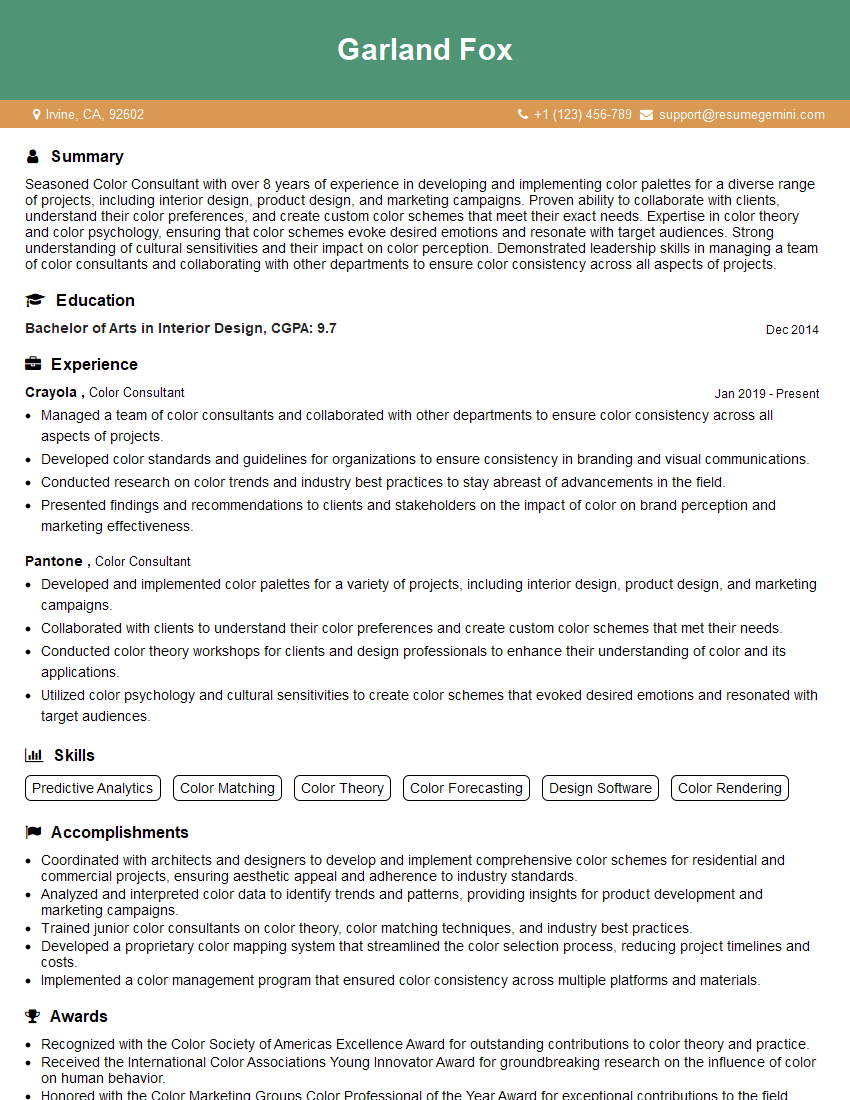
Mastering Pantone Color Matching Expertise opens doors to exciting career opportunities in creative and technical fields, offering high demand and competitive salaries. To significantly increase your chances of landing your dream role, crafting an ATS-friendly resume is crucial. This ensures your qualifications are effectively communicated to Applicant Tracking Systems and recruiters alike. ResumeGemini is a trusted resource that can help you build a professional and impactful resume tailored to your specific skills and experience. We provide examples of resumes specifically tailored to Pantone Color Matching Expertise to guide you. Take the next step towards your dream career today!
Explore more articles
Users Rating of Our Blogs
Share Your Experience
We value your feedback! Please rate our content and share your thoughts (optional).
What Readers Say About Our Blog
Amazing blog
Interesting Article, I liked the depth of knowledge you’ve shared.
Helpful, thanks for sharing.