Are you ready to stand out in your next interview? Understanding and preparing for Sign Language and Nonverbal Communication interview questions is a game-changer. In this blog, we’ve compiled key questions and expert advice to help you showcase your skills with confidence and precision. Let’s get started on your journey to acing the interview.
Questions Asked in Sign Language and Nonverbal Communication Interview
Q 1. Explain the difference between interpreting and translating in the context of Sign Language.
While both interpreting and translating involve conveying meaning between languages, they differ significantly in their process and context. Translation is a written process; it involves converting written text from one language to another. Interpreting, on the other hand, is an oral or signed process, conveying meaning in real-time between two languages, in this case, spoken language and sign language. Think of it like this: translation is like meticulously crafting a letter, while interpreting is like having a live conversation, adapting your message on the fly.
In sign language, interpreting involves more than just translating individual words. It requires understanding the nuances of facial expressions, body language, and cultural context of both the source and target languages to accurately convey the message’s meaning and intent. A direct word-for-word translation often fails to capture the subtleties, leading to misinterpretations. For example, a seemingly simple statement like “I’m tired” might be signed differently depending on whether the speaker is physically exhausted or emotionally drained.
Q 2. Describe your experience with various Sign Language modalities (e.g., ASL, SEE, etc.).
My experience encompasses a range of sign language modalities, primarily focusing on American Sign Language (ASL), but also including exposure to Signed Exact English (SEE) and various regional sign systems. ASL, being a visual language with its own grammatical structure and lexicon, demands a deep understanding of its linguistic nuances. My proficiency in ASL includes interpreting various settings, from educational to medical and legal contexts. SEE, conversely, aims for a more direct word-to-sign correspondence with spoken English. Understanding these differences is crucial for choosing the appropriate method based on the context and the Deaf individual’s communication preferences.
I’ve actively sought opportunities to interact with and learn from Deaf individuals fluent in these different modalities, recognizing that language acquisition is a continuous journey, constantly adapting and evolving with cultural shifts.
Q 3. How do you maintain accuracy and fluency while interpreting complex or technical information?
Maintaining accuracy and fluency with complex or technical information requires meticulous preparation and strategic interpretation techniques. For example, when interpreting a medical lecture, I would thoroughly review the material beforehand, identifying key terms and concepts. During the interpretation, I use various techniques such as paraphrasing, simplification, and using visual aids to help the Deaf audience grasp the concepts clearly. Instead of directly translating complex jargon, I would explain the concepts in a way that is both accurate and accessible.
Let’s say a speaker uses the term “ischemic stroke.” Instead of simply signing the term, I would explain it in layman’s terms, perhaps as “a stroke caused by a blockage in a blood vessel in the brain.” This ensures understanding while maintaining the accuracy of the message.
Continuous professional development is essential; I regularly attend workshops and conferences to stay updated with the latest terminology and techniques in different fields.
Q 4. What strategies do you employ to manage fatigue during prolonged interpreting assignments?
Prolonged interpreting assignments can be physically and mentally demanding. I employ several strategies to manage fatigue and maintain my performance. These include:
- Proper hydration and nutrition: Maintaining adequate fluid and energy levels is paramount.
- Regular breaks: Taking short breaks at regular intervals allows for rest and mental refocusing. Even a few minutes of stretching or deep breathing exercises can make a significant difference.
- Teamwork: Where possible, I work collaboratively with other interpreters to share the workload and avoid burnout.
- Self-awareness: Recognizing my own physical and mental limitations is critical. If I’m experiencing excessive fatigue, I won’t hesitate to communicate this to the relevant parties and request appropriate adjustments or breaks.
Ultimately, prioritizing self-care is crucial to preventing burnout and delivering high-quality interpreting services.
Q 5. Explain the ethical considerations of sign language interpreting.
Ethical considerations in sign language interpreting are paramount. The core principle is confidentiality; interpreters must treat all information shared during an assignment as strictly private. Accuracy and impartiality are also vital; interpreters should convey the meaning of the source message faithfully and without bias.
Another crucial aspect is cultural competency; understanding the specific cultural norms and communication styles of the Deaf community being served is essential. For example, respecting the Deaf community’s preferences regarding communication styles and avoiding assumptions about their capabilities or preferences is crucial. This includes being mindful of appropriate terminology and avoiding patronizing language. Finally, maintaining professional boundaries and disclosing any potential conflicts of interest are vital for ensuring ethical practice.
Q 6. Describe your experience working with diverse Deaf communities.
My experience working with diverse Deaf communities has been incredibly enriching. I’ve worked with individuals from various cultural backgrounds and linguistic backgrounds, each with their own unique communication styles and preferences. This experience has highlighted the importance of cultural sensitivity and adaptability in interpreting.
For instance, working with a Deaf community that uses a specific regional sign system required me to supplement my ASL skills with further research and learning of that specific variation. It wasn’t just about understanding the signs themselves, but also the cultural nuances embedded in their usage. Building rapport and trust with individuals from various cultural groups is as important as understanding the language itself.
Q 7. How do you adapt your interpreting style to different communication contexts?
Adapting my interpreting style depends heavily on the communication context. In a formal setting, like a legal proceeding, my interpretation style will be more formal and precise, prioritizing accuracy and clarity over expressiveness. In a casual setting, like a social gathering, my style may be more relaxed and conversational, allowing for more natural and fluid communication.
The audience also plays a crucial role. If interpreting for a Deaf child, I would use simpler vocabulary and incorporate more visual aids. If working with a group of Deaf adults discussing a technical topic, my interpreting would focus on accuracy and the use of appropriate technical terminology. Flexibility and adaptability are paramount to ensuring effective communication in diverse contexts.
Q 8. How do you handle situations where you encounter unfamiliar vocabulary or concepts?
Encountering unfamiliar vocabulary or concepts is a common challenge in sign language interpreting. My approach is multifaceted and prioritizes accuracy and transparency. First, I utilize contextual clues within the conversation to infer meaning. I observe the speaker’s facial expressions, body language, and the overall context of the discussion to build understanding. If the meaning remains elusive, I may politely ask for clarification from the speaker, using techniques such as finger spelling or asking for a simpler explanation in spoken language, if appropriate. For example, if I encounter a technical term I don’t know in a medical setting, I’ll politely ask the doctor for a simpler explanation or to write it down, then I will research the term later to further improve my understanding for future reference.
Secondly, I maintain a constant process of professional development through continuous learning. This includes attending workshops, conferences, and independent study using resources like dictionaries of sign language and glossaries specific to different fields. It’s important to acknowledge the limitation of my knowledge and not pretend to understand something I don’t.
Q 9. How do you navigate situations with conflicting communication styles between Deaf and hearing individuals?
Conflicting communication styles between Deaf and hearing individuals often stem from cultural differences and varying communication preferences. Deaf individuals may communicate using a range of styles, from formal to informal, while hearing individuals may unknowingly impose their communication norms. My role as an interpreter is to bridge this gap, promoting mutual understanding and respect. I achieve this by adapting my interpreting style to suit the specific context and communication styles of both parties.
For example, if a Deaf individual prefers a more direct and concise style of communication and the hearing individual speaks very verbosely, I might adjust my interpretation to be more concise, reflecting the Deaf individual’s style while still accurately conveying the full meaning.
Furthermore, I actively educate participants about cultural nuances and communication preferences, explaining any cultural differences to both parties. This proactive approach can prevent misunderstandings and foster more effective communication.
Q 10. What technologies are you familiar with to aid in interpreting?
Technology plays an increasingly important role in modern interpreting. I am proficient in using video remote interpreting (VRI) platforms, which allow for real-time interpretation via video conferencing. I’m also familiar with various software applications for note-taking and transcription services that can supplement my interpretation. These tools enable me to handle a broader range of interpreting assignments and improve the overall efficiency of the process.
Additionally, I’m comfortable utilizing assistive technology for individuals with additional communication needs. This includes experience with captioning software and other assistive devices for individuals with multiple disabilities.
Q 11. Discuss your understanding of Deaf culture and its impact on communication.
Understanding Deaf culture is fundamental to effective interpreting. Deaf culture is rich and diverse, with its own unique values, norms, and communication styles. It’s not merely the absence of hearing; it’s a vibrant culture with its own history, art, literature, and social structures. A key element of Deaf culture is the emphasis on visual communication; Sign Language is not just a way to communicate; it is an integral part of their identity and community building.
Respect for Deaf culture is crucial because it impacts how I interpret. For example, I am mindful of the importance of eye contact and facial expressions in Deaf communication. I am also aware of the importance of Deaf community norms and social cues which might differ from the hearing world and adjust my interpretation accordingly. Interpreting is not just about translating words; it’s about conveying the cultural context and nuances appropriately.
Q 12. How do you ensure accurate and effective relay of nuanced emotional cues during interpretation?
Conveying nuanced emotional cues accurately requires keen observation skills and a deep understanding of both signed and spoken language. I pay close attention to the speaker’s facial expressions, body language, tone of voice (if spoken), and the overall context of the conversation. I use my own facial expressions and body language to mirror and convey the emotions effectively in the target language. For example, if someone is expressing sadness, I not only translate the words but also convey the sadness through my own facial expressions and body language in my interpretation. This includes subtle adjustments in my signing speed, pauses, and emphasis to reflect the emotions.
Additionally, I maintain continuous awareness of the emotional impact on both parties involved in the interaction. The goal is to ensure that the emotion is understood and not misinterpreted or lost in translation.
Q 13. Describe your process for self-assessment and professional development as an interpreter.
Self-assessment and professional development are integral to my work as an interpreter. I regularly review my own performance through self-reflection, seeking feedback from colleagues and clients. I keep a journal documenting challenging situations, reflecting on my strategies, and identifying areas for improvement. This allows for continuous growth and refinement of my skills.
My professional development involves ongoing training and education through attending workshops, conferences, and online courses. This includes keeping abreast of developments in the field, new technologies, and cultural insights. I actively seek mentorship and guidance from experienced interpreters and actively engage in professional organizations dedicated to improving interpreting standards. Continuing education is an ongoing commitment to ensuring my interpreting practices remain high-quality.
Q 14. How do you maintain confidentiality during your interpreting work?
Confidentiality is paramount in my work. I strictly adhere to ethical guidelines and professional codes of conduct that emphasize confidentiality. I never disclose information shared during interpreting assignments, whether it be personal, medical, legal, or financial. I treat all communication I encounter as strictly private and confidential. I understand that breaching confidentiality could have serious consequences, impacting clients’ lives and my professional standing. I also ensure that any notes or recordings made during interpreting assignments are securely stored and disposed of according to established procedures.
Furthermore, I actively educate clients about confidentiality expectations at the start of each assignment. This ensures everyone understands the importance of confidentiality and their responsibility in maintaining it.
Q 15. What are the key components of effective nonverbal communication?
Effective nonverbal communication hinges on several key components working in harmony. Think of it as an orchestra – each instrument (nonverbal cue) plays a crucial role in creating a cohesive and meaningful message. These components include:
- Body Language: This encompasses posture, gestures, facial expressions, and eye contact. A slumped posture might suggest disinterest, while open and expansive gestures can convey confidence. Maintaining eye contact (while culturally appropriate) demonstrates engagement.
- Proxemics: This refers to the use of space. The distance we maintain from others communicates intimacy and power dynamics. Standing too close might feel invasive, while excessive distance can create a sense of detachment.
- Kinesics: This is the study of body movement, including gestures, posture, and facial expressions. A subtle nod can indicate agreement, whereas a furrowed brow suggests concern or disagreement.
- Haptics: This relates to touch. A handshake, a pat on the back, or even a simple touch on the arm can convey different levels of intimacy and rapport. The appropriateness of touch is highly culturally dependent.
- Paralanguage: This involves the vocal cues that accompany speech, such as tone, pitch, volume, and pace. A sharp tone might signal anger, while a softer tone suggests calmness. Silence, too, can be a powerful nonverbal cue.
Mastering these components allows for nuanced and impactful communication, ensuring your message is received clearly and accurately.
Career Expert Tips:
- Ace those interviews! Prepare effectively by reviewing the Top 50 Most Common Interview Questions on ResumeGemini.
- Navigate your job search with confidence! Explore a wide range of Career Tips on ResumeGemini. Learn about common challenges and recommendations to overcome them.
- Craft the perfect resume! Master the Art of Resume Writing with ResumeGemini’s guide. Showcase your unique qualifications and achievements effectively.
- Don’t miss out on holiday savings! Build your dream resume with ResumeGemini’s ATS optimized templates.
Q 16. Describe how cultural differences can impact nonverbal communication.
Cultural differences significantly impact nonverbal communication. What’s considered polite or acceptable in one culture might be offensive or misinterpreted in another. For instance:
- Eye Contact: Prolonged eye contact is valued in some Western cultures as a sign of honesty and engagement, but in other cultures, it can be seen as disrespectful or challenging.
- Personal Space: The comfortable distance between individuals varies widely. What feels normal in one culture might feel intrusive in another.
- Gestures: A gesture that’s innocuous in one culture might be offensive or have a completely different meaning in another. The “OK” hand gesture, for example, can be insulting in some parts of the world.
- Touch: Physical touch is interpreted differently across cultures. What might be a friendly gesture in one culture might be considered inappropriate or even harassing in another.
Understanding these cultural nuances is crucial for effective cross-cultural communication. Failing to do so can lead to misunderstandings, misinterpretations, and even offense.
Q 17. How do you interpret body language in different contexts?
Interpreting body language requires considering the context. A single gesture, posture, or facial expression can mean different things depending on the situation. For example:
- Context 1: Job Interview: A candidate fidgeting might be interpreted as nervousness, a lack of confidence, or even dishonesty.
- Context 2: Casual Conversation with Friends: That same fidgeting might simply reflect comfort, energy, or excitement.
- Context 3: Medical Setting: A patient clutching their chest might indicate pain, whereas in a different setting it might simply mean they’re cold.
Therefore, effective interpretation requires observing multiple cues simultaneously and considering the surrounding circumstances. Looking for clusters of consistent cues, rather than relying on a single gesture, gives a more accurate picture.
Q 18. How do you identify and address communication barriers related to nonverbal cues?
Addressing communication barriers related to nonverbal cues requires careful observation, empathy, and clear communication. Here are some strategies:
- Clarification: If unsure about a nonverbal cue, gently ask for clarification. For example, “I noticed you seemed hesitant; is there something you’d like to discuss?”
- Active Listening: Pay close attention to both verbal and nonverbal cues. Reflect back what you see and hear to ensure understanding. “It seems like you’re saying X, but your body language suggests Y. Can you elaborate?”
- Cultural Sensitivity: Be aware of and sensitive to cultural differences in nonverbal communication. Avoid making assumptions based solely on your own cultural background.
- Environment: Assess the environment. Noise, distractions, or uncomfortable seating can significantly influence nonverbal cues.
By actively addressing potential barriers and promoting a safe space for open communication, we can overcome misunderstandings and foster stronger connections.
Q 19. Explain how you would handle a situation where nonverbal cues contradict verbal communication.
When nonverbal cues contradict verbal communication, it’s crucial to address the discrepancy directly and respectfully. This usually signals a deeper emotional or psychological issue.
Step-by-step approach:
- Acknowledge the Discrepancy: Gently point out the inconsistency. For example, “I noticed you said you’re fine, but your body language suggests otherwise.”
- Create a Safe Space: Emphasize that it’s safe to express their true feelings without judgment.
- Active Listening: Encourage them to elaborate on the discrepancy. “Can you tell me more about what’s going on?”
- Empathy and Validation: Show understanding and validate their feelings, even if you don’t fully understand them. “That sounds really difficult.”
- Further Investigation (if necessary): In professional settings, you might need to escalate the situation to a supervisor or HR for further support or intervention, especially if the discrepancy persists or indicates a serious issue.
The goal is not to confront, but to create a space where the individual feels comfortable expressing their true feelings, whether verbal or nonverbal.
Q 20. How can nonverbal communication enhance or hinder effective communication?
Nonverbal communication can significantly enhance or hinder effective communication. It acts as a powerful amplifier or a disruptive noise depending on its alignment with the verbal message.
- Enhancement: When verbal and nonverbal cues are consistent, the message is reinforced, making it more impactful and memorable. A confident speaker with open body language and strong eye contact will be perceived as more credible and persuasive.
- Hindrance: Inconsistent cues create confusion and distrust. For example, someone saying they are happy while exhibiting a downcast expression will likely be perceived as insincere. This can lead to misinterpretations, misunderstandings, and breakdown in communication.
Therefore, careful attention to both verbal and nonverbal communication is crucial for delivering a clear, concise, and credible message.
Q 21. Describe how you would ensure accessibility for individuals with varying communication needs.
Ensuring accessibility for individuals with varying communication needs requires a multifaceted approach. This includes:
- Sign Language Interpreters: Providing qualified interpreters for individuals who are deaf or hard of hearing.
- Assistive Listening Devices: Making available devices like hearing loops or FM systems to aid individuals with hearing impairments.
- Visual Aids: Using visual aids like presentations, diagrams, or written materials to support verbal communication.
- Augmentative and Alternative Communication (AAC) Systems: Utilizing various AAC technologies, such as picture exchange systems (PECS) or communication boards, to accommodate individuals with speech impairments or complex communication needs.
- Adaptive Communication Strategies: Adjusting communication style to suit the individual’s needs and preferences – for example, using slower speech, clear enunciation, and minimizing background noise.
- Culturally Sensitive Approaches: Being mindful of cultural differences and practices in communication.
In essence, accessibility is about creating an inclusive environment where everyone can participate fully and effectively, regardless of their communication style or limitations.
Q 22. How do you incorporate visual aids or other assistive technologies to enhance communication?
Incorporating visual aids and assistive technologies is crucial for enhancing communication, especially in sign language interpretation. It’s about maximizing clarity and accessibility for all parties involved. Think of it like adding subtitles to a movie – it makes the content understandable even for those who might struggle with the primary mode of communication.
Visual aids: Pictures, diagrams, written words, and objects can significantly clarify abstract concepts or complex information. For example, when interpreting a medical procedure, a diagram showing the steps involved can be invaluable. Similarly, using a visual representation of a geographical location during a travel-related interpretation can be incredibly helpful.
Assistive technologies: These can include video relay services (VRS), which enable communication between deaf individuals and hearing individuals through a video interpreter, or specialized software for captioning or real-time transcription of spoken language. These technologies bridge communication gaps and extend accessibility beyond the immediate physical presence of an interpreter.
Strategic use: The key is to use these aids judiciously. Overusing them can be distracting, while underutilizing them can leave the audience struggling to comprehend the information. A skilled interpreter anticipates the need for visual aids and integrates them seamlessly into the communication flow.
Q 23. What strategies do you employ to facilitate clear and effective communication across cultural differences?
Facilitating clear communication across cultural differences requires a deep understanding of cultural nuances and a flexible approach. Sign languages, like spoken languages, have regional variations and cultural embeddedness.
Cultural awareness: I start by recognizing that different cultures have different communication styles. Some cultures are more direct, while others are more indirect. Some value personal space more than others. This awareness informs my interpretation style, ensuring that the message is conveyed appropriately and respectfully.
Linguistic adaptation: I adapt my signing style to be more culturally sensitive. This might mean adjusting my signing speed, using specific cultural signs, or avoiding certain gestures that could be misinterpreted.
Building rapport: Establishing a rapport with both the deaf and hearing individuals is essential. This involves actively listening, showing empathy, and demonstrating respect for their cultural background. A simple smile or nod can go a long way in building trust and understanding.
Seeking clarification: When uncertainty arises, I don’t hesitate to ask clarifying questions from both parties to ensure accuracy and avoid misinterpretations due to cultural differences.
Q 24. Explain your understanding of the linguistic features of Sign Language.
Sign languages are fully-fledged natural languages with their own grammatical structures, syntax, and lexicon – they are not simply mime or gestures. They possess a rich linguistic complexity that rivals spoken languages.
Grammar: Sign languages use spatial relationships, facial expressions, and body movements to convey grammatical information, often in ways that differ significantly from spoken languages. For instance, grammatical relationships might be indicated through the location of signs in space.
Syntax: The order of signs in a sentence can significantly alter its meaning, just as in spoken languages. There are rules governing the placement of signs, and these rules vary between sign languages.
Lexicon: Sign languages have their own distinct vocabulary (lexicon), with many signs that have no direct equivalent in spoken languages. The signs themselves are often iconic (reflecting the meaning visually), but many are arbitrary (no inherent connection to the meaning).
Morphology: Like spoken languages, many sign languages incorporate morphological processes, which involve changing the form of a sign to modify its meaning (e.g., adding a repetitive movement to indicate plurality).
Q 25. How do you differentiate between various dialects of Sign Language?
Differentiating between dialects of sign languages involves recognizing variations in sign vocabulary, grammar, and signing style. These differences can be regional (geographical location) or social (based on community or age group).
Vocabulary: Different dialects might use different signs for the same concept. For example, the sign for “thank you” may vary slightly in handshape or movement across regions within a single country.
Grammar: The grammatical structures of different dialects can also differ. For instance, the order of signs within a sentence might change, or the way grammatical information is conveyed through facial expressions or body movement may differ.
Signing style: Variations in signing style include differences in signing speed, handshape precision, and the use of particular non-manual markers (facial expressions and body postures). These stylistic differences are often subtle and difficult to pinpoint, requiring extensive experience and exposure to various dialects.
Immersion and observation: To master this differentiation, I rely on extensive immersion in various signing communities, studying and observing the linguistic features of those dialects firsthand. Regular interaction with sign language users from different backgrounds helps develop a keen eye for these subtle variations.
Q 26. Describe your experience with interpreting in various settings (medical, legal, educational, etc.).
My interpreting experience spans various settings, each with its own unique communication challenges and ethical considerations.
Medical: Interpreting in medical settings requires a high level of accuracy and cultural sensitivity. Medical terminology needs careful consideration, and ensuring both parties fully understand the information exchanged is paramount.
Legal: Legal settings demand precise and impartial interpretation. The accuracy of the information conveyed can have legal ramifications, so the interpreter must maintain strict neutrality and adhere to ethical guidelines.
Educational: In educational settings, I’ve worked with students from diverse backgrounds, adapting my interpretation style to facilitate their learning and inclusion. This involves understanding the learning styles and educational needs of the students.
Other settings: I have also interpreted in social settings, community events, and religious services, demonstrating adaptability across different communication contexts and utilizing the appropriate interpreting modes.
Q 27. What are some common challenges faced by sign language interpreters, and how have you overcome them?
Sign language interpreters face numerous challenges, but effective strategies exist to overcome them.
Maintaining neutrality and impartiality: It is crucial to remain objective, avoiding any influence on the communication between the parties. This is especially critical in legal and medical settings.
Managing fatigue: Interpreting is mentally and physically demanding. Strategies like taking breaks, practicing self-care, and utilizing note-taking techniques are vital for managing fatigue and maintaining accuracy.
Dealing with challenging communication styles: Some individuals may have communication styles that make interpreting difficult. Developing strategies to handle interruptions, rapid speech, and unclear instructions is essential.
Addressing language barriers within the Deaf community: Understanding regional variations and different levels of fluency is essential. Cultural considerations and linguistic accommodations may need to be addressed.
Overcoming these challenges: Professional development, collaboration with other interpreters, and seeking supervision when needed are invaluable for improving skills and addressing challenges.
Q 28. Describe a situation where you had to make a quick decision that affected the flow of communication. What did you do and why?
During a medical appointment, the doctor was explaining a complex diagnosis using highly technical terminology. The patient, visibly distressed, was struggling to understand. I noticed the patient’s increasing anxiety and recognized that a direct translation of the medical jargon was not only confusing but was also escalating their emotional distress.
My decision: I opted to break down the explanation into simpler terms, using analogies and visual aids to illustrate the concepts. Instead of translating word-for-word, I focused on conveying the essence of the message in a way the patient could grasp, prioritizing emotional support alongside accurate information.
Reasoning: My priority was to ensure the patient understood the critical aspects of their diagnosis without adding to their anxiety. While maintaining accuracy, I adjusted my interpretation to suit the patient’s immediate emotional state and cognitive processing capabilities. The result was a more productive and less stressful interaction for everyone involved.
Key Topics to Learn for Sign Language and Nonverbal Communication Interview
- Understanding Sign Language Variations: Explore the nuances of different sign languages (e.g., ASL, BSL) and their regional dialects. Consider the impact of cultural differences on signing styles and interpretation.
- Nonverbal Communication Decoding: Practice interpreting facial expressions, body language, and proxemics within the context of a signed conversation. Understand how these elements enhance or contradict verbal communication (signed or spoken).
- Effective Communication Strategies: Develop techniques for clear and concise signing, ensuring proper grammar, fluidity, and expression. Learn strategies for adapting communication style to different audiences and settings.
- Interpreting and Translating: Understand the difference between interpreting (conveying meaning dynamically) and translating (providing a verbatim written equivalent). Practice both skills within simulated interview scenarios.
- Ethical Considerations: Familiarize yourself with professional codes of conduct for sign language interpreters and communicators, including confidentiality and impartiality.
- Technological Applications: Explore assistive technologies used for communication, such as video relay services (VRS) and captioning software. Discuss their implications and limitations.
- Problem-Solving in Communication: Practice navigating challenging communication situations, such as dealing with differing communication styles, technical difficulties, or ambiguous messages. Develop strategies for clarifying misunderstandings.
Next Steps
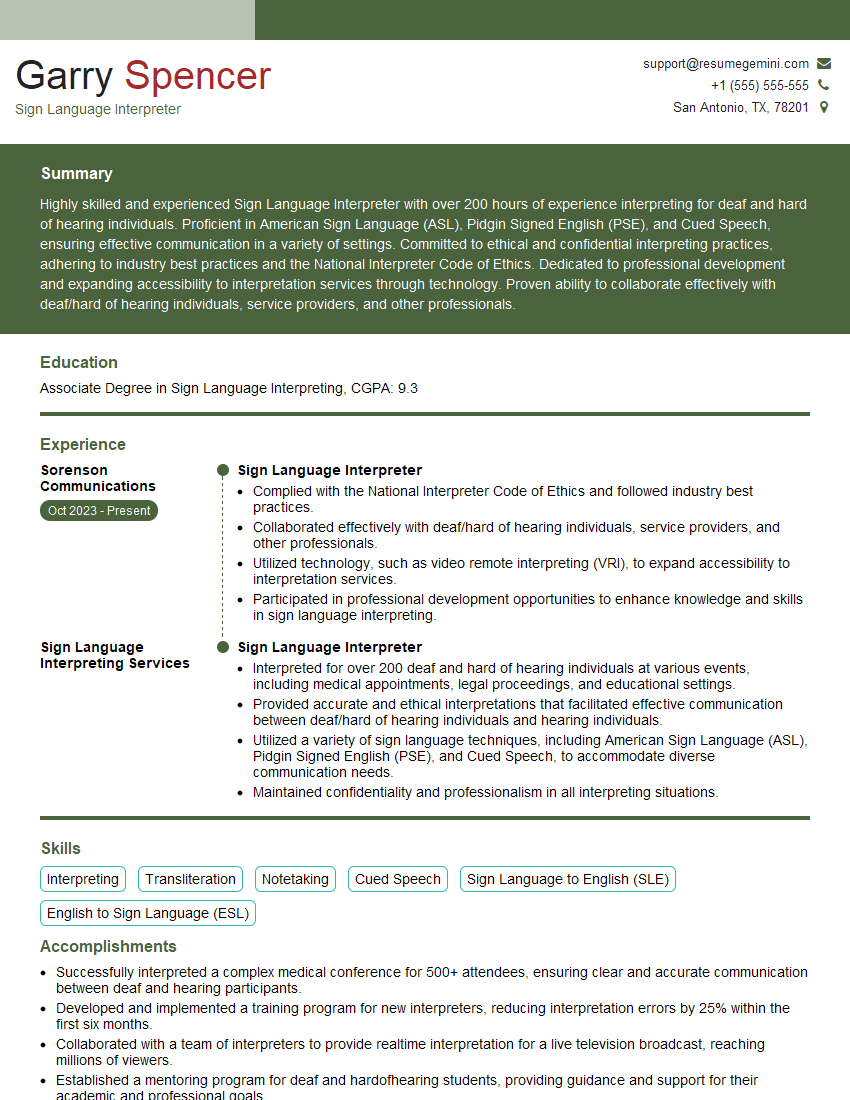
Mastering Sign Language and Nonverbal Communication opens doors to rewarding careers in diverse fields, offering opportunities for impactful communication and connection. A strong resume is essential for showcasing your skills and experience to potential employers. Building an ATS-friendly resume increases your chances of getting noticed and invited for interviews. ResumeGemini is a trusted resource to help you create a professional and impactful resume. Examples of resumes tailored to Sign Language and Nonverbal Communication professionals are available, providing valuable templates to guide your creation process.
Explore more articles
Users Rating of Our Blogs
Share Your Experience
We value your feedback! Please rate our content and share your thoughts (optional).
What Readers Say About Our Blog
Amazing blog
Interesting Article, I liked the depth of knowledge you’ve shared.
Helpful, thanks for sharing.