The right preparation can turn an interview into an opportunity to showcase your expertise. This guide to Structural Framing interview questions is your ultimate resource, providing key insights and tips to help you ace your responses and stand out as a top candidate.
Questions Asked in Structural Framing Interview
Q 1. Explain the different types of wood framing connections.
Wood framing connections are crucial for the structural integrity of a building. They transfer loads from one member to another, ensuring stability and resisting forces like wind and gravity. The type of connection depends on the specific load and the members involved. Common types include:
- Nail Connections: These are the most common, using nails of various sizes and types (common, sinkers, etc.) driven into the wood. The strength depends on the number, size, and angle of the nails, as well as the wood species. For example, toe-nailing (driving nails at an angle) is used to connect intersecting members.
- Screw Connections: Screws provide superior strength and withdrawal resistance compared to nails, especially in engineered wood products. They are particularly useful in situations requiring adjustable connections or higher load capacity. Different screw types exist, optimized for specific applications.
- Bolted Connections: Used for heavier loads and larger members, bolted connections offer high strength and allow for easy disassembly. Bolts are typically used with washers and nuts to ensure proper clamping force. This is common in heavy timber construction or connection to steel components.
- Metal Connectors: These include plates, angles, and other prefabricated metal pieces that are fastened to the wood members to improve connection strength and efficiency. They are often used in complex joints or where high strength is required, like in seismic zones. Examples include joist hangers, hurricane straps, and shear plates.
- Glue Connections: While not as common as other methods, glue can be used in conjunction with other fasteners to enhance strength and stiffness in joints. Wood glue creates a strong bond when properly applied, especially in laminated lumber.
Choosing the appropriate connection type involves careful consideration of the loads, species of wood, and building codes.
Q 2. Describe your experience with various framing materials (e.g., lumber, engineered wood).
My experience encompasses a wide range of framing materials, from traditional lumber to advanced engineered wood products. I’ve worked extensively with various lumber grades, understanding their strength properties and limitations. For instance, I know that selecting the appropriate grade of lumber – like No. 1 or No. 2 – is critical depending on the member’s function and load requirements.
Engineered wood products, such as Laminated Veneer Lumber (LVL), Parallel Strand Lumber (PSL), and Glulam, offer significant advantages in terms of strength, consistency, and dimensional stability. I’m proficient in designing and constructing with these materials, understanding their unique characteristics and optimal application methods. For example, I’ve used LVL beams to span longer distances than would be feasible with traditional lumber, resulting in cleaner and more efficient designs.
I also have experience working with composite lumber, which offers durability and resistance to rot and insects, ideal for exterior applications. Proper understanding of material properties and their respective limitations is crucial for safe and effective structural design.
Q 3. How do you ensure proper wall bracing and shear resistance in a framing structure?
Proper wall bracing and shear resistance are paramount for preventing collapse during lateral loads (wind, earthquakes). This is achieved through a combination of techniques:
- Sheathing: Plywood or OSB sheathing, nailed to the studs, acts as a diaphragm, transferring lateral loads to the foundation. The nailing pattern must comply with building codes to ensure adequate strength.
- Diagonal Bracing: This involves strategically placing diagonal members within the wall framing to resist shear forces. It’s particularly important in taller walls or areas prone to seismic activity.
- Wall Anchors: These connect the wall framing to the foundation, transferring lateral loads to the ground. Different types of anchors are available, selected based on the soil conditions and load requirements. This is incredibly important for preventing racking (out-of-plane movement).
- Structural Panels: In modern construction, structural panels (like SIPs or CLT) offer superior shear resistance compared to traditional stick framing. They act as both structural and bracing elements, simplifying construction and enhancing performance.
The design and implementation of bracing systems must strictly adhere to local building codes and engineering standards to ensure sufficient resistance to lateral loads. I always verify my designs with calculations or engineering software to confirm compliance.
Q 4. Explain the importance of proper foundation preparation for framing.
Proper foundation preparation is the cornerstone of a stable and long-lasting framed structure. A poorly prepared foundation can lead to settling, cracking, and ultimately, structural failure. Key aspects include:
- Level and Stable Base: The foundation must be level and stable to provide an even support for the framing. Any unevenness or settlement can cause stress concentrations and lead to problems later on.
- Proper Drainage: The foundation should be designed and constructed with adequate drainage to prevent water accumulation around the structure. Excess moisture can weaken the foundation and lead to wood rot.
- Sufficient Bearing Capacity: The foundation must have sufficient bearing capacity to support the weight of the structure and its contents. Soil testing and engineering analysis are crucial to ensure this.
- Protection from Termites and Moisture: Appropriate measures, such as termite barriers and moisture protection, should be implemented to safeguard the foundation and the framing from damage.
I always review the foundation plans carefully and inspect the site during construction to ensure compliance with the design and building codes. A strong foundation is the first step in a successful project.
Q 5. Describe your experience with reading and interpreting architectural and structural drawings.
Reading and interpreting architectural and structural drawings is fundamental to my work. I’m proficient in deciphering various drawing types, including plans, elevations, sections, and details. I understand the symbology used to represent framing members, connections, and other structural elements.
I can extract information like member sizes, species, spacing, and connection details from the drawings. This information is critical for preparing material lists, sequencing construction, and ensuring that the framing is built according to the design. I am also comfortable using architectural and structural detailing software like AutoCAD or Revit to assist in plan reading and the development of detailed framing plans.
On several projects, my ability to accurately interpret complex drawings helped prevent costly errors and ensured that the construction proceeded smoothly and efficiently. This includes identifying potential clashes or conflicts early on and proposing alternative solutions.
Q 6. How do you manage framing projects to meet deadlines and budgets?
Managing framing projects to meet deadlines and budgets requires careful planning and execution. My approach involves:
- Detailed Scheduling: Creating a realistic schedule that accounts for all phases of construction, including material procurement, labor allocation, and potential delays.
- Cost Estimation: Preparing accurate cost estimates based on material prices, labor rates, and other project expenses. This includes contingency planning for unforeseen circumstances.
- Material Management: Efficiently procuring and managing materials to minimize waste and ensure timely delivery to the construction site.
- Team Coordination: Effective communication and coordination with the construction team, subcontractors, and suppliers are crucial for smooth progress.
- Progress Monitoring: Regularly monitoring progress against the schedule and budget, identifying any potential issues early on and taking corrective actions.
I’ve successfully managed multiple projects under tight deadlines and budget constraints, employing these strategies to deliver high-quality work on time and within budget. Proactive communication and careful planning are essential to successful project management.
Q 7. What are some common framing issues and how do you resolve them?
Common framing issues I’ve encountered include:
- Dimensional Errors: Incorrectly cut members or improper spacing can lead to instability and structural problems. Careful measurement and adherence to plans are crucial to avoid this.
- Improper Connections: Weak or incorrectly installed connections can compromise the strength of the structure. Using appropriate fasteners and ensuring proper installation techniques are critical.
- Warping and Twisting of Lumber: This can cause alignment problems and affect the structural performance. Selecting properly dried lumber and addressing potential moisture issues is important.
- Lack of Proper Bracing: Insufficient bracing can result in instability and damage during lateral loads. Adhering to building codes and employing suitable bracing techniques is necessary.
- Foundation Issues: Problems with the foundation, such as uneven settling, can transfer stress to the framing and lead to damage. Addressing foundation issues early on is key.
My approach to resolving these issues involves careful inspection, identifying the root cause, and implementing corrective measures. This often involves replacing faulty members, reinforcing connections, or addressing foundation problems. Prevention is always better than cure, hence, thorough planning and quality control are fundamental to avoiding these issues.
Q 8. Explain your understanding of building codes and regulations related to framing.
Building codes and regulations are crucial for ensuring structural safety, stability, and fire resistance in framing. They dictate minimum requirements for material quality, member sizes, connection methods, and overall structural design. My understanding encompasses a wide range of codes, including the International Building Code (IBC) and local amendments specific to geographical regions and environmental conditions. For instance, I’m familiar with the requirements for snow load calculations in high-altitude areas or wind load considerations in coastal regions. These codes aren’t just about following rules; they’re about designing structures that can withstand various environmental stresses and protect occupants. Understanding these codes is integral to my job, as it ensures all my framing projects meet the minimum safety standards and receive necessary permits.
- Material specifications: Codes define acceptable lumber grades, moisture content, and treatment for various applications. For example, pressure-treated lumber is often mandated for ground contact.
- Spacing requirements: Codes specify minimum and maximum spacing for studs, joists, and rafters to ensure adequate structural support and prevent racking.
- Connection details: Codes detail appropriate methods for connecting framing members, such as nail patterns for sheathing and specific hardware for beam-to-column connections.
Q 9. Describe your experience with different framing techniques (e.g., platform framing, balloon framing).
I have extensive experience with both platform and balloon framing, understanding their strengths and limitations in various applications. Platform framing, the most common method today, involves building a complete floor system before erecting walls. This approach offers good stability and ease of construction, particularly in multi-story buildings. Each floor serves as a platform for the next. Balloon framing, conversely, involves running studs continuously from the foundation to the roof. While it uses less lumber and provides good vertical strength, it’s more challenging to work with and less resistant to fire spread. I’ve worked on several projects using both methods. For instance, I led a team that used platform framing for a three-story residential building, leveraging its ease of construction and inherent stability for that height. On a smaller project, we opted for balloon framing for its cost-effectiveness and superior vertical strength on a small two-story structure. The choice always depends on the specific project requirements, budget, and local building codes.
Q 10. How do you ensure the accuracy and quality of framing work?
Accuracy and quality in framing are paramount. My approach involves a multi-layered quality control system. This begins with meticulous plan review, ensuring a thorough understanding of the design intent. During construction, I employ regular inspections and use precision measuring tools – lasers, levels, and measuring tapes – to verify dimensions and alignment. I pay close attention to details like proper spacing, plumbness of walls, and level floors. Furthermore, I emphasize proper nailing techniques and the use of engineered connections where necessary to enhance structural integrity. Finally, thorough documentation, including photos and detailed progress reports, provides a verifiable record of the work executed. I recently caught a potential issue during a routine inspection: a slightly misaligned header was detected early, preventing a significant problem later on.
Q 11. What is your experience with using framing software or CAD programs?
I’m proficient in several framing software and CAD programs, including AutoCAD, Revit, and SketchUp. These tools are essential for creating accurate framing plans, generating cut lists, and performing structural analyses. Using software like AutoCAD allows me to create detailed 2D drawings, ensuring accurate dimensions and cut lists for materials. Revit’s capabilities extend to 3D modeling, allowing for better visualization and coordination with other trades. This capability significantly reduces errors and improves communication between the design and construction teams. For example, I used Revit on a recent project to accurately model the complex roof framing system and detect potential clashes between different building components before construction began. SketchUp helps in visualizing complex designs and presenting them to clients. These software tools improve efficiency and ensure accuracy in framing design and construction.
Q 12. How do you manage and motivate a team of framers?
Teamwork is crucial in framing. I foster a collaborative and respectful environment where each member feels valued. My approach is based on clear communication, delegation of tasks based on individual skills, and consistent monitoring of progress. I provide regular feedback, celebrate successes, and address concerns promptly. Motivation is nurtured through recognizing individual contributions, offering training opportunities for skill enhancement, and maintaining a safe and efficient work environment. For example, I recently recognized a framer’s exceptional work on a challenging section of the project, boosting team morale and highlighting the importance of detail-oriented work. A well-motivated team produces high-quality work and fosters a positive work environment.
Q 13. Describe your experience with safety protocols in framing construction.
Safety is my top priority. I enforce strict adherence to OSHA regulations and site-specific safety plans. This includes the mandatory use of personal protective equipment (PPE), such as hard hats, safety glasses, and gloves. I conduct regular safety briefings, emphasizing hazard awareness and safe work practices. Proper tool handling, fall protection measures, and the safe operation of machinery are meticulously enforced. Furthermore, I ensure the worksite is kept clean and organized to prevent tripping hazards. I’ve implemented a system of daily safety checks and weekly toolbox talks where we discuss potential hazards and best practices for safe framing. This proactive approach helps prevent injuries and maintain a safe work environment for the entire team.
Q 14. How do you handle changes or revisions during the framing process?
Changes and revisions are inevitable. My process for handling them involves careful review and assessment of their impact on the overall structural integrity and schedule. I collaborate closely with the design team and the client to understand the reasons for the change and to determine the best approach for implementation. This often involves updating the plans, recalculating material quantities, and adjusting the construction schedule accordingly. Clear communication is key to ensuring that everyone is informed and involved in the decision-making process. Careful documentation of all changes and revisions ensures a clear audit trail. On a recent project, we successfully handled an unexpected change in the foundation design by working closely with the engineers and making timely adjustments to the framing plan without compromising structural integrity or delaying the project.
Q 15. How do you calculate the quantity of materials needed for a framing project?
Calculating material quantities for framing starts with detailed plans. We use the blueprints to determine the lengths and sizes of each lumber component – studs, joists, rafters, etc. – needed for the structure. This often involves breaking down the project into smaller, manageable sections (e.g., walls, floors, roof).
For each section, we carefully measure the required lengths and account for waste (cutting losses, mistakes). We typically add a 10-15% contingency to the total material quantities to accommodate unforeseen circumstances or minor errors. Software like On-Screen Takeoff or dedicated construction estimating software is often used to automate this process, providing detailed material lists and cost estimations.
Example: Let’s say we need 100 studs, each 8 feet long, for a wall. We would order slightly more than 800 linear feet of lumber, factoring in waste. This process is repeated for every framing member in the project, leading to a comprehensive materials list.
Career Expert Tips:
- Ace those interviews! Prepare effectively by reviewing the Top 50 Most Common Interview Questions on ResumeGemini.
- Navigate your job search with confidence! Explore a wide range of Career Tips on ResumeGemini. Learn about common challenges and recommendations to overcome them.
- Craft the perfect resume! Master the Art of Resume Writing with ResumeGemini’s guide. Showcase your unique qualifications and achievements effectively.
- Don’t miss out on holiday savings! Build your dream resume with ResumeGemini’s ATS optimized templates.
Q 16. Explain your understanding of load-bearing walls and non-load-bearing walls.
Load-bearing walls are structural elements designed to support the weight of the building above them, transferring the load down to the foundation. They are critical for the stability and integrity of the entire structure. These walls typically use thicker lumber and more robust framing techniques. Examples include exterior walls in many structures, and interior walls supporting upper floors or roofs.
Non-load-bearing walls, on the other hand, are primarily for partitioning spaces or providing visual separation. They don’t support significant vertical loads. They are often lighter in construction, using thinner studs and different framing methods. Interior walls separating rooms on the same floor are commonly non-load-bearing.
Distinguishing Feature: The key difference lies in their role in the building’s structural system. Load-bearing walls are part of the primary load path, while non-load-bearing walls are not. Incorrectly identifying a load-bearing wall as non-load-bearing can have serious structural consequences.
Q 17. What are the different types of roof framing systems?
Several roof framing systems exist, each with its advantages and disadvantages. The choice depends on factors like the roof’s span, slope, and the overall architectural design.
- Truss Systems: These prefabricated, triangular structures are highly efficient and widely used for their strength and cost-effectiveness, especially for long spans. They are manufactured off-site and assembled on-site, speeding up construction.
- Rafter Systems: These systems use individual rafters that run from the ridge to the exterior walls, offering more design flexibility but often requiring more on-site labor.
- Gambrel Roofs: These have two slopes on each side, creating a double-pitched effect, offering increased usable attic space.
- Hip and Valley Roofs: Characterized by sloping sides that meet at a ridge, distributing loads effectively across multiple directions.
Example: A large-span warehouse might benefit from a truss system due to its efficiency, while a more traditional home might utilize a rafter system for greater design freedom.
Q 18. Explain your experience with different types of foundation walls and their interaction with framing.
My experience encompasses various foundation walls, and their interaction with framing is crucial for structural soundness. The foundation must provide a stable base capable of supporting the framed structure above.
- Concrete Block Walls: Common and cost-effective, they provide good strength and stability. Framing is typically attached using anchor bolts embedded in the concrete blocks.
- Concrete Poured Walls: Offer excellent strength and durability, especially in seismic zones. Framing is anchored using embedded plates or bolts.
- Wood Foundation Walls: Becoming more popular for its sustainability and ease of construction, but requires careful design and treatment to protect against moisture damage. Framing is directly attached using appropriate connectors.
Interaction: Proper connection between the foundation and framing is critical. Incorrect anchoring can lead to racking, settling, or even structural failure. This involves ensuring proper alignment, sufficient anchoring strength, and use of appropriate fasteners. Moisture barriers and flashing are also crucial to prevent water intrusion.
Q 19. How do you deal with unforeseen problems or challenges during a framing project?
Unforeseen problems are inevitable in construction. My approach involves a systematic problem-solving methodology.
- Assess the Problem: Thoroughly evaluate the nature and extent of the issue, documenting it with photos and notes.
- Identify Potential Solutions: Brainstorm various solutions, considering safety, structural integrity, and cost implications.
- Consult Relevant Codes and Standards: Ensure any proposed solution meets building codes and industry best practices.
- Develop a Mitigation Plan: Document the chosen solution, including materials, labor, and time required. Communicate the plan to the project team and stakeholders.
- Implement and Monitor: Carefully execute the mitigation plan, monitoring progress and making adjustments as needed.
- Document Lessons Learned: After resolution, document the issue, the solution, and any lessons learned to prevent similar problems in future projects.
Example: Discovering rotted lumber during framing necessitates replacing the affected pieces. We’d document this, source replacement lumber, and adjust the schedule accordingly.
Q 20. What is your experience with prefabricated framing components?
I have extensive experience with prefabricated framing components, primarily utilizing pre-engineered trusses and wall panels. These components offer several advantages:
- Increased Efficiency: Faster construction times, reducing labor costs and project timelines.
- Improved Accuracy: Factory-fabricated components are more precise, leading to fewer errors and less waste.
- Enhanced Quality Control: Manufacturing processes ensure consistent quality and adherence to specifications.
Challenges: Proper planning and coordination are crucial. Accurate site surveys and detailed shop drawings are essential to ensure the components fit perfectly on-site. Handling and installation require specialized equipment and skilled labor. I’ve also had experiences where minor site variations necessitate adjustments on-site, requiring careful planning to avoid delays.
Q 21. How do you ensure the proper installation of windows and doors within the framing?
Proper installation of windows and doors is crucial for both aesthetics and building performance. The process involves careful coordination with the framing, ensuring accurate openings and proper flashing to prevent water intrusion.
Framing Considerations: The rough openings in the framing must be precisely sized to accommodate the window or door unit, allowing for sufficient clearance for installation and operation. Headers and sills need to be appropriately sized and braced to support the loads. Properly sized and installed flashing around windows and doors is paramount for effective weatherproofing.
Installation: The units are typically installed by specialized installers using appropriate shims to ensure level and plumb installations. Caulk and sealant are used to ensure proper sealing against air and water infiltration. I always verify the units are securely anchored to the framing and meet code requirements.
Q 22. What is your experience with moisture control and protection in framing?
Moisture control is paramount in structural framing to prevent rot, mold, and structural weakening. My approach involves a multi-layered strategy beginning with proper site preparation – ensuring a level foundation to prevent water pooling. Next, I focus on using treated lumber in areas prone to moisture, particularly foundation sills and ground-contact members. This treated lumber, often pressure-treated with preservatives, significantly extends its lifespan. We also use waterproof membranes, such as polyethylene sheeting or housewrap, as a barrier between the framing and exterior cladding. Proper flashing around windows and doors is crucial to redirect water away from these vulnerable areas, preventing water intrusion. Finally, ensuring adequate ventilation in the wall and roof cavities allows for the escape of moisture vapor, reducing the risk of condensation and damage. In one project, we encountered a particularly challenging site with high groundwater. We implemented a comprehensive drainage system around the foundation and used a robust vapor barrier, resulting in a completely dry structure even after several heavy rainfalls.
Q 23. Describe your approach to problem-solving in a framing project.
Problem-solving in framing relies heavily on a systematic approach. I begin by thoroughly understanding the problem, analyzing blueprints, and conducting on-site assessments. This includes considering the surrounding context – the soil conditions, existing infrastructure, and any potential environmental factors. Next, I brainstorm potential solutions, weighing their feasibility, cost-effectiveness, and impact on the project timeline. This often involves consulting with engineers or other specialists as needed. Once a solution is chosen, I implement it meticulously, documenting each step and making adjustments as required. For example, on a recent project, we encountered unexpected variations in the foundation dimensions. Instead of halting the project, we collaborated with the foundation team and the structural engineer to adjust the framing plan, ensuring it remained structurally sound and within code. Regular quality checks throughout the process are crucial to catch and address any issues early on.
Q 24. How do you ensure compliance with building codes and regulations?
Compliance with building codes is not merely a box to tick; it’s fundamental to the safety and structural integrity of the building. I ensure compliance through several key steps. First, I maintain a thorough understanding of all relevant codes for the project location, including local, state, and national regulations. Then, I meticulously review the project plans, ensuring they adhere to these regulations. This involves checking for correct framing dimensions, appropriate fastener types and spacing, and compliance with fire safety regulations. During construction, regular inspections are conducted by myself and often by third-party inspectors to monitor progress and identify any deviations from the plans or code requirements. Detailed documentation of all materials used and construction methods is kept, readily available for any audits. This meticulous approach minimizes risks and ensures that the completed structure meets all legal requirements and safety standards. For example, understanding the different requirements for seismic zones dictates specific framing techniques and fastener selection.
Q 25. How do you create and manage a detailed framing schedule?
Creating and managing a framing schedule requires careful planning and organization. I begin by breaking down the project into smaller, manageable tasks, such as foundation preparation, wall framing, roof framing, and sheathing. Then, I estimate the time needed for each task, considering the size of the project, the number of workers, and potential challenges. Using project management software, I develop a detailed schedule, allocating resources and assigning responsibilities to each team member. This schedule is regularly monitored, with any delays or changes communicated promptly to all parties involved. Regular progress meetings allow for adjustments and ensure the project stays on track. A critical path analysis can also be employed to pinpoint tasks that are essential for the project timeline, and prevent delays.
Q 26. What is your experience with different types of wall sheathing?
I have extensive experience with various wall sheathing materials, each with its unique properties and applications. Oriented Strand Board (OSB) is a cost-effective and widely used option, providing excellent strength and stability. Plywood, another common choice, offers superior surface quality for finishing. Structural Insulated Panels (SIPs) are a more advanced option offering superior insulation and structural strength but with higher installation costs. The choice of sheathing depends on several factors, including budget, building codes, and design requirements. For example, in high-wind areas, OSB with a higher thickness and appropriate fastener spacing might be necessary to meet structural requirements. In applications demanding a smoother finish, plywood is often preferred.
Q 27. Explain your familiarity with different types of insulation for wall and roof framing.
Insulation is critical for energy efficiency and thermal comfort. For wall framing, I’ve used various types, including fiberglass batts, rigid foam insulation (like XPS or polyurethane), and cellulose. Fiberglass batts are a common, cost-effective solution, easily installed in wall cavities. Rigid foam offers superior insulation value and acts as a vapor barrier in some cases. Cellulose insulation is an environmentally friendly option made from recycled paper. For roof framing, similar materials are employed, often with attention to proper ventilation to prevent moisture buildup. The selection of insulation depends on factors like the climate, the building’s R-value requirements, and the budget. For example, in colder climates, using higher R-value insulation, perhaps rigid foam, would be prioritized. Properly installed insulation is also critical to achieving the desired energy efficiency.
Q 28. Describe your experience working with other trades during the framing phase.
Effective collaboration with other trades is essential for a successful framing project. Open communication and coordination are key. I ensure seamless transitions between trades by providing clear communication about schedules, material requirements, and access to work areas. During the framing phase, I work closely with electricians, plumbers, and HVAC technicians, ensuring that their needs are accommodated in the framing plan. This often involves pre-planning for electrical outlets, plumbing rough-ins, and HVAC ductwork. Effective communication prevents conflicts and delays, ensuring a smooth and efficient workflow. For instance, working with electricians requires careful coordination to ensure that electrical conduits are properly located within the walls and do not interfere with structural members.
Key Topics to Learn for Your Structural Framing Interview
- Loads and Load Paths: Understanding dead loads, live loads, wind loads, seismic loads, and how they transfer through the structure. Practical application: Analyzing load distribution in a multi-story building.
- Material Properties: Knowledge of the properties of steel, timber, and concrete, including strength, stiffness, and ductility. Practical application: Selecting appropriate materials for specific structural elements based on project requirements and budget.
- Structural Analysis Techniques: Familiarity with methods like static analysis, dynamic analysis, and finite element analysis (FEA). Practical application: Using software like SAP2000 or ETABS to model and analyze building frames.
- Connection Design: Understanding different types of connections (bolted, welded, etc.) and their design considerations. Practical application: Designing efficient and safe connections to ensure structural integrity.
- Code Compliance: Knowledge of relevant building codes and standards (e.g., IBC, ASCE). Practical application: Ensuring designs meet all safety and regulatory requirements.
- Design Principles: Understanding fundamental principles like equilibrium, compatibility, and stability. Practical application: Identifying potential design flaws and proposing solutions.
- Construction Methods and Practices: Familiarity with common construction techniques and practices related to structural framing. Practical application: Understanding the sequence of construction and potential challenges during the build process.
- Sustainability and Green Building Practices: Awareness of sustainable design principles and their application in structural framing. Practical application: Selecting eco-friendly materials and optimizing designs for energy efficiency.
Next Steps: Unlock Your Career Potential
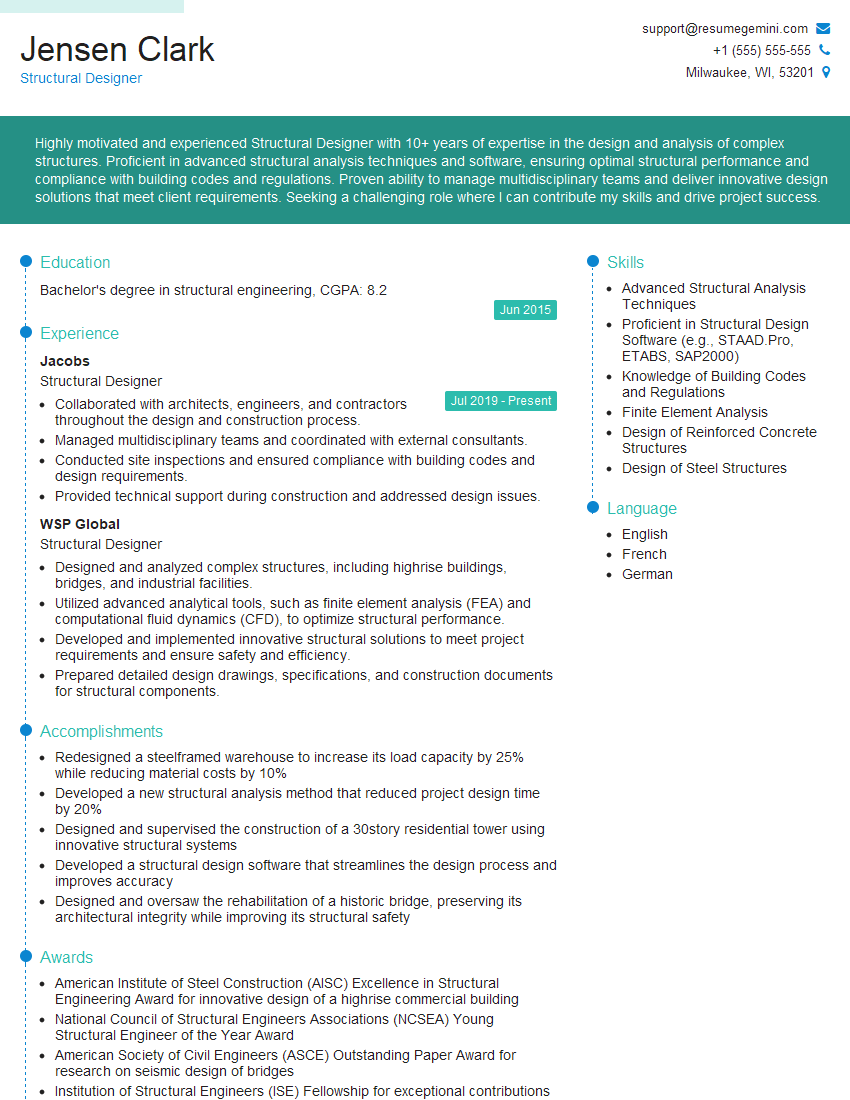
Mastering structural framing is crucial for career advancement in the construction and engineering industries. It opens doors to exciting projects and leadership opportunities. To maximize your job prospects, it’s vital to present your skills effectively. Creating an ATS-friendly resume is key to getting your application noticed. We recommend using ResumeGemini to build a professional and impactful resume that highlights your expertise in structural framing. ResumeGemini provides examples of resumes tailored to this field, helping you showcase your qualifications to potential employers.
Explore more articles
Users Rating of Our Blogs
Share Your Experience
We value your feedback! Please rate our content and share your thoughts (optional).
What Readers Say About Our Blog
Amazing blog
Interesting Article, I liked the depth of knowledge you’ve shared.
Helpful, thanks for sharing.